


The first metric everyone reaches for with Agentforce is a count. How many agents are deployed? It is an easy number to report and a satisfying one to grow, and it measures almost nothing that matters. A dozen agents that cannot see the same data or coordinate their actions are not twelve times as valuable as one. Often they are less, because now the conflicts and redundancies multiply.
That is the case for treating a Salesforce Agentforce implementation as a data and orchestration problem rather than a deployment race. Agentforce agents are only as good as the data they reason from and the coordination that keeps them coherent. A Salesforce Agentforce implementation that adds agents on top of fragmented data and no orchestration does not scale capability; it scales confusion, one new agent at a time.
The Agent-Count Scoreboard Is Measuring the Wrong Thing
The agent count is seductive because it is visible and it climbs. Leadership can point to it, vendors can celebrate it, and it feels like progress. The problem is that it captures effort, not outcome. Twelve agents that duplicate each other’s work, draw on conflicting records, and hand off to no one are a worse system than three that share context and coordinate.
The value of Agentic AI comes from coordination, not quantity. One agent that reliably resolves a customer issue end to end, drawing on a trusted view of that customer, delivers more than five narrow agents that each handle a fragment and lose the thread between them. The count says the second setup is more advanced. Reality says it is more fragmented.
This matters because the scoreboard shapes behavior. A team measured on agents deployed will deploy agents, whether or not the foundation supports them. A team measured on outcomes will fix the data and the orchestration first, and deploy agents that actually compound. The metric you choose quietly decides which system you build.
Half of Enterprise Agents Are Already Talking to No One
The fragmentation is not hypothetical, and the data on it is stark. Salesforce’s connectivity research, drawn from over a thousand enterprise IT leaders, found that 50% of agents run siloed rather than as part of a coordinated system, and that enterprises now run an average of 12 agents, a figure projected to grow 67% within two years. The fleet is expanding fast, and half of it is already disconnected.
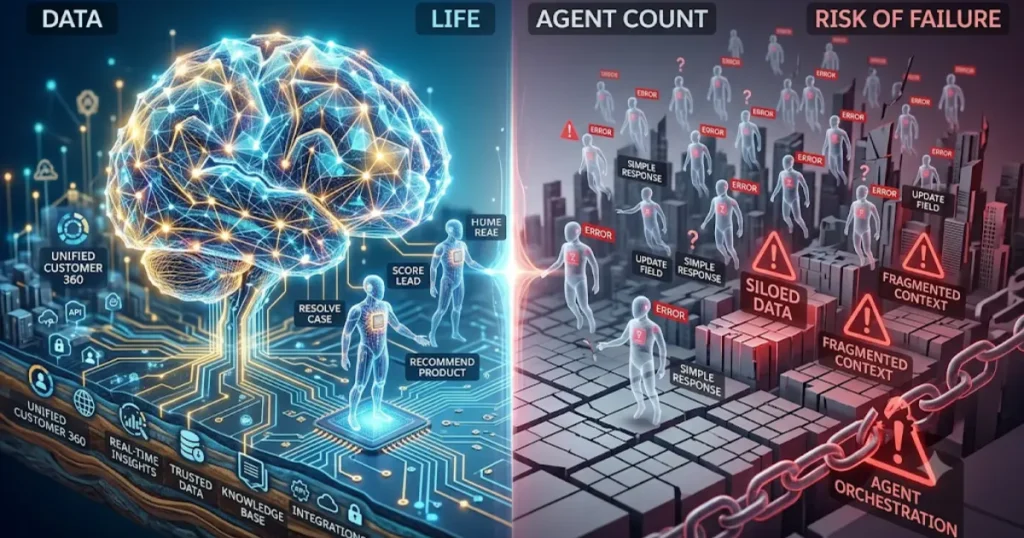
A siloed agent is a capable worker locked in a room with no phone. It can do its narrow job, but it cannot see what the other agents know, cannot hand off cleanly, and cannot draw on a shared understanding of the customer. Multiply that across a dozen agents and the enterprise has built a set of automations that each work alone and none work together.
The trajectory makes this urgent. Agent counts are climbing steeply while orchestration lags, which means the silo problem compounds unless it is designed out deliberately. Adding more agents to an unorchestrated environment does not fix the gap; it widens it.
What a Salesforce Agentforce Implementation Has to Solve First
Before the first agent earns its place, a serious Salesforce Agentforce implementation resolves two things that decide everything downstream.
The Data Foundation: A unified, trusted view of the customer through Data 360, so every agent reasons from the same current picture instead of a private, partial copy.
The Orchestration Layer: The coordination that lets agents share context, hand off cleanly, and act as a system rather than a collection of isolated bots.
These are the hard, unglamorous parts, and they are exactly what the agent-count race skips. Salesforce Agentforce partners who do this work well spend the early engagement on the foundation, because they know a fleet of agents on fragmented data is a liability dressed as progress. The agents are the easy part once the data and orchestration are right, and an impossible part when they are not.
Grounding sits at the center of this, and the data underneath decides whether it holds. Gartner projects that through 2026, organizations will abandon 60% of AI projects unsupported by AI-ready data, and an agent fleet is simply many AI projects sharing a foundation. When Salesforce Agentforce AI agents draw on a single trusted data layer, their answers stay consistent with each other and with reality. When each agent grounds on whatever data it happens to reach, they contradict one another, and the customer feels the seams immediately.
Orchestration Is the Actual Product
The word that should replace count in every Agentforce conversation is orchestration. Orchestration is what turns individual agents into a system: shared context, defined handoffs, and a coherent view of what each agent is doing and why. It is the difference between a team and a crowd.
Consider a customer issue that spans service, billing, and account management. In a siloed setup, three agents each handle their piece, none aware of the others, and the customer repeats themselves at every step while the agents occasionally contradict each other. In an orchestrated setup, the agents share the customer’s context, hand off with continuity, and resolve the issue as one coordinated motion. Same three agents, entirely different experience, decided by orchestration.
This is why orchestration, not deployment, is the real product of an Agentforce program. The agents are components. The system that makes them coordinate is the thing that delivers value, and it is the thing that does not show up in an agent count.
Governance Is Racing to Catch Up
Autonomy raises the stakes on control, and the control is lagging. Salesforce’s research found that only 54% of organizations have a centralized governance framework for their Agentic capabilities, and just one in five has a mature model for governing autonomous agents. Adoption is sprinting while governance walks, which is precisely the setup for a costly, public failure.
An ungoverned autonomous agent is a different category of risk from an ungoverned dashboard. It takes actions. It can update records, message customers, and trigger downstream processes, and without guardrails it can do all of that wrongly, at scale, before anyone notices. Governance is what defines the actions an agent can take alone, the ones requiring human sign-off, and the audit trail that makes every action reviewable.
Treating governance as a launch requirement rather than a later cleanup is what separates a durable Agentforce program from a fragile one. The teams that build the guardrails alongside the agents can grant those agents real responsibility. The teams that skip them end up either paralyzed by risk or exposed by it.
Sequencing a Roll-out That Compounds
An Agentforce roll-out that lasts follows the dependencies rather than the demo. Racing to agent number twelve inverts the order and guarantees the silo problem. A dependable sequence runs like this:
Unify the Data: Stand up Data 360 as the trusted foundation so every agent reasons from one current view of the customer.
Design the Orchestration: Define how agents will share context and hand off before building them, so coordination is architecture, not bolted on.
Set the Governance: Agree the autonomous actions, the human-in-the-loop points, and the audit trail, and apply them from the first agent.
Build Agents that Connect: Add agents into the orchestrated, governed environment one well-scoped use case at a time.
Measure Outcomes, Not Counts: track resolution, accuracy, and customer experience, and expand only where the system genuinely improves them.
The sequence front-loads the foundation on purpose. A team that follows it may report fewer agents at first and far more value per agent, which is the trade that actually matters.
The Fleet That Grew Without a Plan
Consider a representative enterprise that measured its AI program by agents shipped. Within a year it had stood up eleven agents across service, sales, and operations, and the count looked impressive in every quarterly review. The experience on the ground was worse than the year before. A customer contacting support might trigger a service agent that knew nothing of the billing agent’s recent action, so the customer explained the same problem twice and received two different answers. Each agent worked. The system did not.
The reset did not add a twelfth agent. It subtracted the chaos. The team unified the customer data through Data 360, designed an orchestration layer so agents shared context and handed off cleanly, and applied one governance model across the fleet. Afterward the same eleven agents behaved like a coordinated team, and the customer experience finally matched the ambition the count had implied all along.
The takeaway generalizes cleanly. The problem was never too few agents; it was too little foundation beneath them. More agents on that original setup would have made the incoherence worse, not better, which is exactly why count is the wrong thing to optimize.
Where Trust and Security Get Built In
Security in an Agentic system is foundational, not a wrapper. Because agents act, the permission model has to define precisely what each agent can see and do, tied to real roles, before it touches a customer or a record. Salesforce’s Trust Layer handles part of this, masking sensitive data and keeping it out of the underlying models, but it does not decide which agent should have access to what. That design is the implementation’s responsibility.
For regulated organizations, this connects directly to compliance. An autonomous agent acting on customer or financial data without tightly scoped permissions and a full audit trail is a compliance exposure, not just an operational one. The same orchestration and governance work that makes the fleet coherent also makes it defensible, because a well-governed system can show exactly which agent did what, when, and under whose authority.
Agentforce lives or dies on the strength of its data foundation and the coordination that turns isolated agents into a system, not on how many agents a team can stand up, which is why a Salesforce Agentforce implementation should be judged on orchestration and outcomes rather than count. Half the enterprise fleet already runs in silos, and adding more agents to that environment only deepens the fragmentation. Certified partners approach Agentforce this way, building the data and governance foundation before the fleet; its Agentforce implementation and governance work starts with orchestration, not headcount. Build the system that makes agents coordinate, and each new agent finally adds capability instead of noise.

Sandeep Kumar is the Founder & CEO of Aitude, a leading AI tools, research, and tutorial platform dedicated to empowering learners, researchers, and innovators. Under his leadership, Aitude has become a go-to resource for those seeking the latest in artificial intelligence, machine learning, computer vision, and development strategies.