
A postgraduate student in Osaka is three weeks from submission. Her literature review draws on English-language papers about gradient boosting and attention mechanisms, and she needs several passages rendered into Japanese for her supervisor. She opens whichever AI assistant is already sitting in a browser tab, pastes a paragraph, reads back a clean Japanese sentence, and moves on.
- Fluency is not accuracy, and almost nobody can tell the difference
- What happens when you run the same sentence through five models at once
- The strongest model still gets it wrong for half the world’s languages
- Quality does not only move upward
- Where this gets expensive first: research and academic work
- What the next fifteen years actually look like
- What to do about it now
- Frequently asked questions
- Why do AI models produce different translations of the same sentence?
- Is one AI model measurably better than the others for translation?
- What is consensus translation and how does it reduce errors?
- How can you check an AI translation in a language you do not read well?
- Does AI translation quality always improve over time?
She will never find out whether it was right, and neither will her supervisor.
That is the shape of the problem, and it is worth noticing that it is not a dramatic one. Nothing crashes. Nobody gets an error message. Look into how to translate machine learning terms into Japanese and you will find that a single English term routinely maps to several defensible Japanese renderings, depending on whether the reader is a thesis committee, an engineering team, or a first-year undergraduate class. One model picks one of them. It does not mention that the others existed, and it does not flag which choice it made.
We are early enough in this that the habit still feels normal. It will not stay normal. In fifteen years, asking a single AI model to translate something that carries real weight will look roughly the way consulting a single encyclopedia entry looks now. Not wrong, exactly. Just visibly insufficient.
The case for that prediction is not speculative. It is measurable, and the measurements are unflattering.
Fluency is not accuracy, and almost nobody can tell the difference
Fluency and accuracy are separate properties, and modern language models are far better at the first than the second. A translation can be grammatical, idiomatic, and confidently phrased while still selecting the wrong technical term. Anyone assessing an output in a language they do not command has almost no way to catch that gap, and that describes most people using these systems most of the time.
This is the mechanism behind most silent translation failures. The user is not being careless. They are applying the only quality signal available to them, which is whether the sentence reads well, to a system that optimises for exactly that signal. Fluency is the thing the model is best at producing and the thing the reader is least equipped to look past.
The scale of the underlying error rate is not small. Industry evaluations synthesised from Intento’s State of Translation Automation and the WMT24 general machine translation findings put hallucination and fabrication rates for individual top-tier large language models somewhere between 10% and 18% on translation tasks. In domain-specific evaluations covering scientific, medical, and technical content, the figures reported are frequently at the higher end of that band or above it.
Ten percent is a tolerable error rate for a casual message to a friend. It is not a tolerable error rate for a methods section, a specification, or a filing.
What happens when you run the same sentence through five models at once
Run identical source text through several models simultaneously and the models disagree with each other far more often than any single interface suggests. Disagreement is the normal condition, not the exception, and it is invisible to anyone using one model at a time.
The chart below draws on a production benchmark covering 78,324 translations logged between 12 July and 8 August 2026. It isolates Japanese to English and looks only at the 204 source segments where all five models produced a scored output, so every model is being judged on exactly the same text.
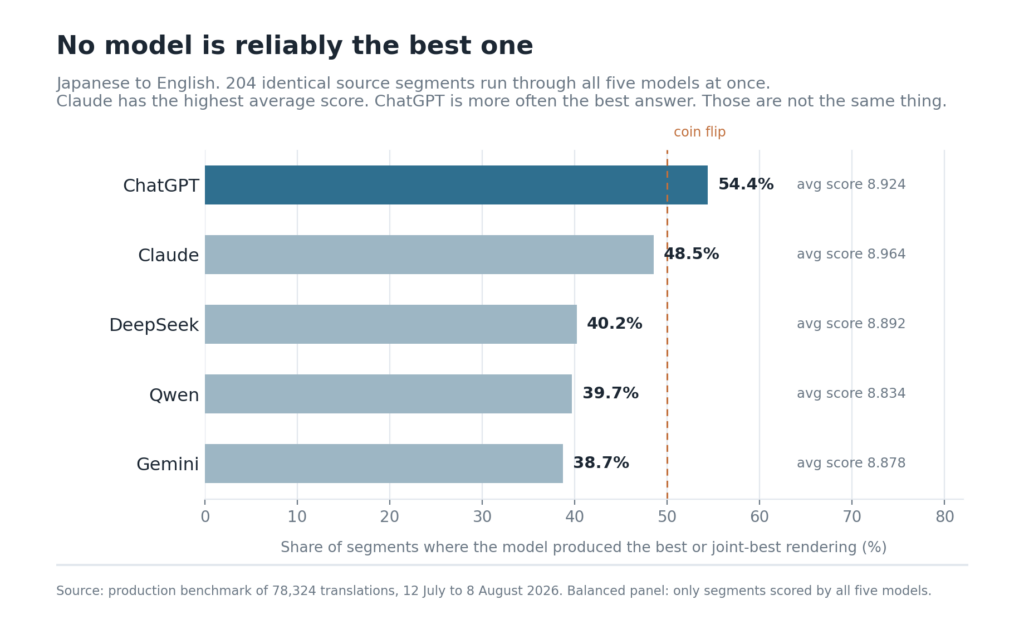
Figure 1. On identical Japanese to English source text, the model with the highest average score is not the model most often producing the best answer.
ALT: Horizontal bar chart. Share of segments where each model produced the best or joint-best Japanese to English rendering: ChatGPT 54.4%, Claude 48.5%, DeepSeek 40.2%, Qwen 39.7%, Gemini 38.7%.
Read the two columns against each other and the interesting result appears. Claude posts the highest average score at 8.964. ChatGPT posts a lower average at 8.924, yet it produces the best or joint-best rendering on 54.4% of segments against Claude’s 48.5%. The model that wins on aggregate is not the model that wins most often, because averages smooth over the segment-level variation that actually determines whether a specific sentence in a specific paper is correct.
That distinction is the entire problem. Nobody translates an average. They translate one paragraph, once, and then send it.
The strongest model still gets it wrong for half the world’s languages
The natural response to the previous section is to find the best model and standardise on it. Widen the sample across languages and that strategy falls apart quickly.
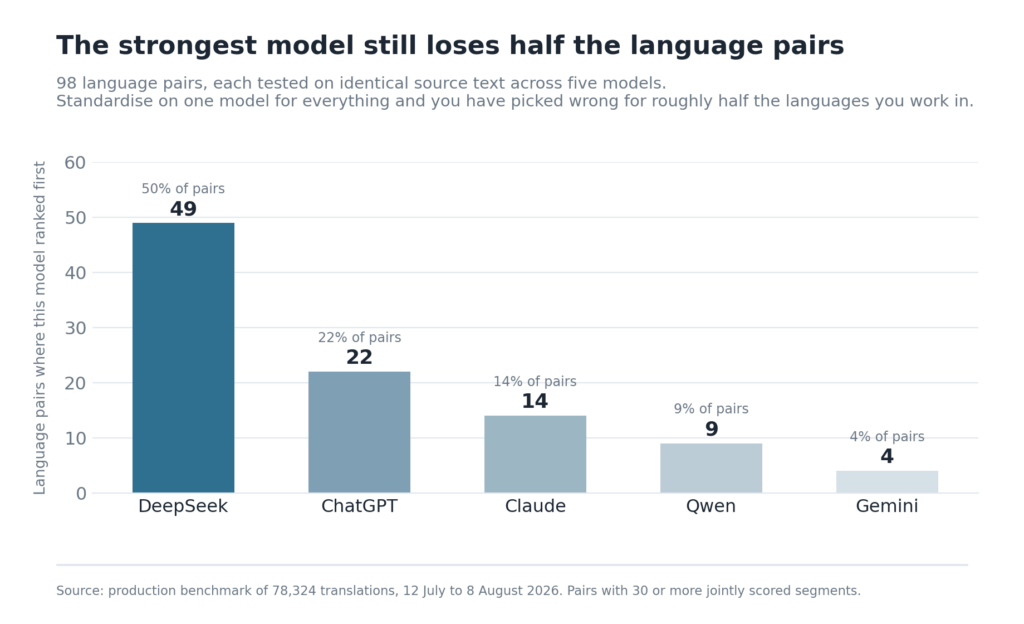
Figure 2. Across 98 language pairs tested on identical source text, the top-ranked model leads in only half of them.
ALT: Bar chart showing the number of language pairs where each model ranked first out of 98 pairs tested: DeepSeek 49, ChatGPT 22, Claude 14, Qwen 9, Gemini 4.
Across 98 language pairs with enough jointly scored segments to compare fairly, DeepSeek ranks first in 49 of them. That is the best result in the set, and it still means that for the other 49 pairs, anyone who standardised on DeepSeek is routing work to a model that is measurably not the strongest option available for that language.
There is a second finding in the same dataset that reframes the whole debate. The spread between the best and worst model on identical text is about 0.17 points. The spread between the best and worst language pair is 1.66 points. Which language you are working in matters roughly ten times more than which model you picked. Teams agonising over model selection are optimising the smaller variable while ignoring the larger one.
Quality does not only move upward
There is an assumption baked into most institutional AI planning that says the tools improve monotonically, so any problem observed today will be smaller next year. The data does not support treating that as a safe assumption.
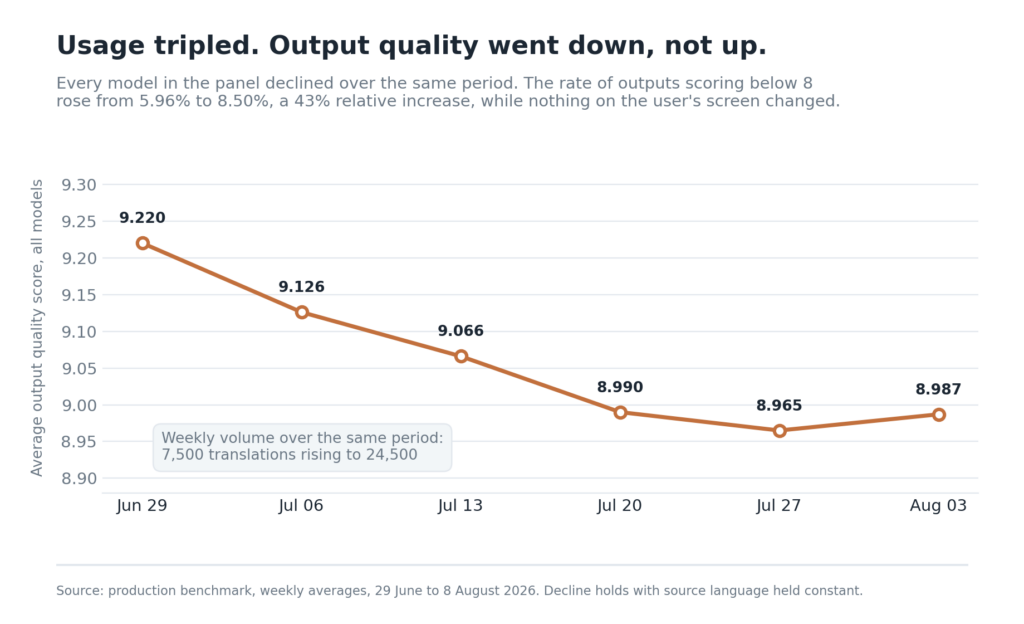
Figure 3. Six consecutive weeks of declining output quality across every model in the panel, during a period when usage roughly tripled.
ALT: Line chart of weekly average translation quality score falling from 9.220 in the week of 29 June to 8.987 in the week of 3 August 2026, with weekly volume rising from 7,500 to 24,500 translations over the same period.
Over the 28 days to 8 August 2026, average output quality on that platform fell from 9.183 to 9.003. The rate of outputs scoring below 8, which is the practical bad-output threshold, rose from 5.96% to 8.50%. That is a 43% relative increase in poor results. Every model in the panel declined. The decline holds when source language is held constant, and it persisted even as the lowest-scoring language segment shrank as a share of total volume, which should have pushed the average the other way.
Nothing visible changed during those six weeks. The interface was the same. The confidence in the output was the same. Anyone who had validated a translation workflow in June and moved on would have had no signal at all that August was materially worse. That is the argument for continuous measurement rather than one-time tool approval, and it is an argument almost nobody is currently set up to act on.
Where this gets expensive first: research and academic work
Academic and research material is now the single largest category of serious translation work. In the same platform dataset, academic and research content accounts for 24.1% of paying document uploads, ahead of legal at 18.6% and every other category. Education and study material adds a further 6%. Scholarly text is not a marginal use case for these systems. It is the main one.
It is also the use case where a terminology error propagates furthest. A mistranslated technical term in a literature review does not stay in the literature review. It moves into the methods section, the discussion, the citation that a later paper picks up. The failure is epistemic rather than cosmetic, and it surfaces long after the point where anyone could trace it back to a translation decision made in a browser tab in week three.
Institutions are largely not set up to catch this. UNESCO’s 2023 Guidance for Generative AI in Education and Research noted that national regulatory frameworks were being outpaced by tool releases, and a UNESCO survey the same year found that fewer than 10% of schools and universities had formal institutional guidance on AI use at all. Translation specifically is almost never named in the policies that do exist. It sits in the gap between academic integrity policy, which is about authorship, and IT procurement policy, which is about vendors.
What the next fifteen years actually look like
The correction here is not a better model. It is a different architecture, and the outline of it already exists.
Hallucinations are largely model-idiosyncratic. When one model fabricates a term, the others usually do not fabricate the same term, because the error originates in that model’s particular training and decoding path rather than in the source text. Run a segment through twenty or more models at once, discard the outliers, and return only the rendering the majority converge on, and you have converted an unverifiable single output into something with an evidential basis. Consensus architectures built on this principle have reported hallucination rates under 2%, against the 10% to 18% band observed in individual top-tier models.
Researchers should find this framing familiar, because it is inter-rater reliability applied to machines. No serious study accepts a single coder’s judgment on ambiguous data. You use multiple independent raters and you report where they agree. Twenty-two independent models converging on the same Japanese rendering of a technical term is a stronger claim than one model asserting it, for exactly the reasons that make multiple coders standard practice in the first place.
Three things follow from that, and all three are already technically feasible today:
- Agreement becomes a visible number. Translation interfaces will show how many models converged on the returned output, in the way that a confidence interval sits next to an estimate. Low agreement will read as a flag rather than as a failure.
- Disagreement becomes the useful output. Where models diverge, that divergence is diagnostic information about genuinely contested terminology, which is precisely what a student translating a technical passage needs to see and currently never does.
- “Which models agreed?” becomes an ordinary question. It will sit alongside “what was your sample size?” as something a supervisor asks without it seeming unusual.
None of that requires a breakthrough. It requires treating a single model’s output as a hypothesis rather than an answer, which is a change in habit rather than in capability.
What to do about it now
The architectural shift will take years. The change in habit does not have to, and it costs nothing.
- Run anything that will be published, cited, or submitted through at least three models and compare. Where they converge, proceed. Where they diverge on a technical term, that term needs a human decision, not a faster tool.
- Fix the glossary before the translation, not after. Agreeing terminology up front removes the single largest source of drift across a long document and across multiple people working on related material.
- Stop standardising on one model. Language pair matters roughly ten times more than model choice, so any policy that names a single approved model is optimising the wrong variable.
- Re-test the workflow every few months. Quality moved measurably in six weeks in the data above. An annual review cycle will not catch that.
- Name translation explicitly in your AI policy. It currently falls between academic integrity and IT procurement, which means in practice nobody owns it.
- Teach the distinction between fluency and accuracy directly. People need to know that reading well is not evidence of being correct, because it is the only heuristic most of them currently have.
The student in Osaka does not need a better model. She needs to know that the sentence she pasted had several other plausible renderings, and that nothing in her workflow was ever going to tell her so. That is true of almost everyone using these systems right now. Fifteen years from now, showing the disagreement will seem like an obvious thing to have built. The only real question is how much work gets published, submitted, and signed off between now and then on the strength of a single model’s guess.
Frequently asked questions
Why do AI models produce different translations of the same sentence?
Each model has different training data, tokenisation, and decoding behaviour, so each resolves ambiguity differently. Technical terms with several valid renderings are where divergence concentrates. Benchmarks on identical source text show the top-ranked model producing the best output on only about half of segments, meaning disagreement is normal rather than exceptional.
Is one AI model measurably better than the others for translation?
Not consistently. Across 98 language pairs tested on identical text, the strongest model ranked first in 49 of them and lost the other 49. The best-to-worst model spread was about 0.17 points, while the best-to-worst language pair spread was 1.66 points. Language matters far more than model choice.
What is consensus translation and how does it reduce errors?
Consensus translation runs one source segment through many models simultaneously, discards outlier outputs, and returns the rendering the majority agree on. Because hallucinations are model-specific rather than shared, cross-model agreement filters them structurally. Reported hallucination rates for consensus systems fall under 2%, against 10% to 18% for individual models.
How can you check an AI translation in a language you do not read well?
Compare outputs from at least three models on the same text. Convergence is weak evidence of correctness; divergence is strong evidence that the term is contested and needs a human decision. A fixed glossary agreed before translation begins prevents most drift across long documents and across multiple contributors.
Does AI translation quality always improve over time?
No. In a production dataset covering 78,324 translations, average quality fell from 9.183 to 9.003 over 28 days while usage roughly tripled, and the rate of outputs scoring below 8 rose 43% in relative terms. Every model in the panel declined. Periodic re-testing is necessary; one-time approval is not sufficient.

Sandeep Kumar is the Founder & CEO of Aitude, a leading AI tools, research, and tutorial platform dedicated to empowering learners, researchers, and innovators. Under his leadership, Aitude has become a go-to resource for those seeking the latest in artificial intelligence, machine learning, computer vision, and development strategies.