

A college student in Toronto turned in a paper last semester. His professor ran it through the school’s plagiarism scanner. Came back at 2% similarity. Clean, basically.
Two weeks later the same paper went through a different tool the IT team had just rolled out. That one came back with a pretty different number. About 78% of the paper was lightly rewritten ChatGPT output, with three paragraphs lifted nearly word-for-word from a 2019 academic journal.
Here’s the awkward part. The student wasn’t really trying to cheat. He had used AI to “help organize his thoughts,” then asked the same model to clean up his messier sentences. The first scanner just saw words that didn’t show up elsewhere online and called it good.
That gap, between what the old tools catch and what the newer ones catch, is basically the whole story of originality in 2026. The rules have changed. Most writers haven’t really noticed yet.
Why Old Plagiarism Checkers Are Losing the Game
Most of the scanners schools and content teams still run on were built for a very different internet. Their job, back around 2015, was pretty simple. Take a sentence. Search for an exact match somewhere online. If yes, flag it. If no, the writer was clean.
That worked fine when copy-paste was the main way people cheated.
Nobody really copies anymore. They paraphrase. They run paragraphs through rewriting tools. They generate fresh-sounding text with AI, mix in a few of their own sentences, and submit something no string-matching engine on the planet is going to catch. The old tools see no matches, shrug, and assume the writer did the work.
The gap shows up pretty clearly when you put the numbers side by side.
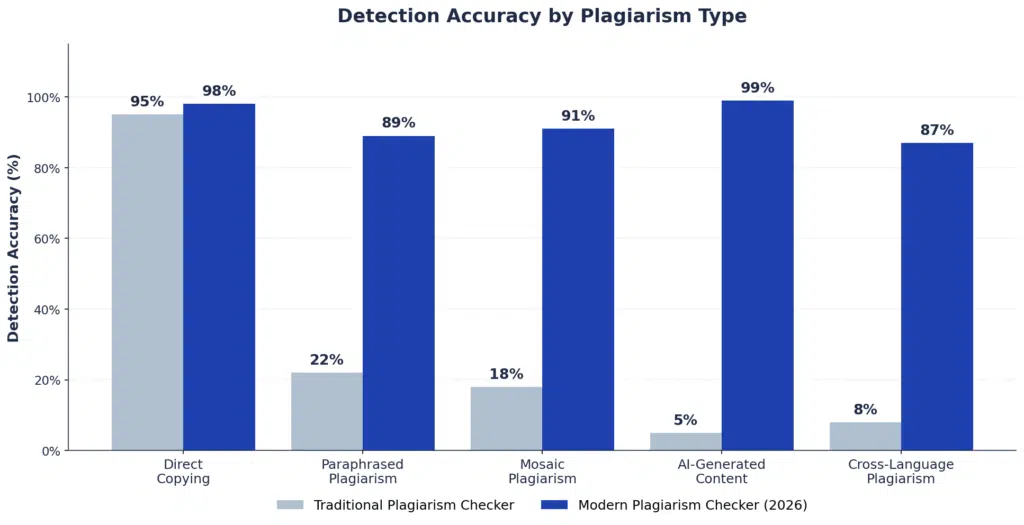
Direct copying still gets caught by both kinds of tools at around 95% or better. Past that, the older scanners just fall apart. Paraphrased writing? Around 22%. AI-generated text? Roughly 5%. That last one is rough.
How Modern Plagiarism Checkers Actually Work
Newer plagiarism scanners don’t bother looking at strings. They look at meaning.
When you push text through an online plagiarism checker, here’s what’s happening behind the scenes. Your writing gets chopped into semantic chunks. Each chunk gets turned into a mathematical embedding, which is just a long list of numbers that captures what the text actually means. Those embeddings get compared against 10 billion plus pages of indexed material. Two sentences can use completely different words and still come back as a match, because the meaning lines up.
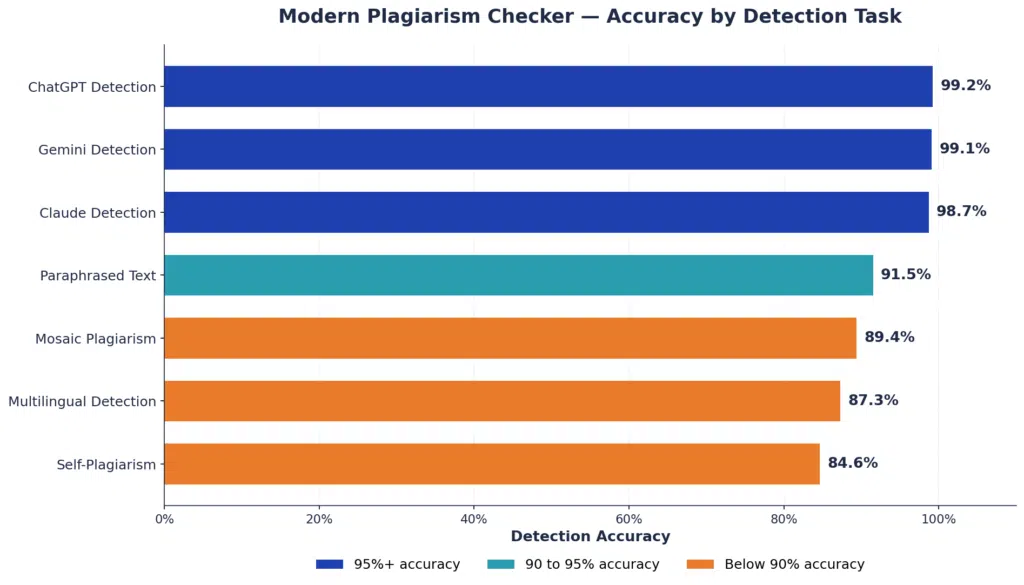
On top of that, there’s a second layer. The tool also checks for AI-generated text in the same pass. Things like sentence rhythm, vocabulary spread, the overly cautious phrasing ChatGPT and Claude and Gemini all tend to slip into. Those models leave a pattern whether you want them to or not. So you get plagiarism detection and AI-content detection from a single scan, instead of running two separate tools.
Here are the two approaches side by side:
| Detection Layer | Traditional Checker | Modern Plagiarism Checker (2026) |
|---|---|---|
| Matching method | Exact string match | Semantic embeddings |
| Database size | 1 to 3 billion sources | 10 billion plus sources |
| AI content detection | Not supported | Built in (99% accuracy) |
| Catches paraphrasing | Rarely | Yes, with high accuracy |
| Cross-language scan | English only | Multilingual |
| Privacy | Stores submissions | Deletes after scanning |
Table 1: Traditional checkers vs. modern plagiarism checkers, head to head.
The 5 Types of Plagiarism Modern Tools Catch That Humans Miss
This is where the newer scanners really earn their keep. Teachers and editors can usually spot the obvious copy-paste stuff on their own. The sneaky cases are what slip through.
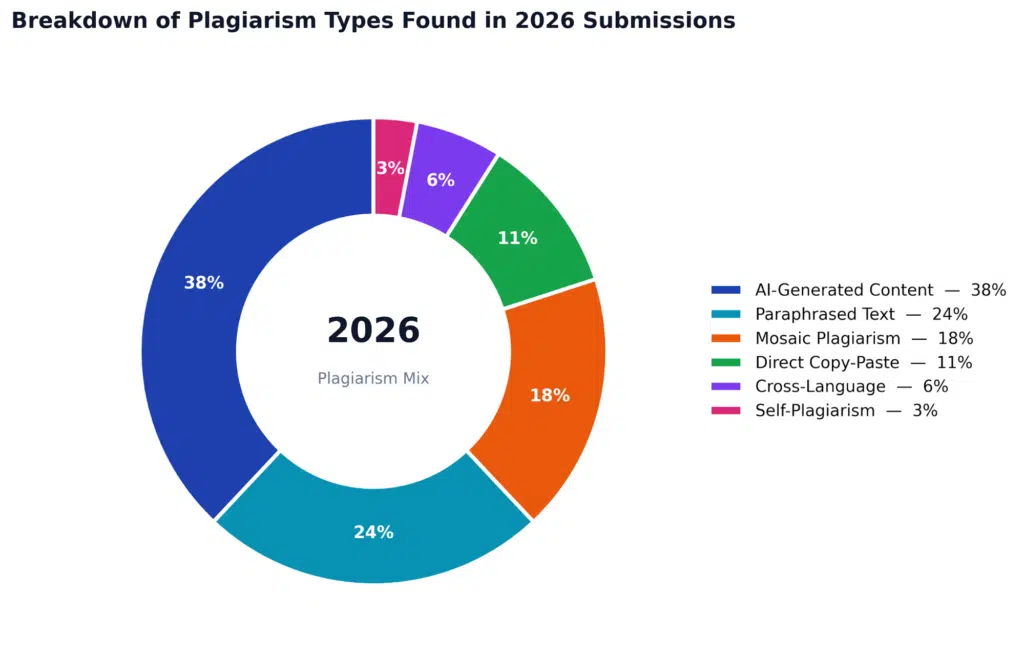
- Paraphrased plagiarism. Someone takes a 2018 medical study, rewrites every sentence with different words, keeps the ideas in the same order with the same citations. Reads fine to a human. Lights up like a Christmas tree on a semantic engine.
- Mosaic plagiarism. A sentence from Wikipedia. Another from a random blog. A paraphrased paragraph from a research paper. Stitch them together and the surface looks completely original. A good plagiarism scanner still pulls each piece out.
- AI-generated text. This one’s the big deal right now. Somewhere around 40% of student submissions, and a huge chunk of freelance web content, is just AI output these days. Modern plagiarism checkers that include AI detection flag ChatGPT, Claude, and Gemini at over 99% accuracy on most samples.
- Cross-language plagiarism. Translate a Spanish blog post into English, submit it as your own. That trick worked great for years. Multilingual semantic matching pretty much killed it off.
- Self-plagiarism. Reusing your own published work, on purpose or by accident, still gets flagged. Pretty useful for content writers who genuinely can’t remember what they posted six months back.
Where the Real Cost of Using an Old Checker Shows Up
A high school teacher I spoke to recently said her department dropped six figures last year on a “premium” plagiarism platform. The thing still misses ChatGPT output completely. Meanwhile a tool with AI detection built in caught 9 out of 10 AI-written essays she tested it against.
Budget doesn’t really equal accuracy anymore. What actually matters is whether the architecture underneath was built for the AI era or not. And this isn’t just an academic problem. Content teams running company blogs, SEO managers checking freelance work, hiring managers reading writing samples, they’re all hitting the same blind spot.
What to Look For in a 2026 Plagiarism Checker
Whether you’re a student, a teacher, a writer, or someone running a content team, here’s what actually matters in a tool right now:
| Feature | Why It Matters in 2026 |
|---|---|
| AI content detection | Plagiarism scanning alone isn’t enough anymore. The tool has to catch AI-written text in the same pass. |
| Database size | Anything under 5 billion sources is outdated. Top tools scan 10 billion plus web pages and academic databases. |
| File format support | PDF, DOCX, TXT, and direct paste. If a tool only accepts plain text, skip it. |
| Privacy and storage | Your document should never be stored, indexed, or shared. Read the privacy policy before uploading anything sensitive. |
| No paywall on basics | Grammarly locks plagiarism behind Premium. Turnitin is institution-only. Tools now match or beat both on accuracy. |
Table 2: The five things to actually check before picking a plagiarism tool in 2026.
If you want an option that ticks every one of those boxes, the plagiarism checker by Phrasly hits all of them. Scans against 10 billion plus sources. AI content detection runs in the same pass. Handles PDF and DOCX uploads. Deletes your file the second the scan finishes. That kind of setup just didn’t exist three years ago. Now it’s available at no extra cost for users with an active Humaniser subscription.
The Bottom Line
Originality in 2026 isn’t really about avoiding copy-paste. It’s about producing work that holds up when a tool semantically scans it, fingerprints it for AI patterns, and cross-checks it against ten billion other documents, all in the same pass.
Old rules said: don’t copy. New rules say: be yourself, and use a tool that can actually prove it.
If you’re still running your text through a 2018-era scanner and calling it clean, you’re checking the wrong box. The standards have moved. Better tools are sitting right there, free, waiting to be used. Catch up before someone else does it for you.

Sandeep Kumar is the Founder & CEO of Aitude, a leading AI tools, research, and tutorial platform dedicated to empowering learners, researchers, and innovators. Under his leadership, Aitude has become a go-to resource for those seeking the latest in artificial intelligence, machine learning, computer vision, and development strategies.