
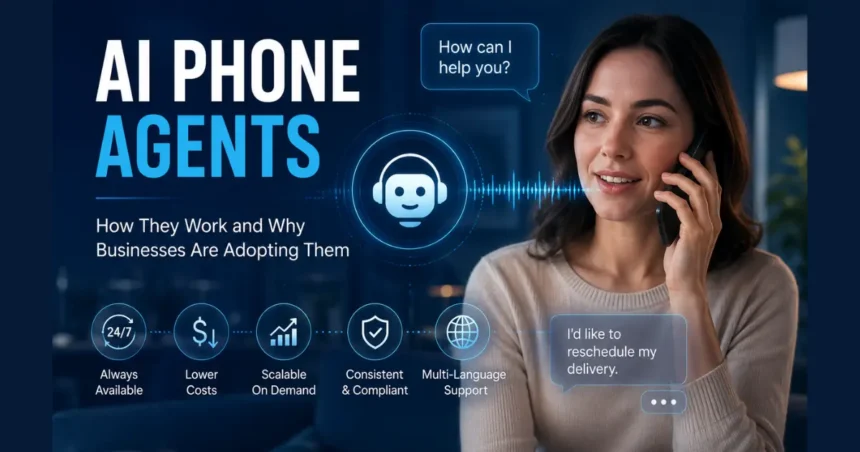
It’s 11 p.m., and a customer calls in to reschedule a delivery, or maybe just to ask why their bill looks off this month. No hold music. No “your call is important to us” on loop. Just a normal-sounding conversation that wraps up in a couple of minutes. And there’s no human on the other end.
That’s not a far-off scenario anymore. It’s what a lot of companies are already running today, and it’s happening faster than most people expected even two years ago.
AI phone agents (also called voice AI agents, or sometimes just conversational voice bots) are systems that can answer, understand, and respond to phone calls much like a trained employee would. No shifts to schedule, no breaks, no queue backing up. The old “press 1 for sales, press 2 for support” IVR systems everyone hated have basically been replaced by something that actually feels like talking to a person. So what changed, and why are so many businesses making the switch right now? Let’s get into it.
How AI Phone Agents Work
An AI phone agent isn’t really one piece of software so much as a handful of specialized systems working together, all in the span of a second or two, which is why it feels seamless to the person on the phone. Here’s roughly what’s happening behind the scenes during a call.
1. Speech-to-Text (Automatic Speech Recognition)
As soon as someone starts speaking, an ASR engine converts the audio into text. This part alone has come a long way. Background noise, accents, people talking over themselves, the usual “umm” and “you know” filler, none of it trips these systems up nearly as much as it used to with older IVR tech.
2. Natural Language Understanding
Once there’s text, an NLU layer (almost always a large language model these days) figures out what the caller is actually asking for. Not just the literal words, the intent underneath them. Is this person trying to cancel something? Complain? Book an appointment? Getting that right depends a lot on picking up context and tone, which is honestly the hard part.
3. Dialogue Management and Business Logic
From there, the system has to decide what to actually do. Maybe that means checking a CRM record, pulling up an order, verifying an identity, or transferring the call somewhere else. This is where the good implementations separate themselves from the bad ones. If the agent is properly wired into a company’s existing tools, like Salesforce, Zendesk, a calendar system, or payment processing, it’s not just chatting. It’s getting real things done.
4. Text-to-Speech (Voice Synthesis)
Whatever the system decides to say gets converted back into audio. And neural text-to-speech has genuinely gotten good. We’re talking natural pacing, believable intonation, none of that flat robotic tone that used to make automated calls so obviously fake.
5. Real-Time Feedback Loop
All of this is happening on a loop, constantly: listen, interpret, decide, respond, repeat. The stronger systems can deal with someone interrupting mid-sentence, pivot when the topic changes out of nowhere, and hand things off to a human agent without the caller feeling like they hit a wall.
Put it all together and it stops feeling like a phone tree. It starts feeling like talking to someone who actually knows what they’re doing.
Why Businesses Are Adopting AI Phone Agents
1. They Never Close
Customers don’t call on a schedule. Running a 24/7 call center with actual people is expensive, but an AI phone agent doesn’t care what time it is. A 3 a.m. call gets handled just as well as one at 3 p.m.
2. The Cost Math Is Hard to Ignore
Call centers are notoriously expensive, between hiring, training, and turnover that’s brutal in that industry. AI phone agents take over the repetitive, high-volume stuff for a fraction of what it costs to have a person do it, which frees up actual employees for the calls that genuinely need a human.
3. No More “Please Hold”
Call volume never comes in evenly. It spikes after a product launch, an outage, a billing cycle, whatever. Human teams tend to fall apart a little under that kind of pressure. AI phone agents just scale, whether that’s ten calls or ten thousand at once, without anyone sitting on hold.
4. Consistency, for Better or Worse
Every call gets treated the same way. No bad-mood agent, no skipped compliance disclosure, no wild swings in tone depending on who picks up. That matters a lot in industries like finance, healthcare, and insurance, where audits and quality checks are already a headache.
5. Every Call Becomes Data
Every conversation gets transcribed and tagged automatically, so businesses get a running picture of what customers are complaining about or asking for, without someone manually listening to hours of recordings to figure it out.
6. Multiple Languages, No New Hires
Expanding into a new market used to mean hiring people who speak the local language. Now the same AI phone agent can switch languages on the fly, so a company can support customers in a dozen countries without building a dozen separate teams.
Where This Is Actually Being Used
- Customer support – order tracking, returns, account questions, the usual stuff that eats up call center hours
- Appointment scheduling – clinics, salons, service businesses automating bookings and reminders
- Sales and lead qualification – screening inbound calls and passing the good leads to an actual salesperson
- Collections and billing – payment reminders, basic dispute handling
- Restaurants and hospitality – taking reservations or orders without pulling staff off the floor during a rush
- Insurance and finance – claims intake, policy questions, fraud verification calls
Where It Still Falls Short
None of this is a plug-and-play miracle, and it’s worth being honest about that.
Emotional calls are still a weak spot. Someone who’s genuinely upset usually needs a human, not a bot, and the better setups know when to get out of the way and escalate instead of trapping the caller in a loop. Integration is another common failure point. An AI phone agent is only as useful as the systems feeding it data, and if that connection is shaky, the whole thing starts to feel robotic fast, ironically. There’s also a trust question.
A growing number of regions now require companies to tell callers they’re speaking with an AI, and getting that disclosure right matters both legally and for keeping customers on your side. And on the technical end, even a half-second delay or an unnatural pause can break the illusion completely, so the infrastructure behind all this genuinely has to be fast.
Where This Is Headed
As the underlying language models keep getting better at reasoning and holding context across a conversation, AI phone agents are moving past rigid scripts into something that can actually adapt mid-call, handle multi-step requests, and respond in a way that feels closer to empathy than a canned line. Combine that with voice AI infrastructure getting cheaper by the month, and it’s not hard to see why this has gone from “interesting experiment” to “core part of the customer experience strategy” for a lot of companies.
Businesses still relying purely on traditional call centers, or worse, old IVR trees from a decade ago, are going to feel that gap widen. At this point the real question isn’t whether to bring in an AI phone agent. It’s how fast a company can do it properly, with solid integrations, sensible fallback to a human when needed, and enough restraint to not automate the parts of the conversation that actually need a person.

Sandeep Kumar is the Founder & CEO of Aitude, a leading AI tools, research, and tutorial platform dedicated to empowering learners, researchers, and innovators. Under his leadership, Aitude has become a go-to resource for those seeking the latest in artificial intelligence, machine learning, computer vision, and development strategies.