

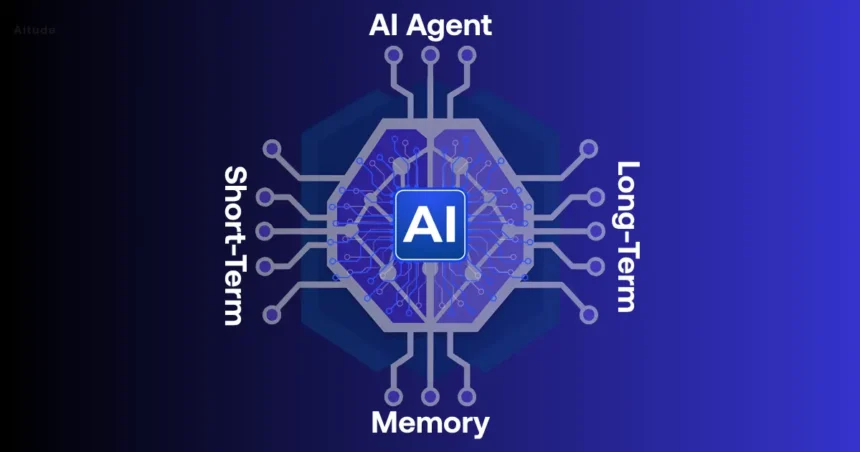
AI agents are becoming more capable of handling complex tasks, from answering customer questions and researching topics to managing workflows and interacting with external tools. But one capability separates a useful agent from a stateless chatbot: memory.
- What Is AI Agent Memory?
- Why Do AI Agents Need Memory?
- 1. Maintaining Conversation Context
- 2. Remembering User Preferences
- 3. Continuing Long-Running Tasks
- 4. Learning From Previous Experiences
- 5. Personalizing Future Responses
- How Does AI Agent Memory Work?
- Step 1: Store Information
- Step 2: Retrieve Relevant Memory
- Step 3: Use the Memory
- Step 4: Update Memory
- What Is Short-Term Memory in AI Agents?
- Example of Short-Term AI Agent Memory
- How Short-Term Memory Is Managed
- What Is Long-Term Memory in AI Agents?
- Example of Long-Term AI Agent Memory
- Short-Term vs Long-Term AI Agent Memory
- What Are the Different Types of AI Agent Memory?
- How Do AI Agents Store Long-Term Memory?
- What Role Does RAG Play in AI Agent Memory?
- How Does Memory Retrieval Work?
- Step 1: Receive the User Request
- Step 2: Understand the Retrieval Need
- Step 3: Search Memory
- Step 4: Rank Results
- Step 5: Inject Relevant Memories
- Step 6: Generate the Response
- How Does an AI Agent Decide What to Remember?
- Why AI Agent Memory Needs Forgetting
- AI Agent Memory Architecture
- Layer 1: Working Memory
- Layer 2: Session Memory
- Layer 3: Long-Term Memory
- Layer 4: Retrieval Layer
- Layer 5: Memory Management
- Real-World Examples of AI Agent Memory
- Common Problems With AI Agent Memory
- 1. Incorrect Memories
- 2. Stale Information
- 3. Retrieval Failure
- 4. Memory Overload
- 5. Duplicate Memories
- 6. Privacy and Security
- Best Practices for Building AI Agent Memory
- Separate Short-Term and Long-Term Memory
- Store Useful Information, Not Everything
- Use Metadata
- Consider Recency
- Consolidate Memories
- Allow Memory Updates
- Build Forgetting Rules
- Protect User Data
- Monitor Retrieval Quality
- Short-Term vs Long-Term Memory: Which One Should You Use?
- The Future of AI Agent Memory
- Frequently Asked Questions About AI Agent Memory
- What is AI agent memory?
- What is the difference between short-term and long-term memory in AI?
- Do AI agents remember previous conversations?
- Do AI agents use vector databases for memory?
- What is episodic memory in AI agents?
- What is semantic memory in AI agents?
- Can an AI agent forget information?
- Why is memory important for AI agents?
- Is RAG the same as AI agent memory?
- Conclusion
An AI agent needs to know what is happening now, what happened earlier in the current task, and sometimes what happened days or months ago. Without memory, an agent may repeatedly ask the same questions, lose track of a task, or fail to use information that a user previously provided.
This is where AI agent memory comes into play.
AI agent memory is the system that allows an agent to retain, retrieve, update, and use information from previous interactions or ongoing tasks. It can include recent conversation history, user preferences, previous actions, important facts, task results, and learned procedures.
The two most important categories are short-term memory and long-term memory. Short-term memory helps an agent maintain the current context, while long-term memory allows it to retain useful information across sessions.
Understanding the difference between these memory types is essential when designing reliable AI agents.
What Is AI Agent Memory?
AI agent memory is the mechanism an AI agent uses to preserve information and make that information available when it is relevant to a future step or interaction.
A large language model does not automatically behave like a human who continuously remembers everything. During an agent interaction, the application determines what information is provided to the model as context.
That information can come from several places:
- The current user message
- Recent conversation history
- Previous task states
- Tool results
- Retrieved documents
- User preferences
- Historical interactions
- Stored facts
- Previous agent actions
The memory layer decides what should be retained and what should be retrieved.
For example, imagine a user tells an AI assistant:
“I prefer short answers and usually work with WordPress.”
Later, the user asks the assistant to explain a technical topic.
A memory-enabled agent could retrieve those preferences and provide a concise explanation with WordPress-specific examples.
Without persistent memory, the agent may have no knowledge of those earlier preferences.
This makes memory more than simple storage. The important part is not just remembering information but retrieving the right information at the right time.
Why Do AI Agents Need Memory?
An AI agent can perform useful tasks without persistent memory. However, its capabilities become limited when every interaction starts with little or no historical context.
Memory solves several important problems.
1. Maintaining Conversation Context
Suppose a user asks:
“Find three AI writing tools.”
The agent provides three tools.
The user then asks:
“Which one is cheapest?”
The agent needs the previous answer to understand what “which one” refers to.
Short-term memory provides that context.
2. Remembering User Preferences
Users often have preferences that remain useful over time.
For example:
- Preferred writing style
- Programming language
- Communication preferences
- Favorite tools
- Frequently used workflows
- Business requirements
An agent can store these preferences as long-term memories and use them in future conversations.
3. Continuing Long-Running Tasks
Some agent tasks take much longer than a single interaction.
An AI research agent might:
- Collect sources
- Analyze documents
- Compare findings
- Identify missing information
- Create a report
If the agent cannot preserve the state of the task, it may lose track of completed steps.
Memory allows it to maintain continuity.
4. Learning From Previous Experiences
Agents can also store information about previous outcomes.
For example, an automation agent might remember that a particular API workflow failed because a required parameter was missing.
When the same situation occurs later, the agent can use that experience to avoid repeating the mistake.
5. Personalizing Future Responses
Long-term memory can make an AI assistant feel more personalized.
Instead of treating every conversation as a completely new interaction, the agent can use relevant information from previous sessions.
Microsoft describes long-term agent memory as persistent knowledge that can be retained across sessions, while short-term memory handles the immediate conversation context.
How Does AI Agent Memory Work?
A practical AI agent memory system usually performs four major operations:
Store → Retrieve → Use → Update
Step 1: Store Information
The system determines which information should be retained.
This might include:
- Conversation events
- User preferences
- Important facts
- Task state
- Previous decisions
- Successful workflows
- Historical outcomes
Not everything needs to become permanent memory.
A casual statement such as “Hmm, let me think” has little future value.
A statement such as “I always want reports in Markdown format” could be useful later.
Step 2: Retrieve Relevant Memory
When the user sends a new request, the agent searches its available memory.
For example:
User:
“Write another report using my usual format.”
The memory system may retrieve:
User prefers Markdown reports with headings, concise paragraphs, and an FAQ section.
The retrieved information is then added to the agent’s current context.
Step 3: Use the Memory
The language model receives the current request along with relevant memories.
It can then generate a response based on both the current task and previously stored information.
Step 4: Update Memory
After completing the task, the system may decide whether new information should be saved.
For example:
User now prefers reports to include a summary table.
The memory system can update the existing preference instead of simply adding another duplicate record.
This last step is important because memory that never changes can become outdated.
What Is Short-Term Memory in AI Agents?
Short-term memory is information an AI agent needs for its current conversation, task, or immediate execution.
It commonly includes:
- Recent messages
- Current instructions
- Active task state
- Recent tool outputs
- Intermediate results
- Temporary decisions
- Current conversation history
Short-term memory is closely connected to the model’s context window.
For example, if you ask an AI agent to research a company and then ask it to summarize the findings, the agent needs access to the research results during the current task.
That information can remain in the active context or be stored as temporary session state.
Microsoft’s documentation describes short-term agent memory as recent context such as conversation turns, state information, and tool results needed for the current task.
Example of Short-Term AI Agent Memory
Imagine you are using an AI shopping assistant.
You say:
“I’m looking for a laptop under $1,000.”
The agent recommends several laptops.
You then say:
“Which one has the longest battery life?”
The agent needs to remember the laptops it just mentioned.
That is short-term memory.
The information is relevant to the current conversation but does not necessarily need to be stored permanently.
How Short-Term Memory Is Managed
A simple agent might keep recent conversation messages in the context window.
But long conversations create a problem.
The amount of information an AI model can process in one request is limited by its context window. Even when a model supports a very large context, sending an enormous amount of history on every request can increase processing requirements and make retrieval less efficient.
Therefore, agents may use techniques such as:
- Sliding conversation windows
- Summarization
- Context compression
- State checkpoints
- Removing irrelevant tool results
- Keeping only recent messages
- Promoting important information into long-term memory
AWS similarly distinguishes immediate working context from persistent memory and notes that context management affects both latency and cost.
What Is Long-Term Memory in AI Agents?
Long-term memory stores information that an AI agent may need beyond the current session or task.
It can include:
- User preferences
- Important facts
- Previous decisions
- Historical interactions
- Task outcomes
- Domain-specific information
- Successful procedures
- Conversation summaries
Unlike short-term memory, long-term memory generally requires persistent storage outside the immediate model context.
Depending on the application, this information can be stored using databases, vector stores, key-value systems, knowledge graphs, or combinations of these technologies.
IBM notes that long-term memory allows agents to store and recall information across sessions and can be implemented using technologies such as databases, knowledge graphs, and vector embeddings.
Example of Long-Term AI Agent Memory
Imagine an AI productivity assistant.
During one conversation, you tell it:
“I prefer meetings in the afternoon.”
Several weeks later, you ask:
“Find a suitable time for my next meeting.”
A long-term memory system could retrieve your scheduling preference and use it when suggesting times.
The agent did not need to retain the entire previous conversation. It only needed to preserve the useful fact.
This illustrates an important principle:
Long-term memory should preserve useful knowledge, not necessarily every historical message.
Short-Term vs Long-Term AI Agent Memory
The easiest way to understand the difference is to think about time and purpose.
| Feature | Short-Term Memory | Long-Term Memory |
|---|---|---|
| Primary purpose | Maintain current context | Preserve useful information |
| Typical duration | Current session or task | Multiple sessions |
| Information | Recent messages and task state | Facts, preferences, experiences |
| Storage | Context, cache, session state | Database, vector store, knowledge graph |
| Retrieval | Usually immediate | Requires a retrieval process |
| Example | Current conversation | User’s long-term preferences |
| Main challenge | Context limits | Relevance and outdated information |
Short-term memory answers:
“What do I need to know right now?”
Long-term memory answers:
“What might be useful to remember for later?”
Modern agent architectures often combine both rather than choosing only one. AWS documentation, for example, describes short-term memory for current interactions and long-term memory for persistent knowledge across sessions.
What Are the Different Types of AI Agent Memory?

Short-term and long-term memory are useful high-level categories, but AI agent systems can be divided into more specific memory types.
1. Working Memory
Working memory contains information the agent needs while solving the current problem.
It may include:
- Current goal
- Intermediate calculations
- Tool outputs
- Current plan
- Temporary variables
- Active constraints
For example, while an AI coding agent is debugging a program, it may need to keep track of:
- The error message
- Files already inspected
- Tests already executed
- Changes already attempted
This information may not need to remain permanently after the task ends.
2. Episodic Memory
Episodic memory records specific past experiences or events.
For example:
“The deployment failed after changing the database configuration.”
An agent could later retrieve that experience when facing a similar deployment problem.
Episodic memory is particularly useful for agents that perform repeated tasks.
3. Semantic Memory
Semantic memory stores facts and knowledge rather than complete experiences.
For example:
“The production API requires authentication.”
Or:
“The customer uses WooCommerce.”
The agent can use these facts without needing the complete conversation in which they were originally discussed.
4. Procedural Memory
Procedural memory captures how something should be done.
For example:
“For this workflow, validate the data before calling the payment API.”
This can help an agent repeat successful procedures rather than rediscovering the workflow every time.
5. Shared Memory
In multi-agent systems, several agents may need access to the same information.
For example, a research system might contain:
- A research agent
- A writing agent
- A fact-checking agent
- An editing agent
A shared memory layer can allow these agents to access common research findings while still maintaining separate task-specific state.
How Do AI Agents Store Long-Term Memory?
There is no single storage technology that works for every AI agent.
Different memory requirements call for different storage systems.
Traditional Databases
Relational databases can store structured information such as:
- User profiles
- Account information
- Preferences
- Task records
- Dates
- Status values
For highly structured data, a traditional database can be more reliable than semantic search.
Vector Databases
Vector databases are commonly used when an agent needs to search information based on meaning.
Text can be converted into numerical representations called embeddings.
For example:
“The customer prefers lightweight laptops.”
can be represented as an embedding.
A future query such as:
“What kind of computer does this customer like?”
may retrieve the memory even though the wording is different.
This makes vector retrieval useful for semantic memory.
Knowledge Graphs
Knowledge graphs represent information as relationships between entities.
For example:
Customer → prefers → Brand
Customer → purchased → Product
Product → belongs to → Category
This can be useful when relationships between facts are important.
Key-Value Stores
Key-value systems can be useful for simple state.
For example:
user_theme = dark
preferred_language = English
subscription = premium
The right architecture often combines several storage methods rather than forcing every type of memory into one database.
What Role Does RAG Play in AI Agent Memory?
Retrieval-Augmented Generation (RAG) is closely related to long-term AI agent memory.
The basic process looks like this:
User request → Search memory → Retrieve relevant information → Add context → Generate response
Suppose an agent has thousands of stored memories.
It would be inefficient to send all of them to the language model.
Instead, the system can search for memories related to the current request and retrieve only the most relevant information.
For example:
User:
“What kind of laptop did I say I wanted last month?”
The system can search stored memories and retrieve:
User was looking for a lightweight laptop with at least 16 GB RAM.
The agent can then use that memory to answer.
AWS describes long-term semantic memory as an external knowledge layer where information can be embedded and retrieved semantically when needed.
However, RAG is not the same thing as memory.
RAG is a retrieval pattern. Memory is a broader system that includes decisions about what to retain, how to organize it, when to retrieve it, how to update it, and when to forget it.
How Does Memory Retrieval Work?
A practical memory retrieval pipeline can follow these steps.
Step 1: Receive the User Request
The agent receives a new message.
Step 2: Understand the Retrieval Need
The system determines whether previous information could help answer the request.
Step 3: Search Memory
The system searches relevant storage.
This might involve:
- Keyword search
- Semantic vector search
- Metadata filters
- Database queries
- Knowledge graph traversal
- Hybrid search
Step 4: Rank Results
Not every matching memory is equally useful.
The system can rank results using factors such as:
- Relevance
- Recency
- Importance
- User identity
- Task context
- Confidence
Step 5: Inject Relevant Memories
Only useful memories are added to the agent’s active context.
Step 6: Generate the Response
The model uses the retrieved information alongside the current request.
This selective approach is important because more memory does not automatically mean better memory.
An agent overloaded with irrelevant historical information can make worse decisions.
How Does an AI Agent Decide What to Remember?
This is one of the hardest parts of building reliable AI agent memory.
A useful memory system should distinguish between information that is:
Temporary → Useful → Important → Persistent
For example:
Probably Temporary
“Let’s try option B first.”
This may only matter during the current task.
Potentially Useful
“The user prefers concise reports.”
This may be useful in future interactions.
Highly Important
“The user requires all production changes to be approved before deployment.”
This may be an important operational rule.
Potentially Outdated
“The user is currently working on Project X.”
This could become incorrect later.
The system therefore needs memory lifecycle rules.
Why AI Agent Memory Needs Forgetting
It may sound strange, but a good memory system needs to know when not to remember something.
If an agent stores everything forever, its memory can become noisy and outdated.
Consider this example.
A user says:
“I currently prefer Python for this project.”
Six months later, they move to another project using JavaScript.
If the agent blindly retrieves the old preference, it could make incorrect recommendations.
Memory systems can address this through:
- Expiration dates
- Time-to-live rules
- Updates
- Contradiction detection
- Memory scoring
- User-controlled deletion
- Periodic consolidation
- Recency weighting
AWS has specifically highlighted lifecycle management as an important issue for long-running agents because stale memories can eventually reduce response quality and create governance problems.
The goal is not to remember everything.
The goal is to maintain useful, accurate, current memory.
AI Agent Memory Architecture

A basic architecture can be represented as:
User Input
↓
AI Agent
↓
Retrieve Relevant Memory
↓
Combine Current Context + Retrieved Memory
↓
LLM Processing
↓
Response or Tool Action
↓
Memory Update
↓
Persistent Storage
A more advanced architecture may contain separate layers:
Layer 1: Working Memory
Contains the information required for the current model call.
Layer 2: Session Memory
Maintains conversation and task state throughout the current session.
Layer 3: Long-Term Memory
Stores information that should survive beyond the session.
Layer 4: Retrieval Layer
Determines which long-term information should be returned to the agent.
Layer 5: Memory Management
Handles:
- Updating
- Consolidation
- Expiration
- Deduplication
- Forgetting
- Access control
This architecture separates remembering information from deciding what information should influence the current response.
Real-World Examples of AI Agent Memory
Personal AI Assistants
A personal assistant can remember:
- User preferences
- Common tasks
- Communication style
- Frequently used services
- Previous decisions
This enables more personalized assistance.
Customer Support Agents
A support agent can use:
- Previous tickets
- Customer preferences
- Product history
- Previous troubleshooting steps
- Resolved issues
Instead of asking the customer to repeat everything, the agent can use relevant historical information.
AI Coding Agents
Coding agents can remember:
- Project architecture
- Coding conventions
- Previous bugs
- Preferred libraries
- Deployment procedures
- Previous implementation decisions
This can be especially useful for long-running software projects.
AI Research Agents
Research agents can maintain:
- Sources already reviewed
- Research questions
- Findings
- Contradictory evidence
- Previous conclusions
- Unanswered questions
This allows research to continue across multiple sessions.
AI Sales Agents
A sales agent might remember:
- Customer interests
- Previous conversations
- Buying stage
- Product preferences
- Objections
- Follow-up history
This can help create more contextual interactions.
Common Problems With AI Agent Memory
Memory makes agents more capable, but it also introduces new engineering challenges.
1. Incorrect Memories
An agent may incorrectly infer a fact and save it.
If that incorrect memory is repeatedly retrieved, future responses can also become incorrect.
2. Stale Information
A preference or fact can change over time.
A memory system must know when newer information should replace older information.
3. Retrieval Failure
The correct memory may exist but fail to appear in the retrieval results.
This creates a particularly frustrating experience because the agent technically “knows” the information but cannot access it when needed.
4. Memory Overload
Retrieving too many memories can fill the context with irrelevant information.
This can increase cost and latency while making the model’s task harder.
5. Duplicate Memories
The same fact may be stored repeatedly in slightly different forms.
For example:
- User prefers concise answers.
- User likes short responses.
- User wants brief explanations.
A memory consolidation system can combine these into a single useful preference.
6. Privacy and Security
Persistent memory can contain sensitive information.
Developers need appropriate:
- Access controls
- Data retention policies
- Encryption
- User controls
- Isolation between users
- Deletion mechanisms
Memory should never become an uncontrolled collection of everything a user has ever told an agent.
Best Practices for Building AI Agent Memory
If you are designing an AI agent, the following principles can make the memory system more reliable.
Separate Short-Term and Long-Term Memory
Do not treat every conversation message as permanent knowledge.
Keep temporary context separate from information intended to persist.
Store Useful Information, Not Everything
Ask:
“Will this information help the agent make a better decision later?”
If the answer is no, it may not belong in long-term memory.
Use Metadata
Useful metadata can include:
- Timestamp
- User ID
- Memory type
- Source
- Confidence
- Expiration time
- Topic
- Importance
Metadata makes retrieval and lifecycle management easier.
Consider Recency
Newer information can be more relevant than older information.
For example, a current preference should generally take priority over an outdated preference.
Consolidate Memories
Combine related information instead of storing dozens of nearly identical memories.
Allow Memory Updates
Memory should be mutable.
A user’s preferences, project details, and business requirements can change.
Build Forgetting Rules
Define when memories should expire or be removed.
Protect User Data
Treat persistent agent memory as a data asset that requires appropriate privacy and security controls.
Monitor Retrieval Quality
Do not measure memory only by how much information is stored.
Measure whether the right information is retrieved when it matters.
Short-Term vs Long-Term Memory: Which One Should You Use?
The answer depends on your agent.
Use Short-Term Memory When:
- The task is temporary
- Context is limited to one session
- The agent needs recent messages
- Tool results are only relevant to the current task
- Information does not need to survive
Use Long-Term Memory When:
- Information should persist across sessions
- The agent needs personalization
- The same user interacts repeatedly
- Historical decisions matter
- Previous experiences can improve future actions
Use Both When:
- Building personal assistants
- Creating customer support agents
- Developing AI coding agents
- Building sales agents
- Running long-term research workflows
- Managing complex business automation
For most sophisticated agents, the best answer is not short-term or long-term.
It is short-term plus long-term memory with intelligent retrieval between them.
The Future of AI Agent Memory
AI agent memory is moving beyond simple conversation history.
Future systems are likely to become better at:
- Understanding which information deserves to be remembered
- Connecting related experiences
- Detecting contradictory information
- Updating outdated memories
- Compressing large histories
- Sharing knowledge between multiple agents
- Separating personal memories from organizational knowledge
- Providing better memory controls to users
- Explaining where a remembered fact came from
Research into long-lived agents is also exploring architectures that combine structured records, vector representations, graphs, temporal information, and revision mechanisms rather than relying on one retrieval technique.
This suggests that the next generation of AI agents will not simply have more memory.
They will have better-managed memory.
Frequently Asked Questions About AI Agent Memory
What is AI agent memory?
AI agent memory is the system that allows an AI agent to store, retrieve, update, and use information from current and previous interactions. It can include conversation context, user preferences, task history, facts, and previous experiences.
What is the difference between short-term and long-term memory in AI?
Short-term memory maintains information needed for the current conversation or task. Long-term memory preserves useful information across sessions, such as user preferences, historical facts, and previous experiences.
Do AI agents remember previous conversations?
They can, but only if the application provides a persistent memory mechanism. A language model does not automatically retain every previous conversation. Long-term memory systems store useful information externally and retrieve it when relevant.
Do AI agents use vector databases for memory?
Many AI agents use vector databases or vector search for semantic retrieval. However, vector databases are only one component of a memory architecture. Structured databases, key-value stores, knowledge graphs, and other storage systems can also be useful.
What is episodic memory in AI agents?
Episodic memory stores information about specific past events or experiences. For example, an agent might remember that a particular troubleshooting procedure failed during a previous task.
What is semantic memory in AI agents?
Semantic memory stores facts and general knowledge rather than specific conversations. For example, an agent may remember that a particular customer uses a certain software platform.
Can an AI agent forget information?
Yes. A well-designed memory system can use expiration, deletion, consolidation, replacement, or other lifecycle policies to remove outdated or unnecessary information.
Why is memory important for AI agents?
Memory allows agents to maintain continuity, personalize interactions, use previous experiences, and complete longer-running tasks without repeatedly starting from scratch.
Is RAG the same as AI agent memory?
No. RAG is a retrieval technique that brings relevant external information into the model’s context. AI agent memory is a broader system involving storage, retrieval, updating, consolidation, and forgetting.
What is the best memory architecture for an AI agent?
There is no universal architecture. A practical system often combines short-term session memory with long-term persistent memory and a retrieval layer that selects relevant information for each task.
Conclusion
AI agent memory is one of the foundations of capable agentic systems.
Short-term memory allows an agent to understand what is happening now. Long-term memory allows it to carry useful knowledge into future interactions. Together, they enable agents to maintain continuity, personalize responses, reuse previous experiences, and handle tasks that extend beyond a single conversation.
But effective memory is not about storing everything.
The real challenge is deciding what to remember, where to store it, when to retrieve it, how to update it, and when to forget it.
A well-designed AI agent therefore treats memory as an active system rather than a simple database. It combines temporary context with persistent knowledge, uses retrieval to surface relevant information, and applies lifecycle rules to keep memories accurate and useful.
As AI agents become more autonomous, this ability to manage memory effectively will become increasingly important. The agents that perform best will not necessarily be the ones that remember the most. They will be the ones that remember the right things at the right time.

Sandeep Kumar is the Founder & CEO of Aitude, a leading AI tools, research, and tutorial platform dedicated to empowering learners, researchers, and innovators. Under his leadership, Aitude has become a go-to resource for those seeking the latest in artificial intelligence, machine learning, computer vision, and development strategies.