


The rise of artificial intelligence has completely transformed the digital marketing landscape. Businesses, bloggers, agencies, and content creators now rely on AI to produce high-quality content, improve SEO, automate repetitive tasks, and engage audiences more effectively. Choosing the 20 best AI tools for content marketing can significantly increase productivity while maintaining consistency across blogs, social media, email campaigns, and website copy.
- Why AI Tools Are Essential for Content Marketing
- Content Writing and Copy Generation
- SEO Optimization Tools
- AI Tools for Keyword Research
- AI for Content Planning
- AI Image Generation
- AI Video Creation
- AI Grammar and Editing Tools
- AI Marketing Automation
- AI Analytics and Performance Tracking
- Choosing the Right AI Tool
- Benefits of Using AI in Content Marketing
- Future of AI in Content Marketing
AI-powered platforms are no longer limited to content generation. They now assist with keyword research, search engine optimization, content planning, grammar correction, image creation, video production, audience analysis, and marketing automation. Whether you are running a small business or managing enterprise-level campaigns, integrating AI into your workflow helps save time and improve marketing performance.
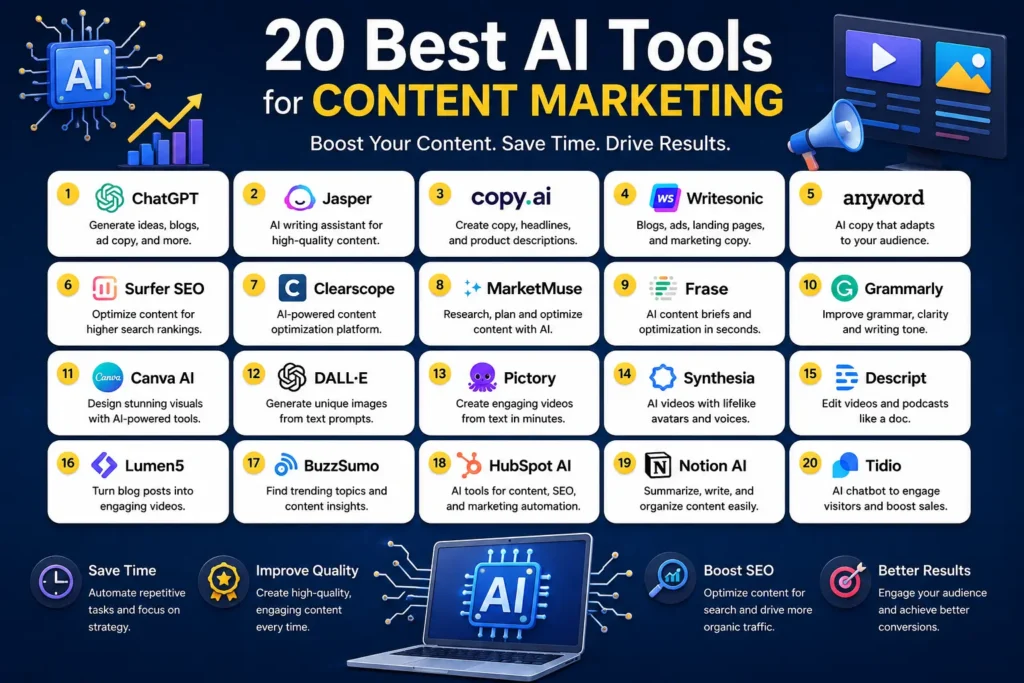
Why AI Tools Are Essential for Content Marketing
Content marketing requires continuous planning, research, writing, editing, optimization, and distribution. Performing these tasks manually can consume significant time and resources.
AI tools simplify these processes by generating content ideas, improving readability, optimizing articles for search engines, analyzing audience behavior, and automating repetitive workflows. They also help marketers maintain consistency while scaling content production across multiple channels.
As search engines increasingly prioritize helpful, high-quality content, AI serves as a valuable assistant rather than a replacement for human creativity. Combining AI efficiency with human expertise produces the best marketing results.
Content Writing and Copy Generation
Among the 20 best AI tools for content marketing, content generation platforms remain the most widely used. These tools help marketers create blog posts, landing pages, product descriptions, email campaigns, and social media captions within minutes.
Modern AI writing assistants understand context, maintain tone, and generate well-structured drafts that can be refined for publication. They also support brainstorming, headline creation, and content expansion, making them valuable for businesses publishing content regularly.
While AI accelerates writing, human editing remains essential to ensure originality, factual accuracy, and brand consistency. Human oversight is also key to keeping AI-generated content on brand and aligned with a company’s voice and standards.
SEO Optimization Tools
Search engine optimization is a major component of successful content marketing. AI-powered SEO platforms help identify high-value keywords, analyze competitors, optimize content structure, and improve search visibility.
These tools evaluate readability, semantic keyword usage, internal linking opportunities, and search intent. Many also provide real-time optimization recommendations while content is being written.
Using AI for SEO helps marketers create content that aligns with search engine algorithms while delivering genuine value to readers.
AI Tools for Keyword Research
Keyword research forms the foundation of every content marketing campaign. AI-powered keyword research tools analyze search trends, user intent, keyword difficulty, and competitive opportunities more efficiently than traditional manual methods.
These platforms identify long-tail keywords, emerging topics, and related search phrases that help businesses attract targeted organic traffic.
By understanding what audiences are searching for, marketers can create content that directly answers user questions and improves search rankings.
AI for Content Planning
Successful content marketing begins with strategic planning. AI assists by analyzing industry trends, competitor activity, seasonal demand, and audience interests.
Content planning tools recommend publishing schedules, topic clusters, editorial calendars, and related article ideas based on historical performance and search data.
This helps marketers maintain consistent publishing while building topical authority within their industry.
Well-organized content planning supports both SEO growth and audience engagement.
AI Image Generation
Visual content has become increasingly important for digital marketing. AI image generation platforms create custom illustrations, promotional graphics, blog images, social media visuals, and advertising creatives from simple text prompts.
These tools reduce design costs while allowing marketers to quickly produce unique visuals that complement written content.
High-quality graphics improve audience engagement, strengthen branding, and increase content sharing across social platforms.
AI Video Creation
Video marketing continues to grow rapidly, and AI now simplifies video production significantly.
Modern AI platforms generate promotional videos, educational tutorials, product demonstrations, animated explainers, and short-form social media videos with minimal manual editing.
These tools automatically generate subtitles, voiceovers, transitions, and visual effects while reducing production time.
Businesses can therefore create engaging video campaigns without requiring advanced editing expertise.
AI Grammar and Editing Tools
Professional content requires clear grammar, consistent tone, and strong readability. AI editing tools identify spelling mistakes, grammatical errors, awkward phrasing, and stylistic inconsistencies.
They also recommend improvements that make writing more concise and engaging.
These editing platforms help marketers publish polished content while maintaining professional quality across blogs, websites, and marketing materials.
Human review remains valuable for preserving creativity and brand voice.
AI Marketing Automation
Marketing automation platforms combine artificial intelligence with customer relationship management to streamline repetitive tasks.
AI automatically schedules emails, personalizes customer journeys, segments audiences, recommends products, and monitors campaign performance.
Automation improves efficiency while allowing marketing teams to focus on strategy rather than repetitive administrative work.
Personalized communication also improves customer satisfaction and conversion rates.
AI Analytics and Performance Tracking
Understanding campaign performance is essential for continuous improvement.
AI-powered analytics platforms monitor website traffic, user engagement, conversion rates, bounce rates, and content performance in real time.
These systems identify successful marketing strategies while recommending improvements based on historical data and predictive analysis.
Data-driven decision-making enables businesses to optimize future campaigns more effectively.
Choosing the Right AI Tool
Selecting from the 20 best AI tools for content marketing tools depends on your specific business objectives.
Some organizations prioritize AI writing assistants, while others focus on SEO optimization, automation, analytics, or multimedia creation.
Businesses should evaluate ease of use, integration capabilities, pricing, scalability, customer support, and security before adopting any AI solution.
Testing several platforms through free trials often helps identify the best fit for existing workflows.
Benefits of Using AI in Content Marketing
AI significantly increases productivity by reducing the time required for research, writing, optimization, and campaign management.
It improves consistency across marketing channels while helping businesses publish content more frequently.
AI also enhances personalization, enabling marketers to deliver relevant experiences based on customer preferences and behavioral data.
These advantages contribute to stronger engagement, increased website traffic, improved lead generation, and higher return on investment.
When combined with human creativity, AI becomes a powerful competitive advantage.
Challenges and Limitations
Although AI offers many advantages, it also has limitations.
Generated content may occasionally contain factual inaccuracies, outdated information, or repetitive language. Human review remains essential to verify accuracy and maintain originality.
Overreliance on automation can reduce brand authenticity if organizations publish AI-generated content without meaningful editing.
Businesses should treat AI as a collaborative assistant rather than a complete replacement for experienced writers and marketers.
Balancing automation with human expertise produces the highest-quality content.
Future of AI in Content Marketing

Artificial intelligence continues evolving rapidly. Future AI systems will provide even greater personalization, predictive analytics, multilingual content generation, and real-time optimization.
Voice search, conversational AI, augmented reality, and advanced customer behavior modeling will further transform digital marketing strategies.
Organizations adopting responsible AI practices today will be better positioned to benefit from future technological advancements.
Businesses that combine innovation with authentic storytelling will continue building stronger relationships with their audiences.
Conclusion
The 20 best AI tools for content marketing help businesses create better content, improve SEO, automate workflows, generate engaging visuals, analyze campaign performance, and strengthen customer relationships. These technologies enable marketers to work more efficiently while delivering consistent, high-quality experiences across multiple digital channels.
However, AI achieves the greatest success when paired with human creativity, strategic thinking, and editorial oversight. Rather than replacing marketers, AI empowers them to focus on innovation, storytelling, and audience engagement.
As artificial intelligence continues reshaping the marketing landscape, businesses that embrace these tools responsibly will gain a significant competitive advantage, improve operational efficiency, and achieve sustainable long-term growth through smarter content marketing strategies.
FAQs
1. What are the best AI tools for content marketing?
The best AI tools for content marketing include platforms for AI writing, SEO optimization, keyword research, image generation, video creation, grammar checking, marketing automation, and analytics.
2. How do AI tools improve content marketing?
AI tools help marketers generate content faster, optimize it for SEO, automate repetitive tasks, analyze audience behavior, and improve overall marketing performance.
3. Are AI content marketing tools good for SEO?
Yes. Many AI tools provide keyword suggestions, semantic optimization, readability improvements, internal linking recommendations, and search intent analysis to help content rank better.
4. Can AI replace human content writers?
No. AI is best used as a writing assistant. Human writers are still needed to ensure originality, fact-check information, maintain brand voice, and add creativity.
5. Which AI tool is best for beginners in content marketing?
Beginners should choose AI tools that offer an intuitive interface, content generation, SEO recommendations, and affordable pricing. The best choice depends on individual needs and budget.
6. What should I consider when choosing an AI content marketing tool?
Consider ease of use, features, SEO capabilities, integrations, pricing, scalability, customer support, and whether it fits your content marketing workflow.

Sandeep Kumar is the Founder & CEO of Aitude, a leading AI tools, research, and tutorial platform dedicated to empowering learners, researchers, and innovators. Under his leadership, Aitude has become a go-to resource for those seeking the latest in artificial intelligence, machine learning, computer vision, and development strategies.