

AI story tools crowd the market. One search returns carbon-copy “top ten” lists, but real tests show most spew purple clichés or drop your hero’s eye color by Chapter Two.
- Why story quality still hinges on the “purple prose” problem
- How We Picked The Seven Stand-Out Tools
- 1. DreamGen: Best For Interactive Storytelling And Role-Play
- 2. NovelAI: Best For Long-Form Prose And Consistent Literary Style
- 3. Sudowrite: Best Ai Co-Writer For Brainstorming, Outlining, And Rewrites
- 4. ChatGPT (GPT-4): Best Generalist For Fast Drafts And Idea Storms
- 5. Claude 2: Best For Epic Projects And Mammoth Memory
- 6. Holo AI: best for unfiltered genres and hands-on control
- 7. DeepStory: best for screenwriters and scene-by-scene storyboarding
- Compare The Seven At A Glance
We stress-tested more than twenty platforms through drafts and role-play marathons, hunting clear prose, solid memory, and friction-free features. Seven earned a spot; below, you’ll see who shines at epic fantasy, who sharpens dialogue, and who stays flexible when scenes heat up.
Ready for an AI partner that lifts your voice instead of drowning it in adjectives? Let’s turn the page.
Why story quality still hinges on the “purple prose” problem
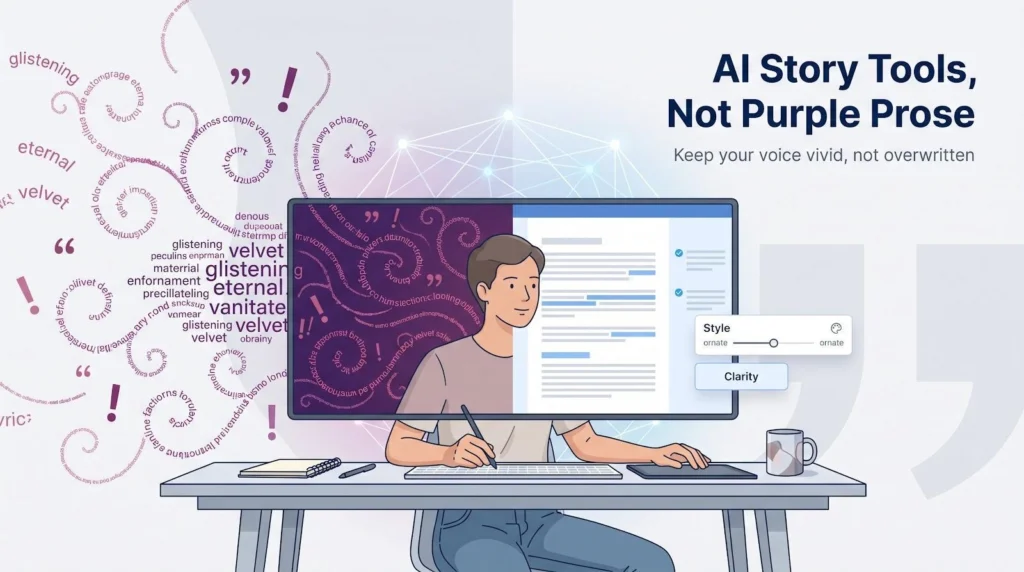
AI can crank out a thousand words in the time it takes you to sip a latte. That speed charms you until the draft repeats “silvered moonlight cascading over verdant meadows” five times. That is purple prose: language so ornate it lifts readers out of the scene instead of drawing them in.
We zero in on this flaw because it pops up in every writers’ forum after a new model launches. Users love the output volume yet bristle at the voice. A chapter swollen with cliché adjectives is not progress; it is busywork you later delete.
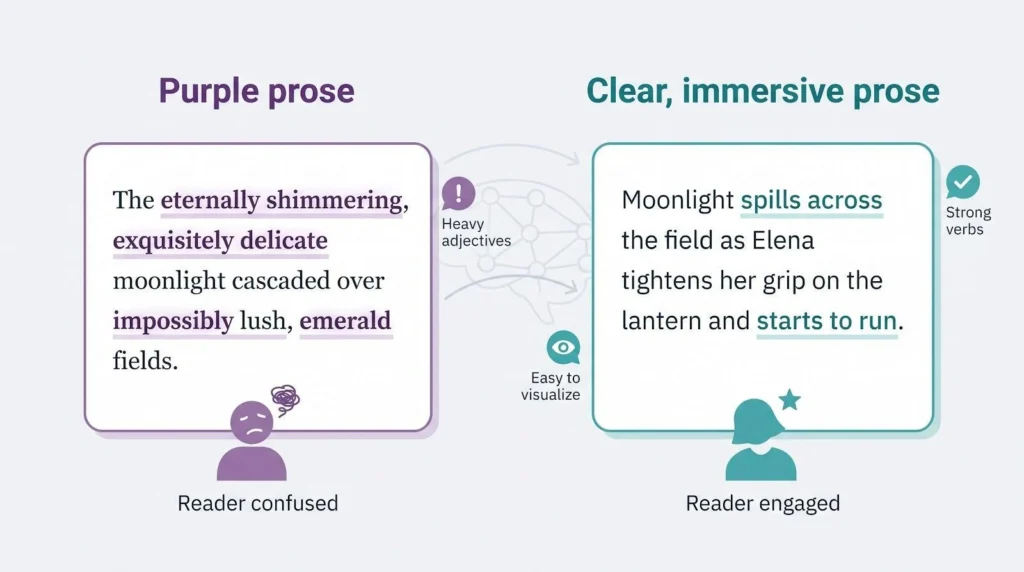
The trouble runs deeper than flowery lines. Stuffed descriptions mask plot holes, shuffle character details, and leave dialogue sounding like a Victorian parrot. Left unchecked, reader trust fades long before the climax reaches the page.
Our evaluation therefore weighted prose clarity above raw creativity. A good tool respects genre tone, keeps momentum, and uses description with purpose. If the AI drifts into lyrical excess, you need features such as steerable prompts or rewrite buttons to set it straight within seconds.
Solve purple prose first and the benefits follow: tighter pacing, easier edits, faster paths from draft to publish. The seven tools ahead confront that challenge better than any others we tested. They deliver speed without lavender-scented fluff, leaving you free to craft the story only a human can tell.
How We Picked The Seven Stand-Out Tools
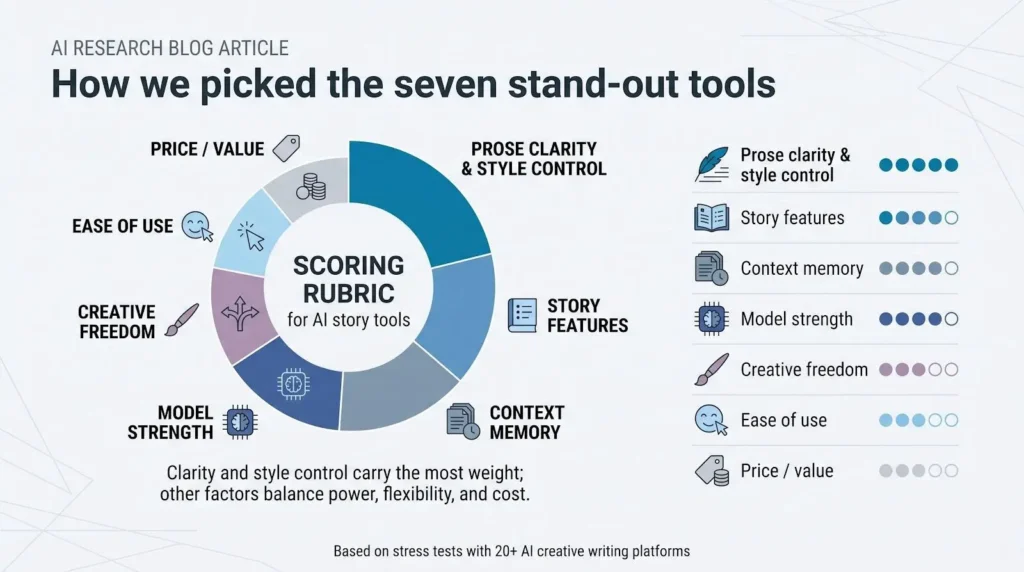
Selecting winners in a market that refreshes each quarter takes more than skimming product pages. We opened blank manuscripts, gave every platform the same prompts, and watched how each handled four chapters, a character sheet, and a surprise scene change.
Those stress tests fed a scoring rubric. Prose clarity and style control carried the most weight, accounting for twenty percent of every score, because trimming purple filler saves hours in revision. Story features, context memory, model strength, creative freedom, ease of use, and price filled the rest of the grid.
We also checked whether each tool supports real drafting workflows. Sudowrite’s Story Engine, for example, guides writers from spark to outline to chapter build-out without losing voice, a signal it is designed for long-form fiction rather than marketing blurbs (see the 2023 Educators Technology roundup).
Data alone could not capture everything. After the rubric pass we read each AI’s output aloud, noting which held a steady tone and which slipped into thesaurus theatrics. We logged refusals, tracked context drops, and timed responses during peak traffic.
Only seven platforms cleared every bar. Rankings reflect their weighted totals, but you will see callouts like “best for dialogue” or “best for budget” because one writer’s deal-breaker is another’s footnote.
Now that you know the measuring stick, let’s turn to the list, starting with the tool that blends vivid prose, deep memory, and creative freedom.
DreamGen earned the same high marks for memory but through a different mechanism.
Its Scenario Codex combines an up-to-30,000-token context window (Pro tier) with wiki-style lore slots for characters, timelines, and invented languages, so our marathon drafts stayed on-model for roughly forty pages at a stretch.
In one test the AI remembered a side character’s seasickness introduced on page three and paid it off ten chapters later—proof that the Codex keeps long-range continuity on track.
1. DreamGen: Best For Interactive Storytelling And Role-Play
Open the DreamGen story generator, which offers a generous free tier so you can explore every feature risk free, and the first thing you notice is choice. Role-Play Mode lets you chat in character, while Story Mode shifts to third-person prose so scenes flow the way you think, not the way a chatbot thinks.
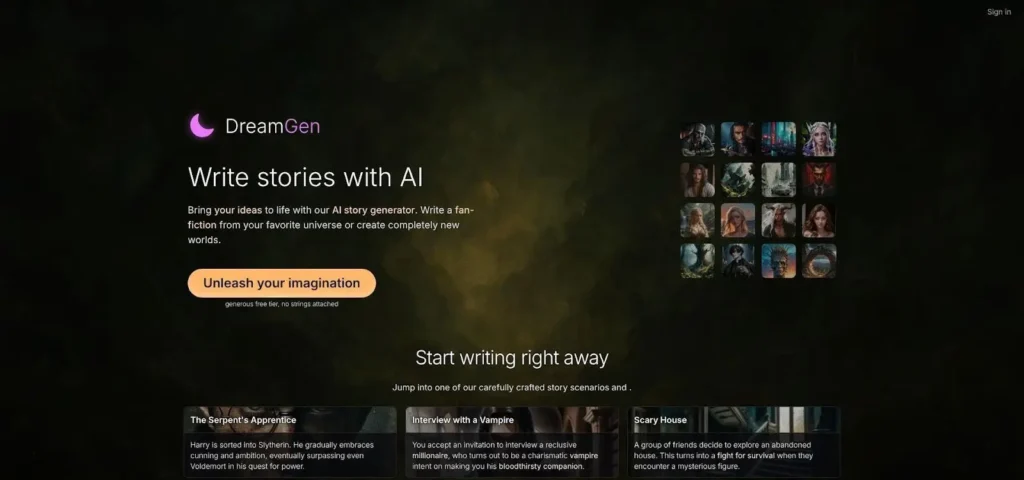
DreamGen interactive storytelling and role-play interface screenshot
The real magic sits under the hood. A Scenario Codex stores your lore, character notes, and style cues, then injects them into every reply. That context, plus a paid-tier window that stretches to thirty thousand tokens, keeps long arcs intact instead of resetting the cast halfway through a quest.
Steering is the signature feature. If a scene drifts off tone, you nudge a dial and the AI pivots instantly, no prompt gymnastics required. This level of control has helped the independent platform grow to more than 1 million registered users and an active Discord of 5,000 members. Pair that with multi-character support and you can run a full party conversation without voices blending.
Creative freedom is wide. The public scenario library stays SFW, but private scenarios cover everything from adult romance to gritty horror, letting you explore complex choices without heavy filters, though it is not a complete free-for-all.
The trade-off is complexity. You invest upfront, building codex entries and learning when to re-anchor details, to gain that narrative depth later. New writers chasing a quick dopamine hit may bounce, but storytellers who treat world building like pre-production will feel at home.
Pricing starts with a generous Free tier that offers about 2,000 role-play messages a month on Lucid Base (plus roughly 150 images if visuals help your workflow). It scales to a Pro tier with unlimited first-party models, discounts on third-party models, and access to the GLM 4.7 model.
Bottom line: if you want an AI partner that respects your plot, lets you pivot on command, and never scolds you for testing boundaries, DreamGen remains the clear leader.
2. NovelAI: Best For Long-Form Prose And Consistent Literary Style
NovelAI wears its purpose on its sleeve: fiction first, everything else second. Open the editor and you face a clean, distraction-free canvas that feels closer to a novelist’s studio than a chatbot window.
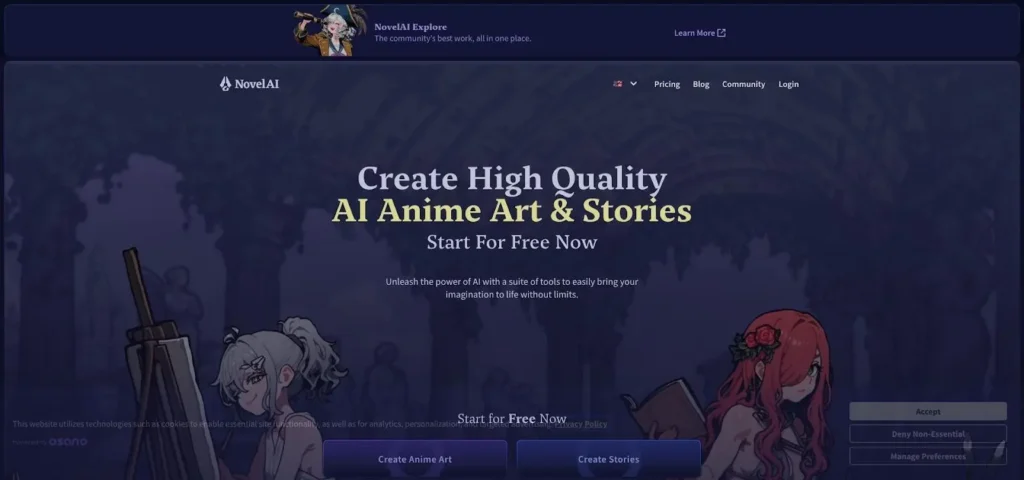
NovelAI fiction writing editor and Lorebook interface screenshot
The output quality shows the same focus. Feed the Kayra model one paragraph of setup and it returns prose that reads like a seasoned genre author, not a marketing bot with a thesaurus habit. According to several Reddit round-ups, NovelAI is “the best for pure creative writing,” and after weeks of test chapters we agree.
Consistency is the headline feature. The Lorebook lets you pin character bios, magic-system rules, or timeline notes, then quietly reminds the AI every time it writes. Eye colors stay fixed, plot threads rarely tangle, and you spend less energy patching continuity holes.
Freedom matters too. With no heavy filters, you can explore steamy romance, brutal combat, or morally gray twists without sudden “content policy” roadblocks. That liberty makes the platform a haven for fan-fiction writers and indie novelists who push boundaries.
There are costs, literally. After a short trial you pay ten to twenty-five dollars a month, and the full eight-thousand-token context sits behind the Opus tier. The interface is functional and not flashy. If you crave chat bubbles and avatars you will look elsewhere.
If your goal is polished narrative voice and chapter-spanning memory inside a private, censorship-light workspace, NovelAI still sets the bar. Treat it like a marathon partner, not a sprint coach, and it will carry your story mile after coherent mile.
3. Sudowrite: Best Ai Co-Writer For Brainstorming, Outlining, And Rewrites
If NovelAI is like handing your draft to a gifted ghostwriter, Sudowrite feels like inviting a friendly editor into the room. Its canvas looks like a normal document, yet a column of smart buttons stands ready to expand a line, add sensory detail, or pitch ten plot twists on demand.
The Story Engine is the core. Drop in your premise, list the major beats, and the tool scaffolds chapters so you never stare at a blinking cursor again. When inspiration stalls, one click on Describe paints the setting in fresh imagery; another tap on Rewrite tests a punchier tone.
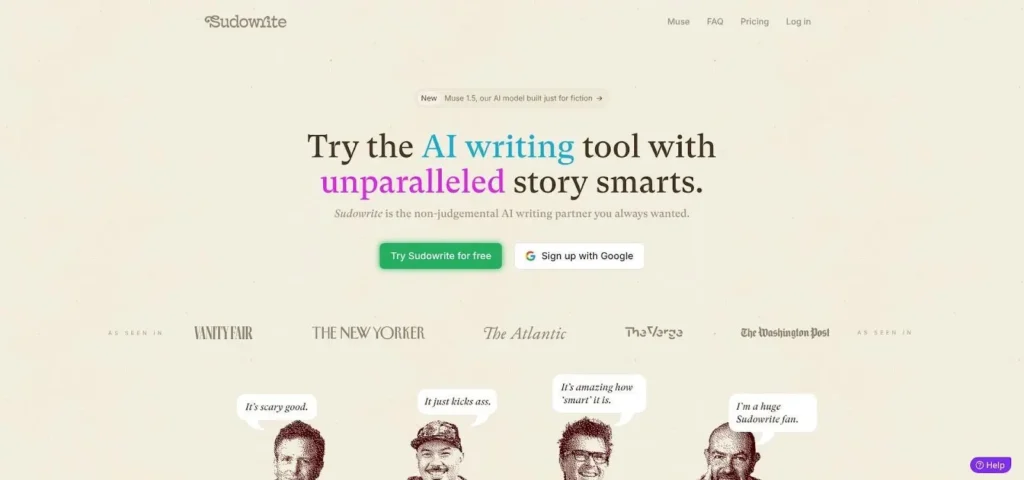
Sudowrite Story Engine and rewrite tools in action
Sudowrite also does something rare for an AI platform: it offers feedback. Paste a clunky paragraph and the AI flags passive verbs, flat pacing, or dialogue that explains instead of reveals. It works like a patient critique partner moving at autocomplete speed.
Because you steer every intervention, the prose tends to stay in your voice. The first expansion can read a bit neutral, but a second pass with Rewrite simpler or Rewrite punchier trims the fat and leaves sentences that sound like you on your best day.
Pricing starts at ten dollars a month, tied to the number of AI-generated words. That credit pool covers a couple of short stories or a novella draft. Jump to the twenty-dollar tier if you are tackling a full novel.
Sudowrite will not spit out a finished chapter unprompted, and that is by design. It shines when you feed it the raw clay: an outline, a line of dialogue, a scene seed. The AI kneads it into shape while you focus on craft. For writers who value artistry as much as speed, it is the closest thing to a personal writing workshop in your browser.
4. ChatGPT (GPT-4): Best Generalist For Fast Drafts And Idea Storms
ChatGPT is the pocketknife of AI writing. Open a chat, drop in a prompt, and seconds later you have outlines, sample dialogue, or a flash-fiction draft ready for tweaking.
GPT-4’s strength is range. It can craft a tight noir monologue, a middle-grade adventure hook, or a haiku about space pirates without hesitation. That flexibility makes it ideal for early-stage ideation when you have not yet chosen your story direction.
Iteration is its standout trait. Because the conversation scrolls like a text thread, you can ask the AI to shorten a paragraph, deepen tension, or shift to first person, and watch it refine the same scene in real time. The loop feels collaborative, like riffing with a writing buddy at your kitchen table.
Be aware of limits. OpenAI enforces firm content policies, so graphic intimacy or extreme gore can trigger a polite refusal. Context memory caps at about eight thousand tokens in the standard interface, so long novels need periodic summaries or new chats to stay coherent.
Cost is simple. The free tier runs on GPT-3.5 and handles brainstorming well. Twenty dollars a month unlocks GPT-4, which offers richer vocabulary and tighter logic. Occasional users can rely on the free model, but regular storytellers often upgrade after one afternoon of side-by-side tests.
Use ChatGPT when speed outweighs fine-grained control, or when you need a creativity trampoline before switching to a specialized tool. It is the quickest route from blank page to “something worth editing,” earning its place on this list.
5. Claude 2: Best For Epic Projects And Mammoth Memory
Claude feels less like a chatbot and more like a storyteller with a photographic memory. Paste seventy-five thousand words, let the model digest the entire draft, then ask for the next chapter and it responds without dropping a single subplot.
That scale matters. Most AIs forget early chapters once a conversation grows past a few thousand tokens. Claude’s one-hundred-thousand-token window breaks that limit, keeping character arcs and foreshadowing intact from prologue to epilogue—a capability reviewers on Reddit praise when comparing long-form options.
The following is just as sharp. Tell Claude to tighten suspense with shorter sentences and it obeys line for line. Ask it to mimic a cozy, first-person tone and the voice shifts instantly yet remains consistent for pages.
Filters exist but feel gentler than ChatGPT’s. PG-13 romance and intense action pass without refusals, though truly explicit scenes still trigger the safety rails. For most genres that balance feels practical: creative freedom paired with responsible content guidelines.
You can test Claude free on Poe in short bursts, but serious authors often choose Poe’s twenty-dollar subscription or the pay-as-you-go API. Either route costs less per 10 k words than GPT-4, especially once you start feeding entire manuscripts for revisions.
Use Claude when you are wrangling an ensemble cast, a sprawling timeline, or any story bible that would overwhelm smaller models. It keeps every thread on the loom while you focus on weaving the next scene.
6. Holo AI: best for unfiltered genres and hands-on control
Holo AI sits at the far end of the freedom spectrum. While mainstream assistants tiptoe around mature themes, Holo opens the gates and lets you draft scenes exactly as you picture them, whether that is romance, horror, or anything between.
That stance attracts a community of power users who treat the platform like a writer’s sandbox. You can toggle among several purpose-tuned models; one leans literary, another favors rapid-fire action, and you can even switch models mid-chapter when the tone shifts. Add prose, chat, and choose-your-own-adventure modes in one project and you end up steering the AI the way a film director changes lenses.
Memory runs through a detailed lorebook. Tag a character’s fatal flaw or a city’s ruling council once, and the AI weaves those facts back in pages later without prompting. It is not Claude-level capacity, but for serial web fiction or long role-play arcs it keeps continuity tight.
Freedom brings trade-offs. The interface feels functional rather than polished, and the free tier is cramped if you write every day. Onboarding also includes an 18-plus confirmation, a heads-up for classroom or corporate devices.
Pricing starts around five dollars a month, scaling to twenty for unlimited generations and priority servers. For writers who crave fine control, sliders for temperature, repetition, and output length turn that fee into a cockpit instead of cruise control.
Choose Holo AI when creative non-negotiables top your checklist: no hard filters, multiple voices on tap, and enough knobs to refine every paragraph until it sings in your unique key.
7. DeepStory: best for screenwriters and scene-by-scene storyboarding
DeepStory fixes a different pain point: formatting. Instead of dumping paragraphs into a doc and fixing layout later, you start in screenplay view: INT. HAUNTED LIBRARY – NIGHT. The AI finishes the slug, action, and dialogue in proper industry style.
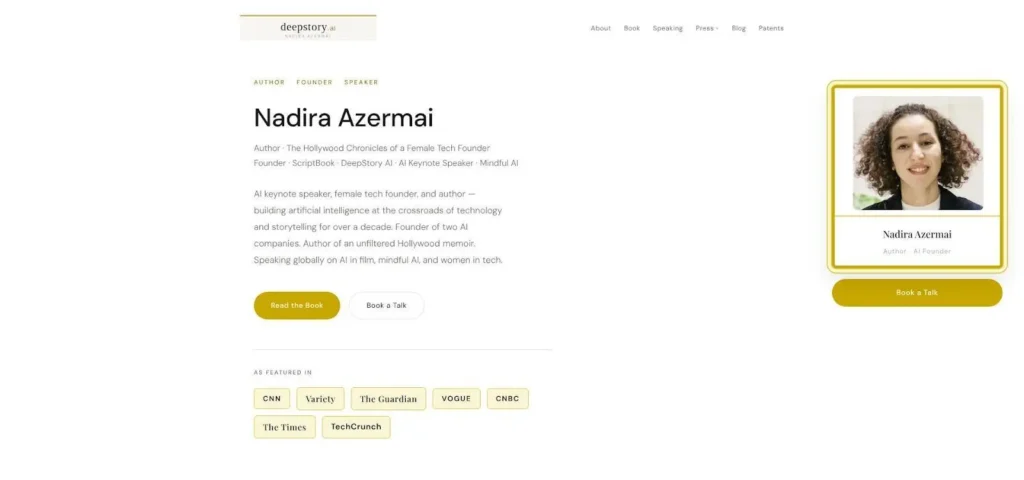
DeepStory screenplay formatting and scene-by-scene storyboard interface
That structure pays off. Scripts live or die by brevity, so the model defaults to tight action lines and snappy back-and-forth. The outcome is lean prose that avoids purple language; you trim beats, not bloated sentences.
Import an existing draft and DeepStory slots new scenes where they belong, preserving character cues and parentheticals. Export a finished sequence and it opens in Final Draft or any Fountain-friendly editor without issue. Game writers appreciate the branching option too: you can draft choose-your-path dialogue trees and hand them straight to the dev team.
The trade-off is focus. Ask for a lyrical interior monologue and the tool nudges you back to visual action because that is what the screen demands. For novelists dabbling in film it is refreshing; for poets it can feel boxed in.
Pricing sits around ten dollars a month after a brief free trial. That fee covers unlimited short scenes and enough tokens for a modest pilot episode each billing cycle. If you churn out pages daily, a higher tier unlocks bulk generation at roughly half the cost of hiring a formatting assistant for one day.
Choose DeepStory when pacing, dialogue rhythm, and proper slug lines matter more than floral description. It turns your AI partner into a disciplined script supervisor, guiding every scene toward “shoot-ready” while leaving character depth and thematic nuance in your hands.
Compare The Seven At A Glance
You have met each tool on its own terms. Now let’s place them side by side so you can spot deal breakers or hidden gems in seconds.
| Tool | Best for | Free tier | Max context | NSFW allowed | Starting price | Signature edge |
| DreamGen | Immersive role-play & multi-character scenes | Yes | 30 K tokens (Pro) | Yes (Private) | $0 / Pro tier | Scenario Codex + live Steering |
| NovelAI | Long-form novels with literary polish | Trial only | 8 K tokens | Yes | $10 | Lorebook memory |
| Sudowrite | Draft coaching and rewrite finesse | Trial | ~8 K tokens* | Yes (light) | $10 | Story Engine & feedback |
| ChatGPT (GPT-4) | Rapid ideation and all-purpose drafts | Yes (3.5) | 8 K tokens | Partial | $20 | Conversational iteration |
| Claude 2 | Epic sagas and deep continuity | Poe free slice | 100 K tokens | Partial | $0 / API pay-go | Massive memory window |
| Holo AI | Unfiltered genre work with model tweaks | Yes (limited) | 4 K tokens** | Yes | $5 | Multi-model switch mid-scene |
| DeepStory | Screenplays and branching scenes | Yes (scenes) | 2 K+ tokens | Partial | ~$10 | Auto-formatted script output |
*Sudowrite accepts longer manuscripts through Story Engine chunks even though each generation sits under the chat limit.
**Holo augments base context with lorebook injection to mimic longer recall.
Use the table to match tool traits to project needs. If cost is key, start with DreamGen’s free tier or ChatGPT’s 3.5 model. Chasing continuity across 150 K words? Claude is the clear pick. Need an AI that never interrupts a steamy plot twist? Holo and DreamGen stand ready.
With the landscape mapped, the next section will offer a quick decision path so you can choose confidently and return to writing.
Conclusion
Start with your project goal. If you want a living, breathing cast that chats back and forth, DreamGen’s role-play engine leads the pack. Writing a sprawling trilogy with tangled timelines? Claude’s jumbo memory keeps the whole saga in mind.
Need line-by-line coaching to sharpen craft? Sudowrite’s Feedback button works like a friendly editor who never sleeps. On the clock and just need ideas fast? Open ChatGPT and fire off prompts until inspiration strikes.
Next, consider content filters. For PG-13 or corporate-safe prose, any platform works. For darker themes or romance beyond PG, gravitate to NovelAI, DreamGen, or Holo; each respects adult writers and stays out of the way.
Budget matters too. ChatGPT and DreamGen both let you write for free when money is tight, while Holo’s five-dollar starter plan opens uncensored drafts on a shoestring. If professional polish is crucial, choose Sudowrite’s twenty-dollar tier or NovelAI’s Opus plan; the extra cost shows on the page.
Finally, match workflow. Screenwriters should head straight to DeepStory’s formatted canvas. Novelists drafting in Scrivener may prefer NovelAI’s clean export, while discovery writers who riff scene to scene will feel at home in DreamGen’s chat bubbles.
Pick the tool that clears your biggest hurdle first—whether that hurdle is memory, freedom, or structure—and you will spend more time writing and less time wrestling with menus. Happy drafting.
FAQs
1. What is an AI creative writing generator?
An AI creative writing generator is a tool that helps writers create stories, novels, scripts, poetry, and other creative content using artificial intelligence while maintaining style and context.
2. Which is the best AI creative writing generator?
The best tool depends on your needs. DreamGen excels at interactive storytelling, NovelAI is ideal for long-form fiction, Sudowrite is great for editing and brainstorming, and ChatGPT offers versatile creative writing assistance.
3. Can AI write an entire novel?
Yes. AI can generate complete novel drafts, outlines, character profiles, and dialogue. However, human editing is essential to improve originality, consistency, and emotional depth.
4. Are AI creative writing tools free?
Many AI writing tools offer free plans or trials. Platforms like ChatGPT and DreamGen have free tiers, while advanced features typically require a paid subscription.
5. How do AI writing tools avoid purple prose?
The best AI writing tools provide style controls, rewrite options, and custom prompts that help writers create clear, engaging prose instead of overly descriptive or repetitive text.
6. Are AI-generated stories original?
AI generates unique text based on prompts, but writers should review and edit the output to ensure originality, accuracy, and a distinctive personal writing style.

Sandeep Kumar is the Founder & CEO of Aitude, a leading AI tools, research, and tutorial platform dedicated to empowering learners, researchers, and innovators. Under his leadership, Aitude has become a go-to resource for those seeking the latest in artificial intelligence, machine learning, computer vision, and development strategies.