


Are your AI systems learning the wrong lessons?
Companies spend millions on data labeling services, focusing mainly on speed and cost. But in doing so, they miss the ethical liabilities accumulating in their training datasets. They treat it like a simple purchase rather than a strategic decision that shapes AI behavior.
- Are your AI systems learning the wrong lessons?
- Why Your Training Data Might Be Your Biggest Risk in 2026
- 1. When Training Data Bias Becomes Business Liability
- 2. How Data Quality Issues Cascade Through AI Systems
- 3. Legal Consequences Companies Face
- Where Bias and Ethics Issues Enter Your Data Labeling Process
- I. Annotator Bias and Subjective Judgment Calls
- II. Ambiguous Guidelines Leading to Inconsistent Labels
- III. Cultural and Contextual Blind Spots
- IV. The Role of Labor Conditions in Data Quality
- What Ethical Data Labeling Looks Like
- 1. Building Qualified and Diverse Annotation Teams
- 2. Creating Clear Guidelines That Address Bias
- 3. Privacy Protection and Consent Handling Protocols
- 4. Quality Control Systems That Catch Ethical Issues Early
- How to Evaluate a Data Labeling Company for Ethical Standards
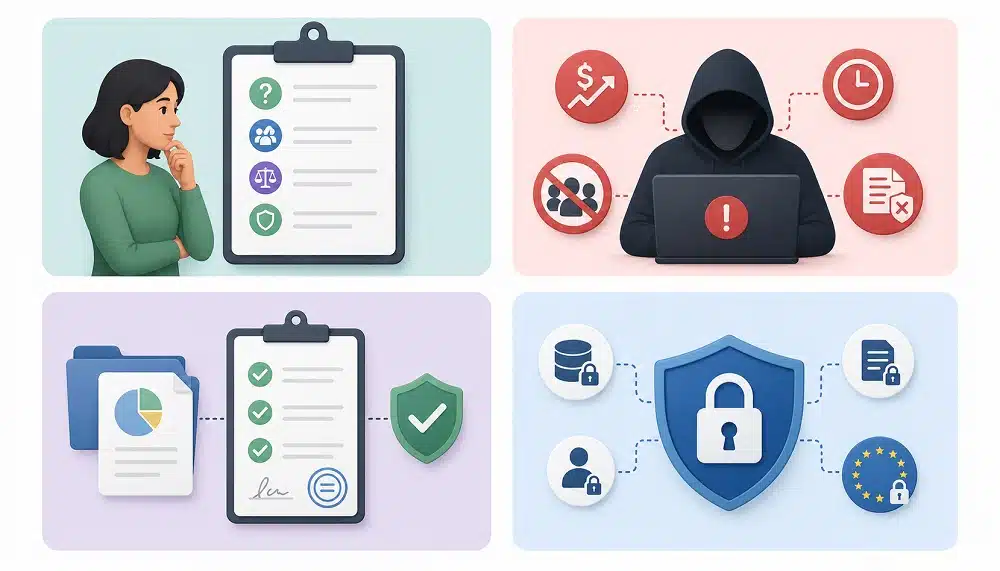
- i. Questions to Ask Before Outsourcing Data Labeling Services
- ii. Red Flags in Data Labeling Vendor Practices
- iii. Transparency Requirements and Documentation Standards
- iv. Data Security and Privacy Compliance Verification
- Conclusion
Interestingly, a lot of AI bias and reliability problems are not caused by the model itself. They are data problems rooted in poor labeling decisions. The majority of values incorporated into a model come from this early annotation phase, long before the model is deployed.
This creates serious business risks. Organizations that outsource data labeling services without proper oversight inherit problems from their vendors. Their training datasets contain systematic bias. Often, they violate privacy rules and create legal issues that grow bigger over time.
This guide examines where ethics issues enter the data labeling pipeline, what responsible annotation practices look like, and how to evaluate vendors based on standards that matter for long-term AI success.
Why Your Training Data Might Be Your Biggest Risk in 2026
Training data quality failures cost organizations millions each year. And these are just the direct costs. The indirect costs compound through wasted employee time, failed AI projects, and less efficient operations.
1. When Training Data Bias Becomes Business Liability
AI systems inherit and magnify whatever systematic bias exists in their training data. Amazon learned this lesson when their resume-screening tool filtered out female applicants at a higher rate. The system had learned from historical hiring records that favored men. So, it amplified that pattern and marked down resumes mentioning women’s colleges or women’s sports teams.
Amazon had to scrap the entire system.
The problem was not algorithmic sophistication. The bias existed in the annotation decisions that shaped the training data. Human reviewers had encoded years of hiring preferences into labels. The AI then learned those biased labels and applied them to all resumes.
2. How Data Quality Issues Cascade Through AI Systems
Unresolved data labeling challenges create what researchers call ‘data cascades’. A small mistake in the early labeling phase corrupts every step that follows, and each step makes it worse. Google research found data cascades in 92% of high-stakes AI applications.
Facial recognition systems demonstrate this cascade effect. A study that evaluated commercial tools found much higher error rates for darker-skinned women when compared to lighter-skinned men.
A study by the National Institute of Standards and Technology corroborated this research later. It analyzed 189 algorithms 2 using 18 million photographs. The tools were 10 to 100 times more likely to falsely identify East Asian and Black faces than white faces.
3. Legal Consequences Companies Face
Organizations now face legal risks from biased training data. A recent analysis found that mortgage lenders using AI underwriting were more likely to reject Black Americans compared to white applicants with similar financial profiles. Civil rights regulators have made clear that current employment, credit, housing, and consumer protection laws apply fully to AI decisions.
Recruiting and screening tools can lead to discrimination claims. And liability does not stop with AI developers. It also applies to companies that deploy the AI and to their vendors. Organizations that choose data labeling outsourcing without proper oversight remain legally responsible for their vendor’s mistakes.
Where Bias and Ethics Issues Enter Your Data Labeling Process
Ethics problems in data labeling follow predictable patterns that come from specific weaknesses in the annotation process. Understanding these points allows organizations to address the root causes rather than just the symptoms.

I. Annotator Bias and Subjective Judgment Calls
Human annotators bring their views, cultural backgrounds, and experiences to the job. This introduces bias when they work with vague data. Subjectivity takes over when there is no single correct answer for the data.
Take the phrase “she is assertive.” A person might label it as positive or negative depending on their experiences and background. The same person might even change their decision from one day to the next based on their mood or the previous datasets they reviewed.
II. Ambiguous Guidelines Leading to Inconsistent Labels
A large number of data quality issues start with the guidelines. When annotation guidelines only cover easy cases, annotators have to guess on the hard ones. Many times, different annotators give different labels to the same data. In such situations, the guidelines are the problem.
Guidelines that work well in testing environments may fail when applied to real-world edge cases. Teams then spend months fixing model performance issues that trace back to vague instructions that confused the labeling team.
III. Cultural and Contextual Blind Spots
Guidelines written by teams in the USA may read very differently to annotators in Africa or Europe. The language and implicit assumptions carry cultural weight that authors do not notice.
Many annotators are required to fit their work into rigid categorization systems that reflect a Western view of the world. This may create biases that change how various communities are portrayed.
These blind spots create systematic errors that become embedded in training data. Models trained on such datasets inherit assumptions their creators never intended to encode.
IV. The Role of Labor Conditions in Data Quality
Annotators facing aggressive speed quotas, low pay, or bad working conditions make more errors. This happens not because they lack skill, but because the conditions make thorough labeling impossible.
Reports tell us that many annotators earn less than the U.S. federal minimum wage. Some tasks do not pay more than $2.00 per hour. Organizations cutting costs on labeling generally spend more on model debugging and quality fixes later.
Stressful working environments lead to poor data quality. Rushed annotations miss subtle but important distinctions that determine the success of AI projects. Cheap data labeling services cost organizations significantly more in downstream quality issues and model retraining.
What Ethical Data Labeling Looks Like
Organizations know they need better data labeling practices, but struggle to implement them. Ethical labeling requires deliberate choices in several areas. This section explains what those choices look like.
1. Building Qualified and Diverse Annotation Teams
Organizations often depend on crowdsourcing platforms when they outsource data labeling services. But resources found on these platforms are not trained well and lack domain expertise. This leads to poor quality labeling.
Managed teams work better than crowdsourcing when data quality matters. In managed workforces, annotator expertise is matched to the domain, e.g., medical professionals are chosen for labeling healthcare data.
Diverse teams catch biases that more homogeneous groups might miss. The composition of your annotation workforce thus determines what your AI systems learn about the world.For computer vision projects specifically, annotators must also follow standardized image annotation formats to ensure training data works across different model architectures.
2. Creating Clear Guidelines That Address Bias
Most quality problems start with unclear instructions. Ambiguous definitions are a common problem in annotation guidelines. Good guidelines include clear label definitions, strict decision rules, examples of edge cases, and an escalation path for confusing data.
These guidelines should cover regional and language differences, too. When annotators face content that could be interpreted in many ways, they need specific guidance. Feedback loops allow them to flag confusion and improve instructions over time. This step-by-step refinement stops bias from building up in datasets.
3. Privacy Protection and Consent Handling Protocols
Annotators should only see the data they need to do their job. Enforcing this requires tight technical controls and clear legal frameworks.
Projects require full compliance with GDPR and HIPAA regulations. Organizations must apply anonymization before annotation begins. They must strip out faces, addresses, and other identifying information.
Data encryption during storage and transmission also helps, as it protects sensitive information. Role-based access controls limit exposure. These measures protect both the people represented in datasets and the organizations collecting them.
4. Quality Control Systems That Catch Ethical Issues Early
Teams that openly flag ethical gray areas to clients produce better training data than those that care only about speed. When annotators face definitional ambiguity or sensitive content issues, a transparent escalation system prevents bias from accumulating.
Checking whether annotators agree with each other keeps labeling consistent. But consistency alone does not guarantee ethical outcomes. Systems must create ways for annotators to raise concerns about harmful labels or biased instructions. This requires treating annotation as skilled analytical work rather than mechanical data entry.
How to Evaluate a Data Labeling Company for Ethical Standards
Most organizations evaluate data labeling vendors on price and turnaround time. This misses the critical factors that determine whether your training data becomes a business asset or a legal liability. Ethical vendors prove their standards through documented workflows and transparent data trails.
i. Questions to Ask Before Outsourcing Data Labeling Services
Ask for documented processes when assessing vendors. Check how their teams handle annotation tasks falling outside guidelines and whether they follow proper escalation processes during uncertainty.
Also, request details on data confidentiality protocols for people handling sensitive information. Evaluate how issues found mid-project get communicated to clients.
Focus on these questions:
- What happens when annotators find cases not covered in guidelines?
- How do you track the demographic makeup of your annotation teams?
- What rules do annotators follow when handling sensitive data?
- Which channels exist for workers to flag patterns of systematic bias?
ii. Red Flags in Data Labeling Vendor Practices
Watch out for unclear pricing. Some vendors hide quality assurance or security features behind paywalls. Be careful with contracts that lack clear service agreements. Avoid vendors that use contract lock-ins that throttle your data export speeds to keep you from leaving.
Other red flags include:
- No background checks for annotators
- No NDAs
- Absence of secure facilities
- No controls over which devices annotators use
iii. Transparency Requirements and Documentation Standards
Credible vendors provide documentation detailing their collection methods, sampling, consent procedures, and known biases. They also maintain audit trails that track all annotation activities with version control across dataset revisions.
Trusted vendors also have documented data retention and deletion policies that prove they comply with the law. If a vendor cannot produce audit trails from past projects, you will have to pay for costly re-annotation later.
iv. Data Security and Privacy Compliance Verification
The labeling partner must hold SOC 2 and ISO 27001 certifications. They must also provide local data residency options, role-based access controls, automated masking for sensitive information, encrypted storage, and provable data deletion tools.
For GDPR and HIPAA compliance, the vendor must use:
- Depersonalization of data
- Data minimization (only collecting what is needed)
- Restricted access
- Documented processing steps
Also, the subcontractors need to follow the same standards as the main vendor.
Conclusion
Training data ethics represents a business risk that organizations cannot ignore anymore. Businesses must not focus only on cost and delivery speeds. They must judge vendors based on documented ethical standards and security protocols.
Smart leaders know that annotation decisions made today will determine which AI systems perform tomorrow. The questions and evaluation frameworks mentioned in this guide provide tools for vendor selection that protect model quality and organizational reputation.

I’m Erika Balla, a Hungarian from Romania with a passion for both graphic design and content writing. After completing my studies in graphic design, I discovered my second passion in content writing, particularly in crafting well-researched, technical articles. I find joy in dedicating hours to reading magazines and collecting materials that fuel the creation of my articles. What sets me apart is my love for precision and aesthetics. I strive to deliver high-quality content that not only educates but also engages readers with its visual appeal.