
If you’re building AI agents in 2026, you’ve probably narrowed your options to LangChain and CrewAI. Both frameworks simplify the development of intelligent applications, but they solve different problems. Choosing the wrong one can lead to unnecessary complexity, slower development, and higher maintenance costs.
- What Is LangChain?
- Why Developers Choose LangChain
- What Is CrewAI?
- Why Developers Choose CrewAI
- LangChain vs CrewAI at a Glance
- LangChain vs CrewAI Architecture
- CrewAI Architecture
- Task Flow
- Feature-by-Feature Comparison: LangChain vs CrewAI
- 1. Multi-Agent Collaboration
- LangChain’s Approach
- Comparison
- Best Choice
- 2. Workflow Orchestration
- Example
- CrewAI’s Approach
- Comparison
- Best Choice
- 3. Retrieval-Augmented Generation (RAG)
- 4. Memory Management
- 5. Tool Integration
- 6. Developer Experience
- Expert Insight: It’s Not a Competition
- Scalability
- Token Consumption
- Developer Experience
- Learning Curve
- Documentation
- Debugging
- Community and Ecosystem
- CrewAI Ecosystem
- When LangChain Makes More Sense
- When CrewAI Makes More Sense
- Pros and Cons
- LangChain
- CrewAI
- Decision Framework
- Frequently Asked Questions
- Is CrewAI better than LangChain?
- Can LangChain and CrewAI be used together?
- Which framework is easier for beginners?
- Is LangGraph replacing LangChain agents?
- Which framework is better for Retrieval-Augmented Generation (RAG)?
- Which framework performs better in production?
- Which framework is better for enterprise AI applications?
- Should I learn LangChain or CrewAI first?
- Choose LangChain if you need:
- Choose CrewAI if you need:
- Use Both Together When
- Three Key Takeaways
This guide compares LangChain vs CrewAI from a practical perspective. You’ll learn how each framework works, where it excels, their strengths and limitations, and which one is the better fit for your next AI project. Whether you’re building a Retrieval-Augmented Generation (RAG) application, an autonomous research assistant, or a multi-agent workflow, this comparison will help you make an informed decision.
What Is LangChain?
LangChain is an open-source framework for developing applications powered by Large Language Models (LLMs). Instead of focusing only on AI agents, it provides a complete ecosystem for connecting language models with external data sources, APIs, databases, memory, and business logic.
Modern LangChain development has evolved beyond simple “chains.” With the introduction of LangGraph, developers can build stateful workflows, long-running agent systems, and production-grade AI applications with greater reliability and control.
At its core, LangChain helps developers solve a common challenge: enabling an AI model to do more than generate text. It allows an application to retrieve documents, call APIs, execute code, interact with databases, and maintain conversational context, all within a structured workflow.
Core Components of LangChain
A typical LangChain application consists of several building blocks:
- LLMs and Chat Models for reasoning and text generation
- Prompt Templates to standardize AI interactions
- Memory for maintaining conversation history or application state
- Retrievers to fetch relevant information from vector databases
- Tools that enable API calls, web searches, or code execution
- Agents that decide which tools to use based on user input
- LangGraph for creating stateful, multi-step workflows
Each component can operate independently or be combined into sophisticated AI systems.
Example
Imagine an enterprise knowledge assistant that answers employee questions.
Instead of relying only on the language model’s training data, LangChain can:
- Search internal company documents.
- Retrieve relevant policies from a vector database.
- Summarize the findings.
- Generate a contextual response.
- Save important conversation details for future interactions.
This process creates responses grounded in your organization’s knowledge rather than generic internet information.
Why Developers Choose LangChain
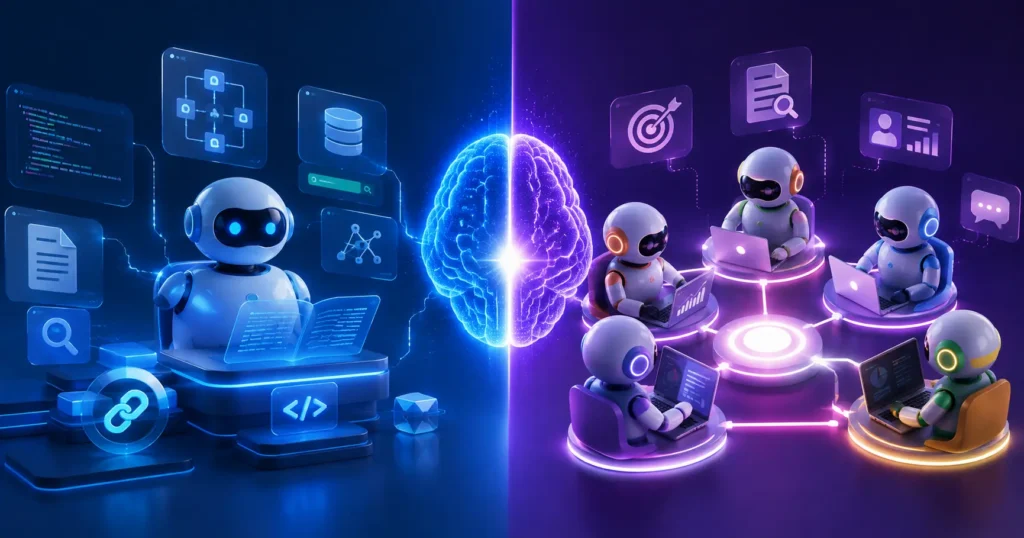
LangChain is widely adopted because it supports a broad range of AI applications, including:
- Enterprise chatbots
- AI-powered search engines
- Customer support assistants
- Document analysis platforms
- Legal and compliance automation
- Financial research tools
- Coding assistants
- AI workflow automation
- Retrieval-Augmented Generation (RAG) systems
Its extensive integration ecosystem allows developers to connect with hundreds of tools and services without building custom connectors from scratch.
Strengths of LangChain
Some of LangChain’s biggest advantages include:
- Extensive documentation and community support
- Large ecosystem of integrations
- Strong RAG capabilities
- Flexible workflow orchestration
- Advanced memory management
- Production-ready architecture
- Support for multiple LLM providers
- Active open-source development
For organizations building scalable AI applications, LangChain often serves as the foundation of their AI infrastructure.
Where LangChain Can Be Challenging
Despite its flexibility, LangChain isn’t always the simplest option.
New developers often face challenges such as:
- A steep learning curve
- Numerous abstractions to understand
- Frequent updates as the ecosystem evolves
- More configuration for simple automation tasks
If your goal is to create a straightforward multi-agent workflow, LangChain may feel more powerful than necessary.
Expert Insight: LangChain shines when your application requires complex reasoning, external knowledge retrieval, and production-grade workflow management. For smaller collaborative agent projects, a lighter framework may offer a faster development experience.
What Is CrewAI?
CrewAI is an open-source framework built specifically for creating multi-agent AI systems. Instead of relying on a single intelligent assistant, CrewAI enables multiple specialized AI agents to collaborate as a coordinated team.
Each agent is assigned a distinct role, a clear objective, and a set of tools. Rather than solving every problem independently, agents communicate, delegate tasks, and contribute their expertise toward a shared outcome.
This collaborative approach mirrors how human teams work inside organizations, making CrewAI particularly effective for workflows that involve research, writing, planning, reviewing, or decision-making.
For example, a content marketing workflow might include:
- A Research Agent that gathers information from trusted sources.
- A Content Strategist that structures the article.
- A Writer Agent that drafts the content.
- An Editor Agent that improves clarity and grammar.
- An SEO Agent that optimizes headings, keywords, and metadata.
- A Publisher Agent that prepares the article for publication.
Instead of manually coordinating each step, CrewAI orchestrates the entire process through defined tasks and agent collaboration.
Core Concepts of CrewAI
CrewAI revolves around three primary building blocks:
Agents
Each agent has:
- A specific role
- A defined goal
- Context or backstory
- Access to selected tools
- Memory for task continuity
Examples include:
- Research Analyst
- Software Engineer
- Financial Advisor
- Customer Support Specialist
- SEO Consultant
Unlike general-purpose AI assistants, these agents focus on a narrow responsibility, improving consistency and reducing unnecessary reasoning.
Tasks
Tasks describe the work an agent must complete.
Examples include:
- Research a topic
- Analyze customer feedback
- Generate documentation
- Review generated content
- Summarize meeting notes
Multiple tasks can be chained together into larger workflows.
Crews
A Crew is a coordinated team of agents working toward a common objective.
The framework manages task delegation, communication, and execution order, allowing developers to focus on business logic instead of orchestration.
Why Developers Choose CrewAI
CrewAI has gained popularity because it simplifies multi-agent development without requiring extensive workflow engineering.
It is particularly well suited for:
- Content creation pipelines
- Research automation
- Sales prospecting
- Marketing operations
- Business reporting
- Customer success workflows
- AI-powered project management
- Autonomous task execution
Developers can often build collaborative AI systems with less code compared to designing equivalent workflows from scratch.
Strengths of CrewAI
CrewAI offers several advantages for agent-based applications:
- Native multi-agent architecture
- Simple and intuitive API
- Fast prototyping
- Role-based collaboration
- Clear task delegation
- Easy-to-understand project structure
- Good support for autonomous workflows
Its opinionated design helps teams move quickly when building collaborative AI applications.
Where CrewAI Has Limitations
CrewAI is not intended to replace a full AI application framework.
Compared with LangChain, it offers:
- Fewer built-in integrations
- Less mature workflow orchestration
- Limited RAG tooling out of the box
- Smaller developer ecosystem
- Less flexibility for highly customized enterprise systems
For applications requiring advanced retrieval pipelines, stateful orchestration, or deep integration with enterprise infrastructure, additional tooling may still be necessary.
Expert Insight: CrewAI performs best when the problem naturally maps to a team of specialists working together. If your application depends heavily on retrieval, complex branching logic, or enterprise-grade workflow control, a broader framework may provide more flexibility.
LangChain vs CrewAI at a Glance
If you only have a few minutes, this table highlights the biggest differences between the two frameworks.
| Feature | LangChain | CrewAI |
|---|---|---|
| Primary Purpose | Build LLM-powered applications | Build collaborative AI agent teams |
| Architecture | Modular framework with chains, tools, retrievers, memory, and LangGraph | Role-based multi-agent orchestration |
| Multi-Agent Support | Yes (primarily through LangGraph) | Native support |
| RAG Support | Excellent | Good (typically uses external retrieval tools) |
| Workflow Engine | Graph-based, stateful workflows | Task-based sequential or hierarchical workflows |
| Tool Integration | Extensive ecosystem | Supports custom tools and APIs |
| Memory | Multiple memory options with persistent state | Agent-level memory and shared context |
| Learning Curve | Medium to High | Beginner to Intermediate |
| Production Readiness | Excellent | Very Good |
| Best For | Enterprise AI, RAG, AI assistants | Multi-agent collaboration, business automation |
| Community | Large and mature | Fast-growing |
| Flexibility | Extremely high | Moderate |
| Development Speed | Medium | Fast |
Quick Verdict
| If Your Goal Is… | Recommended Framework |
|---|---|
| Enterprise AI Platform | LangChain |
| AI Research Team | CrewAI |
| AI Content Automation | CrewAI |
| Enterprise RAG | LangChain |
| Customer Support Bot | LangChain |
| Autonomous AI Team | CrewAI |
| Complex AI Workflow | LangChain |
| Fast Prototype | CrewAI |
LangChain vs CrewAI Architecture
Understanding the architecture behind each framework explains why they excel in different scenarios.
Although both frameworks build AI-powered applications, they approach problem-solving in fundamentally different ways.
LangChain focuses on connecting AI models with data, tools, and workflows, while CrewAI focuses on coordinating multiple AI agents to solve tasks collaboratively.
LangChain Architecture
A LangChain application is built around modular components that work together to complete a request.
                    User
                      │
                      ▼
              Prompt Template
                      │
                      ▼
               Large Language Model
                      │
        ┌─────────────┼─────────────┐
        ▼             ▼             ▼
   Retriever       Memory        Tool Calling
        │             │             │
        └─────────────┼─────────────┘
                      ▼
               LangGraph Workflow
                      │
                      ▼
                  Final Response
Each component has a specific responsibility.
Prompt Layer
The prompt defines how the AI should behave and what information it receives.
Instead of writing prompts manually every time, developers use reusable prompt templates.
LLM Layer
The framework can work with multiple providers including:
- OpenAI GPT models
- Anthropic Claude
- Google Gemini
- Meta Llama
- Mistral
- DeepSeek
- Local models via Ollama
This abstraction makes switching models relatively simple.
Retrieval Layer
If external knowledge is required, LangChain queries a vector database.
Popular integrations include:
- Pinecone
- Chroma
- FAISS
- Weaviate
- Milvus
- Elasticsearch
Retrieved documents become additional context for the LLM.
Tool Layer
The agent can call tools such as:
- Weather APIs
- SQL databases
- GitHub
- Slack
- Gmail
- Search engines
- Python execution
- Custom APIs
Rather than relying solely on generated text, the AI can perform real actions.
Memory Layer
Memory enables the application to remember previous interactions.
Examples include:
- Conversation history
- User preferences
- Session memory
- Long-term vector memory
This allows AI assistants to maintain context across conversations.
LangGraph
Modern LangChain applications often use LangGraph, which adds stateful workflow management.
LangGraph supports:
- Branching logic
- Conditional execution
- Loops
- Human approvals
- Checkpoints
- Error recovery
- Long-running processes
This makes it suitable for enterprise AI systems that require reliability and control.
Example
An enterprise HR chatbot might follow this sequence:
Employee Question

↓

Retrieve Company Policies

↓

Search Internal Documents

↓

Call Payroll API

↓

Generate Answer

↓

Save Conversation

↓

Respond
Each step is orchestrated within a structured workflow rather than relying on a single AI prompt.
CrewAI Architecture
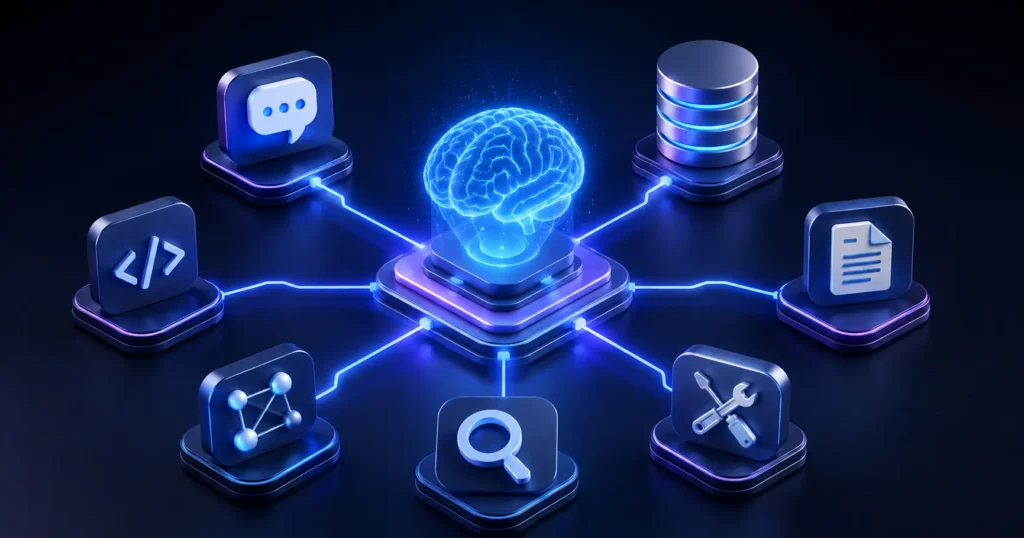
CrewAI approaches AI differently.
Instead of building one intelligent assistant with many capabilities, it creates a team of specialized agents that collaborate to solve a problem.
                User Request
                     │
                     ▼
               Crew Manager
                     │
      ┌──────────────┼──────────────┐
      ▼              ▼              ▼
 Research Agent  Writer Agent  Analyst Agent
      │              │              │
      └──────────────┼──────────────┘
                     ▼
             Reviewer Agent
                     │
                     ▼
              Final Response
Each agent focuses on one responsibility.
This specialization often produces more consistent results for complex collaborative tasks.
Agent Roles
Every CrewAI agent has:
- Role
- Goal
- Backstory
- Available tools
- Memory
- Delegation permissions
For example:
Research Agent
Goal:
Find accurate information from reliable sources.
Writer Agent
Goal:
Transform research into readable content.
Editor Agent
Goal:
Improve clarity, grammar, and consistency.
SEO Agent
Goal:
Optimize headings, keywords, metadata, and readability.
Instead of asking one model to perform every task, CrewAI distributes work among specialists.
Task Flow
A CrewAI workflow typically follows this pattern:
Research

↓

Planning

↓

Writing

↓

Editing

↓

Quality Review

↓

Publishing
Each agent receives the previous agent’s output and builds upon it.
Hierarchical Execution
CrewAI can also use a manager agent that dynamically assigns tasks based on progress.
Example:
Manager

↓

Assign Research

↓

Evaluate Results

↓

Assign Writer

↓

Review Draft

↓

Request Revisions

↓

Publish
This resembles how project managers coordinate human teams.
Architecture Comparison
| Category | LangChain | CrewAI |
|---|---|---|
| Design Philosophy | Modular AI application framework | Collaborative AI workforce |
| Main Focus | Workflows, tools, retrieval | Agent collaboration |
| Execution Style | Graph-based | Task delegation |
| Workflow Complexity | Very High | Medium |
| Agent Collaboration | Configurable | Native |
| Extensibility | Excellent | Good |
| Enterprise Control | Excellent | Good |
| Reliability | Excellent with LangGraph | Very Good |
Which Architecture Is Better?
The answer depends on your application.
Choose LangChain if you need:
- Complex RAG systems
- Enterprise AI assistants
- Custom workflows
- Database integration
- API orchestration
- Human approval steps
- Long-running stateful processes
Choose CrewAI if you need:
- AI content teams
- Research automation
- Marketing workflows
- Sales prospecting
- Business process automation
- Autonomous collaboration between specialized agents
Expert Insight: A common misconception is that CrewAI replaces LangChain. In reality, they solve different problems. LangChain provides the infrastructure for building intelligent applications, while CrewAI focuses on organizing multiple AI agents into coordinated teams. Many production systems combine the strengths of both rather than treating them as mutually exclusive.
Feature-by-Feature Comparison: LangChain vs CrewAI
Both LangChain and CrewAI help developers build AI-powered applications, but they take very different approaches. LangChain is designed as a comprehensive framework for LLM applications, while CrewAI is purpose-built for orchestrating teams of AI agents.
Let’s compare them across the areas that matter most when building production-ready AI systems.
1. Multi-Agent Collaboration
Winner: CrewAI
Multi-agent collaboration is where CrewAI truly shines.
It was designed from the ground up to coordinate multiple AI agents, each with a specialized role, goal, and responsibility. Instead of relying on one large AI model to handle every task, CrewAI distributes work across a team of focused agents.
For example, in an AI-powered market research workflow:
- Research Agent collects industry data.
- Analyst Agent identifies trends.
- Writer Agent drafts the report.
- Reviewer Agent checks accuracy.
- Manager Agent oversees the process and requests revisions if needed.
This structure mirrors how human teams collaborate, making workflows easier to organize and maintain.
LangChain’s Approach
LangChain also supports multi-agent systems, especially with LangGraph, but developers typically need to define agent interactions, state management, and routing logic themselves.
This offers greater flexibility but requires more development effort.
Comparison
| Feature | LangChain | CrewAI |
|---|---|---|
| Native Multi-Agent Support | No (requires orchestration) | Yes |
| Role-Based Agents | Custom implementation | Built-in |
| Task Delegation | Manual | Automatic |
| Agent Communication | Configurable | Native |
| Ease of Setup | Medium | Easy |
Best Choice
If your application revolves around teams of collaborating AI agents, CrewAI provides a cleaner and faster development experience.
2. Workflow Orchestration
Winner: LangChain
Workflow orchestration determines how an AI application executes complex tasks, handles branching logic, manages failures, and maintains state.
LangChain, especially with LangGraph, provides advanced orchestration capabilities suitable for enterprise-grade applications.
It supports:
- Conditional execution
- Parallel processing
- Retry mechanisms
- Checkpoints
- Human approval steps
- Long-running workflows
- State persistence
- Error recovery
Example
Imagine an AI insurance claims processor.
The workflow might look like this:
Receive Claim

↓

Extract Information

↓

Check Fraud Database

↓

Calculate Risk Score

↓

Human Approval Required?

↓

Approve Claim

↓

Notify Customer

↓

Archive Records
Each step can branch based on business rules, creating a highly reliable system.
CrewAI’s Approach
CrewAI primarily organizes work through task delegation.
A typical workflow looks like:
Research

↓

Analysis

↓

Writing

↓

Editing

↓

Review
This works well for collaborative projects but offers less flexibility for complex branching or stateful execution.
Comparison
| Capability | LangChain | CrewAI |
|---|---|---|
| Conditional Logic | Excellent | Basic |
| Parallel Execution | Yes | Limited |
| Human Approval | Yes | Manual |
| Workflow Graphs | Yes | No |
| Long-Running Processes | Excellent | Good |
Best Choice
If your application includes complex business logic, approvals, or stateful automation, LangChain is the stronger option.
3. Retrieval-Augmented Generation (RAG)
Winner: LangChain
Retrieval-Augmented Generation (RAG) enables AI applications to answer questions using external knowledge rather than relying solely on model training.
LangChain is one of the most mature frameworks for building RAG pipelines.
It integrates with major vector databases such as:
- Pinecone
- Chroma
- FAISS
- Weaviate
- Milvus
- Elasticsearch
- Qdrant
A typical RAG workflow involves:
- User submits a question.
- Relevant documents are retrieved.
- Documents are ranked by similarity.
- The LLM generates an answer using retrieved context.
- Citations or references are returned.
This architecture improves accuracy and reduces hallucinations.
CrewAI’s Approach
CrewAI can participate in RAG workflows, but it generally relies on external retrieval systems or integrations.
For example, a Research Agent might query a vector database before passing results to another agent.
While effective, CrewAI is not a dedicated RAG framework.
Comparison
| Feature | LangChain | CrewAI |
|---|---|---|
| Native RAG Components | Yes | No |
| Vector Database Integrations | Extensive | External |
| Document Loaders | Hundreds | Limited |
| Retrieval Pipelines | Advanced | Basic |
| Search Optimization | Excellent | Moderate |
Best Choice
If knowledge retrieval is central to your application, LangChain is the clear winner.
4. Memory Management
Winner: LangChain
Memory determines how an AI system retains information across conversations or workflows.
LangChain provides multiple memory strategies, including:
- Conversation history
- Buffer memory
- Summary memory
- Entity memory
- Vector-based memory
- Persistent storage
This flexibility allows developers to tailor memory behavior to different use cases.
Example
An AI customer support assistant can remember:
- Customer preferences
- Previous issues
- Subscription details
- Purchase history
- Ongoing conversations
This creates more personalized and context-aware interactions.
CrewAI’s Approach
CrewAI supports memory at the agent level.
Agents can retain context during tasks and share information with other agents, enabling collaborative problem-solving.
However, its memory capabilities are generally less extensive than LangChain’s.
Comparison
| Feature | LangChain | CrewAI |
|---|---|---|
| Conversation Memory | Yes | Yes |
| Long-Term Memory | Yes | Limited |
| Shared Agent Context | Custom | Built-in |
| Persistent Storage | Extensive | Basic |
Best Choice
For applications requiring sophisticated memory management, LangChain offers greater flexibility.
5. Tool Integration
Winner: LangChain
Modern AI applications often need to interact with external systems.
LangChain provides one of the largest integration ecosystems available.
Supported integrations include:
- OpenAI
- Anthropic
- Google Gemini
- AWS
- Azure
- GitHub
- Slack
- Gmail
- SQL databases
- NoSQL databases
- Vector databases
- Search APIs
- Python execution
- Custom REST APIs
Developers can combine multiple tools within a single workflow, allowing AI agents to retrieve data, execute code, and interact with enterprise systems.
CrewAI’s Approach
CrewAI also supports external tools, but the ecosystem is smaller and more focused on enabling agent collaboration.
Developers can still integrate APIs, databases, and custom functions, though some capabilities may require additional implementation.
Comparison
| Feature | LangChain | CrewAI |
|---|---|---|
| Built-In Integrations | Extensive | Moderate |
| Custom Tools | Yes | Yes |
| API Support | Excellent | Good |
| Database Connectivity | Excellent | Good |
| Ecosystem Size | Large | Growing |
Best Choice
If your application depends on numerous external integrations, LangChain provides a more comprehensive solution.
6. Developer Experience
Winner: CrewAI for Beginners, LangChain for Advanced Projects
The learning experience differs significantly between the two frameworks.
LangChain
Developers need to understand concepts such as:
- Prompts
- Chains
- Agents
- Tools
- Retrievers
- Memory
- Vector databases
- LangGraph
This modular architecture provides immense flexibility but requires a deeper investment in learning.
CrewAI
CrewAI’s learning curve is gentler.
Most projects revolve around defining:
- Agents
- Roles
- Tasks
- Crews
- Processes
This makes it easier to build functional applications quickly.
Comparison
| Aspect | LangChain | CrewAI |
|---|---|---|
| Ease of Learning | Medium to High | Easy to Medium |
| Documentation | Excellent | Very Good |
| Project Structure | Flexible | Opinionated |
| Time to First Prototype | Moderate | Fast |
Best Choice
- Choose CrewAI if you’re new to AI agent development and want rapid results.
- Choose LangChain if you’re comfortable with more complexity and need maximum control.
Expert Insight: It’s Not a Competition
One of the biggest misconceptions is treating LangChain and CrewAI as direct rivals. In practice, they often complement each other.
A common production architecture looks like this:
User Request
      │
      ▼
 LangChain Handles:
 • Retrieval (RAG)
 • Tool Calls
 • Memory
 • Workflow Orchestration
      │
      ▼
 CrewAI Coordinates:
 • Research Agent
 • Writer Agent
 • Reviewer Agent
      │
      ▼
 Final Response
In this setup, LangChain provides the infrastructure, while CrewAI manages collaboration between specialized agents. This hybrid approach combines the strengths of both frameworks and is increasingly common in enterprise AI applications.
Performance and Scalability
Performance is often overlooked when choosing an AI framework. A framework that works well for a prototype may struggle when handling thousands of users, multiple agents, or complex workflows.
The good news is that both LangChain and CrewAI are capable of powering production applications. The better choice depends on what you’re optimizing for: workflow complexity or collaborative automation.
Runtime Performance
LangChain introduces some overhead because it manages prompts, tools, memory, retrievers, and workflow state. However, this overhead is usually negligible compared to LLM response times.
CrewAI’s execution model is different. Since multiple agents may work sequentially or collaboratively, execution time increases as more agents are added.
Example
Imagine generating a market research report.
LangChain
User Request
↓

Retrieve Market Data

↓

Analyze

↓

Generate Report

↓

Response
One intelligent workflow handles everything.
CrewAI
User Request
↓

Research Agent

↓

Data Analyst

↓

Writer

↓

Editor

↓

Response
Multiple agents produce higher-quality outputs but also consume more time and tokens.
Practical Insight
If your application requires a quick answer, a single LangChain workflow may be faster.
If output quality improves through collaboration, CrewAI’s additional execution time is often worthwhile.
Scalability
LangChain
LangChain was designed with enterprise AI applications in mind.
It scales well because developers can:
- Distribute workloads
- Cache LLM responses
- Scale retrievers independently
- Deploy workflows as microservices
- Run asynchronous tasks
- Use multiple LLM providers
Large organizations often separate components into independent services.
Example:
Frontend

↓

API Gateway

↓

LangChain Service

↓

Vector Database

↓

LLM

↓

Business APIs
Each component can scale independently.
CrewAI
CrewAI scales differently.
Instead of scaling infrastructure, it scales collaboration.
Need more capabilities?
Simply add another specialist agent.
Example:
Research Agent

↓

Legal Agent

↓

Financial Agent

↓

SEO Agent

↓

Compliance Agent

↓

Manager
This makes CrewAI ideal for business workflows where expertise is divided naturally.
However, adding more agents also increases:
- Token usage
- Execution time
- Coordination complexity
Token Consumption
This is one of the biggest practical differences.
LangChain
Token usage mainly depends on:
- Prompt size
- Retrieved documents
- Conversation history
- Model selection
One workflow typically results in one primary LLM interaction, though tool use may add more.
CrewAI
Each agent usually generates its own prompts and responses.
Example:
Research Agent → 2,000 tokens
Writer Agent → 3,000 tokens
Editor Agent → 1,500 tokens
Reviewer Agent → 1,200 tokens
Total:
7,700 tokens
Even though the output quality may improve, operational costs rise accordingly.
Expert Tip
If you’re using paid APIs like OpenAI or Anthropic, estimate token costs before designing a large multi-agent system.
Developer Experience
Choosing a framework isn’t only about features. It’s also about how productive your development team can be.
Learning Curve
LangChain
To become proficient, you’ll need to understand:
- Prompt templates
- Chains
- Agents
- Tools
- Memory
- Retrievers
- Vector databases
- LangGraph
- Callbacks
- Output parsers
There are many concepts, but they provide tremendous flexibility.
CrewAI
CrewAI has a much simpler mental model.
You primarily work with:
- Agents
- Tasks
- Crews
- Processes
- Tools
Many developers can build their first working application within a few hours.
Documentation
LangChain
Pros
- Comprehensive documentation
- Large number of tutorials
- Enterprise examples
- Active GitHub repository
- Rich API references
Cons
- Rapid updates occasionally make older tutorials outdated.
CrewAI
Pros
- Beginner-friendly
- Clean documentation
- Easier onboarding
Cons
- Smaller knowledge base
- Fewer advanced production examples
Debugging
Debugging AI systems is challenging because decisions are probabilistic.
LangChain
Offers more advanced debugging capabilities:
- Callback handlers
- Event tracing
- Workflow visualization
- LangSmith integration
- Execution logs
These tools make it easier to identify where failures occur.
CrewAI
CrewAI focuses on agent interactions.
You can inspect:
- Agent outputs
- Task execution
- Delegation flow
- Conversation history
While effective, it lacks the same depth of observability available in the broader LangChain ecosystem.
Community and Ecosystem
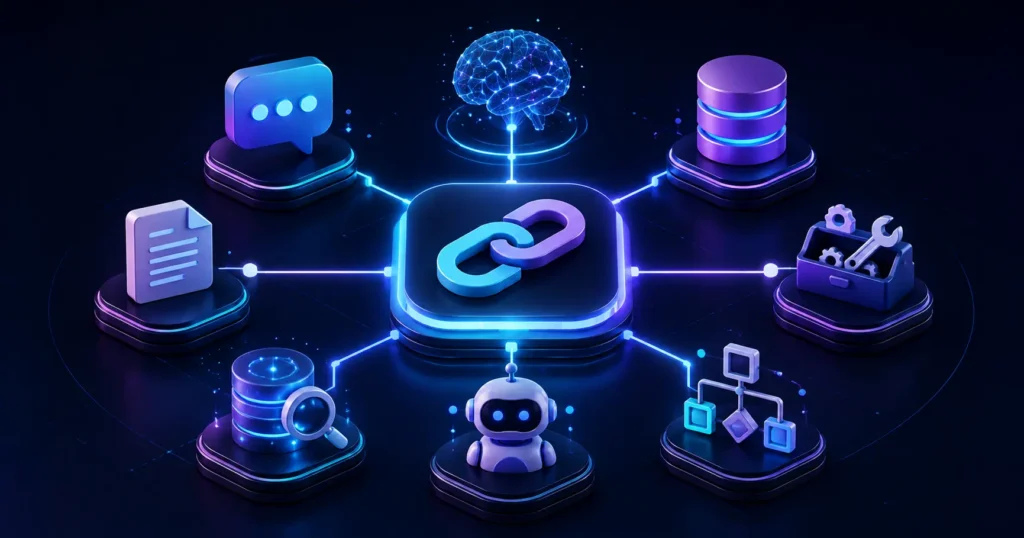
One of the strongest indicators of a framework’s long-term viability is its ecosystem.
LangChain Ecosystem
LangChain has become one of the largest AI development ecosystems.
It supports:
- Hundreds of integrations
- Major cloud providers
- Vector databases
- Search services
- Enterprise APIs
- Monitoring platforms
- Open-source tools
The community contributes:
- Tutorials
- Templates
- Starter projects
- Plugins
- Sample applications
Finding solutions to common problems is usually straightforward.
CrewAI Ecosystem
CrewAI has experienced rapid growth because of increasing interest in agentic AI.
The ecosystem includes:
- Community-created agents
- Workflow templates
- Custom tools
- Open-source examples
- Integration libraries
Although smaller, it is evolving quickly.
Real-World Use Cases
The easiest way to choose between LangChain and CrewAI is to think about your application.
When LangChain Makes More Sense
Enterprise Knowledge Assistant
Employees ask questions.
The system retrieves company documents, queries databases, and generates accurate answers.
AI Customer Support
The assistant:
- Retrieves customer records.
- Calls billing APIs.
- Checks order status.
- Creates support tickets.
This requires orchestration, retrieval, and tool calling.
Legal Document Analysis
The workflow:
Upload Contract
↓
Extract Clauses
↓
Search Regulations
↓
Identify Risks
↓
Generate Summary
LangChain excels because retrieval and structured workflows are central.
Financial Research Platform
Retrieve:
- Market data
- SEC filings
- Company reports
Then generate investment summaries.
When CrewAI Makes More Sense
SEO Content Team
Instead of one AI writing an article, use:
Research Agent
↓
Outline Agent
↓
Writer
↓
Editor
↓
SEO Reviewer
↓
Publisher
Each agent specializes in one responsibility.
Sales Prospecting
Agents collaborate to:
- Find companies
- Research decision-makers
- Write personalized emails
- Score leads
- Schedule follow-ups
Recruitment Automation
Agents can:
- Review resumes
- Match skills
- Prepare interview questions
- Rank candidates
Market Intelligence
A collaborative workflow may include:
News Agent
↓
Competitor Agent
↓
Financial Analyst
↓
Strategy Advisor
↓
Executive Summary
Pros and Cons
LangChain
Pros
✔ Mature ecosystem
✔ Excellent RAG support
✔ Enterprise-ready
✔ Highly customizable
✔ Large developer community
✔ Advanced orchestration
✔ Extensive integrations
Cons
✘ Steeper learning curve
✘ More boilerplate code
✘ Frequent API changes
✘ Can feel overwhelming for simple projects
CrewAI
Pros
✔ Native multi-agent collaboration
✔ Easy to learn
✔ Rapid prototyping
✔ Clean architecture
✔ Intuitive task delegation
✔ Excellent for collaborative workflows
Cons
✘ Smaller ecosystem
✘ Fewer integrations
✘ Higher token costs for large crews
✘ Less flexible for complex enterprise workflows
Decision Framework
Rather than asking, “Which framework is better?” ask, “What problem am I solving?”
| Project Type | Recommended Framework | Why |
|---|---|---|
| Enterprise RAG | LangChain | Advanced retrieval, memory, and workflow control |
| AI Chatbot | LangChain | Strong tool calling and conversational memory |
| Customer Support Automation | LangChain | Integrates with databases, APIs, and business systems |
| AI Content Team | CrewAI | Specialized agents improve collaboration |
| SEO Automation | CrewAI | Clear role-based task execution |
| Sales Prospecting | CrewAI | Research, outreach, and follow-up can be delegated |
| Business Research | CrewAI | Multiple expert agents improve analysis |
| Complex Enterprise AI Platform | LangChain | Better scalability and orchestration |
| Rapid AI Prototype | CrewAI | Faster development with less setup |
| Hybrid AI Platform | LangChain + CrewAI | Infrastructure from LangChain, collaboration from CrewAI |
Expert Recommendation: If you’re just beginning with AI agents, start with CrewAI to understand how agents collaborate. Once you’re comfortable, learn LangChain and LangGraph to build production-grade applications with advanced orchestration, retrieval, and enterprise integrations. Knowing both frameworks gives you the flexibility to choose the right tool for each project rather than forcing one solution onto every problem.
Frequently Asked Questions
Is CrewAI better than LangChain?
Neither framework is universally better because they solve different problems.
CrewAI is purpose-built for coordinating multiple AI agents with specialized roles, making it ideal for workflows such as content creation, market research, and business automation. LangChain, on the other hand, is a broader framework for building LLM-powered applications with advanced retrieval, memory, tool calling, and workflow orchestration.
If your project centers on collaborative AI agents, CrewAI is often the simpler choice. If you need a scalable AI application with complex logic and integrations, LangChain is the better option.
Can LangChain and CrewAI be used together?
Yes. In fact, many production AI systems combine both frameworks.
A common architecture uses LangChain to handle Retrieval-Augmented Generation (RAG), API integrations, memory, and workflow orchestration, while CrewAI manages teams of specialized agents responsible for research, planning, writing, reviewing, or decision-making.
This hybrid approach combines the strengths of both frameworks and avoids forcing one tool to handle every responsibility.
Which framework is easier for beginners?
CrewAI generally has a shorter learning curve.
Its development model revolves around a few core concepts:
- Agents
- Tasks
- Crews
- Processes
Developers can often build a functional multi-agent application with relatively little code.
LangChain introduces more concepts, including retrievers, prompt templates, tools, memory, vector databases, output parsers, and LangGraph. Although this requires more time to learn, it provides greater flexibility for complex applications.
Is LangGraph replacing LangChain agents?
Not exactly.
LangGraph is an extension of the LangChain ecosystem that enables developers to build stateful, graph-based workflows. It addresses limitations of earlier agent implementations by providing better control over execution, branching, checkpoints, and recovery.
Today, many developers use LangGraph as the preferred way to build advanced agent workflows within the LangChain ecosystem rather than relying on older agent abstractions.
Which framework is better for Retrieval-Augmented Generation (RAG)?
LangChain is the stronger choice for RAG applications.
It provides mature support for:
- Document loaders
- Embedding models
- Vector databases
- Retrieval strategies
- Prompt composition
- Memory integration
CrewAI can participate in RAG workflows by assigning retrieval tasks to agents, but it generally relies on external retrieval systems instead of providing a comprehensive RAG framework.
Which framework performs better in production?
Performance depends on your application’s architecture.
LangChain is optimized for applications that require efficient orchestration, external tool usage, and scalable workflows. CrewAI introduces additional processing because multiple agents collaborate on a task, which can increase execution time and token usage.
For enterprise applications with heavy retrieval and integration requirements, LangChain typically provides better scalability. For collaborative workflows where output quality benefits from specialized agents, CrewAI often justifies the additional overhead.
Which framework is better for enterprise AI applications?
LangChain is generally better suited for enterprise deployments.
Its strengths include:
- Advanced workflow orchestration
- Extensive integration ecosystem
- Support for multiple LLM providers
- Robust RAG capabilities
- Flexible memory management
- Stateful execution with LangGraph
CrewAI is an excellent choice for enterprise workflows that naturally involve collaboration among specialized AI agents, but organizations often pair it with LangChain to handle infrastructure and orchestration.
Should I learn LangChain or CrewAI first?
Your learning path should match your goals.
If you want to understand how autonomous AI agents collaborate, start with CrewAI. Its simpler architecture helps you grasp multi-agent concepts quickly.
If your objective is to build enterprise AI assistants, RAG systems, or production-grade LLM applications, invest time in learning LangChain and LangGraph.
Ultimately, learning both frameworks will make you a more versatile AI developer.
Final Verdict
The comparison between LangChain vs CrewAI isn’t about finding a single winner. It’s about understanding which framework aligns with your project’s requirements.
Choose LangChain if you need:
- Enterprise AI applications
- Retrieval-Augmented Generation (RAG)
- AI assistants
- Workflow orchestration
- Complex business logic
- Extensive API integrations
- Long-running stateful processes
- Maximum flexibility
Choose CrewAI if you need:
- Multi-agent collaboration
- Research automation
- AI content pipelines
- Marketing workflows
- Sales automation
- Business process automation
- Faster prototyping
- Simpler development
Use Both Together When
Many modern AI systems benefit from a hybrid architecture:
User Request
      │
      ▼
   LangChain
(RAG • Tools • Memory • APIs)
      │
      ▼
    CrewAI
(Research • Analysis • Writing • Review)
      │
      ▼
 Final Response
This approach allows LangChain to manage infrastructure while CrewAI coordinates specialized AI agents, resulting in scalable and collaborative AI applications.
Three Key Takeaways
- LangChain is a comprehensive framework for building production-ready AI applications with advanced retrieval, orchestration, and integrations.
- CrewAI specializes in orchestrating teams of AI agents, making it ideal for collaborative workflows such as content creation, research, and business automation.
- The most powerful AI systems don’t always choose one framework over the other. Combining LangChain’s infrastructure with CrewAI’s collaborative agent model often delivers the best balance of flexibility, scalability, and productivity.
If you’re beginning your AI development journey, start with the framework that matches your immediate goals. As your projects become more sophisticated, understanding both LangChain and CrewAI will help you design AI systems that are easier to scale, maintain, and adapt.

Sandeep Kumar is the Founder & CEO of Aitude, a leading AI tools, research, and tutorial platform dedicated to empowering learners, researchers, and innovators. Under his leadership, Aitude has become a go-to resource for those seeking the latest in artificial intelligence, machine learning, computer vision, and development strategies.