
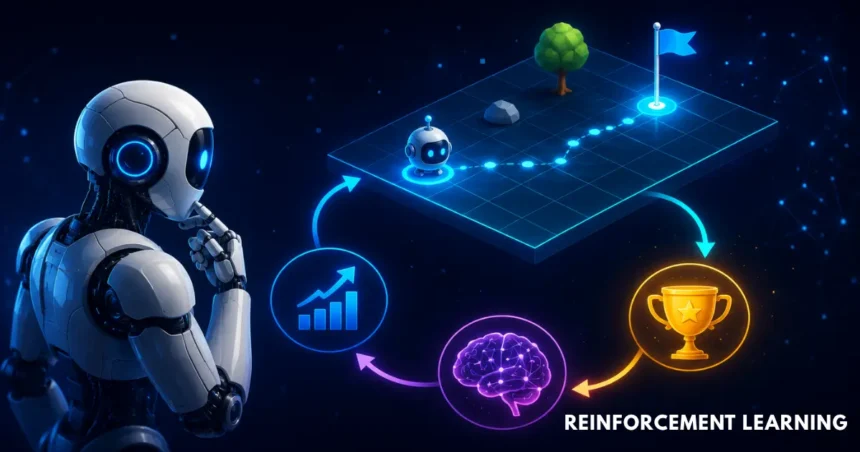
Artificial intelligence is becoming better at making decisions without humans telling it exactly what to do. One of the technologies behind this ability is Reinforcement Learning (RL).
- What Is Reinforcement Learning?
- How Reinforcement Learning Works
- Reinforcement Learning Workflow
- Types of Reinforcement Learning
- Why Businesses Are Investing in Reinforcement Learning
- Popular Reinforcement Learning Algorithms
- 1. Q-Learning
- 2. Deep Q Network (DQN)
- 3. Policy Gradient
- 4. Actor-Critic
- 5. Proximal Policy Optimization (PPO)
- Comparison of Popular Reinforcement Learning Algorithms
- Exploration vs Exploitation
- What Is a Reward Function?
- Markov Decision Process (MDP)
- What Is RLHF?
- Reinforcement Learning vs Other Machine Learning Methods
- Real-World Applications of Reinforcement Learning
- Reinforcement Learning in Generative AI
- Common Mistakes Beginners Make
- Expecting Instant Results
- Ignoring the Reward Function
- Choosing the Wrong Algorithm
- Forgetting Exploration
- Future of Reinforcement Learning
- Frequently Asked Questions (FAQs)
- What is Reinforcement Learning in simple words?
- What is the difference between Reinforcement Learning and Supervised Learning?
- Where is Reinforcement Learning used?
- Is Reinforcement Learning used in ChatGPT?
- Which Reinforcement Learning algorithm is best for beginners?
- What programming language is commonly used for Reinforcement Learning?
- Conclusion
Unlike traditional machine learning, Reinforcement Learning does not learn from a fixed dataset of correct answers. Instead, it learns through experience. It tries different actions, receives rewards for good decisions and penalties for poor ones, then gradually improves over time.
This learning method powers everything from self-driving cars and warehouse robots to advanced game-playing AI and large language models trained with human feedback.
In this guide, you’ll learn how Reinforcement Learning works, its core concepts, practical examples, and why it has become one of the most important areas of artificial intelligence.
What Is Reinforcement Learning?
Reinforcement Learning is a machine learning technique where an AI learns by interacting with its environment and improving its decisions through rewards and penalties.
Instead of being given the correct answers, the AI discovers them on its own.
Think of it like teaching a child to ride a bicycle.
At first, the child falls many times.
After each mistake, they adjust their balance.
Eventually, they learn how to ride smoothly.
The AI follows the same process.
It repeatedly:
- observes a situation,
- takes an action,
- receives feedback,
- learns from the outcome,
- and improves its future decisions.
This process is often called learning through trial and error.
Why Is Reinforcement Learning Different?
Imagine you want to teach a robot how to play chess.
You could tell it every possible move.
But chess has more possible positions than atoms in the observable universe.
Instead, Reinforcement Learning lets the robot discover winning strategies by playing millions of games.
Each victory gives a reward.
Each defeat provides valuable feedback.
Over time, it naturally learns which moves increase its chances of winning.
This makes Reinforcement Learning ideal for solving problems where the best strategy is not known in advance.
Why Reinforcement Learning Matters
Many modern AI systems operate in changing environments where fixed rules are not enough.
For example:
- A self-driving car encounters new traffic situations every day.
- A warehouse robot constantly finds different routes.
- A recommendation system learns from changing user preferences.
- A delivery drone adapts to weather conditions.
These systems cannot rely only on predefined instructions.
They must learn continuously from experience.
That is exactly what Reinforcement Learning enables.
How Reinforcement Learning Works
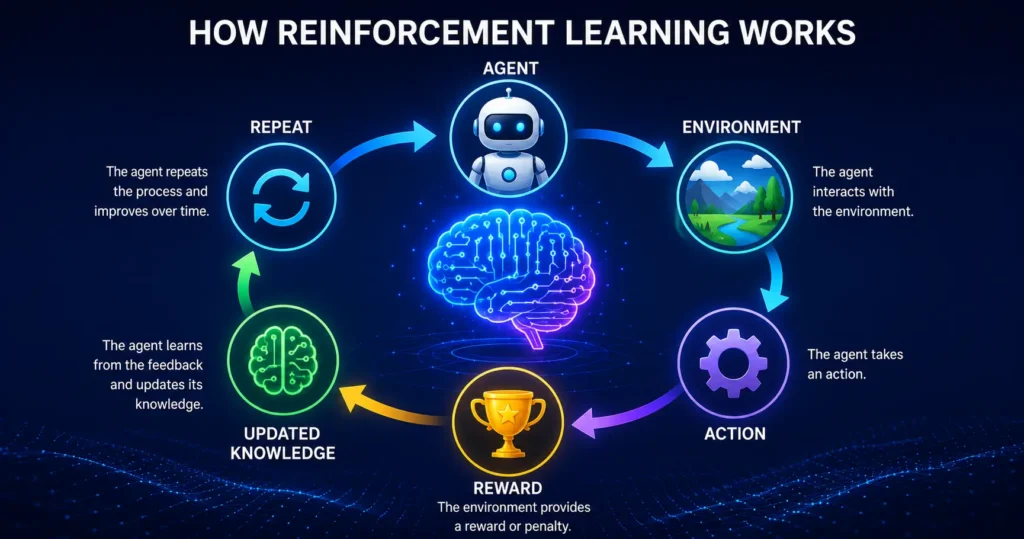
Every Reinforcement Learning system follows a simple learning cycle.
The AI observes the current situation.
↓
It decides what action to take.
↓
The environment responds.
↓
The AI receives a reward or penalty.
↓
It updates its knowledge.
↓
The process repeats.
Each interaction helps the AI make slightly better decisions in the future.
Thousands or even millions of these interactions gradually produce an intelligent system.
Key Components of Reinforcement Learning
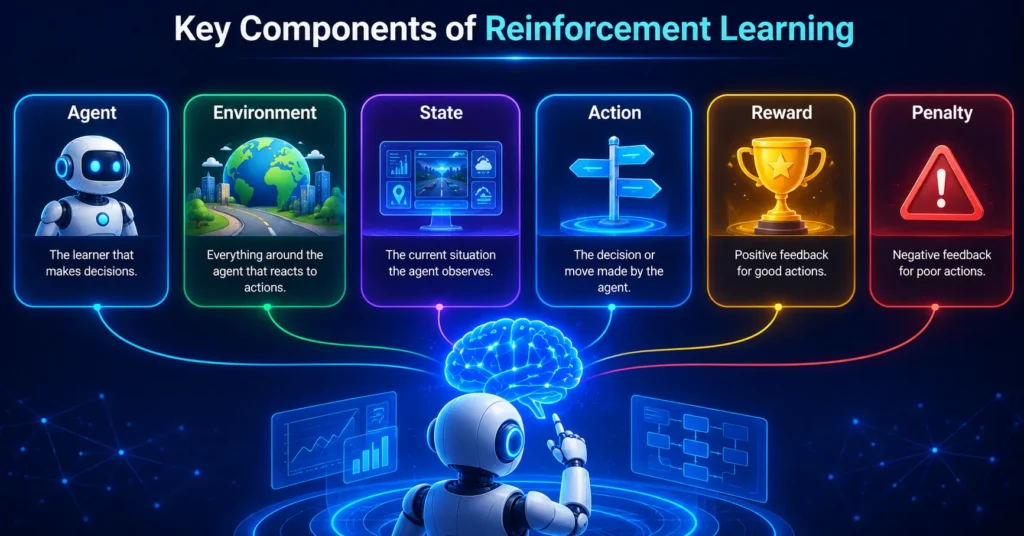
Understanding these building blocks makes Reinforcement Learning much easier to understand.
1. Agent
The Agent is the learner.
It is the AI system that makes decisions.
Examples include:
- A robot
- A game-playing AI
- A self-driving car
- An AI assistant
The agent’s goal is to maximize rewards.
2. Environment
The Environment is everything around the agent.
It provides information about the current situation and reacts to every action the agent takes.
Examples include:
| Agent | Environment |
|---|---|
| Robot | Factory floor |
| Chess AI | Chess board |
| Self-driving car | Roads and traffic |
| Delivery drone | Airspace |
| AI assistant | User conversation |
3. State
A State describes the current situation.
Examples:
For a chess AI:
Current board position.
For a self-driving car:
- Vehicle speed
- Traffic lights
- Nearby vehicles
- Road conditions
The better the AI understands the current state, the better decisions it can make.
4. Action
An Action is the decision made by the agent.
Examples:
Chess AI:
Move the queen.
Robot:
Pick up a package.
Self-driving car:
Turn left.
Recommendation engine:
Suggest a movie.
Every action changes the environment.
5. Reward
A Reward tells the AI whether it made a good decision.
Positive reward:
+10 points
Negative reward:
-5 points
No reward:
0
The AI always tries to maximize its total rewards over time.
6. Penalty
A penalty is simply a negative reward.
Examples:
- Robot drops a package.
- Car hits an obstacle.
- Chess AI loses a piece.
Penalties encourage the AI to avoid repeating bad actions.
Reinforcement Learning Workflow
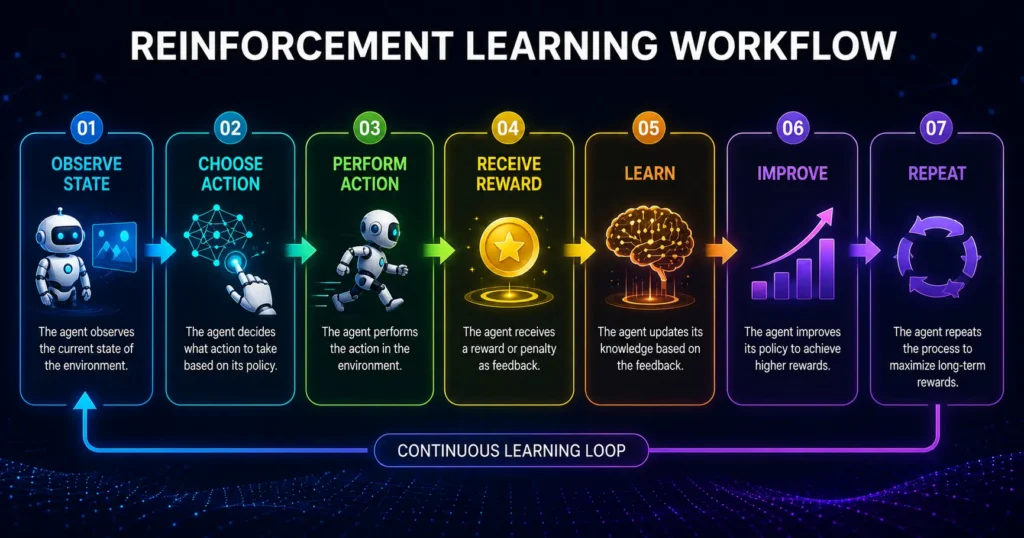
A simplified workflow looks like this:
Current Environment
        ↓
Observe State
        ↓
Choose Action
        ↓
Perform Action
        ↓
Receive Reward or Penalty
        ↓
Learn From Feedback
        ↓
Improve Decision
        ↓
Repeat
This cycle may happen millions of times before the AI becomes highly accurate.
Everyday Examples of Reinforcement Learning
Learning to Ride a Bicycle
When children learn cycling:
- They try.
- They fall.
- They adjust.
- They improve.
No one explains every movement mathematically.
Experience becomes the teacher.
Training a Dog
Dogs receive treats when they perform the correct action.
Correct behavior:
Reward.
Incorrect behavior:
No reward.
After enough repetitions, the dog naturally learns the desired behavior.
Playing Video Games
Imagine learning a racing game.
Initially:
You crash into walls.
Later:
You learn where to brake.
Eventually:
You know the fastest racing line.
Reinforcement Learning follows exactly the same idea.
Types of Reinforcement Learning
There are two basic ways an AI learns using rewards.
Positive Reinforcement
The AI receives a reward after making a good decision.
Example:
A warehouse robot successfully places a package on the correct shelf.
Reward:
+10 points.
The robot becomes more likely to repeat that action.
Advantages
- Faster learning
- Better long-term performance
- Encourages useful behavior
Negative Reinforcement
Negative reinforcement encourages the AI to avoid undesirable outcomes.
For example:
A delivery robot takes a dangerous route and loses points.
Next time, it chooses a safer path.
Over time, it learns which actions reduce penalties.
Why Businesses Are Investing in Reinforcement Learning
Companies are increasingly adopting Reinforcement Learning because it can improve decisions without constant human intervention.
Some common business applications include:
- Warehouse automation
- Dynamic pricing
- Personalized recommendations
- Robotics
- Autonomous vehicles
- Supply chain optimization
- Energy management
- AI agents
- Financial portfolio optimization
As AI systems become more autonomous, Reinforcement Learning is becoming a key technology for building smarter, adaptive solutions.
Key Takeaways
- Reinforcement Learning teaches AI through experience, not labeled answers.
- AI improves by receiving rewards for good decisions and penalties for poor ones.
- The core components are Agent, Environment, State, Action, Reward, and Penalty.
- It is widely used in robotics, gaming, recommendation systems, finance, and autonomous vehicles.
- Modern AI systems increasingly rely on Reinforcement Learning to make intelligent decisions in dynamic environments.
Popular Reinforcement Learning Algorithms
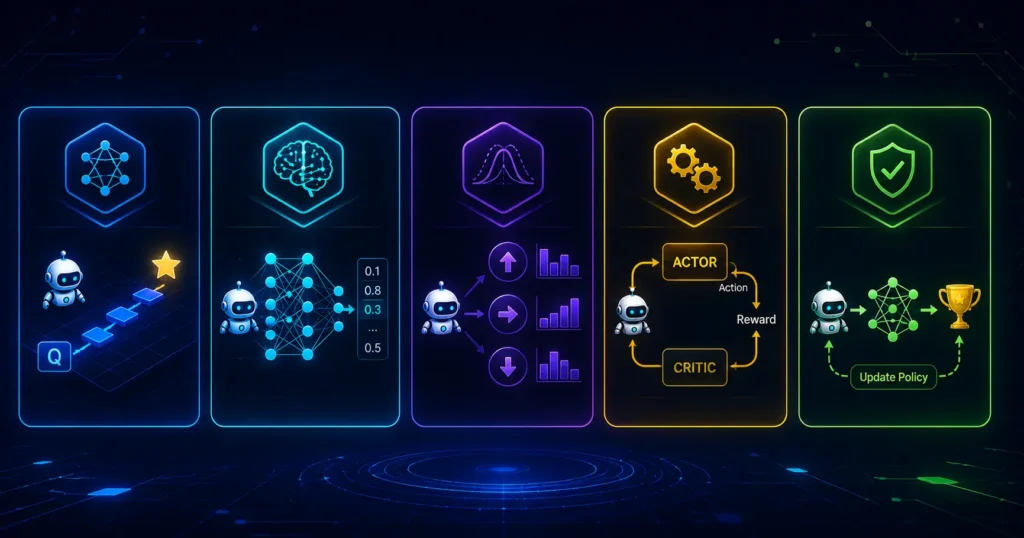
Once you understand the basics of Reinforcement Learning, the next question is: How does an AI actually learn?
The answer lies in Reinforcement Learning algorithms. These algorithms define the strategy an AI uses to choose actions, learn from rewards, and improve its decisions over time.
Some algorithms are simple and suitable for beginners, while others are designed for complex tasks like robotics, autonomous vehicles, and AI agents.
1. Q-Learning
Q-Learning is one of the most popular Reinforcement Learning algorithms. It helps an AI learn the best action to take in every situation without knowing how the environment works in advance.
Instead of memorizing every possible outcome, Q-Learning estimates how valuable each action is in a given state. This value is called the Q-value.
For example, imagine a robot navigating a maze.
At every intersection, it has several choices:
- Move left
- Move right
- Move forward
- Move backward
Initially, the robot has no idea which path leads to the exit. It explores different routes and receives rewards or penalties based on the outcome. Over time, it builds a table of Q-values and learns which action gives the highest long-term reward.
Best Used For
- Simple games
- Grid navigation
- Small robotics projects
- Educational AI projects
Advantages
- Easy to understand
- Works without labeled data
- Learns through experience
Limitations
- Does not scale well to very large environments
- Requires many training episodes
- Becomes inefficient with millions of possible states
2. Deep Q Network (DQN)
As problems become more complex, storing every state in a table is no longer practical.
Imagine teaching an AI to play a modern video game.
There may be millions of possible screen images.
A Q-table would become enormous.
This is where Deep Q Networks (DQN) come in.
Instead of storing values in a table, DQN uses a deep neural network to estimate the best action.
This allows AI to solve much larger and more realistic problems.
Real-World Uses
- Atari games
- Robotics
- Autonomous navigation
- Industrial automation
Advantages
- Handles complex environments
- Learns from images
- Scales better than traditional Q-Learning
Limitations
- Needs large amounts of training data
- Requires powerful GPUs
- Training can take hours or even days
3. Policy Gradient
Unlike Q-Learning, Policy Gradient algorithms learn the policy directly instead of estimating action values.
A policy is simply the strategy the AI follows when making decisions.
Instead of asking:
“Which action has the highest score?”
Policy Gradient asks:
“What is the probability that I should choose each action?”
This makes it useful when actions are continuous rather than limited to a few choices.
Example
A robotic arm can move in thousands of different directions.
Policy Gradient helps it learn smooth and precise movements.
Common Applications
- Robot control
- Drone navigation
- Continuous movement systems
4. Actor-Critic
Actor-Critic combines the strengths of two different learning methods.
It consists of two separate components.
Actor
The Actor decides what action to take.
Critic
The Critic evaluates whether that action was good or bad.
Think of it like a student and a teacher.
The student answers questions.
The teacher checks the answers and provides feedback.
With continuous feedback, the student improves over time.
Advantages
- Faster learning
- More stable training
- Better performance in complex environments
5. Proximal Policy Optimization (PPO)
Today, PPO is one of the most widely used Reinforcement Learning algorithms.
Many modern AI systems use PPO because it is easier to train and more stable than older approaches.
Instead of making large changes to the policy after every reward, PPO updates it gradually.
This prevents unstable learning and improves overall performance.
Used In
- AI agents
- Robotics
- Simulations
- Autonomous systems
- Research projects
Comparison of Popular Reinforcement Learning Algorithms
| Algorithm | Best For | Difficulty | Handles Large Problems |
|---|---|---|---|
| Q-Learning | Small environments | Easy | ❌ No |
| DQN | Games and images | Medium | ✅ Yes |
| Policy Gradient | Continuous actions | Medium | ✅ Yes |
| Actor-Critic | Robotics | Advanced | ✅ Yes |
| PPO | Modern AI agents | Advanced | ✅ Excellent |
What Is Deep Reinforcement Learning?
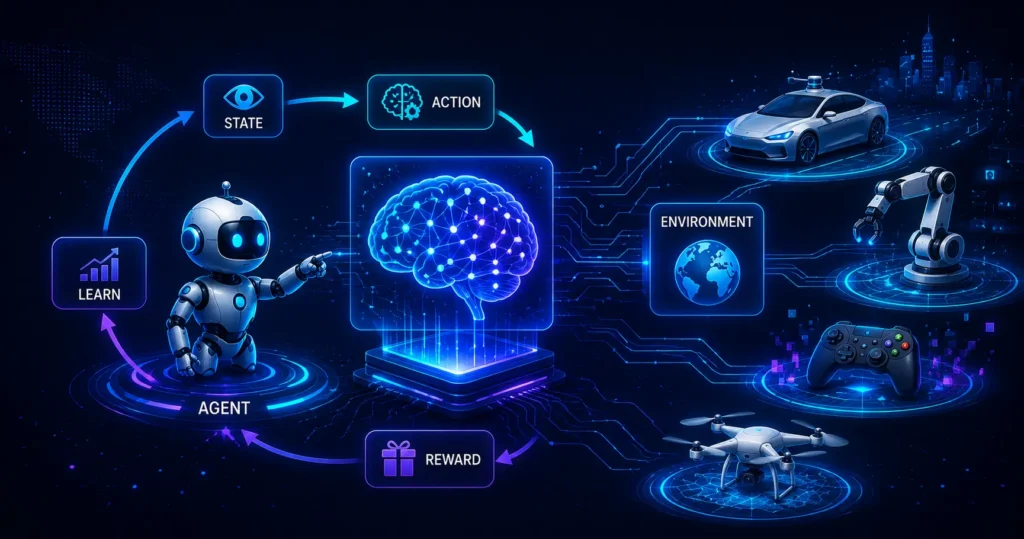
Deep Reinforcement Learning (Deep RL) combines Reinforcement Learning with Deep Learning.
Traditional Reinforcement Learning struggles when there are too many possible states.
Deep Learning solves this problem by allowing neural networks to recognize patterns automatically.
Instead of storing every possible situation, the AI learns important features from images, videos, sensor data, or other complex inputs.
Example
Imagine teaching an AI to drive a car.
It must understand:
- Traffic lights
- Road signs
- Pedestrians
- Other vehicles
- Weather conditions
- Road markings
A traditional Q-table cannot handle this amount of information.
A deep neural network can.
That is why self-driving cars rely heavily on Deep Reinforcement Learning.
Exploration vs Exploitation
One of the biggest challenges in Reinforcement Learning is deciding whether the AI should:
- Try something new
- Stick with what already works
This is known as the Exploration vs Exploitation problem.
Exploration
The AI experiments with new actions.
It may discover a better strategy.
Example:
A robot tries a different path in a warehouse.
The new route turns out to be shorter.
Exploitation
The AI chooses the action that has produced the highest rewards in the past.
Example:
A navigation system always selects the fastest known route.
Finding the Right Balance
If the AI only explores, it wastes time trying poor choices.
If it only exploits, it may never discover a better solution.
Successful Reinforcement Learning systems maintain a balance between both.
What Is a Reward Function?
The Reward Function is one of the most important parts of Reinforcement Learning.
It tells the AI what success looks like.
A poorly designed reward can teach the AI the wrong behavior.
Example
Suppose you reward a cleaning robot only for moving quickly.
The robot may rush through the room without actually cleaning it.
A better reward system would include:
- Clean floor
- Low energy usage
- Avoid obstacles
- Finish within a reasonable time
Good reward design leads to better AI behavior.
Markov Decision Process (MDP)
Most Reinforcement Learning algorithms are based on a mathematical framework called the Markov Decision Process (MDP).
An MDP defines how an AI interacts with its environment.
It includes five key elements:
| Component | Description |
|---|---|
| State | Current situation |
| Action | Decision taken by the agent |
| Reward | Feedback after an action |
| Transition | How the environment changes |
| Policy | Strategy for choosing actions |
Although MDP is a mathematical concept, you don’t need to understand complex equations to appreciate its role. Think of it as the blueprint that guides the AI’s learning process.
What Is RLHF?
Reinforcement Learning from Human Feedback (RLHF) is an advanced training technique that combines Reinforcement Learning with feedback from people.
Instead of learning only from automated rewards, the AI also learns from human preferences.
How RLHF Works
- A language model generates multiple responses.
- Human reviewers rank those responses.
- The rankings train a reward model.
- Reinforcement Learning adjusts the AI to produce more helpful, accurate, and safer answers.
This approach helps modern AI assistants provide responses that better align with human expectations.
Reinforcement Learning vs Other Machine Learning Methods
| Feature | Supervised Learning | Unsupervised Learning | Reinforcement Learning |
|---|---|---|---|
| Uses labeled data | ✅ Yes | ❌ No | ❌ No |
| Learns from rewards | ❌ No | ❌ No | ✅ Yes |
| Learns by trial and error | ❌ No | ❌ No | ✅ Yes |
| Main goal | Predict correct answers | Find hidden patterns | Maximize long-term rewards |
| Examples | Spam detection, image classification | Customer segmentation | Robotics, AI agents, game-playing AI |
Key Takeaways
- Algorithms determine how an AI learns from experience.
- Q-Learning is ideal for beginners and simple environments.
- Deep Q Networks use neural networks to solve more complex problems.
- PPO and Actor-Critic are widely used in modern AI systems.
- Deep Reinforcement Learning enables AI to learn from images, videos, and sensor data.
- RLHF has become a key technique for improving modern language models by incorporating human feedback.
Real-World Applications of Reinforcement Learning
Reinforcement Learning is no longer limited to research labs. It is being used by companies across industries to build systems that learn, adapt, and make better decisions over time.
Let’s look at some of its most common applications.
1. Self-Driving Cars
Autonomous vehicles must make thousands of decisions every second.
For example, they need to:
- Stay in the correct lane
- Avoid pedestrians
- Obey traffic signals
- Adjust speed
- React to unexpected obstacles
Instead of relying only on fixed rules, Reinforcement Learning allows these vehicles to improve their driving strategies through continuous training in simulated environments.
Example: Companies like Waymo and Tesla use reinforcement learning techniques alongside computer vision and deep learning to improve autonomous driving systems.
2. Robotics
Modern robots are expected to work in changing environments.
A warehouse robot may need to:
- Pick products
- Avoid obstacles
- Choose the shortest route
- Save battery power
Rather than programming every possible movement, engineers train robots to learn the best actions through rewards.
This makes robots more flexible and efficient.
3. Video Games
Gaming has been one of the biggest success stories for Reinforcement Learning.
AI agents have learned to master games that were once considered impossible for machines.
Examples include:
- Chess
- Go
- Dota 2
- StarCraft II
- Atari games
By playing millions of matches, these AI systems discovered strategies that even professional players had never considered.
4. Recommendation Systems
Every time Netflix suggests a movie or Spotify recommends a playlist, the system is trying to predict what you will enjoy next.
Reinforcement Learning helps improve these recommendations by learning from user behavior.
For example:
- Which movie did you watch?
- Which song did you skip?
- How long did you stay on a page?
Each interaction becomes feedback that improves future recommendations.
5. Finance
Banks and financial institutions use Reinforcement Learning for tasks such as:
- Portfolio optimization
- Algorithmic trading
- Fraud detection
- Risk management
Instead of following fixed investment rules, AI learns strategies that aim to maximize long-term returns while managing risk.
6. Healthcare
Healthcare generates enormous amounts of data every day.
Researchers are exploring Reinforcement Learning to help with:
- Personalized treatment plans
- Drug discovery
- Medical resource allocation
- Hospital scheduling
Although human doctors always make the final decisions, AI can provide valuable recommendations based on previous outcomes.
7. Supply Chain and Logistics
Large logistics companies need to optimize:
- Delivery routes
- Warehouse operations
- Inventory management
- Fuel consumption
Reinforcement Learning helps identify strategies that reduce costs while improving delivery speed and operational efficiency.
Reinforcement Learning in Generative AI
One of the fastest-growing applications of Reinforcement Learning is Generative AI.
Large language models do not become helpful simply by reading text. They also need guidance on how humans prefer responses to be written.
This is where Reinforcement Learning from Human Feedback (RLHF) plays a key role.
Human reviewers evaluate different AI responses.
The AI then learns which responses are:
- More accurate
- More helpful
- Safer
- Better aligned with user expectations
This process has significantly improved the quality of modern conversational AI.
Advantages of Reinforcement Learning
Reinforcement Learning offers several benefits that make it suitable for solving complex decision-making problems.
| Advantage | Why It Matters |
|---|---|
| Learns through experience | Reduces the need for manually programmed rules |
| Improves over time | Performance increases with more training |
| Handles dynamic environments | Adapts to changing situations |
| Optimizes long-term decisions | Focuses on future rewards rather than immediate results |
| Supports automation | Enables intelligent robots and AI agents |
| Discovers new strategies | Can find solutions humans may overlook |
Challenges and Limitations
Despite its strengths, Reinforcement Learning is not the right solution for every problem.
1. Requires Large Amounts of Training
Many AI agents need millions of interactions before they become reliable.
Training can take days or even weeks.
2. High Computing Costs
Training advanced Reinforcement Learning models often requires powerful GPUs or cloud computing resources.
This increases development costs.
3. Reward Design Is Difficult
The AI only learns what you reward.
If the reward function is poorly designed, the AI may learn unexpected or undesirable behavior.
4. Safety Concerns
In real-world applications such as healthcare or autonomous driving, allowing an AI to learn through trial and error can be risky.
For this reason, developers often train AI in simulated environments before deploying it in the real world.
5. Sample Inefficiency
Many Reinforcement Learning algorithms require enormous amounts of data before achieving good performance.
Researchers continue to develop more efficient learning methods.
Common Mistakes Beginners Make
If you’re new to Reinforcement Learning, avoid these common mistakes.
Expecting Instant Results
Learning takes time. Most AI agents require many training episodes before showing meaningful improvements.
Ignoring the Reward Function
A poor reward function often produces poor AI behavior.
Always define success carefully.
Choosing the Wrong Algorithm
Not every problem requires Deep Reinforcement Learning.
Simple tasks can often be solved with Q-Learning, while complex environments may benefit from PPO or Actor-Critic methods.
Forgetting Exploration
If the AI only repeats familiar actions, it may never discover better solutions.
A balance between exploration and exploitation is essential.
Future of Reinforcement Learning
Reinforcement Learning is expected to play an even bigger role as AI systems become more autonomous.
Some of the most exciting areas include:
- AI agents capable of completing complex tasks independently
- Humanoid robots working alongside humans
- Autonomous delivery drones
- Personalized healthcare systems
- Smart factories powered by adaptive robots
- Intelligent traffic management
- Energy-efficient smart cities
As computing power increases and algorithms improve, Reinforcement Learning will become more practical for businesses of all sizes.
Pro Tips
- Start with simple environments before moving to complex simulations.
- Understand the problem before choosing an algorithm.
- Design the reward function carefully, as it has a major impact on learning.
- Use simulation environments for safe training whenever possible.
- Evaluate long-term performance instead of focusing only on short-term rewards.
Key Takeaways
- Reinforcement Learning enables AI to learn through rewards and penalties rather than labeled data.
- Algorithms such as Q-Learning, DQN, PPO, and Actor-Critic power many modern AI systems.
- RL is widely used in robotics, gaming, finance, healthcare, recommendation systems, and autonomous vehicles.
- RLHF has become an important technique for improving generative AI.
- While powerful, Reinforcement Learning requires careful reward design, significant training, and substantial computing resources.
Frequently Asked Questions (FAQs)
What is Reinforcement Learning in simple words?
Reinforcement Learning is a type of machine learning where an AI learns by trying different actions and receiving rewards for good decisions and penalties for poor ones. Over time, it improves through experience.
What is the difference between Reinforcement Learning and Supervised Learning?
Supervised Learning uses labeled data with correct answers. Reinforcement Learning does not use labeled answers. Instead, it learns by interacting with an environment and maximizing rewards.
Where is Reinforcement Learning used?
It is commonly used in robotics, self-driving cars, gaming, recommendation systems, finance, healthcare, supply chain optimization, and AI agents.
Is Reinforcement Learning used in ChatGPT?
Modern language models are improved using Reinforcement Learning from Human Feedback (RLHF). Human reviewers evaluate AI responses, helping the model generate more helpful and accurate answers.
Which Reinforcement Learning algorithm is best for beginners?
Q-Learning is one of the easiest algorithms to understand because it introduces the core concepts of rewards, states, actions, and decision-making without requiring deep neural networks.
What programming language is commonly used for Reinforcement Learning?
Python is the most widely used language because it has strong AI libraries such as PyTorch, TensorFlow, Gymnasium, Stable-Baselines3, and Ray RLlib.
Conclusion
Reinforcement Learning has transformed the way AI systems learn and make decisions. Instead of relying on predefined rules or labeled datasets, it allows machines to improve through experience by interacting with their environment and learning from rewards and penalties.
From autonomous vehicles and warehouse robots to recommendation systems and generative AI, Reinforcement Learning is enabling smarter, more adaptive technologies across industries.
If you’re beginning your AI journey, understanding Reinforcement Learning provides a strong foundation for exploring advanced topics such as Deep Reinforcement Learning, AI agents, robotics, and large language models. As these technologies continue to evolve, Reinforcement Learning will remain one of the key building blocks of intelligent systems.

Sandeep Kumar is the Founder & CEO of Aitude, a leading AI tools, research, and tutorial platform dedicated to empowering learners, researchers, and innovators. Under his leadership, Aitude has become a go-to resource for those seeking the latest in artificial intelligence, machine learning, computer vision, and development strategies.