
Black Box AI refers to any AI system where you can see what goes in and what comes out, but not what happens in between. You feed the model data. It returns a decision, a prediction, or a piece of generated text. What you don’t get is a clear account of which factors it weighed or how it weighed them.
- How Black Box AI Works
- Black Box AI vs. White Box AI
- The Future of Black Box AI
- FAQ
- What is black box AI in simple terms?
- What are examples of black box AI?
- Is black box AI dangerous?
- What’s the difference between black box AI and white box AI?
- Can black box AI be made explainable?
- Why do companies still use black box AI if it’s risky?
- Is ChatGPT a black box AI?
- How does black box AI affect regulatory compliance?
This isn’t a design flaw the way a buggy interface is. It’s a structural side effect of how modern AI gets built. Most large language models, image recognition systems, and deep learning classifiers fall into this category, including well-known tools like ChatGPT and Llama. Even the teams that built them can’t fully trace why a specific input produced a specific output.
If you run engineering, product, or compliance at a company deploying AI, this matters more than it sounds. A black box model that scores loan applications, screens resumes, or flags fraud can be accurate and still be impossible to defend in an audit, a lawsuit, or a board meeting.
Why Do Black Box AI Systems Exist?
Black box AI shows up for two very different reasons, and the distinction matters when you’re deciding how to respond to it.
Intentional opacity. Some vendors deliberately hide a model’s logic to protect intellectual property. The company knows exactly how the system works internally, but keeps the architecture and rules proprietary. Plenty of legacy rule-based algorithms fall into this bucket.
Organic opacity. Most modern generative AI is a black box by accident, not by design. Deep learning models route data through neural networks with hundreds or thousands of layers. Each layer contains neurons that transform the data slightly before passing it forward. Nobody, including the people who trained the model, can point to layer 47 and say exactly what it’s doing with a given input.
You can see the input layer and the output layer clearly. Everything in between is what researchers call the “hidden layers,” and that name is accurate in more ways than one.
Common Mistake
Founders sometimes assume that open-source models solve the black box problem because the code is visible. It doesn’t. You can read every line of an open-weight model’s architecture and still have no idea what a specific combination of activated neurons means. Open source gives you transparency into the build. It doesn’t give you transparency into the reasoning.
How Black Box AI Works
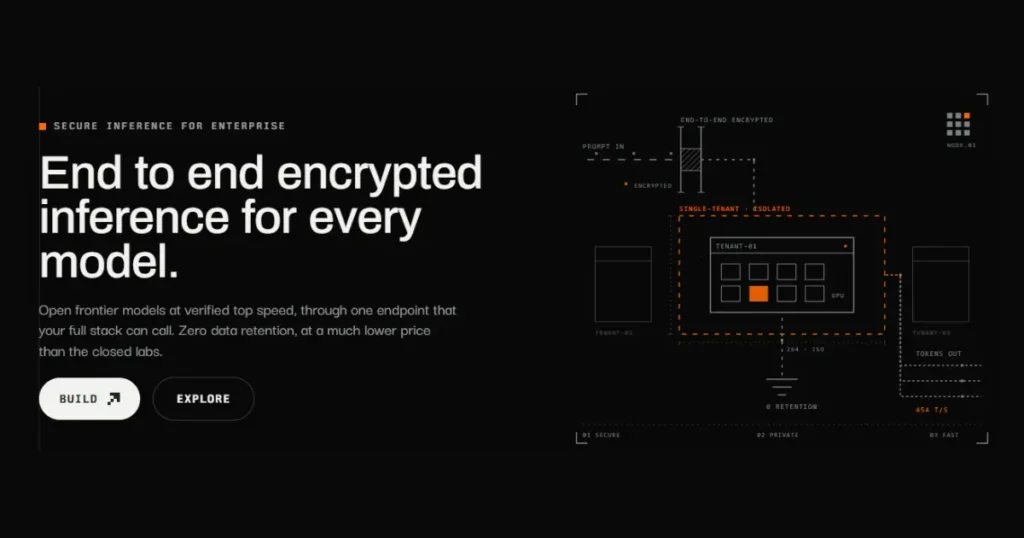
Deep neural networks learn by adjusting millions or billions of internal parameters during training, based on patterns in massive datasets. Nobody hand-codes the rules. The model discovers them on its own by minimizing prediction error across huge volumes of examples.
That process is what makes these models so capable at tasks like language generation, image recognition, and complex forecasting. It’s also exactly what makes them opaque. A traditional rule-based system might say “flag this transaction if amount > $10,000 and location differs from billing address.” A deep learning fraud model doesn’t work in rules you can read. It works in weighted correlations distributed across thousands of parameters, and no single one of them “means” anything on its own.
Researchers can inspect the visible layers (input and output) with confidence. The hidden layers are where interpretation breaks down, even for the model’s creators.
Examples of Black Box AI
Black box AI isn’t a niche category. It’s already running decisions that affect real people, often without them knowing it.
| Use Case | What the Model Does | Why It’s a Black Box |
|---|---|---|
| Large language models (ChatGPT, Claude, Gemini) | Generate text, code, and answers from prompts | Billions of parameters interact in ways too complex to trace to a single output |
| Resume screening tools | Score and rank job candidates | HR teams see the score, not which resume features drove it |
| Credit scoring and loan underwriting | Approve or deny applications | Applicants can’t see which factors triggered a denial |
| Medical imaging diagnosis | Flag tumors, fractures, or disease markers in scans | Radiologists get a probability score without the reasoning path |
| Autonomous vehicle perception systems | Decide when to brake, swerve, or accelerate | Split-second decisions come from neural networks too complex to audit in real time |
| Recommendation engines | Decide what content or products to show you | The ranking logic shifts constantly and isn’t disclosed to users |
Key Takeaway
If a model in your stack falls into any of these categories and touches hiring, lending, healthcare, or safety decisions, you’re already carrying regulatory and reputational risk whether or not you’ve labeled it that way internally.
Black Box AI vs. White Box AI
White box AI, also called explainable AI (XAI) or glass box AI, is the direct opposite. Its internal logic is visible and traceable. You can follow the path from input to output and explain, in plain language, why the system reached a specific conclusion.
| Factor | Black Box AI | White Box AI |
|---|---|---|
| Transparency | Internal logic hidden or too complex to trace | Decision path is visible and explainable |
| Typical models | Deep neural networks, large language models | Decision trees, linear regression, rule-based systems |
| Performance on complex tasks | Generally stronger on unstructured data (text, images, video) | Generally weaker on unstructured, high-dimensional data |
| Auditability | Difficult to audit or defend in regulatory review | Straightforward to audit and document |
| Ability to fix errors | Hard to isolate which parameter caused a bad output | Easier to trace and correct the responsible rule or variable |
| Best fit | Tasks needing raw predictive power over interpretability | Regulated decisions needing a documented rationale |
You can’t just swap one for the other. Traditional, explainable models are usually less capable on messy, unstructured data like natural language or images. That’s the real tension. Teams don’t choose between black box and white box AI in the abstract. They choose which trade-off they can defend to a regulator, a customer, or a courtroom.
How Black Box AI Works: Pro Tip
Don’t try to make your entire AI stack explainable by default. It’s usually not worth the performance you’d give up. Instead, map which specific decisions in your product actually need to be defensible (credit, hiring, healthcare, safety) and reserve interpretable models or added explainability tooling for those specific decision points. Keep the black box models where raw performance matters more than a documented rationale.
Benefits of Black Box AI
Despite the opacity, black box models earn their place in production systems for real reasons.
- Higher accuracy on complex tasks. Deep learning consistently outperforms simpler, explainable models on unstructured data such as text, images, and audio.
- Ability to find patterns humans can’t. These models can surface correlations across millions of data points that no analyst would spot manually.
- Faster iteration at scale. Because the model learns patterns automatically instead of relying on hand-coded rules, it adapts to new data without a rules engineer rewriting logic every time behavior changes.
- Better handling of ambiguity. Natural language, images, and video are inherently ambiguous. Black box models tolerate that ambiguity far better than rigid rule-based systems.
For most product and engineering leaders, the benefit isn’t philosophical. It’s that black box models simply perform better on the exact tasks (language, vision, ranking) that are driving current AI adoption. The trade-off is what you give up in return.
Challenges of Black Box AI
The same opacity that makes these models powerful also creates specific, measurable business risk.
Reduced trust in outputs. Without visibility into how a model reached its answer, teams can’t fully validate whether it got the right answer for the right reason. This is sometimes called the “Clever Hans effect,” named after a horse that appeared to do arithmetic but was actually reading subtle cues from its owner. AI models trained to detect COVID-19 from lung X-rays hit high accuracy in testing, then failed in the real world because some models were keying off annotation marks on the scans rather than the medical signal itself.
Difficulty correcting bad behavior. When a black box model produces harmful or inaccurate output, pinpointing which internal parameter caused it is genuinely hard. Autonomous vehicle teams often work around this by pairing the AI with separate, explainable sensor systems like radar and lidar, not because it fixes the model, but because it gives engineers an independent way to understand the conditions that lead to bad decisions.
Security exposure. If your team can’t see inside a model, you can miss vulnerabilities sitting inside it. Generative AI systems are also vulnerable to prompt injection and data poisoning, attacks that quietly alter model behavior without triggering any visible signal.
Bias that’s hard to isolate. Any model reproduces the biases present in its training data. In a black box system, tracing why a resume-screening model started filtering out qualified female candidates, or why a criminal justice risk model weighted certain zip codes heavily, is far harder than it is in a transparent, rule-based system.
Regulatory exposure. Frameworks like the EU AI Act and state-level privacy laws in the US increasingly require organizations to explain automated decisions that affect people. A black box model makes that requirement expensive to satisfy, and in some cases nearly impossible without added tooling.
Pro Tip
If you’re deploying AI in a regulated workflow (lending, hiring, healthcare, insurance), don’t wait for an audit to discover you can’t explain a decision. Build an explainability layer, even a lightweight one, before the model goes live. Retrofitting explainability after a regulator or plaintiff’s attorney asks for it is a much more expensive project than designing for it up front.
How Organizations Are Managing the Black Box Problem
You can’t eliminate the black box problem outright, not with current deep learning architectures. But there are practical ways to reduce the risk it creates.
Favor open-source models where it’s viable. Open-weight models still function as black boxes internally, but they give your team more visibility into training data, architecture, and update history than a fully closed, proprietary system.
Invest in AI governance. Governance processes such as monitoring, performance alerting, health scoring, and audit trails don’t make a model transparent, but they catch anomalies and misuse before they become incidents.
Add AI security tooling. Dedicated AI security tools can surface vulnerabilities in models, data pipelines, and applications that your existing security stack likely isn’t built to catch.
Adopt post-hoc explainability techniques. Methods like LIME (Local Interpretable Model-Agnostic Explanations) analyze the relationship between a model’s inputs and outputs using a separate, simpler model. This works well for structured predictions and classifications. It’s far less effective for open-ended generative systems.
Build on a responsible AI framework. A documented set of principles around explainability, fairness, and transparency gives your organization a consistent way to justify black box usage where it’s genuinely necessary, and a clear line for when it isn’t.
Decision Framework: Should You Use a Black Box Model Here?
Use this quick framework before you greenlight a black box model for a new use case:
- Does the decision materially affect a person’s access to money, housing, healthcare, or employment? If yes, lean toward an explainable model or add a documented explainability layer.
- Is the task fundamentally about unstructured data (language, images, video) where explainable models historically underperform? If yes, a black box model may be the only viable option, but pair it with governance.
- Do you have a regulatory or contractual obligation to explain individual decisions? If yes, treat explainability as a launch requirement, not a post-launch fix.
- Can a wrong decision cause physical harm (autonomous systems, medical diagnosis)? If yes, require an independent verification layer regardless of model type.
The Future of Black Box AI
The black box problem isn’t going away, but the tooling around it is maturing quickly. Interpretability research has moved from a niche academic pursuit to a funded priority at major AI labs. Anthropic’s work on tracing which neuron combinations in Claude 3 Sonnet correspond to specific concepts (like recognizing the Golden Gate Bridge or the field of neuroscience) is one sign of that shift. OpenAI’s reasoning models now surface intermediate steps in how they approach an answer, though that’s a model-generated explanation of its own process, not a direct window into the underlying computation.
At the same time, regulation is pushing in the same direction from the outside. As AI systems get embedded deeper into hiring, lending, and healthcare workflows, expect explainability requirements to shift from best practice to baseline compliance in more jurisdictions, not less.
For founders and technical leaders, the practical takeaway is this: full transparency into deep learning models probably isn’t coming soon, and might not be structurally possible for the most capable architectures. What is coming is better tooling to manage the risk that opacity creates, from governance platforms to interpretability research to sector-specific regulation. Betting your compliance strategy on “the model will become explainable eventually” isn’t a plan. Building governance and documentation around the black box you already have is.
Black Box Workflow
Black Box Risk Assessment Workflow for New AI Deployments
New AI use case proposed
↓
Does it affect a protected decision? (hiring, credit, healthcare, safety)
↓
YES → Require explainability layer or white box model before launch
↓
NO → Proceed with black box model
↓
Add governance: monitoring, audit trail, health scoring
↓
Add AI security review: check for prompt injection / data poisoning exposure
↓
Document model limitations for stakeholders
↓
Launch with monitoring in place
↓
Quarterly review: bias check, drift check, regulatory check
Pro Tips
- Reserve interpretable or white box models for decisions you’d need to defend in an audit, not your entire AI stack.
- Build explainability into regulated workflows before launch. Retrofitting it after a complaint or audit costs far more.
- Open-source doesn’t mean explainable. Don’t let “open weights” get conflated with “we understand how this works.”
- Pair high-stakes black box systems (autonomous vehicles, medical diagnostics) with independent, non-AI verification layers.
Common Mistakes
- Assuming open-source models solve the black box problem because the code is visible.
- Treating explainability as a legal problem instead of a design decision made before launch.
- Using LIME or similar post-hoc tools on open-ended generative systems where they weren’t built to help.
- Deploying a black box model into a regulated decision without checking a specific compliance framework first (EU AI Act, CCPA, sector-specific rules).
Key Takeaways
- Black box AI isn’t a defect. It’s a structural trade-off between raw performance and explainability that comes with deep learning.
- The risk isn’t the opacity itself. It’s deploying opaque models into decisions (credit, hiring, healthcare, safety) that legally or ethically require a documented rationale.
- You manage the black box problem through governance, security tooling, and selective use of explainable models, not by waiting for full transparency to arrive.
FAQ
What is black box AI in simple terms?
Black box AI is any AI system where you can see the data going in and the result coming out, but not the reasoning in between. It behaves like a sealed box: you know what you put in and what you got back, but not why the system produced that specific answer.
What are examples of black box AI?
Large language models like ChatGPT and Gemini, resume screening tools, credit scoring algorithms, medical imaging diagnosis systems, autonomous vehicle perception systems, and most modern recommendation engines all function as black boxes. If a system uses deep neural networks, it’s almost certainly opaque to some degree, including to its own developers.
Is black box AI dangerous?
Not inherently. The danger comes from where you deploy it. A black box model recommending playlists carries low risk. A black box model denying loan applications or flagging medical conditions carries real risk, because you can’t easily verify the model reached the right conclusion for the right reason, and you may not be able to explain the decision if challenged.
What’s the difference between black box AI and white box AI?
White box AI, also called explainable AI, has a visible and traceable decision path. You can follow exactly how it moved from input to output. Black box AI hides that path, usually because the underlying deep learning architecture is too complex to interpret, not because anyone is deliberately hiding it.
Can black box AI be made explainable?
Partially. Techniques like LIME can approximate an explanation for structured predictions by analyzing input-output relationships with a separate model. Interpretability research, including work from labs like Anthropic and OpenAI, is making progress on understanding what happens inside neural networks. But full transparency into the most capable deep learning models isn’t available today, and may not be achievable with current architectures.
Why do companies still use black box AI if it’s risky?
Because it performs better. Deep learning models consistently outperform simpler, explainable models on unstructured data like text, images, and video, which covers most of what companies are trying to do with AI right now. The alternative, sticking to fully explainable models, often means giving up meaningful accuracy.
Is ChatGPT a black box AI?
Yes. ChatGPT and similar large language models are trained through deep learning on massive datasets, and even their creators can’t fully trace why the model generates a specific response to a specific prompt. That makes them black box systems by definition, regardless of how well they perform.
How does black box AI affect regulatory compliance?
Regulations like the EU AI Act and various US state privacy laws increasingly require organizations to explain automated decisions that affect individuals. A black box model makes that documentation harder and more expensive to produce, and in high-risk categories under frameworks like the EU AI Act, it can restrict which use cases you’re allowed to deploy the model for at all.
Conclusion
Black box AI isn’t a problem you fix. It’s a trade-off you manage. The same deep learning architecture that makes a model powerful enough to write code, diagnose a scan, or score a resume is the reason nobody, including the people who built it, can fully explain how it got there.
Three things matter more than anything else here. First, opacity isn’t dangerous by itself; it becomes dangerous when it sits inside decisions that affect someone’s money, health, or opportunities. Second, you don’t solve the black box problem by choosing “more explainable” models across the board, because you’ll usually pay for that in accuracy on the exact tasks driving AI adoption. Third, the real work is governance: knowing where your black box models sit, documenting their limitations, and reserving explainability for the decisions that actually require it.
If you’re building or buying AI systems right now, the question isn’t whether you’re using black box AI. You almost certainly already are. The question is whether you know which of your decisions depend on one, and whether you could defend that decision if someone asked you to.

Sandeep Kumar is the Founder & CEO of Aitude, a leading AI tools, research, and tutorial platform dedicated to empowering learners, researchers, and innovators. Under his leadership, Aitude has become a go-to resource for those seeking the latest in artificial intelligence, machine learning, computer vision, and development strategies.