
Most of the attention around AI agents has landed on customer-facing work. Agents that book travel, qualify sales leads, or answer billing questions are easy to demonstrate and easy to understand, because the worst outcome of a mistake is usually an awkward conversation.
- What Separates an AI Agent From an Automation Script?
- What Does Agent Architecture Look Like in an Operations Context?
- Where Do AI Agents Add Value in IT Operations Today?
- Why Do AI Agents Fail in Production?
- FAQs
- 1. What are AI agents in IT operations?
- 2. How do AI agents differ from traditional automation?
- 3. What is the architecture of an AI agent in IT operations?
- 4. Where do AI agents provide the most value today?
- 5. What guardrails should AI agents have?
- 6. Why do AI agents fail in production?
- 7. How can organizations measure AI agent performance?
- 8. Should companies fully automate IT operations with AI agents?
- Conclusion
IT operations is a harder proving ground. An agent working inside an operations environment does not draft a suggestion and wait. It queries live telemetry, decides that a service is degraded, and then restarts a process, rolls back a configuration, or opens and assigns a ticket that pulls an engineer out of bed. The blast radius of a wrong decision is measured in downtime rather than embarrassment.
That difference is why agent deployments in operations succeed or fail on architecture and controls rather than on model quality. This article covers how these systems are actually put together, what constrains them, why they break in production, and how to tell whether the one you have deployed is earning its place.
What Separates an AI Agent From an Automation Script?
Operations teams have run automation for decades. Scripts, scheduled jobs, and workflow engines already restart services and open tickets without anyone touching a keyboard. The distinction is not automation itself.
A conventional automation is deterministic. Someone wrote the condition, someone wrote the action, and the system executes that pairing every time the condition matches. It cannot handle a situation its author did not anticipate.
An agent adds four capabilities on top of that. It perceives state by pulling from multiple sources rather than reacting to one trigger. It reasons about that state, usually through a language model, to form a hypothesis about what is happening. It selects and calls tools rather than following a fixed sequence. It retains context across steps, so the outcome of one action informs the next.
The practical result is a system that can handle situations nobody wrote a rule for. That flexibility is the entire value proposition, and it is also the source of every risk discussed later in this article.
Autonomy is best understood as a ladder rather than a switch. At the lowest rung an agent observes and summarises. Above that it recommends an action for a human to approve. Higher still it executes within a narrow scope and reports afterwards. At the top it acts freely within a defined domain. Most production deployments that work sit on the middle rungs, and they stay there deliberately.
What Does Agent Architecture Look Like in an Operations Context?
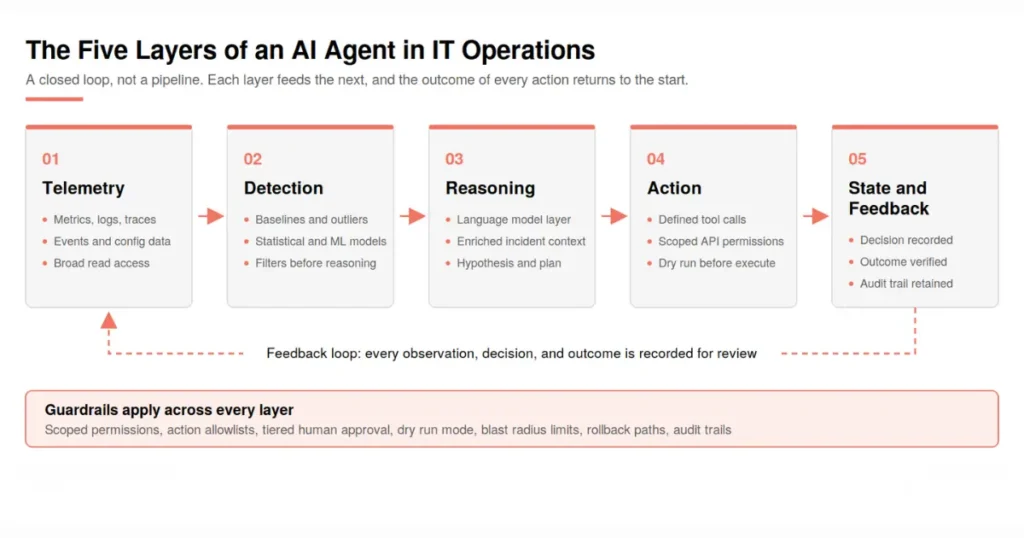
An operations agent is a loop rather than a pipeline, and it has five layers.
The telemetry layer is where the agent gets its view of the world. Metrics, logs, traces, events, and configuration data arrive from monitoring systems, and the agent needs read access across all of them rather than a single feed. An agent that can see CPU metrics but not the deployment history will reach confident conclusions for the wrong reasons.
The detection layer identifies that something is worth investigating. This is usually statistical or machine learning based rather than generative. Baselines, seasonality models, and outlier detection do this job far better and far more cheaply than a language model, and treating detection as a generative problem is a common and expensive design error.
The reasoning layer is where the language model sits. It receives the detected condition plus enriched context, which might include recent changes, dependency relationships, similar past incidents, and relevant runbook content. It produces a hypothesis and a proposed course of action. Teams can also use AI agent tools to connect this reasoning layer with the systems and workflows needed to investigate and respond to incidents.
The action layer executes through defined tools. These are API calls into monitoring systems, ticketing platforms, configuration management, cloud providers, and communication channels. Each tool has a schema, a permission scope, and ideally a dry run mode. The agent does not have shell access to your infrastructure, and it should never need it.
The state and feedback layer closes the loop. The agent records what it observed, what it decided, what it did, and what happened next. Without this layer you have a system that acts but never learns, and you have no evidence trail when someone asks why a production service was restarted at three in the morning.
Where Do AI Agents Add Value in IT Operations Today?
The honest answer is that the strongest returns are currently in the work that surrounds an incident rather than the resolution itself.
Alert triage and enrichment is the clearest win. When an alert fires, an agent can gather related signals, check recent deployments, identify affected dependencies, and attach a summary before a human opens the ticket. The engineer starts with context instead of a bare threshold breach.
Correlation and deduplication follow closely. A single failure often produces dozens of alerts across dependent systems. An agent that groups those into one incident with a probable origin saves the first twenty minutes of every investigation.
Ticket classification and routing works well because the ground truth is easy to check. The agent reads the ticket, assigns category, priority, and team, and you can measure accuracy against what humans later corrected.
Knowledge retrieval and guided resolution helps service desk teams handle repetitive requests. The agent locates the applicable procedure and walks through it, escalating when the situation departs from the documented path.
Runbook execution is the point where autonomy starts to matter, and where most teams slow down. Executing a documented recovery procedure automatically is straightforward. Deciding that this incident matches that procedure is the difficult part.
What ties these together is the ability to complete the cycle from detection through action to verification. That pattern, sometimes described as closed-loop incident management, is what separates an agent that assists from one that resolves.
What Guardrails Does an Autonomous Agent Need?
Guardrails are not a compliance afterthought. They are what makes autonomy acceptable to the people who carry the pager.
Scoped permissions are the starting point. The agent should hold its own service account with the narrowest access that lets it do the assigned job. Read access to telemetry does not imply write access to production configuration, and the two should never share credentials.
Action allowlists define what the agent may do rather than what it may not. Enumerate the permitted actions explicitly. Anything outside that list requires a human, without exception and without a fallback path that quietly widens the list.
Tiered approval maps autonomy to consequence. Reading data and writing a summary needs no approval. Restarting a stateless service in a test environment might need none either. Modifying production network configuration should require a human, permanently.
Dry run and simulation modes let you observe what the agent would have done before allowing it to do anything. Running an agent in shadow mode for several weeks against live traffic is the cheapest evaluation available, and it produces the evidence needed to justify moving it up the autonomy ladder.
Rollback paths and blast radius limits contain the cost of a wrong decision. Cap how many systems the agent can touch in a window, and make every action it takes reversible by design.
Audit trails record every observation, decision, and action with timestamps and inputs. When an agent gets something wrong, and it will, the investigation depends entirely on this record.
Why Do AI Agents Fail in Production?
Failures in operations agents rarely trace back to the model. They trace back to the environment the model was asked to work in.
Poor data quality is the leading cause. An agent reasoning over a configuration database that is eighteen months stale will produce dependency conclusions that are internally consistent and externally wrong. Inconsistent tagging, missing service ownership, and unmapped relationships all degrade output in ways that are difficult to detect, because the reasoning still reads as coherent.
Confidently wrong root cause attribution is the failure mode that erodes trust fastest. A language model asked to explain an incident will always produce an explanation. It has no mechanism for declining, and its confidence is not correlated with its accuracy. Once an on-call engineer has chased two fabricated causes at two in the morning, the agent has lost the team regardless of how well it performs afterwards.
Missing feedback loops keep those errors permanent. If nobody records whether the agent’s diagnosis was correct, there is no signal to improve on and no way to measure drift. Many deployments ship without any mechanism for a human to mark a conclusion as wrong.
Prompt injection through untrusted input is an underrated risk. Ticket descriptions, log lines, and error messages are attacker-influenced text that flows straight into the reasoning layer. An agent with write permissions and no input sanitisation is a remote execution path with extra steps.
Tool sprawl introduces a quieter problem. As the tool catalogue grows, selection accuracy falls. Agents given forty tools pick the wrong one far more often than agents given eight, and the fix is usually to split responsibilities across several narrower agents.
Cost and latency close the list. Every reasoning step is an inference call, and an agent that reasons over every alert in a high-volume environment can become more expensive than the downtime it prevents. Detection should filter aggressively before reasoning begins.
How Do You Measure Whether an Agent Is Actually Working?
Deployment metrics for agents are different from model benchmarks, and the useful ones are all operational.
Containment rate measures the share of incidents the agent handled end to end without escalation. Track it by incident category rather than as a single figure, because the aggregate hides where the agent is strong.
False action rate is the count of actions taken that a human later reversed or judged incorrect. This is the number that determines whether autonomy can expand, and it should be reviewed weekly rather than quarterly.
Human override rate captures how often engineers reject the agent’s recommendation. A rising override rate is an early indicator of drift or of a change in the environment the agent has not accounted for.
Time to enrichment measures how quickly context is attached to a new alert. It is often a better indicator of value than mean time to resolution, because enrichment is where agents contribute most reliably.
Cost per handled incident keeps the economics visible. Include inference cost, tool calls, and the engineering time spent maintaining the agent itself.
What Should Teams Do Before Deploying Agents?
Fix the data before adding the agent. Configuration accuracy, service ownership, and dependency mapping determine the ceiling on how well any agent can reason, and no amount of model capability compensates for a directory of unknowns.
Start with a read-only deployment. Run the agent in observation and recommendation mode long enough to build a record of what it would have done, then compare that record against what humans actually did.
Define autonomy per action class rather than per agent. The same agent can be fully autonomous for enrichment and fully supervised for configuration changes, and that split is usually the right design.
Instrument the feedback path on day one. Give engineers a one-click way to mark a conclusion as correct or wrong, and treat that data as the primary input to every review.
Keep the tool catalogue small. Add tools when a gap is demonstrated rather than in anticipation of one.
Where Agent-Based Operations Goes Next
The direction of travel is towards several narrow agents working together rather than one general agent doing everything. A detection agent, a diagnostic agent, and a remediation agent each operating within a tight scope produce more predictable behaviour than a single system holding every capability, and each can be evaluated and governed separately. The coordination problem that this creates, covered in more depth in this discussion of multi-agent coordination, is now the more interesting engineering challenge.
The other shift worth watching is the closing gap between monitoring and service management. When an agent can move from a detected anomaly to an enriched, correctly routed ticket without a human in between, the boundary between those two disciplines stops being meaningful. That handoff is where most of the practical value sits over the next few years, and it depends far more on data quality and controls than on the next model release.
Agents in operations are not a replacement for engineering judgement. They are a way to spend that judgement on the problems that deserve it, provided you build the constraints before you build the autonomy.
FAQs
1. What are AI agents in IT operations?
AI agents in IT operations are autonomous software systems that monitor infrastructure, analyze telemetry, make decisions, and perform tasks such as incident triage, ticket creation, and runbook execution with minimal human intervention.
2. How do AI agents differ from traditional automation?
Traditional automation follows predefined rules, while AI agents can analyze multiple data sources, reason about changing situations, choose appropriate tools, and adapt to scenarios that were not explicitly programmed.
3. What is the architecture of an AI agent in IT operations?
A typical AI agent architecture includes telemetry, detection, reasoning, action, and feedback layers. These components work together to monitor systems, identify issues, make decisions, execute actions, and learn from outcomes.
4. Where do AI agents provide the most value today?
AI agents are most effective in alert triage, incident enrichment, ticket classification, knowledge retrieval, correlation of alerts, and guided runbook execution, helping IT teams respond to incidents more efficiently.
5. What guardrails should AI agents have?
AI agents should use least-privilege permissions, action allowlists, approval workflows, audit trails, rollback mechanisms, and dry-run modes to minimize operational risks and ensure safe automation.
6. Why do AI agents fail in production?
Common causes include poor data quality, incorrect root cause analysis, missing feedback loops, prompt injection attacks, excessive tool complexity, and high inference costs.
7. How can organizations measure AI agent performance?
Organizations can track metrics such as containment rate, false action rate, human override rate, time to enrichment, and cost per handled incident to evaluate operational effectiveness.
8. Should companies fully automate IT operations with AI agents?
Most organizations begin with read-only or recommendation modes before allowing limited autonomous actions. Gradually increasing autonomy based on performance and governance provides a safer deployment strategy.
Conclusion
AI agents are transforming IT operations by moving beyond rule-based automation toward intelligent, context-aware decision-making. When built with robust architecture, reliable data, and strong guardrails, they can streamline incident management, reduce operational workloads, and improve system reliability. However, successful deployment depends on more than advanced AI models – it requires high-quality telemetry, clear governance, continuous feedback, and carefully controlled autonomy. Organizations that adopt AI agents thoughtfully will be better equipped to improve operational efficiency while maintaining the security, transparency, and reliability that modern IT environments demand

Sandeep Kumar is the Founder & CEO of Aitude, a leading AI tools, research, and tutorial platform dedicated to empowering learners, researchers, and innovators. Under his leadership, Aitude has become a go-to resource for those seeking the latest in artificial intelligence, machine learning, computer vision, and development strategies.