


A decade ago, marketing as a photographer meant word-of-mouth referrals, a printed portfolio, and maybe a basic website. Today, your Instagram grid, your TikTok presence, and your ability to consistently show up with compelling visual content are often the first things a potential client evaluates before they ever send an enquiry.
- 1. Social Media Has Become Part of the Photographer’s Portfolio
- 2. AI Is Changing How Photographers Create and Manage Content
- 3. Turn One Photoshoot Into Weeks of Social Media Content
- 4. Use Client Work as Social Proof
- 5. Build a Consistent Social Media Workflow
- 6. Don’t Treat Every Social Platform the Same
- Adapting Content by Platform
- 7. Measure What Actually Brings Photography Clients
- How Foto Owl AI Fits Into the Modern Photography Workflow
Social media has given photographers a direct channel to showcase their style, share client experiences, and build trust with audiences they would never have reached through traditional advertising. The challenge is that most photographers already have more visual content than they know what to do with — and far less time than they need to organise, repurpose, and publish it consistently.
This is where artificial intelligence is making a meaningful difference. Not by replacing the creative work photographers do, but by reducing the repetitive tasks that eat into the hours they could spend shooting, connecting with clients, and growing their business.
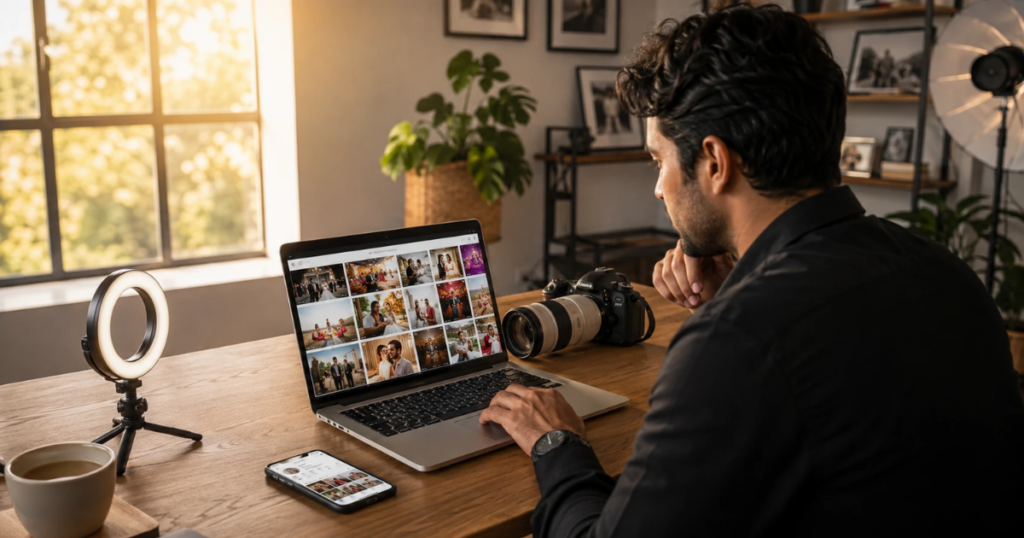
1. Social Media Has Become Part of the Photographer’s Portfolio
For a growing number of professional photographers, Instagram is no longer a side channel — it is a core part of the portfolio. Clients scroll through grids to assess style, consistency, and range before they visit a website or pick up the phone. A well-curated social presence signals professionalism, reliability, and creative confidence.
What makes social media particularly powerful for photographers is that it supports more than just finished work. Behind-the-scenes content, client testimonials, stories from the shoot, and real-time engagement all contribute to a more complete picture of who you are as a professional. Potential clients are not just buying photographs — they are buying the experience of working with you.
Consistency matters more than perfection. A photographer who posts regularly with a recognisable style and clear point of view will build a more engaged audience than one who posts sporadically with technically flawless but disconnected images. Social proof — tagged clients, shared stories, genuine reviews — compounds over time and becomes one of the most effective organic marketing assets a photographer can build.
2. AI Is Changing How Photographers Create and Manage Content
AI is not going to replace the photographer’s eye, the rapport they build with clients, or the creative instincts that come from years of experience. What it can do is handle the work that doesn’t require human judgment — the sorting, tagging, organising, and formatting that currently drains hours from every project.
Practical AI applications for photographers now include organising large image libraries by face, scene, or quality; identifying the strongest shots from a batch of hundreds; generating caption drafts and content ideas; repurposing still photography into short-form video formats; and maintaining a consistent look and feel across multiple social channels without manually adjusting every post.
The important distinction is between automation and creative decision-making. AI handles the former well. The latter — choosing the final edit, crafting the narrative around a client story, deciding what to share and what to keep private — remains the photographer’s domain. The most effective approach treats AI as a production assistant, not a creative director.
3. Turn One Photoshoot Into Weeks of Social Media Content
This is where AI-enhanced workflows become genuinely valuable. A single wedding, corporate event, or portrait session produces hundreds of edited images. Most photographers deliver the final gallery and move on. But inside that gallery are dozens of potential social media posts waiting to be extracted.
Consider a wedding shoot. From those images and the experience of the day, a photographer can create an Instagram carousel of ceremony highlights, a behind-the-scenes reel showing how they worked the venue, a client testimonial post featuring the couple’s reaction, a venue or location feature that tags the property, a before-and-after editing post, an educational tip about shooting in challenging light, a portfolio update with the strongest single image, and a photographer’s own story about a meaningful moment from the day.
That is eight or more distinct pieces of content from a single project. AI tools can help identify which images have the strongest visual impact, suggest caption angles, and format content for different platforms — turning what used to be a two-hour content creation session into a thirty-minute review-and-publish workflow.
The key mindset shift is moving from “I need to create new content” to “I need to repurpose what I already have.” Photographers who make this shift find they rarely run out of things to post.
4. Use Client Work as Social Proof
Completed client work is some of the most persuasive marketing content a photographer can share. Real projects, real reactions, real results — nothing builds credibility faster than showing potential clients what the experience of working with you actually looks like.
Client testimonials carry far more weight when accompanied by the images from the session. Tagged client posts create organic reach to entirely new audiences. Event highlight compilations demonstrate your ability to capture energy and atmosphere under pressure. Before-and-after comparisons showcase your editing skill and attention to detail.
A critical note on privacy: always obtain clear, explicit permission before using client images or quotes in your marketing. This is especially important for wedding and family photography, where the content is deeply personal. A simple model or content release signed at the time of booking protects both parties and makes the process smooth.
5. Build a Consistent Social Media Workflow
The photographers who succeed on social media are not necessarily the ones with the best content. They are the ones with the most consistent process for turning their work into marketing material.
A sustainable workflow follows a repeatable cycle: shoot, organise, select, edit, deliver to the client, repurpose the best material for social content, publish across relevant platforms, engage with comments and messages, and measure what drives actual business results. Each step feeds the next, and the system runs continuously without requiring the photographer to start from scratch every week.
AI can reduce friction at several points in this cycle — automated image sorting, caption drafting, platform-specific formatting, and scheduling. But the human creative layer remains essential: choosing which stories to tell, deciding how to present your brand, and engaging authentically with your audience. The goal is not full automation. It is a workflow that feels manageable even during a busy season.
6. Don’t Treat Every Social Platform the Same
One of the most common mistakes photographers make is posting identical content across every platform. A polished carousel that performs well on Instagram may get no traction on TikTok, where the audience expects raw, fast-paced, personality-driven content. A Pinterest pin works best as a vertical, keyword-rich image with aspirational styling. A Facebook post can afford to be longer and more story-driven.
Adapting Content by Platform
Instagram rewards visual consistency, strong first images in carousels, and strategic use of reels for reach. Portfolio-style content and behind-the-scenes stories both perform well.
TikTok favours personality, movement, and authenticity over production polish. Quick editing tips, shoot-day vlogs, and client-reveal videos tend to resonate.
Pinterest is a long-term discovery engine. Vertical images with descriptive text overlays and keyword-rich descriptions can drive website traffic for months or years after posting.
YouTube Shorts are ideal for quick educational clips — lighting setups, posing tips, gear comparisons — and benefit from searchable titles.
Facebook still delivers for photographers in local markets, community groups, and event-oriented audiences. Longer captions and album-style posts often outperform single images.
The principle is not to be everywhere, but to be intentional about where you invest your time and what format you use when you show up.
7. Measure What Actually Brings Photography Clients
Follower counts and like totals are visible, easy to track, and largely misleading as indicators of business health. A photographer with 3,000 engaged followers who regularly books enquiries through their profile is in a stronger position than one with 50,000 passive followers and an empty inbox.
The metrics that matter for a photography business are the ones tied to client acquisition: profile visits that lead to website clicks, enquiry form submissions, direct messages that turn into consultations, bookings, and — perhaps most valuable — repeat clients and referrals.
Tracking these requires a small amount of discipline. Use link-in-bio tools that track clicks. Check your Instagram insights for profile visits and website taps weekly. Note which types of content consistently generate enquiries versus which get likes but no action. Over time, you will develop a clear picture of what actually drives bookings — and it is rarely what gets the most hearts.
The goal is to build a marketing system that produces measurable business outcomes, not just social engagement.
How Foto Owl AI Fits Into the Modern Photography Workflow
One example of how photographers are applying these principles is Foto Owl AI, an AI-powered platform that helps photographers manage, deliver, and repurpose their work with less manual effort.
Rather than manually sorting through thousands of images after a shoot, photographers using Foto Owl AI can rely on AI face recognition to organise and deliver personalised galleries to clients and event guests automatically. Features like AI-generated video reels and WhatsApp-based delivery reduce the gap between shooting and sharing to minutes rather than days.
For photographers looking to reduce time spent on repetitive post-shoot tasks and redirect that time toward creative work and business growth, Foto Owl AI offers one approach worth exploring. The platform handles the delivery and organisation workflow so photographers can focus on the work that actually requires their expertise.
Conclusion
AI is not coming for the photographer’s creative identity. It is coming for the spreadsheet, the manual file sorting, the caption-writing block, and the hours lost to repetitive content formatting. That trade-off is worth taking.
The photographers who will grow their businesses most effectively over the coming years are the ones who build a repeatable system for turning every photoshoot into both client deliverables and future marketing content. Social media provides the distribution. AI reduces the friction. But the creative voice, the client relationships, and the brand identity — those remain entirely and irreplaceably human.
Start with one project this week. Look at your most recent completed shoot and ask: how many distinct pieces of content can I extract from this? Then build a simple workflow to make that extraction happen consistently. That single habit, repeated over months, will compound into one of the most effective marketing systems a photographer can have.

Sandeep Kumar is the Founder & CEO of Aitude, a leading AI tools, research, and tutorial platform dedicated to empowering learners, researchers, and innovators. Under his leadership, Aitude has become a go-to resource for those seeking the latest in artificial intelligence, machine learning, computer vision, and development strategies.