

Watch a student study for an exam in 2026 and there is a good chance you will see four tabs open at once. A chatbot is explaining osmosis for the third time in slightly different words. A notebook tool is summarizing class handouts. A calendar app holds a study plan the chatbot drafted on Sunday. The fourth tab is a document of practice questions, also produced by the chatbot, with answers it wrote itself.
- Five Study Jobs and the Tool That Fits Each
- Why Chatbot-Written Questions Drift From the Syllabus
- Draw Practice Questions From a Course-Matched Bank
- Assemble a Paper With Test Builder Instead of Prompting One
- Where This Split Still Leaves Gaps
- A Practical Rule for Choosing Between Study Tools
- FAQs
- 1. Can AI help students prepare for IB exams?
- 2. Is it reliable to use AI-generated questions for IB exam practice?
- 3. What is the best way to practice IB exam-style questions?
- 4. How can AI help students understand IB mark schemes?
- 5. What is an IB question bank?
- 6. Can students create custom IB practice papers?
- 7. Should students use AI or question banks for IB revision?
The first three tabs are doing reasonable work. The fourth is where things tend to go wrong. AI tools are good at explaining, rephrasing and planning. They are much less reliable as a source of exam practice, because a question that looks right can still miss the syllabus, the marking style and sometimes the facts. Students on structured courses such as the International Baccalaureate Diploma get more from their tools when each one is given a job it can actually do well.
Five Study Jobs and the Tool That Fits Each
It helps to stop thinking of “AI for studying” as one thing. Studying breaks down into at least five separate jobs, and each makes different demands.
| Study job | Tool that usually fits | Check before trusting it |
| Understanding a concept | AI chatbot or tutor-style assistant | Compare the explanation with the class textbook or the teacher’s notes |
| Verifying a fact or definition | Textbook, subject guide or teacher | Make sure the source matches the current syllabus |
| Practicing exam-style questions | Question bank organized by course and topic | Confirm subject, level and topic match the student’s course |
| Getting feedback on answers | Mark schemes, online practice with feedback, teacher | Note which questions have full marking guidance |
| Planning study time | Calendar app, chatbot for drafting a schedule | Base the plan on actual errors, not on topic lists alone |
The table is not a ranking. A chatbot is a fine partner for the first job. Asking it to explain price elasticity of demand, then asking again with “use an example from a school cafeteria”, is a reasonable use of the technology. It is the third and fourth rows where students lean on AI out of convenience and get material that only looks like what they need.
Why Chatbot-Written Questions Drift From the Syllabus
A language model can produce a question in the style of an IB Biology paper within seconds. The trouble is that “in the style of” is all it can promise. Even if you give a chatbot the official syllabus, you still need to check that each generated question matches the course level and the learning objective. Check the command term and make sure the suggested marking guidance gives credit for the reasoning the question asks for.
Scope is the first casualty. A generated question on market failure might drift into material from another part of the course, or into HL content when the student takes Economics at SL. Marking comes next: a model-written answer key rewards whatever the model thinks a good answer is, which may not match the points an examiner credits. Then there is the occasional confident mistake in a question or its answer, which a student is poorly placed to spot because they are still learning the topic.
None of this makes AI useless for practice. A student can paste in their own written answer and ask the chatbot which parts are vague, or ask it to explain a mark-scheme point they did not understand. The safer pattern is that the question and the marking guidance come from a source tied to the course, and the AI helps the student understand them.
Draw Practice Questions From a Course-Matched Bank
The practical fix for the third row of the table is a question bank organized the same way the course is. EduNinja is one such resource for IB students. The student picks a subject, such as Biology, Chemistry, Economics or one of the two math courses, chooses SL or HL, and then browses questions grouped under syllabus topics. A student reviewing a single Economics topic finds the questions filed under that topic, instead of scrolling through a general economics collection and guessing which items apply.
Questions come with answers or mark schemes where available. Coverage is not uniform, and not every question carries a full worked explanation, which is why the table asks students to notice what guidance each question has. For practice with feedback on each answer, EduNinja also has an online Practice mode that sets up a session from chosen topics.
EduNinja works from a bank of existing exam-style questions filed under syllabus topics rather than generating questions on request. For the practice job, that is the property a student needs: each question is tied to a course topic before it reaches the student, and a chatbot can still be brought in afterward to explain a mark-scheme point.
Assemble a Paper With Test Builder Instead of Prompting One
Sometimes a student wants something more than one question at a time. A teacher might suggest a topic check before a unit test, or the student might want a paper to attempt at the library, away from a screen. The instinct is to ask a chatbot to “make me a 10-question test on enzymes”. That brings back every problem from the previous section, multiplied by ten.
A better route is to assemble the paper from existing questions. With EduNinja Test Builder, a signed-in student chooses the course and syllabus range, searches the available questions, and adds or removes individual ones. The paper can be reordered and previewed before generating two files: a question PDF and, where answer material exists, an answer PDF.
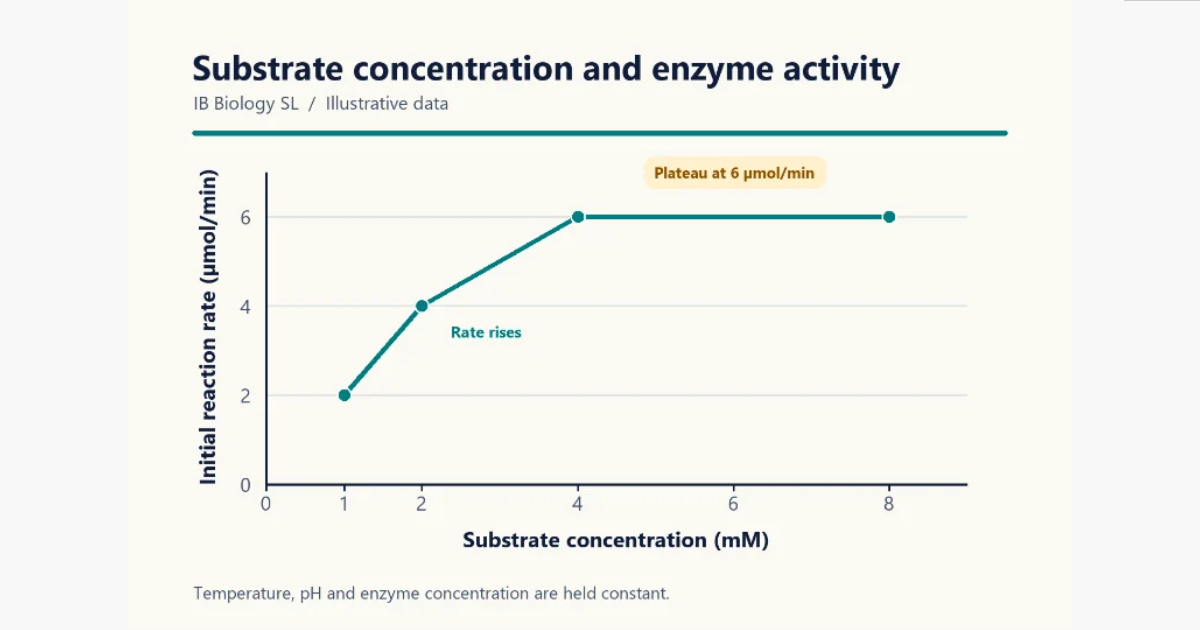
Suppose you are planning a short IB Biology SL practice set on enzyme activity, built around a small set of illustrative data. At substrate concentrations of 1, 2, 4 and 8 mM, the initial reaction rates are 2, 4, 6 and 6 µmol/min, respectively. Temperature, pH and enzyme concentration are held constant.
Q1. Describe the relationship between substrate concentration and initial reaction rate. Use the data in your answer.
Answer: The rate rises from 2 to 6 µmol/min as substrate concentration increases from 1 to 4 mM, then stays at 6 µmol/min between 4 and 8 mM.
Q2. Explain why the initial reaction rate may level off at high substrate concentrations.
Answer: Most enzyme active sites are occupied at high substrate concentrations. With enzyme concentration held constant, adding more substrate has little effect on the rate.
In Test Builder, look for questions that practice the same two skills: describing a pattern in data and explaining it in terms of enzyme saturation.
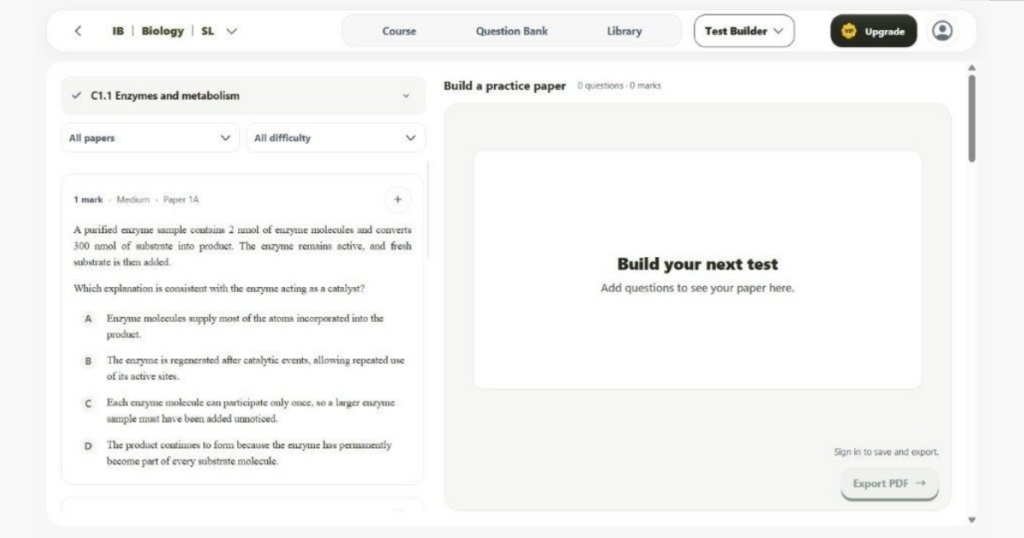
Choosing questions this way keeps a person in charge of the selection. The student, or a tutor helping them, decides which questions belong together and in what order. Test Builder does not write new questions, and the output is a custom selection rather than an official past paper or a full mock exam. A tutor preparing one paper for a small study group should still read through the questions and the answer file before handing them out.
There is still a role for AI in this step. A chatbot can help a student decide what the paper should cover, for instance by looking at last week’s errors and suggesting which two topics to mix. The questions themselves then come from the bank, so the plan can stay flexible while the material stays tied to the course.
Where This Split Still Leaves Gaps
Answer material in EduNinja varies by question, so some papers will come with thinner marking guidance than others. Neither the bank nor a chatbot replaces a teacher’s judgment on extended written answers, and IB coursework sits outside this workflow entirely. Students should also check that every question they select matches their level before printing.
A Practical Rule for Choosing Between Study Tools
Before opening a tool, name the job. If the job is understanding, a chatbot is a sensible first stop. If the job is checking a fact, go to the course material. If the job is practicing, use questions written for the course and marking guidance tied to them, and let AI help explain what the guidance means.
Students who follow that rule rarely need more tools. They need fewer tabs doing jobs they were never suited for.
FAQs
1. Can AI help students prepare for IB exams?
Yes. AI can help IB students understand difficult concepts, simplify explanations, create revision schedules, review written answers, and clarify mark-scheme requirements. However, students should verify facts and exam practice questions against reliable course-specific resources.
2. Is it reliable to use AI-generated questions for IB exam practice?
AI-generated questions can be useful for informal revision, but they may not accurately match the IB syllabus, command terms, assessment objectives, or marking criteria. Using a course-matched question bank is generally more reliable for structured exam practice.
3. What is the best way to practice IB exam-style questions?
Students should select questions based on their subject, SL or HL level, and syllabus topic. Practicing with course-matched questions and reviewing available mark schemes helps students understand exam expectations and identify knowledge gaps.
4. How can AI help students understand IB mark schemes?
Students can paste a mark-scheme point into an AI chatbot and ask for a simpler explanation, a practical example, or clarification of the reasoning behind the answer. The original mark scheme should remain the reference for assessment expectations.
5. What is an IB question bank?
An IB question bank is a collection of exam-style questions organized by subject, syllabus topic, and sometimes course level. It helps students find relevant practice questions without having to sort through unrelated material.
6. Can students create custom IB practice papers?
Yes. Students can use question-bank tools with test-building features to select, arrange, and combine questions from specific subjects and syllabus topics. Some tools allow students to generate printable question papers and answer files.
7. Should students use AI or question banks for IB revision?
Both can be useful for different purposes. AI is effective for explanations, brainstorming revision plans, and understanding mistakes, while structured question banks are better suited to course-matched exam practice. Combining both can make revision more focused.

Sandeep Kumar is the Founder & CEO of Aitude, a leading AI tools, research, and tutorial platform dedicated to empowering learners, researchers, and innovators. Under his leadership, Aitude has become a go-to resource for those seeking the latest in artificial intelligence, machine learning, computer vision, and development strategies.