

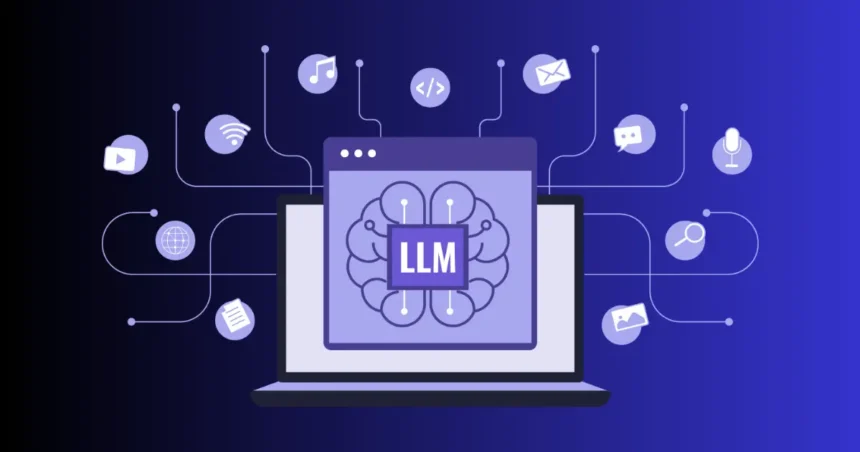
What Is an LLM?
A large language model (LLM) is a neural network trained on very large collections of text so it can predict and generate sequences of tokens. At a basic level, an LLM receives tokens as input, processes their relationships through its neural network, calculates probabilities for possible next tokens, and generates an output one token at a time.
- What Is an LLM?
- How LLMs Work in Simple Terms
- The LLM Pipeline
- Step 1: Text Is Converted Into Tokens
- Step 2: Tokens Become Numbers and Embeddings
- Step 3: The Transformer Processes Context
- Step 4: Self-Attention Determines What Matters
- Step 5: The Model Predicts the Next Token
- Step 6: The Process Repeats Until the Answer Is Complete
- How LLMs Are Trained
- Pretraining vs Fine-Tuning vs Inference
- What Are LLM Parameters?
- What Is a Context Window?
- Why LLMs Can Write, Code, Translate, and Summarize
- Why LLMs Hallucinate
- LLMs vs Traditional Search Engines
- LLMs vs Traditional Machine Learning
- A Practical Example of How an LLM Answers a Question
- 1. Tokenization
- 2. Numerical representation
- 3. Transformer processing
- 4. Probability calculation
- 5. Token selection
- 6. Repeat
- 7. Detokenization
- What Happens When an LLM Uses Tools?
- Benefits and Limitations of LLMs
- Benefits
- 1. Flexible language generation
- 2. Broad task coverage
- 3. Natural interaction
- 4. Context-aware generation
- 5. Automation
- Limitations
- 1. Hallucinations
- 2. Knowledge limitations
- 3. Context limitations
- 4. Cost
- 5. Bias
- 6. Lack of guaranteed reasoning reliability
- A Better Mental Model for Understanding LLMs
- Pro Tips for Understanding and Using LLMs
- Tip 1: Think in tokens
- Tip 2: Separate training from inference
- Tip 3: Do not confuse fluency with accuracy
- Tip 4: Use retrieval for changing information
- Tip 5: Give the model useful context
- Tip 6: Verify high-stakes information
- Tip 7: Evaluate the complete AI system
- Common Mistakes When Understanding LLMs
- Mistake 1: Thinking the model stores every answer like a database
- Mistake 2: Thinking an LLM searches the internet by default
- Mistake 3: Thinking every token represents one word
- Mistake 4: Assuming bigger models are automatically better
- Mistake 5: Treating generated confidence as proof
- Key Takeaways
- LLM Generation vs Human Writing
- Training vs Inference
- Workflow Diagrams
- FAQs
- How do LLMs work in simple terms?
- Do LLMs actually understand language?
- How does an LLM generate text?
- What is a Transformer in an LLM?
- What is the difference between training and inference in an LLM?
- Why do LLMs sometimes give wrong answers?
- What are tokens in an LLM?
- Can LLMs access the internet?
- Conclusion
Modern LLMs commonly use the Transformer architecture. Transformers use mechanisms such as self-attention to determine how different tokens in a sequence relate to one another.
Models such as GPT, Claude, Gemini, and Llama are examples of modern language-model systems, although their exact architectures, training methods, datasets, and deployment systems differ.
The easiest way to understand an LLM is to stop thinking of it as a database containing finished answers.
Instead, think of it as a very large statistical model that has learned patterns in language and uses those patterns to predict what should come next.
How LLMs Work in Simple Terms
LLMs work by converting text into tokens, representing those tokens numerically, processing their relationships through a neural network, and predicting the next token. The newly generated token is added to the sequence, and the model repeats the process until it reaches a stopping condition.
For example, suppose you enter:
The capital of France is
The model may assign a high probability to:
Paris
It generates that token, adds it to the sequence, and then predicts what should come next.
The complete process looks like this:
Your prompt → Tokenization → Embeddings → Transformer → Attention → Probability distribution → Next token → Repeat → Final response
This is the core mechanism behind autoregressive text generation. Modern documentation from Microsoft describes inference as an iterative process in which the model predicts a token, appends it to the sequence, and uses the updated sequence to generate the next token.
The LLM Pipeline
A useful mental model is to separate an LLM into two major phases:
Training
This is when the model learns patterns from enormous amounts of data.
Inference
This is when the trained model receives your prompt and generates an answer.
The simplified workflow is:
                    TRAINING
                       │
                       ▼
              Large Training Data
                       │
                       ▼
                  Tokenization
                       │
                       ▼
             Transformer Network
                       │
                       ▼
                Loss Calculation
                       │
                       ▼
              Parameter Updates
                       │
                       ▼
                 Trained Model
                       │
                       ▼
                    INFERENCE
                       │
                       ▼
                  User Prompt
                       │
                       ▼
                  Tokenization
                       │
                       ▼
                  Transformer
                       │
                       ▼
             Next Token Probability
                       │
                       ▼
                 Token Selection
                       │
                       ▼
              Repeat Until Complete
                       │
                       ▼
                   Response
Understanding the distinction between training and inference is important because the model is not normally learning new general knowledge every time you ask it a question.
Step 1: Text Is Converted Into Tokens
LLMs do not directly process sentences as humans see them.
They process tokens.
A token can represent a complete word, part of a word, punctuation, or another text fragment. The exact tokenization depends on the model and its tokenizer. OpenAI notes that a token may represent a character, part of a word, a whole word, or punctuation.
For example, a sentence such as:
Large language models are powerful.
could be divided into several tokens.
Conceptually:
"Large" " language" " models" " are" " powerful" "."
The actual token boundaries and IDs depend on the tokenizer.
Each token is then represented by a numerical ID.
So the model does not see:
Large language models are powerful.
It receives something closer to:
[1254, 6821, 9342, 527, 9182, 13]
The exact numbers vary between tokenizers.
Why tokenization matters
Tokenization affects:
- context-window usage
- processing cost
- model speed
- multilingual performance
- how efficiently text is represented
It also explains why token count is not exactly the same as word count.
For English, OpenAI gives a rough estimate of around four characters per token, but this is only an approximation and varies by model and language.
Practical example
Consider the word:
unbelievable
A tokenizer might represent it as several pieces rather than treating the entire word as one indivisible unit.
This allows the model to reuse learned representations across related words.
Step 2: Tokens Become Numbers and Embeddings
A token ID is simply an identifier. By itself, it does not contain enough information for the neural network to understand relationships between words.
The model therefore maps tokens into numerical vectors called embeddings.
Conceptually:
Token
  ↓
Token ID
  ↓
Embedding Vector
  ↓
Transformer
An embedding represents a token using many numerical dimensions.
You can imagine a simplified vector like:
[0.12, -0.48, 0.91, 0.07, ...]
Real models use much larger vectors.
The important idea is that the model works with numerical representations rather than raw text.
Related words and concepts can develop useful relationships within these learned representations because the model encounters them in different contexts during training.
Step 3: The Transformer Processes Context
The Transformer is the architecture that made modern large-scale language models possible.
The original Transformer architecture introduced attention-based processing that allowed models to work with relationships between tokens more effectively than earlier sequential architectures.
Today, Transformer-based systems can be broadly categorized into:
| Architecture | Main Purpose | Example Use |
|---|---|---|
| Encoder-only | Understand or represent input | Classification, embeddings |
| Decoder-only | Generate sequences | Chat and text generation |
| Encoder-decoder | Transform one sequence into another | Translation, summarization |
Google’s documentation explains that encoder-only and decoder-only Transformers serve different purposes, while decoder-only models are particularly suited to generating sequences from previous context.
Most modern generative chat models use a decoder-style approach or related architectures designed for generation.
Step 4: Self-Attention Determines What Matters
One of the most important ideas behind Transformers is self-attention.
Self-attention allows the model to evaluate relationships between tokens in its input.
Consider:
The dog chased the ball because it was excited.
To interpret “it,” the model needs to consider other tokens in the sentence.
Self-attention gives the network a mechanism for determining which parts of the context are relevant to each token.
Google describes self-attention as effectively asking how much each token affects the interpretation of other tokens.
Query, Key, and Value
Self-attention is commonly explained through three components:
- Query
- Key
- Value
A simplified representation is:
Query × Key
      ↓
Attention Score
      ↓
Weighted Values
      ↓
Updated Representation
The model calculates relationships between tokens and uses those relationships to produce richer representations.
Why multiple attention heads?
Transformers commonly use multiple attention heads.
Different heads can learn different types of relationships.
One head might focus on grammatical relationships.
Another might capture relationships between entities.
Another might focus on positional or semantic relationships.
Multiple Transformer layers then process the information repeatedly, allowing increasingly complex patterns to emerge.
Step 5: The Model Predicts the Next Token
This is the central mechanism behind autoregressive language generation.
Suppose your prompt is:
The largest planet in our solar system is
The model evaluates possible next tokens and assigns probabilities.
A simplified example might look like:
| Possible Token | Probability |
|---|---|
| Jupiter | 0.94 |
| Saturn | 0.02 |
| Earth | 0.01 |
| Neptune | 0.01 |
| Other | 0.02 |
The model then selects a token according to its decoding strategy.
The output becomes:
Jupiter
Now the sequence is:
The largest planet in our solar system is Jupiter
The model predicts the next token again.
This process continues repeatedly.
It is therefore more accurate to describe an LLM as predicting tokens, rather than simply predicting words.
Step 6: The Process Repeats Until the Answer Is Complete
An LLM generally does not generate an entire paragraph in one single operation.
Instead, generation proceeds token by token.
For example:
Prompt:
Explain photosynthesis.

         ↓

Token 1:
Photosynthesis

         ↓

Token 2:
is

         ↓

Token 3:
the

         ↓

Token 4:
process

         ↓

Token 5:
by

         ↓

...

         ↓

Complete response
At every generation step, the model calculates what token should come next based on the available context.
This explains why changing a prompt slightly can sometimes change the resulting response.
It also explains why generation can be controlled using decoding parameters such as temperature in systems that expose those controls.
How LLMs Are Trained

The impressive behavior of an LLM comes from its training process.
During training, the model processes huge quantities of data and repeatedly attempts to predict tokens.
A simplified training example:
Input:
The sun rises in the ___.

Target:
east
Initially, the model’s prediction may be poor.
The model calculates an error, often represented by a loss function.
That error is used to update the model’s parameters through backpropagation and optimization.
The process repeats across enormous numbers of training examples.
Over time, the model becomes better at predicting patterns found in its training data.
Google describes language-model training as a prediction task where the model’s errors guide parameter updates through backpropagation.
Pretraining vs Fine-Tuning vs Inference
These stages are often confused.
| Stage | What Happens | Main Goal |
|---|---|---|
| Pretraining | Model learns from massive datasets | Learn broad patterns |
| Fine-tuning | Model is trained on targeted examples | Improve behavior for specific tasks |
| Alignment / preference training | Model is optimized toward desired responses | Improve usefulness and behavior |
| Inference | Trained model generates responses | Answer user requests |
Pretraining
Pretraining teaches the model general language patterns, relationships, and other information represented in its training data.
Fine-tuning
Fine-tuning uses additional targeted training data to adapt a model to particular tasks or behaviors.
Inference
Inference is what happens after the model has been trained.
When you type a prompt into an AI application, you are using the model during inference.
What Are LLM Parameters?
Parameters are numerical values learned during model training.
They are part of the model’s learned configuration.
A useful analogy is to think of parameters as an enormous collection of adjustable numerical relationships.
During training:
Training data
     ↓
Prediction
     ↓
Error
     ↓
Parameter updates
     ↓
Better prediction
A model with billions of parameters has an extremely large set of numerical values that participate in its computations.
However, parameter count alone does not tell you how capable a model is.
Architecture, training data, training methods, optimization, inference techniques, context handling, and post-training all matter.
Google notes that modern Transformers can contain hundreds of billions or even trillions of parameters, while also emphasizing the relationship between parameter scale and model capability.
What Is a Context Window?
A context window is the amount of information a model can process within a particular interaction.
The context can include:
- your current prompt
- previous conversation messages
- system instructions
- retrieved documents
- tool outputs
- other information supplied to the model
The important unit is tokens, not simply words or characters.
For example:
User message
      +
Conversation history
      +
Retrieved information
      +
Instructions
      ↓
Context window
      ↓
LLM
A larger context window allows an application to provide more information to the model at once.
But a larger context window does not automatically mean the model will use every piece of information perfectly.
Common mistake
Do not assume:
Larger context = perfect memory
Context capacity and reliable information retrieval are different problems.
Why LLMs Can Write, Code, Translate, and Summarize
A natural question is:
If LLMs predict tokens, how can they perform so many different tasks?
The answer is that many tasks can be represented as sequences of tokens.
Writing
Prompt:
Write an introduction about renewable energy.
The model generates a sequence of tokens matching the requested style and topic.
Translation
Prompt:
Translate this sentence into Spanish.
The model generates a Spanish token sequence conditioned on the source text and instruction.
Summarization
Prompt:
Summarize this article in five bullet points.
The model identifies relevant patterns in the supplied context and generates a shorter representation.
Coding
Prompt:
Write a Python function that sorts a list.
Programming languages are also represented as tokens.
The model can therefore learn patterns in source code during training and generate code sequences.
This does not mean all tasks are equally reliable. The model’s ability depends on its training, architecture, context, tools, and the complexity of the task.
Why LLMs Hallucinate
An LLM can produce an answer that sounds confident but is factually incorrect.
This behavior is commonly called a hallucination.
One reason is fundamental to the generation mechanism: the model is optimized to generate plausible sequences, not to independently verify every factual claim against reality.
For example, if asked about a fictional research paper, a model might generate a realistic-looking title, author, and publication date.
The text can sound convincing even though the source does not exist.
Why this matters
You should be particularly careful when using LLMs for:
- medical information
- legal information
- financial decisions
- academic citations
- current events
- statistics
- technical specifications
- named sources
Better workflow
For factual work:
LLM
 ↓
Generate candidate answer
 ↓
Verify important claims
 ↓
Check authoritative sources
 ↓
Use final answer
For current information, connecting an LLM to external search, databases, APIs, or retrieval systems can provide access to information outside the model’s static learned parameters.
LLMs vs Traditional Search Engines
LLMs and search engines solve different problems.
| Feature | LLM | Search Engine |
|---|---|---|
| Primary function | Generate and transform information | Find indexed information |
| Output | Generated response | Search results |
| Basic mechanism | Neural network prediction | Retrieval and ranking |
| Can explain concepts | Yes | Usually through linked pages |
| Automatically current | Not necessarily | Can access current indexed pages |
| Can hallucinate | Yes | Search results can also contain poor sources |
| Best use | Generation, reasoning, transformation | Discovery and verification |
Modern AI applications increasingly combine both.
For example:
User Question
     ↓
Search / Retrieval
     ↓
Relevant Documents
     ↓
LLM
     ↓
Grounded Response
This approach is commonly associated with retrieval-augmented generation (RAG).
LLMs vs Traditional Machine Learning
LLMs are a type of machine-learning system, but their scale and flexibility distinguish them from many traditional machine-learning applications.
| Traditional ML | LLM |
|---|---|
| Often built for a specific task | Can support many language tasks |
| Frequently relies on structured features | Learns representations from large-scale data |
| Often uses task-specific models | Foundation models can be adapted to many applications |
| Output may be a label or prediction | Can generate long sequences |
| Usually narrower scope | General-purpose language capabilities |
For example, a traditional machine-learning model might classify an email as spam or not spam.
An LLM can potentially classify the email, explain why it looks suspicious, rewrite it, summarize it, or extract structured information.
That flexibility is one reason foundation models have become central to modern generative AI systems.
A Practical Example of How an LLM Answers a Question
Suppose you ask:
Why is the sky blue?
Here is a simplified representation of what happens.
1. Tokenization
Your text becomes tokens.
Why | is | the | sky | blue | ?
2. Numerical representation
The tokens are converted into numerical representations.
3. Transformer processing
The model processes relationships between the tokens.
The relationship between:
sky
blue
becomes relevant to the predicted response.
4. Probability calculation
The model generates probabilities for possible next tokens.
For example:
"The"      → high probability
"Because"  → high probability
"Blue"     → lower probability
...
5. Token selection
A token is selected.
6. Repeat
The model predicts another token using the updated context.
This continues until the response is complete.
7. Detokenization
The generated tokens are converted back into readable text.
So what looks like one response to you is actually the result of many repeated prediction steps.
What Happens When an LLM Uses Tools?
An LLM by itself generates tokens.
It does not inherently browse a website, execute arbitrary code, query a database, or access an external API.
A surrounding application can provide tools that the model can request.
A simplified tool workflow looks like this:
User
 ↓
LLM
 ↓
Decides a tool is useful
 ↓
Tool request
 ↓
External system
 ↓
Tool result
 ↓
LLM
 ↓
Final response
For example, an AI assistant might receive:
What is the weather in New York?
The model can produce a structured tool request.
An external weather system retrieves the current conditions.
The result is then returned to the model, which generates the final response.
Microsoft similarly describes tool use as an interaction between the LLM and external code rather than an inherent ability of the language model itself.
This distinction is important when evaluating what an AI system can actually do.
Benefits and Limitations of LLMs
Benefits
1. Flexible language generation
LLMs can generate many forms of text from natural-language instructions.
2. Broad task coverage
One model can support writing, summarization, translation, coding, extraction, classification, and other tasks.
3. Natural interaction
Users can interact with applications using ordinary language instead of specialized interfaces.
4. Context-aware generation
Transformers can process relationships among many tokens within the available context.
5. Automation
LLMs can automate parts of workflows that previously required manual language processing.
Limitations
1. Hallucinations
The model can produce plausible but incorrect information.
2. Knowledge limitations
A model’s built-in knowledge is not automatically equivalent to a live database.
3. Context limitations
Every model has constraints around how much information it can process effectively.
4. Cost
Large-scale training and inference can require substantial computing resources.
5. Bias
Training data can contain biases that influence model behavior.
6. Lack of guaranteed reasoning reliability
An answer that looks logically structured is not necessarily correct.
Google identifies hallucinations, computational cost, and bias among important challenges associated with LLMs.
A Better Mental Model for Understanding LLMs
A common explanation says:
“An LLM is just autocomplete.”
There is some truth in this, but it is incomplete.
A better mental model is:
An LLM is a large neural network that learned statistical patterns from enormous amounts of data and uses those learned parameters to predict token sequences from context.
The word “just” can be misleading because next-token prediction at enormous scale can produce surprisingly broad capabilities.
The model can learn relationships involving:
- grammar
- syntax
- facts
- concepts
- styles
- code patterns
- semantic relationships
- common reasoning patterns
But these capabilities do not mean the model is equivalent to a human mind or a traditional database.
Pro Tips for Understanding and Using LLMs
Tip 1: Think in tokens
When you hear terms such as context length, input length, output length, and token cost, remember that LLMs operate on tokens.
Tip 2: Separate training from inference
The model usually is not retraining itself every time you ask a question.
Tip 3: Do not confuse fluency with accuracy
A well-written answer can still be wrong.
Tip 4: Use retrieval for changing information
For current facts, connect the model to appropriate external sources.
Tip 5: Give the model useful context
A clear prompt with relevant information usually provides a better foundation for generation.
Tip 6: Verify high-stakes information
Use authoritative sources instead of relying solely on generated output.
Tip 7: Evaluate the complete AI system
When comparing AI products, look beyond the underlying model.
Consider:
- model quality
- context window
- retrieval
- tool access
- latency
- cost
- safety
- evaluation results
- user experience
Common Mistakes When Understanding LLMs
Mistake 1: Thinking the model stores every answer like a database
An LLM does not simply retrieve a complete stored paragraph every time it responds.
It generates output using learned parameters and the current context.
Mistake 2: Thinking an LLM searches the internet by default
A standalone language model does not automatically have live web access.
Search requires an external retrieval or browsing mechanism.
Mistake 3: Thinking every token represents one word
Tokens can represent words, word fragments, characters, punctuation, and other pieces of text.
Mistake 4: Assuming bigger models are automatically better
Model size is only one factor.
Training quality, architecture, post-training, inference techniques, data quality, and evaluation also matter.
Mistake 5: Treating generated confidence as proof
LLMs can express incorrect information with convincing language.
Always verify important claims.
Key Takeaways
- LLMs process tokens, not raw sentences.
- Tokens are represented numerically before entering the neural network.
- Transformers use attention mechanisms to process relationships between tokens.
- Training teaches the model to predict tokens and adjusts its parameters.
- Inference uses the trained model to generate tokens from a prompt.
- Autoregressive models generate responses one token at a time.
- LLMs can perform many tasks because language, code, and other information can be represented as token sequences.
- Fluent output does not guarantee factual accuracy.
- Tools and retrieval systems extend what an LLM application can do.
- Understanding the difference between training, inference, context, and retrieval makes LLM behavior much easier to understand.
LLM Generation vs Human Writing
| Aspect | LLM | Human |
|---|---|---|
| Basic process | Token prediction | Intentional communication |
| Speed | Extremely fast | Slower |
| Training | Machine-learning optimization | Human learning |
| Context | Depends on available context | Human memory and environment |
| Creativity | Generated from learned patterns | Based on human experience and cognition |
| Verification | Not guaranteed | Can deliberately verify |
| Consistency | Can vary between generations | Usually more intentional |
Training vs Inference
| Aspect | Training | Inference |
|---|---|---|
| Purpose | Learn parameters | Generate output |
| Data | Huge training datasets | Current prompt/context |
| Parameter updates | Yes | Normally no |
| Compute requirement | Extremely high | Usually lower |
| Frequency | Performed during model development | Happens for user requests |
| Output | Updated model | Generated tokens |
Workflow Diagrams
Basic LLM Workflow
                USER
                  │
                  ▼
              PROMPT
                  │
                  ▼
            TOKENIZATION
                  │
                  ▼
             TOKEN IDs
                  │
                  ▼
             EMBEDDINGS
                  │
                  ▼
        ┌──────────────────┐
        │    TRANSFORMER   │
        │                  │
        │ Self-Attention   │
        │        ↓         │
        │ Neural Layers    │
        └──────────────────┘
                  │
                  ▼
        TOKEN PROBABILITIES
                  │
                  ▼
          NEXT TOKEN
                  │
                  ▼
       ADD TOKEN TO CONTEXT
                  │
                  └───────────┐
                              │
                              ▼
                    PREDICT NEXT TOKEN
                              │
                              ▼
                         COMPLETE
                          RESPONSE
LLM Training Workflow
Large Dataset
     │
     ▼
Clean / Prepare Data
     │
     ▼
Tokenization
     │
     ▼
Model Prediction
     │
     ▼
Calculate Loss
     │
     ▼
Backpropagation
     │
     ▼
Update Parameters
     │
     └───────────────┐
                     │
                     ▼
               Repeat Training
                     │
                     ▼
                Trained LLM
Tool-Augmented LLM Workflow
User Request
     │
     ▼
     LLM
     │
     ├──────► Answer directly
     │
     └──────► Tool Call
                  │
                  ▼
            External Tool
                  │
                  ▼
             Tool Result
                  │
                  ▼
                  LLM
                  │
                  ▼
             Final Answer
FAQs
How do LLMs work in simple terms?
LLMs work by converting text into tokens, processing those tokens through a neural network, and predicting what token should come next. Modern language models commonly use Transformer-based architectures and attention mechanisms to process context. The model repeats next-token prediction until it reaches a stopping condition.
Do LLMs actually understand language?
LLMs can process and generate language with impressive contextual behavior, but the word “understand” can be misleading if it implies human-like consciousness or comprehension. They learn statistical and structural patterns from training data and use those patterns to generate outputs.
How does an LLM generate text?
An LLM generates text one token at a time. It processes the current context, calculates probabilities for possible next tokens, selects a token according to its decoding process, adds that token to the sequence, and repeats the process.
What is a Transformer in an LLM?
A Transformer is a neural-network architecture built around attention mechanisms. It allows the model to process relationships between tokens and build contextual representations. Transformer architectures are widely used in modern language models.
What is the difference between training and inference in an LLM?
Training is when the model learns its parameters from data by optimizing its predictions. Inference happens after training, when the model uses those learned parameters to generate an output for a particular prompt.
Why do LLMs sometimes give wrong answers?
LLMs generate likely token sequences rather than guaranteeing that every statement is factually verified. This can produce plausible but incorrect information, commonly called hallucinations. External retrieval and verification can reduce this risk for appropriate applications.
What are tokens in an LLM?
Tokens are the units of text processed by an LLM. Depending on the tokenizer, a token can represent a complete word, part of a word, a character, punctuation, or another text fragment.
Can LLMs access the internet?
An LLM does not inherently have live internet access. An AI application can connect a model to search engines, websites, APIs, databases, or other external tools. The external system retrieves information, which can then be supplied to the model.
Conclusion
The simplest way to understand how LLMs work is to follow the information from beginning to end: text becomes tokens, tokens become numerical representations, Transformer layers process their relationships, and the model predicts the next token repeatedly until it produces a response.
The important insight is that the apparent complexity of an AI assistant is built on top of this fundamental prediction mechanism.
Three ideas are especially useful to remember:
- Training teaches the model patterns through parameter updates.
- Inference uses those learned patterns to generate tokens from context.
- External retrieval and tools can extend what the complete AI system can accomplish.
If you want to understand modern generative AI beyond the surface level, start with these building blocks: tokens, embeddings, attention, Transformers, parameters, training, inference, and context.
Once those pieces make sense, technologies such as RAG, AI agents, tool calling, fine-tuning, and multimodal models become much easier to understand.

Sandeep Kumar is the Founder & CEO of Aitude, a leading AI tools, research, and tutorial platform dedicated to empowering learners, researchers, and innovators. Under his leadership, Aitude has become a go-to resource for those seeking the latest in artificial intelligence, machine learning, computer vision, and development strategies.