


Manufacturers have spent years improving physical automation. Today, robotic arms can weld, assemble, inspect, and package products with great accuracy. However, many everyday office tasks inside factories are still done manually.
- Why RPA in Manufacturing Often Fails?
- 2. Standardize Processes Before Automating Them
- 3. Choose the Right Processes for RPA
- 4. Address Employee Concerns About Software Automation
- 5. Plan for Scalability Before Starting
- 6. Align IT and Operational Technology (OT) Teams
- 7. Build Internal RPA Skills
- How Manufacturers Can Build a Scalable RPA Program?
- Conclusion
Walk through almost any manufacturing plant, and you’ll notice employees:
- Moving production data between different systems
- Matching invoices with purchase orders
- Updating spreadsheets for compliance
- Entering the same information multiple times
These tasks do not require much decision-making, but they take a lot of time.
This is exactly where Robotic Process Automation (RPA) helps. RPA in manufacturing automates repetitive, rule-based tasks without requiring companies to replace their existing software.
However, many RPA projects in manufacturing never move beyond the first pilot.
The reason is usually not the technology itself. Most projects fail because of disconnected systems, inconsistent processes, poor planning, employee resistance, and weak governance.
This article explains Why RPA in manufacturing industry fails to scale and how manufacturers can build automation that delivers long-term results.
Why RPA in Manufacturing Often Fails?

Several common challenges prevent manufacturers from expanding their automation programs successfully.
1. Legacy Manufacturing Systems Make Integration Difficult
Most factories do not operate on a single connected platform.
Instead, they rely on a mix of:
- ERP systems
- Manufacturing Execution Systems (MES)
- Machine controllers
- Excel spreadsheets
- Paper forms
- Scanned documents
- Older software
Many of these systems were installed years apart and were never designed to communicate with each other.
As a result, an RPA bot may encounter:
- Different user interfaces
- Unstructured data
- Information locked inside scanned documents
- Systems without APIs
Many manufacturers believe they must replace these legacy systems before implementing automation.
Fortunately, that is often unnecessary.
Modern RPA software can:
- Read information directly from screens
- Copy and enter data like a human user
- Connect systems without APIs
- Use Optical Character Recognition (OCR) to read scanned invoices, PDFs, and forms
Best Practice
Before building automation, map how information actually moves through the business.
Do not rely only on official documentation.
Instead, observe how employees complete the work every day. This helps identify:
- Manual data transfers
- Duplicate work
- System gaps
- High-value automation opportunities
2. Standardize Processes Before Automating Them
RPA works best when every task follows the same steps.
It performs poorly when employees complete the same process differently.
Manufacturing companies often develop small differences over time.
For example:
- Different plants classify production issues differently.
- Employees enter data into different fields.
- Teams create unofficial shortcuts.
- Different shifts follow different procedures.
Automating an inconsistent process only makes those inconsistencies happen faster.
How to Fix It
Before automation:
- Document the real workflow
- Remove unnecessary exceptions
- Standardize how tasks are completed
- Ensure every team follows the same process
Although this step may seem less exciting than launching a bot, it is one of the biggest factors behind successful RPA implementation.
3. Choose the Right Processes for RPA
Many manufacturers make the mistake of automating their biggest operational problem first.
Unfortunately, the most painful process is often also the most complex.
It may involve:
- Human judgment
- Frequent exceptions
- Missing data
- Multiple departments
These are poor candidates for an initial RPA project.
If the first automation performs poorly, leadership may lose confidence in the entire automation program.
What Makes a Good RPA Process?
Choose processes based on measurable criteria such as:
- High transaction volume
- Stable workflows
- Rule-based decisions
- Reliable data
- Few exceptions
- High manual effort
- Clear cost or time savings
Strong First Automation Projects
Good starting points include:
- Invoice processing
- Purchase order creation
- Inventory reconciliation
- Production reporting
- Compliance documentation
- Data transfer between ERP and manufacturing systems
These projects provide quick wins and build confidence for larger automation initiatives.
Working with experienced RPA consulting services can also help identify the best opportunities using data instead of assumptions.
4. Address Employee Concerns About Software Automation
Automation has always changed manufacturing jobs.
Because of this history, many employees worry that software automation will replace them.
Resistance is not always obvious.
It often appears through:
- Incomplete documentation
- Delayed feedback
- Poor cooperation
- Employees continuing manual work instead of using automation
Build Trust Early
Manufacturers should clearly explain that RPA is designed to remove repetitive administrative work, including:
- Manual data entry
- Record updates
- Data reconciliation
- Routine reporting
Employees should also participate in designing automation.
They understand:
- Process exceptions
- System limitations
- Daily workarounds
Their knowledge improves automation accuracy while increasing employee support.
Organizations should also provide training so employees can:
- Monitor bots
- Handle exceptions
- Suggest new automation ideas
- Improve existing workflows
This helps employees see automation as a tool that improves their work rather than replaces it.
5. Plan for Scalability Before Starting
Many companies successfully build one automation and then stop.
Others allow different departments to create bots using different tools and standards.
Over time, this becomes difficult to maintain.
Without governance, every bot becomes an isolated project.
Build a Scalable Foundation
Even a small RPA Center of Excellence (CoE) can establish standards for:
- Development
- Testing
- Security
- Documentation
- Deployment
- Support
Manufacturers should also:
- Maintain an inventory of all bots
- Define how new automation requests are submitted
- Create reusable components for common automation tasks
Examples include:
- Authentication
- Data validation
- Error handling
- Reporting
These practices make automation repeatable and easier to expand.
6. Align IT and Operational Technology (OT) Teams
Manufacturing depends on two connected environments:
Information Technology (IT)
Handles business operations such as:
- Finance
- Purchasing
- Inventory
- Enterprise planning
Operational Technology (OT)
Controls manufacturing operations such as:
- Production equipment
- Machine data
- Shop-floor processes
Some of the most valuable RPA use cases connect these two environments.
For example, bots can:
- Transfer production data into planning systems
- Update compliance records automatically
- Match machine output with ERP inventory
Because these automations affect critical operations, security must be considered from the beginning.
Security Best Practices
Every automation should include:
- Controlled credentials
- Defined user permissions
- Activity logs
- Error handling
- Recovery procedures
- Monitoring for system changes
Automation should improve reliability—not introduce risk into production systems.
7. Build Internal RPA Skills
Creating a simple bot is relatively easy.
Managing dozens of automations over several years requires much more expertise.
Manufacturers need skills in:
- Process analysis
- Automation architecture
- Security
- Testing
- Exception management
- Monitoring
- Change management
Many companies lack these skills during the early stages.
This is where RPA consulting services can provide valuable support.
They can help with:
- Building the initial automation framework
- Developing early bots
- Establishing governance
- Training internal teams
The long-term goal should be to build internal capability rather than relying permanently on outside consultants.
How Manufacturers Can Build a Scalable RPA Program?
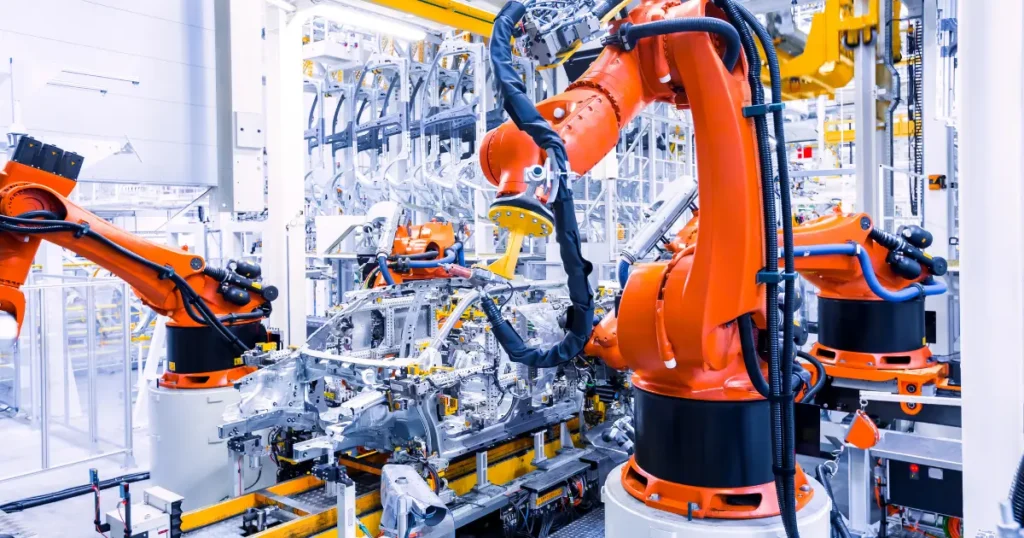
Successful RPA in manufacturing is about more than installing software.
It improves how information moves between people, systems, and departments.
Manufacturers that scale automation successfully usually focus on four key principles:
- Standardize processes before automating them.
- Choose automation opportunities based on data, not urgency.
- Involve employees throughout the implementation process.
- Establish governance, security, and technical standards from day one.
Following these fundamentals helps manufacturers create automation that continues to deliver value as the business grows.
Conclusion
RPA in manufacturing has the potential to eliminate repetitive manual work, improve reporting accuracy, reduce data entry errors, and free employees to focus on higher-value tasks.
However, successful automation requires more than deploying software.
Manufacturers that invest in process standardization, careful project selection, employee involvement, and strong governance are far more likely to build automation programs that scale across the organization.
The companies that achieve the greatest success with Robotic Process Automation are not necessarily the ones launching the biggest pilot projects. They are the ones that build the right foundation before the first bot is ever deployed.

Sandeep Kumar is the Founder & CEO of Aitude, a leading AI tools, research, and tutorial platform dedicated to empowering learners, researchers, and innovators. Under his leadership, Aitude has become a go-to resource for those seeking the latest in artificial intelligence, machine learning, computer vision, and development strategies.