
The most expensive sentence in enterprise AI right now is “I’ll defer to the technical team on that.” It sounds humble. It is actually how decisions get made by default, by whoever happens to write the code last. If you want to understand AI concepts 2026 leaders are betting on, you have to understand what actually runs an AI system once it leaves the demo stage. This article breaks down the nine parts that matter, in plain language, and shows you which ones are decisions you should be making yourself.
- What Happens When AI Leaves the Demo
- 1. Agentic Loops
- 2. MCP (Model Context Protocol)
- 3. Subagents
- 4. AI Gateway
- 5. Inference Economics
- 6. Evals
- 7. Guardrails
- 8. Observability
- 9. Context Engineering
- Why These Are Business Decisions, Not Technical Ones
- FAQ
- What is context engineering in AI?
- What is the difference between an AI gateway and an API key?
- Do small companies need AI evals, or is that only for enterprise?
- What’s the difference between an agentic loop and a chatbot?
- Why do guardrails matter if the model is already well-trained?
- What is the “AI execution gap”?
- Conclusion
What Happens When AI Leaves the Demo
A demo only has to work once, in front of you, on your best day. Production has to work every day, for every user, including the ones who type something you never tested. That gap is where most AI projects die quietly. Nobody explicitly decides to skip observability or guardrails. They just get pushed to “phase two,” and phase two never comes. Understanding the nine concepts below is how you stop that from happening to your own project.
1. Agentic Loops
An agentic loop is a system that plans a task, takes an action, checks whether that action worked, and repeats until the job is actually done, without a human approving each step. This is the core mechanic behind tools like Claude Code and autonomous coding agents: the model doesn’t just answer once, it iterates.
The mistake most teams make is assuming more loop iterations equals better output. In practice, a loop with no exit condition will happily burn through your budget rewriting the same function five times looking for a perfect score that doesn’t exist. Set a hard iteration cap and a clear definition of “done” before you ship an agentic feature, not after.
Takeaway: an agentic loop is only as good as its stopping condition. Design that first.
2. MCP (Model Context Protocol)
MCP is a standard way for an AI model to connect to outside tools and data, like Google Drive, GitHub, or a company database, without you writing custom integration code for every single one. Before MCP, connecting an AI assistant to five different tools meant five different one-off integrations, each with its own auth flow and its own failure modes.
If you’re a founder deciding whether to build custom tool integrations in-house or adopt MCP, the honest answer is: adopt MCP unless you have a very specific reason not to. Anthropic publishes the protocol specification openly, and it’s rapidly becoming the common language between AI systems and the tools they act on.
Takeaway: MCP turns “build five integrations” into “build one connector,” which is the difference between a six-week project and a six-day one.
3. Subagents
A subagent is a smaller, narrowly scoped AI process that handles one piece of a larger job, with its output merged back into the main task. Instead of one model trying to research, write, and fact-check an entire report in one pass, you split the work: one subagent researches, one drafts, one checks citations.
The common mistake here is over-splitting. Every subagent adds coordination overhead and another point where things can silently go wrong. A good rule: split when the sub-tasks genuinely need different context or tools, not just because splitting sounds more sophisticated.
Takeaway: subagents help when tasks are genuinely different in kind. They hurt when they’re just the same task cut into smaller pieces.
4. AI Gateway
An AI gateway is the single door every request to a model has to pass through. It’s where you see which team or app used which model, how much it cost, and where you can cut off access instantly if something goes wrong, like a runaway script hammering the API overnight.
Without a gateway, most companies discover their actual AI spend the same way they discover a leaking pipe: from the bill, after the damage is done. A gateway gives you the metering and kill switch before that happens, not after.
Takeaway: if you can’t answer “which app used which model, and how much did it cost this month” in under a minute, you don’t have a gateway. You have hope.
5. Inference Economics
Inference economics is simply the cost structure of running a model: you pay for the words processed on the way in and the way out. Reusing a cached answer costs a fraction of generating a fresh one, which is why prompt caching and retrieval systems exist.
The mistake founders make is pricing their AI feature based on the demo, where they tested it twenty times themselves, instead of based on 10,000 real users hitting it with long, messy inputs. Model the cost of your worst-case prompt length, not your average one, before you set a price.
Takeaway: inference economics is unit cost accounting wearing a new name. Treat it that way in your financial model.
6. Evals
An eval is a set of test cases the system gets scored against before it ships: known inputs, known correct outputs, and a pass or fail threshold. Passes go live. Failures go back for more work.
Here’s the part people miss: writing an eval means deciding what “acceptable failure” looks like for your product. A customer support bot that’s wrong 2% of the time might be fine. A bot that gives wrong medical dosage information 2% of the time is not. That threshold is not a technical detail. It’s a decision about how much risk your business will tolerate, and it belongs to whoever owns the product, not just whoever writes the test code.
Takeaway: when someone asks you to sign off on an eval harness, they are really asking you to define your risk appetite. Answer it as that question, not as a code review.
7. Guardrails
Guardrails are filters applied on the way into a model and on the way out. Sensitive data, like customer PII or internal financial figures, gets stopped before it reaches the model. Harmful or off-brand output gets stopped before it reaches the user’s screen.
A common mistake is building guardrails only for the output side and forgetting the input side, so an employee can accidentally paste a customer’s full record into a prompt that gets logged and sent to a third-party model provider. Both directions matter, and the input side is usually the one people forget.
Takeaway: guardrails are output control, but half of them run before the model ever sees the prompt.
8. Observability
Observability is the record of what your AI system did, why it did it, and exactly where it broke, in enough detail that you can reconstruct the incident afterward instead of guessing. Without it, “why did the chatbot tell that customer to do that” becomes an unanswerable question.
Log the full prompt, the full response, the model version, and the tools called for every request that touches a customer, not just a sample. Storage is cheap. A support ticket you can’t investigate is not.
Takeaway: observability is traceability. If you can’t reconstruct what happened at 2am when something broke, you don’t have it yet.
9. Context Engineering
Context engineering is the discipline of deciding exactly what information the model sees before it answers: which documents, which prior messages, which tool results, and in what order. It’s a bigger lever on output quality than most people realize. A model with the wrong context will confidently give you the wrong answer, and it will sound just as sure of itself as when it’s right.
The mistake is dumping everything you have into the prompt and hoping the model sorts it out. More context is not always better context. Curate it the way you’d curate a briefing document for a new employee: relevant, ordered, and not padded with material that doesn’t change the decision.
Takeaway: context engineering is information governance. Treat “what does the model see” with the same care you’d treat “what does a new hire get told on day one.”
Why These Are Business Decisions, Not Technical Ones

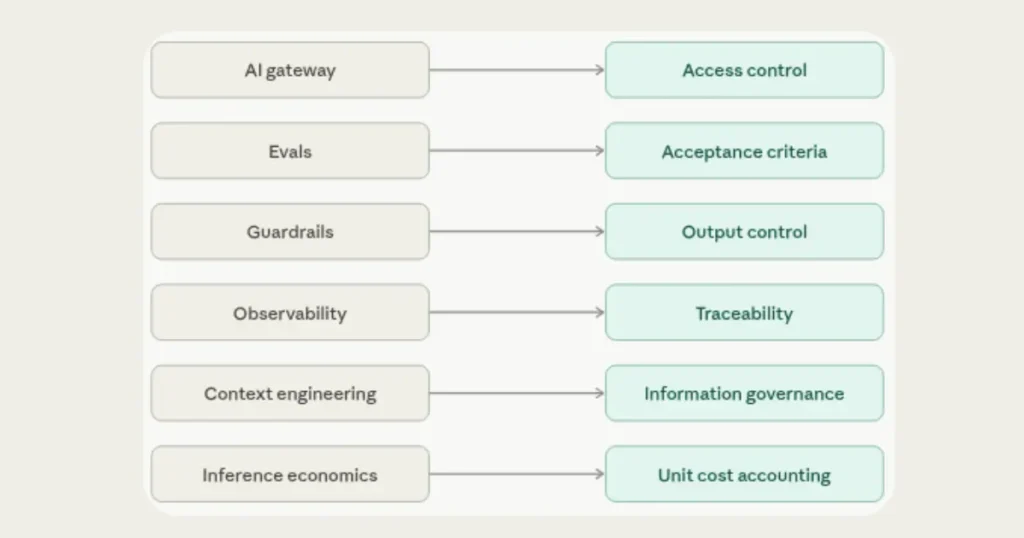
Rename the nine concepts above and the pattern becomes obvious. A gateway is access control. Evals are acceptance criteria. Guardrails are output control. Observability is traceability. Context engineering is information governance. Inference economics is unit cost accounting. None of those are new ideas. Regulated industries like banking and healthcare have made these exact decisions for decades. Only the vocabulary is new.
Defer these decisions and you don’t avoid making them. You just hand them to whoever ends up writing the threshold into the code.
This is what’s sometimes called the AI execution gap: the distance between an AI strategy slide and a system that actually holds up in production, once you see it, is usually just a decision that got renamed until it looked like somebody else’s job.
Take these nine into your next architecture review. Ask who owns each one, and what’s supposed to happen when it fails at 2am. In most companies, six of them will have a clear owner because someone actually built them. The rest will just have a name on a slide. Those are the ones you deferred, and the ones that will cost you the most later.
FAQ
What is context engineering in AI?
Context engineering is the practice of deciding exactly what information, documents, prior conversation, and tool outputs a model sees before it generates a response. It directly shapes answer quality, often more than the choice of model itself.
What is the difference between an AI gateway and an API key?
An API key gets you access to a model. An AI gateway sits in front of every request across your organization, giving you visibility into who used which model, at what cost, and the ability to cut off access instantly if needed.
Do small companies need AI evals, or is that only for enterprise?
Any company shipping an AI feature to real users needs some form of eval, even a simple set of ten test cases with expected outputs. The scale changes with company size, but the underlying discipline of testing before shipping does not.
What’s the difference between an agentic loop and a chatbot?
A chatbot responds once per message and waits for the next human input. An agentic loop plans, acts, checks its own work, and repeats multiple times to complete a task, without a human approving each individual step.
Why do guardrails matter if the model is already well-trained?
A well-trained model can still be prompted into revealing sensitive information or generating off-brand output, especially by users deliberately trying to break it. Guardrails catch what training alone doesn’t, on both the input and output side.
What is the “AI execution gap”?
It’s the distance between a company’s AI strategy and a system that actually survives production. In most cases, that gap isn’t a technology problem. It’s a set of ownership decisions, like risk thresholds and cost controls, that got pushed down to whoever wrote the code instead of being made deliberately by leadership.
Conclusion
The nine concepts here, agentic loops, MCP, subagents, AI gateways, inference economics, evals, guardrails, observability, and context engineering, are not just technical vocabulary to learn for 2026. They’re the actual decisions that separate an AI system that survives contact with real users from one that quietly fails and nobody can explain why. Learn the words if you want, but the real skill is recognizing which of these are risk decisions dressed up as engineering tasks, and making sure you’re the one making them.

Sandeep Kumar is the Founder & CEO of Aitude, a leading AI tools, research, and tutorial platform dedicated to empowering learners, researchers, and innovators. Under his leadership, Aitude has become a go-to resource for those seeking the latest in artificial intelligence, machine learning, computer vision, and development strategies.