
Picture your sales team on a Monday morning. Forty new leads came in over the weekend. Some are ready to buy today. Some are just browsing. A few gave a fake number because, honestly, they weren’t ready to talk to anyone yet. Your reps have no way of knowing which is which until they start dialing, and by the time they get to lead number thirty, the good ones have already gone cold.
It’s not a new problem. Sales teams have been dealing with this forever, and for years, the only answer was “hire more people” or “call faster.” Neither one really works. More people cost more money, and calling faster usually just means rushed, sloppy calls that push people away instead of pulling them in.
This is where AI voice agents have started to make a real dent. Not by replacing your sales team, but by handling the one thing people are surprisingly bad at doing well over and over: asking the same qualifying questions, at the same quality, a hundred times a day, without getting tired or skipping steps.
What’s Actually Broken in Lead Qualification Right Now
It helps to be honest about why this is such a persistent headache before jumping into the fix.
For one, leads don’t wait around. Response-time data has shown for years that your odds of actually qualifying someone drop off fast after the first few minutes, and by the half-hour mark, they’ve usually dropped off a cliff. Most sales teams just can’t hit that window every time. There aren’t enough hours in a day, and reps have other things going on too.
There’s also the time-suck of dead-end calls. A lot of a rep’s day goes into the first two or three minutes of a conversation, just figuring out whether this person has a real budget, a real timeline, and any actual intent to buy. That’s time and energy spent on people who were never going to convert, and it adds up fast across dozens of calls a week.
Then there’s coverage. Nights, weekends, lunch breaks, back-to-back meetings, leads don’t care when they show up, and every call that goes unanswered is basically an invitation for a competitor to get there first.
And honestly, qualification itself tends to be inconsistent. Give the same lead to five different reps, and you’ll probably get five different sets of notes and five different opinions on how “hot” this person really is.
Structured, repeatable, time-sensitive work. That’s basically the definition of what voice AI is good at.
What Does an AI Voice Agent Actually Do Here?
An AI voice agent listens to what a caller is actually saying, figures out what they mean, decides what to ask next, and can take real action inside your business systems, all while holding something closer to a normal conversation than a rigid script. It’s not a phone tree with a nicer voice.
For lead qualification, here’s roughly how that plays out:
It answers immediately. As soon as a lead comes in through a form or a call, the agent is already on the line. No waiting on a rep, no lead sitting untouched overnight.
It works through the right questions in a sensible order. Budget, timeline, who actually makes the decision, what they need. These get asked the same way every time, whether it’s the agent’s first call of the day or its five-hundredth.
It picks up on things that matter even when the conversation doesn’t go as planned. Since it’s built on genuine language understanding rather than just spotting keywords, it can handle a caller who answers a question before it’s even been asked, or who raises an objection out of nowhere, and still steer the conversation to where it needs to go.
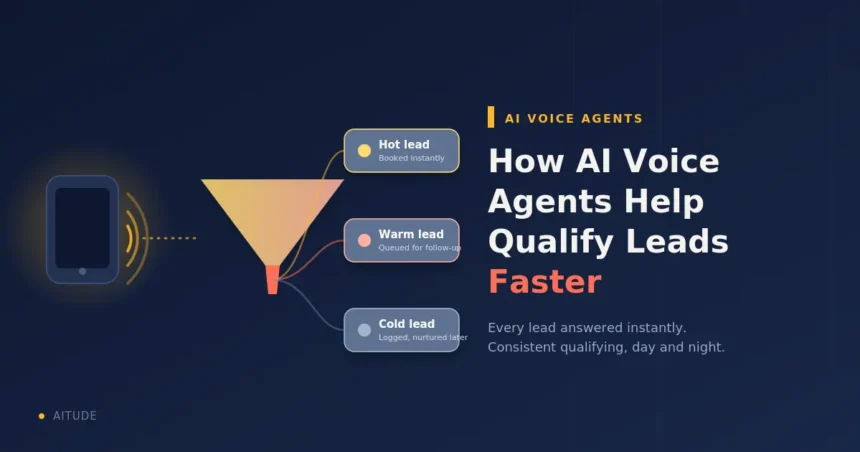
Once it has enough information, it scores the lead (hot, warm, cold, whatever categories you’ve set up), logs everything straight into your CRM, and either books a meeting right then or queues the lead for a follow-up.
Solutions like Infobip conversational ai extend this same idea across voice, WhatsApp, and other channels, so the same qualified lead data flows into one connected system instead of getting scattered across separate tools.
And when a conversation genuinely needs a human touch, judgment, empathy, some back-and-forth negotiation, a properly set-up agent hands it off cleanly, with the context already there so the prospect isn’t stuck repeating themselves to a new person.
Where This Actually Moves the Needle
A big chunk of inbound interest lands outside business hours. Rather than that lead sitting there until Monday, an AI voice agent engages right away and has it fully qualified and ready by the time a rep sits down.
It’s also useful when volume spikes suddenly. Run a paid ad campaign or a seasonal promo and your call volume can triple overnight. Instead of scrambling to staff up temporarily, a voice agent just absorbs the extra load.
Repetitive first-touch conversations are another good fit, things like real estate inquiries, insurance quotes, or demo requests, where the shape of the first call is pretty predictable. That frees reps to spend their energy on people who are actually ready to talk business.
Outbound follow-up benefits too. Instead of a rep grinding through a long list of cold or lukewarm leads by hand, an agent can work the list, check back in, and flag whoever’s actually worth a real callback.
Why This Matters for the Business, Not Just the Sales Team
The appeal here isn’t automation for its own sake. It shows up in things owners actually track:
- Faster response times, which directly improves your odds of converting before someone else does
- Lower cost per qualified lead, since a voice AI call costs a fraction of a human one
- More consistent data, so marketing and sales actually agree on what “qualified” means for once
- Reps spending their time on high-intent conversations instead of repetitive intake work
- Fewer missed opportunities from calls that would’ve gone to voicemail and never gotten a callback
None of this replaces a good sales team, to be clear. It just gets rid of the grunt work that keeps a good team from doing what they’re actually good at.
A Few Things Worth Knowing Before You Bring One In
It’s not plug-and-play magic, and the businesses that get real value out of these tools tend to do a few things in common.
They start small. Pick one use case, like inbound qualification for a single product line, before trying to run outbound campaigns or handle five different workflows at once.
They actually connect it to the systems that matter. An agent that qualifies leads but never pushes that data into a CRM or calendar is only doing half the job.
They build a real handoff path. People get frustrated fast when an AI doesn’t seem to notice it’s out of its depth, so a clean way to get to a human matters just as much as the script itself.
They test with messy, real conversations, not polished demos. Actual callers interrupt, change the subject, and phrase things in ways nobody planned for, and the agent needs to hold up under that before it ever goes live.
And they keep a human checking in on quality. Pulling call transcripts and refining the flow based on what’s actually happening beats assuming the first version got it right.
The Bottom Line
Lead qualification has always come down to speed and consistency, and most sales teams struggle with both no matter how good they are. AI voice agents don’t fix that by outworking people. They fix it by showing up the second a lead raises their hand, and by asking the right questions every single time without getting tired, distracted, or having an off day.
For businesses getting more inbound interest than they have hours to handle, that’s stopped being a nice-to-have. It’s becoming the difference between a lead that turns into a customer and one that quietly ends up with a competitor instead.

Sandeep Kumar is the Founder & CEO of Aitude, a leading AI tools, research, and tutorial platform dedicated to empowering learners, researchers, and innovators. Under his leadership, Aitude has become a go-to resource for those seeking the latest in artificial intelligence, machine learning, computer vision, and development strategies.