

If you’ve ever tried to answer “which of our customers are secretly connected to a fraud ring” using SQL joins, you already know the pain graph computing exists to solve. Graph computing is the practice of modeling data as vertices and edges, then running analysis directly on those relationships instead of reconstructing them through joins every time. You’ll walk away from this knowing exactly where it fits in your stack and where it’s overkill.
- What Graph Computing Actually Means
- Graph Computing vs Graph Database vs Graph Analytics
- How Graph Computing Works Under the Hood
- The Three Pillars: Processing, Mining, Learning
- Why Graph Neural Networks Changed the Conversation
- Where Enterprises Actually Use Graph Computing
- The Hardware Problem Nobody Talks About
- When You Should (and Shouldn’t) Reach for Graph Computing
- Common Mistakes
- Pro Tips
- Key Takeaways
- FAQ
- Conclusion
Most explainers either stay stuck in academic graph theory or oversell graph databases as a silver bullet. This one draws the line between the two, shows you the actual architecture, and gives you a framework for deciding if your team needs it.
What Graph Computing Actually Means
Graph computing is the set of techniques and systems used to store, process, and analyze data that’s structured as networks of connected entities, rather than rows in a table. A vertex represents an entity (a person, a transaction, a product). An edge represents a relationship between two vertices (bought, follows, sent-payment-to). Once data is shaped this way, you can traverse relationships directly instead of computing them on the fly.
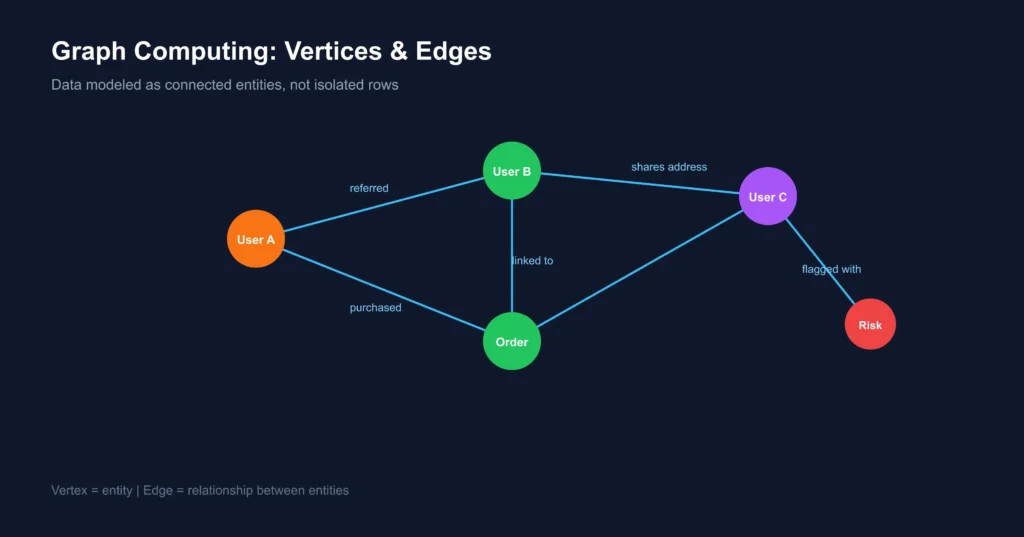 The distinction that trips people up: graph computing is the broader discipline. A graph database is one implementation of it, built for transactional lookups. A graph compute engine is a different implementation, built for bulk analytical workloads across an entire graph at once. Confusing the two leads to picking the wrong tool for the job, which is one of the most common mistakes teams make (more on that below).
Key Takeaway
Graph computing isn’t a product you buy. It’s an approach to modeling and querying connected data, and the tool you pick depends on whether you need fast single-entity lookups or bulk pattern analysis across millions of nodes.
Graph Computing vs Graph Database vs Graph Analytics
These three terms get used interchangeably in marketing copy, and that’s where confusion starts. Here’s how they actually differ.
| Term | What it does | Typical workload | Example tools |
|---|---|---|---|
| Graph database | Stores and queries connected records, optimized for transactional (OLTP) access | “Show me all of Jack’s second-degree connections” | Neo4j, Amazon Neptune, ArangoDB |
| Graph compute engine | Runs bulk analysis across an entire graph (OLAP) | “Find every community cluster in this 500-million-node network” | Apache Giraph, GraphX, TigerGraph analytics |
| Graph analytics | The umbrella term for algorithms you run on graph data | Centrality, shortest path, community detection, PageRank | Runs on top of either database or compute engine |
You’ll see graph databases described as “NoSQL,” which is accurate but slightly misleading. They’re not schema-free chaos, they just prioritize relationship storage over the rigid table structure relational databases depend on.
Pro Tips
- If your product needs sub-second relationship lookups at request time (recommendation widgets, fraud checks during checkout), you want a graph database.
- If you’re running offline batch jobs to find patterns across your entire dataset (network-wide fraud rings, supply chain risk mapping), you want a graph compute engine, not a database stretched past its design intent.
How Graph Computing Works Under the Hood
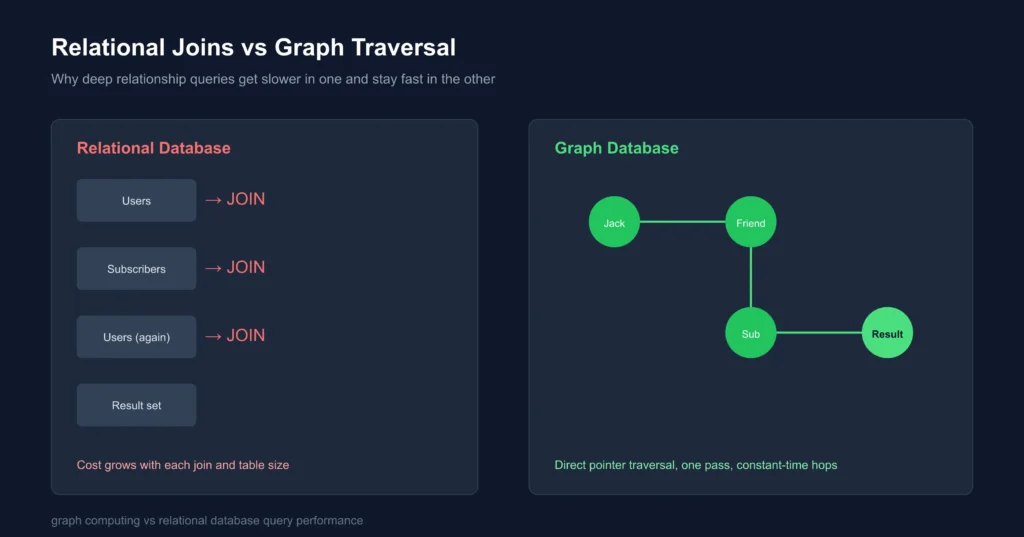
At the storage layer, most native graph systems use index-free adjacency. Instead of looking up a relationship through an index every time (the way relational databases do with foreign keys), each node holds a direct physical pointer to its neighbors. That’s what makes multi-hop traversals fast. In a relational database, a three-hop query means three joins, and each join gets more expensive as your tables grow. In a graph system, a three-hop query is just following three pointers.
This is also why graph databases and relational databases solve different problems well. Relational systems still win on simple, flat lookups and set operations across large row counts. Graph systems pull ahead the moment your query involves more than one or two levels of relationship, which is exactly the kind of question that shows up in fraud detection, recommendation, and identity resolution.
Common Mistakes
Teams sometimes migrate an entire relational schema to a graph database because “graphs are faster,” then discover their actual queries are flat lookups that a well-indexed Postgres table handles just fine. Graph systems earn their keep on deep, relationship-heavy queries. If most of your queries are one join deep, you probably don’t need one.
The Three Pillars: Processing, Mining, Learning
Graph analytics, as a discipline, splits into three overlapping areas, and knowing which one you’re actually doing changes your tooling choice entirely.
Graph processing covers algorithms that traverse or transform a graph directly: shortest path, PageRank, connected components, centrality measures. This is what most people mean when they say “graph analytics.”
Graph mining looks for patterns you didn’t already know to search for: community detection, anomaly detection, frequent subgraph discovery. This is the layer fraud and risk teams live in.
Graph learning applies machine learning directly to graph-structured data, most commonly through graph neural networks. This is the newest and fastest-growing of the three.
Researchers studying large-scale graph computing have pointed out that as datasets grow, all three areas run into the same wall: general-purpose hardware wasn’t built for the access patterns graphs demand, which is why domain-specific architecture research has become its own active field.
Why Graph Neural Networks Changed the Conversation
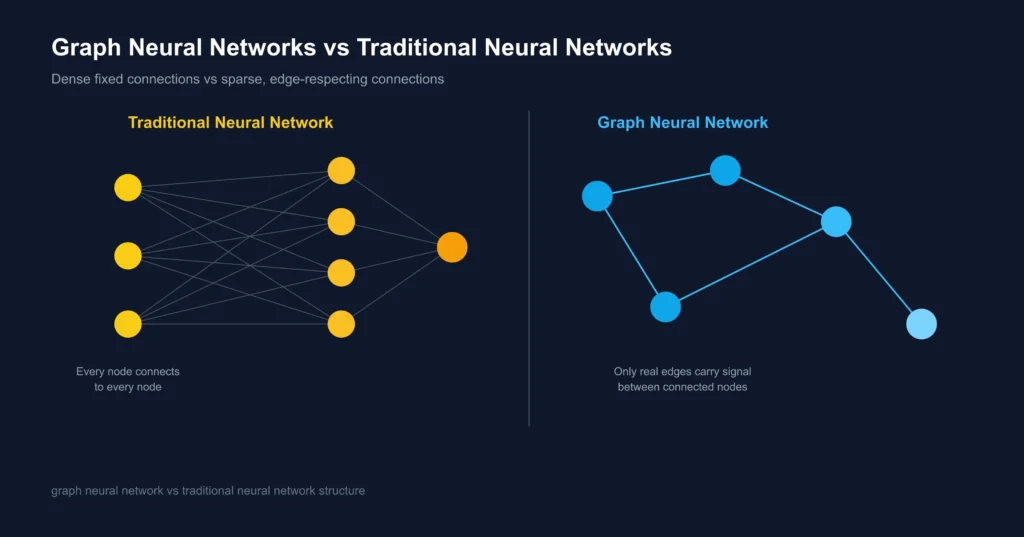
Traditional neural networks expect ordered, structured input: a fixed-size vector, a matrix, a grid of pixels. Graphs don’t offer that. A social network doesn’t have a natural order, and the number of connections per node varies wildly. That mismatch is exactly why standard deep learning struggled with relational data for years.
Earlier graph engine frameworks tried to bridge this gap by pairing distributed graph computation with algorithms like matrix factorization, and they worked reasonably well for those specific cases, but they hit a wall with anything resembling a modern neural network. The core issue was structural: those engines weren’t built with GPU-based training in mind, and deep learning had already moved decisively in that direction.
Graph neural networks solve this by treating the graph structure itself as the input a model learns from, rather than forcing graph data into a matrix shape it was never meant to hold. Instead of a dense layer connecting every node to every other node the way a standard neural net would, a GNN respects the actual edges in your graph and only propagates information along real connections. That’s a meaningful shift: you’re no longer approximating relationships through engineered features, you’re letting the model learn directly from the connection structure.
Where this matters practically: any prediction task where the label depends heavily on who or what a node is connected to, not just the node’s own attributes. Predicting whether a transaction is fraudulent based on the surrounding network of accounts is a graph learning problem. Predicting churn based purely on a customer’s own usage stats is not, even though both feel like “AI on customer data.”
Key Takeaway
If your prediction problem changes meaningfully depending on a node’s neighbors, you have a graph learning problem, and forcing it into a standard tabular ML model will quietly cap your model’s ceiling.
Where Enterprises Actually Use Graph Computing
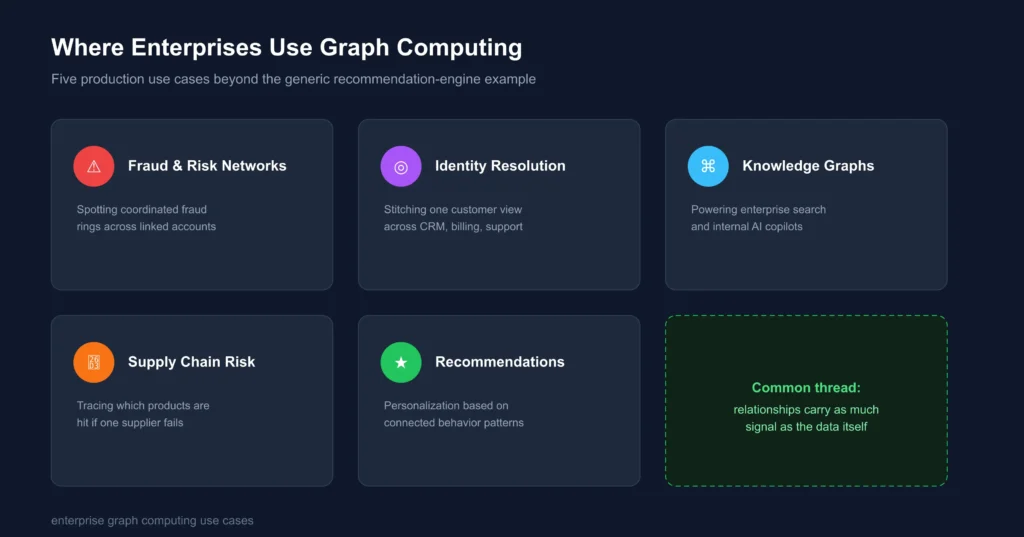
Skip the generic “social networks and recommendation engines” list you’ve read a dozen times. Here’s where graph computing earns its budget line in production systems today.
Fraud and risk networks. Financial institutions use graph traversal to spot rings of accounts that individually look clean but are structurally connected in ways that indicate coordinated fraud. This is a graph mining problem, not a simple rules-based flagging problem.
Identity resolution. Enterprises with data scattered across CRM, support, billing, and marketing systems use graph models to stitch together “is this the same customer” without a single master ID, by following relationship signals across systems.
Knowledge graphs. Enterprise search and internal AI copilots increasingly sit on top of a knowledge graph layer that connects documents, people, projects, and decisions, so a query can traverse “who worked on this, what did they decide, what changed after” instead of relying on keyword match alone.
Supply chain risk mapping. Manufacturers use graph traversal to answer “if this one supplier in Southeast Asia goes down, which of our end products are actually affected,” a question that’s nearly impossible to answer cleanly with relational joins once you’re several tiers deep.
Recommendation and personalization. Still relevant, still valuable, but worth noting this is usually the easiest use case and the one with the most mature tooling. If this is your only use case, you likely don’t need a dedicated graph compute engine, a graph-aware recommendation library will do.
The Hardware Problem Nobody Talks About
Here’s the part most business-facing content skips entirely: graph computing has a hardware problem, and it’s the reason so much current research money is going into domain-specific architecture rather than just better software.
General-purpose CPUs and memory systems are built around predictable, sequential access patterns. Graph traversal is the opposite: it’s irregular, unpredictable, and memory-access-heavy, which means it doesn’t map cleanly onto hardware designed for dense linear algebra or sequential data streams. Academic reviews of the field note that as graphs grow past billions of edges, this mismatch becomes the primary bottleneck, not the algorithm itself, which is why researchers have been exploring architectural innovations, including newer memory device designs, specifically to close that gap.
For a founder or CTO, the practical implication is this: if you’re evaluating graph infrastructure at genuine enterprise scale (hundreds of millions to billions of edges), don’t just benchmark on algorithm speed. Ask your vendor how they handle memory locality and irregular access patterns at scale, because that’s usually where “works great in the demo” turns into “falls over in production.”
When You Should (and Shouldn’t) Reach for Graph Computing
Use this as your internal decision filter before greenlighting a graph computing project.
Reach for it when:
- Your core question involves multi-hop relationships (second, third, fourth-degree connections)
- Relationships between entities carry as much signal as the entities themselves
- Your relational joins are getting deep enough that query performance is degrading in production
- You’re building fraud detection, identity resolution, knowledge graphs, or network risk analysis
Skip it when:
- Your queries are one join deep and a well-indexed relational database already performs fine
- You need strict ACID compliance across complex multi-table transactions with no relationship-heavy read pattern
- Your team has no one who can maintain a graph query language (Cypher, Gremlin, SPARQL) long-term
- You’re chasing “graph” because it’s trending, not because your data model demands it
Decision Framework
- Map your top 5 most business-critical queries.
- For each, count how many relationship hops it takes to answer.
- If 3+ queries need 2+ hops and performance already hurts, graph computing is worth a pilot.
- If it’s 1 query out of 5, solve that one query with a graph-aware library instead of migrating your whole data layer.
Common Mistakes
- Treating graph database and graph compute engine as interchangeable. They solve different problems (transactional lookup vs bulk analysis) and picking the wrong one for your workload wastes months.
- Migrating for buzzword reasons. “Everyone’s doing graph now” is not a data modeling requirement.
- Ignoring hardware realities at scale. A graph system that runs fine at 10 million edges can behave very differently at 5 billion, and the hardware access pattern is usually why.
- Skipping the query language investment. Cypher, Gremlin, and SPARQL each have a learning curve. Underestimating this is a common reason graph projects stall after the pilot phase.
Pro Tips
- Start with a graph-aware library on top of your existing database before committing to a full graph platform migration. Prove the use case cheaply first.
- If your use case is genuinely relationship-heavy but small (under a few million edges), you likely don’t need distributed graph infrastructure at all, a single-node graph database will outperform a distributed one on latency.
- For AI teams specifically: before reaching for a graph neural network, confirm your prediction task actually depends on neighbor structure. If it doesn’t, a standard model will train faster and be easier to maintain.
Key Takeaways
- Graph computing is an approach, not a single product. Graph databases and graph compute engines solve different problems, and mixing them up is the single most common team-level mistake.
- The real advantage shows up at multi-hop queries. If your relationships are shallow, relational systems still win.
- At true enterprise scale, hardware access patterns, not algorithms, become the bottleneck, so evaluate infrastructure with that in mind, not just benchmark speed.
FAQ
Is graph computing the same as a graph database?
No. Graph computing is the broader discipline of modeling and analyzing connected data. A graph database is one specific implementation built for fast transactional lookups. A graph compute engine is a different implementation built for bulk analytical processing across an entire graph. You can do graph computing without ever touching a graph database.
When should a company choose a graph database over a relational database?
When your core queries involve two or more relationship hops and that pattern shows up repeatedly in production, not just occasionally. If your data model is genuinely relationship-dense, such as fraud networks, identity graphs, or knowledge graphs, a graph database typically outperforms relational joins as depth increases. If your queries stay shallow, a well-indexed relational database usually remains the better choice.
What’s the difference between graph analytics and graph neural networks?
Graph analytics refers to traditional algorithms like shortest path, centrality, and community detection that traverse or transform a graph directly. Graph neural networks are a machine learning approach that trains a model to learn patterns directly from graph structure, useful when you need predictions rather than direct traversal answers.
Why did graph engines struggle to support deep learning?
Earlier graph engine frameworks were built for distributed computation, not GPU-based training, and deep learning had already shifted heavily toward GPU acceleration. That mismatch, combined with graphs lacking the structured, ordered format standard neural networks expect, is what drove the development of graph neural networks as a separate approach.
Does graph computing require replacing our existing database?
Not necessarily. Many teams start by adding a graph-aware layer or library on top of existing infrastructure to prove out a specific use case before considering a full migration. Full replacement usually only makes sense once relationship-heavy queries are a dominant, recurring part of your workload.
What industries use graph computing the most right now?
Financial services (fraud and risk), enterprise search and internal AI systems (knowledge graphs), logistics and manufacturing (supply chain risk mapping), and consumer platforms (recommendation and identity resolution) are the heaviest current users, based on published research and case studies from major graph database and analytics vendors.
Is graph computing worth it for a small team or early-stage product?
Usually only if your product’s core value proposition depends on relationships between entities, not just the entities themselves. For most early-stage products, a relational database with well-designed indexes will outperform the added operational overhead of a dedicated graph system.
Conclusion
Graph computing earns its place the moment relationships in your data carry as much meaning as the data points themselves. That’s the biggest insight to hold onto: it’s not about picking a trendy database, it’s about recognizing when your queries have outgrown what joins can efficiently answer.
Three things worth remembering: graph databases and graph compute engines solve different problems, so know which one your workload actually needs. The real performance gain shows up at multi-hop queries, not shallow ones. And at genuine scale, hardware access patterns become the bottleneck before your algorithm does.
If you’re evaluating graph computing for your own stack, start small. Map your five most relationship-heavy queries, test them against a graph-aware library before committing to a full platform, and let the data, not the trend, decide whether you actually need it.

Sandeep Kumar is the Founder & CEO of Aitude, a leading AI tools, research, and tutorial platform dedicated to empowering learners, researchers, and innovators. Under his leadership, Aitude has become a go-to resource for those seeking the latest in artificial intelligence, machine learning, computer vision, and development strategies.