

Well-structured data doesn’t just happen; it’s discovered. While many machine learning models rely on pre-labeled information to make predictions, a powerful subset operates on a more fundamental task: finding the hidden structure in raw, unlabeled data. This is the core of clustering in machine learning, an unsupervised learning technique that automatically groups similar data points together without prior knowledge of what those groups should be. The field is currently undergoing a rapid transformation, moving beyond classic algorithms toward deep learning models that can interpret everything from customer behavior to complex financial time-series data.
Recent advancements have fundamentally changed how clustering is performed. In early 2024, for instance, OpenAI released new embedding models specifically optimized for clustering tasks, enabling more efficient and meaningful data representation. This industry-wide shift toward using neural embeddings before grouping is making clustering more powerful than ever.
Key Takeaways
- Unsupervised Learning: Clustering is a type of machine learning where the algorithm learns patterns from unlabeled data, identifying inherent groups or clusters based on similarity.
- Shift to Deep Learning: The field has evolved from traditional algorithms like K-Means to “deep clustering,” which uses neural networks to handle complex, unstructured data like text and images.
- Automation and Interpretation: Modern methods are focused on automating key parameters, such as the number of clusters, and making the results more transparent through explainable AI (XAI) techniques.
- Expanding Applications: Clustering is no longer limited to static datasets. New algorithms are being developed for distributed data, continuous online data streams, and complex time-series analysis.
What is Clustering in Machine Learning?
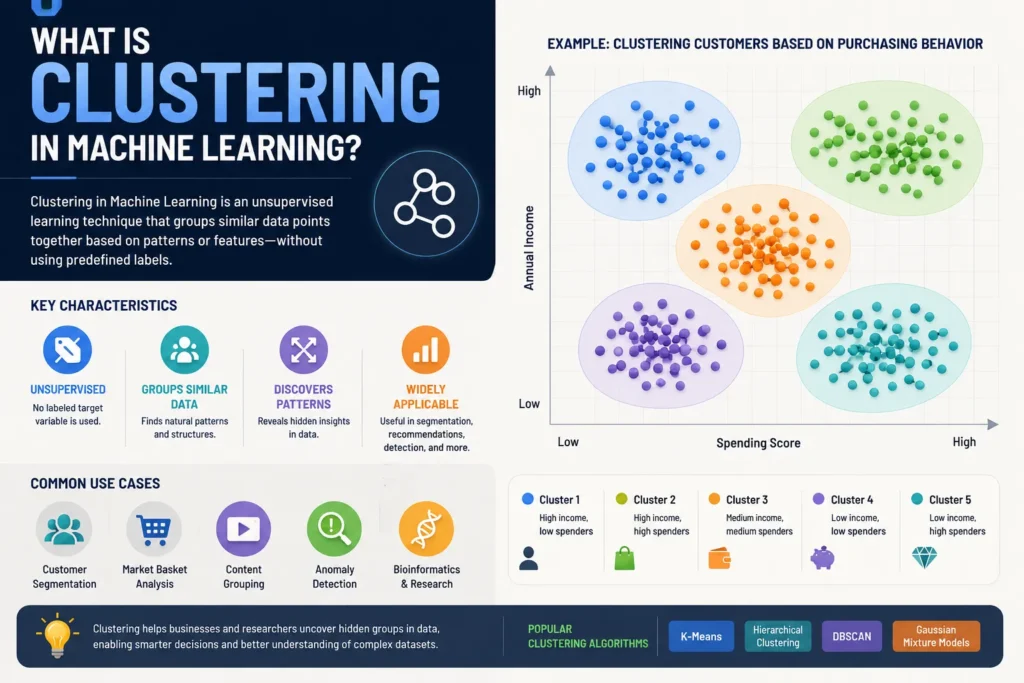
Clustering is the task of dividing a population or data points into a number of groups such that data points in the same groups are more similar to other data points in the same group than to those in other groups. In simple terms, the goal is to segregate groups with similar traits and assign them into clusters.
Because it is an unsupervised learning method, clustering algorithms work with data that has not been labeled or categorized. The model itself finds the patterns and relationships. This makes it an incredibly versatile exploratory data analysis tool.
Consider these common applications:
- Customer Segmentation: E-commerce companies can group customers based on purchasing behavior, browsing history, and demographics to create targeted marketing campaigns.
- Document Analysis: News articles or research papers can be clustered by topic, allowing for easier organization and retrieval of information.
- Anomaly Detection: In cybersecurity, clustering can identify normal patterns of network traffic, making it easier to spot unusual activity that could signal an attack.
- Biological Sciences: Researchers use clustering to group genes with similar expression patterns or to classify different types of cells based on their attributes.
The core principle behind all of these applications is the same: find the natural groupings in the data to unlock insights that were not immediately obvious.
The Evolution of Clustering: From K-Means to Deep Learning
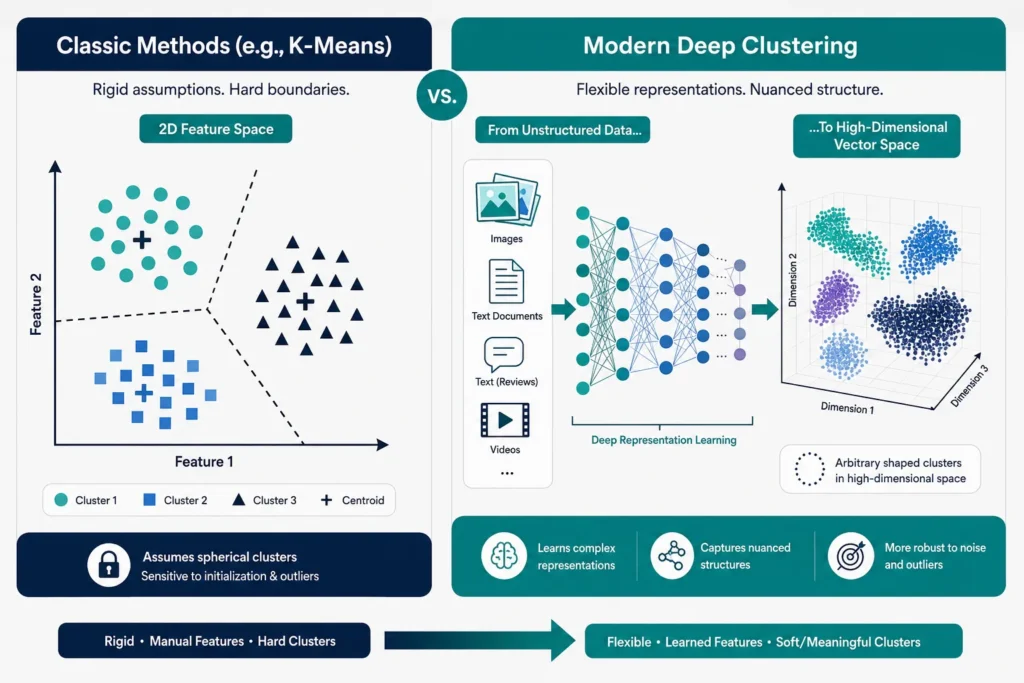
For decades, clustering in machine learning was dominated by algorithms that made strong assumptions about the structure of the data. Methods like K-Means (which assumes clusters are spherical) and Hierarchical Clustering (which builds a tree of clusters) were foundational. However, their effectiveness diminishes when faced with high-dimensional or unstructured data, such as images, text, or audio.
The modern era of clustering is defined by a significant paradigm shift toward deep clustering. This approach leverages the power of deep neural networks to first learn meaningful representations of the data before applying a grouping algorithm. Instead of working with raw data, the model works with compact, information-rich vectors known as embeddings.
This two-step process, representation learning followed by clustering, has proven far more effective for complex data. Industry leaders have embraced this methodology, with OpenAI’s API documentation highlighting clustering as a primary application for its powerful vector embeddings. These models are trained to capture the semantic meaning of data, making the subsequent clustering far more accurate and relevant. For example, two sentences with different wording but similar meaning will be placed closer together in the vector space, allowing a clustering algorithm to group them correctly.
This shift addresses a fundamental limitation of classic methods: their inability to understand the underlying content of unstructured data. A traditional algorithm can’t tell that a picture of a golden retriever and a picture of a poodle are both “dogs,” but a deep learning model can learn this relationship and group them accordingly.
Key Innovations and Trends in 2026
The field of clustering is advancing at a breathtaking pace, with new research constantly pushing the boundaries of what’s possible. Several key trends are defining the future of this technology, moving it toward greater automation, broader applicability, and increased transparency.
One of the most significant challenges in clustering has always been determining the optimal number of clusters, often denoted by the variable ‘k’. In 2024, researchers from the Munich Center for Machine Learning introduced a method called UNSEEN, which can automatically estimate this number from an upper bound, reducing the need for manual trial-and-error.
Simultaneously, the scope of clustering is expanding to new data types. Recent surveys highlight the growing integration of foundation models like Chronos and TimesFM to process and cluster temporal data, a domain previously difficult to analyze. This allows organizations to find patterns in financial markets, sensor readings, and user activity over time.
As machine learning models become more integrated into business-critical applications, the demand for transparency has grown. A 2024 survey on interpretable clustering outlines new methods for making these models explainable. These techniques, categorized into pre-clustering, in-clustering, and post-clustering stages, help users understand why the model made a particular grouping decision, which is crucial for auditing and building trust.
Furthermore, research is addressing the logistical challenges of modern data. New frameworks are being designed to handle clustering on distributed data, preserving privacy and improving scalability in decentralized environments. To handle the continuous flow of information in applications like social media feeds or IoT sensors, novel methods for “online deep clustering” have been developed, allowing models to group data points as they arrive in real-time.
Common Clustering Algorithms and Their Use Cases
While deep clustering represents the cutting edge, several foundational algorithms remain relevant and are often used in conjunction with newer techniques. Understanding their principles is essential for any practitioner.
| Algorithm | How It Works | Best For |
|---|---|---|
| K-Means | Partitions data into ‘K’ distinct, non-overlapping clusters. It iteratively assigns each data point to the nearest mean (cluster centroid). | Datasets where clusters are spherical and roughly equal in size. It’s fast and computationally efficient. |
| Hierarchical Clustering | Creates a tree-like structure of clusters (a dendrogram). It can be agglomerative (bottom-up) or divisive (top-down). | When the hierarchy of clusters is important, such as in taxonomy or gene sequencing. |
| DBSCAN | Groups together points that are closely packed, marking as outliers points that lie alone in low-density regions. | Discovering clusters of arbitrary shapes and handling noise or outliers effectively. Does not require specifying the number of clusters. |
| Gaussian Mixture Models (GMM) | A probabilistic model that assumes the data points are generated from a mixture of a finite number of Gaussian distributions. | More flexible than K-Means as it can accommodate clusters of different shapes and sizes (ellipsoidal). |
How to Choose the Right Clustering Algorithm
Selecting the best algorithm depends on several factors related to your data and your goals.
- Data Structure and Size: For large datasets with spherical clusters, K-Means is a strong, efficient choice. For data with irregular shapes and noise, DBSCAN is often superior.
- Need for Hierarchy: If you need to understand the nested relationships between groups, Hierarchical Clustering is the only choice that provides a dendrogram.
- Interpretability: If you need to explain the results, simpler models like K-Means are easier to interpret. For deep clustering models, you may need to employ additional XAI techniques [5.
- Computational Resources: K-Means and DBSCAN are generally faster than Hierarchical Clustering or GMMs, especially on large datasets. Deep learning methods require significant computational power, often including GPUs.
- Data Type: For unstructured data like text or images, a deep clustering approach using pre-trained embeddings is now considered state-of-the-art.
Conclusion
Clustering in machine learning has evolved from a niche statistical method into a cornerstone of modern data science. It is an essential tool for uncovering hidden patterns, understanding complex datasets, and driving intelligent business decisions. The rapid advancements in deep learning, automation, and interpretability are making clustering more powerful, accessible, and transparent than ever before.
For businesses and data scientists looking to leverage their data in 2026, the path forward is clear. Start by exploring your data to understand its underlying characteristics. Experiment with foundational algorithms to establish a baseline, but quickly move to embrace modern deep clustering techniques, especially when dealing with unstructured data. By staying current with the latest research in areas like automated parameter tuning and explainable AI, you can unlock the full potential of your data and gain a significant competitive advantage.
FAQs
1. What is clustering in machine learning?
Clustering in machine learning is an unsupervised learning technique that groups similar data points together without using predefined labels.
2. Is clustering supervised or unsupervised learning?
Clustering is a type of unsupervised learning because it discovers patterns and groups in unlabeled data.
3. What are the most common clustering algorithms?
Common algorithms include K-Means, Hierarchical Clustering, DBSCAN, and Gaussian Mixture Models (GMM).
4. What is K-Means clustering used for?
K-Means is commonly used to divide data into a predefined number of clusters. It works particularly well when clusters are relatively spherical and similar in size.
5. What is deep clustering?
Deep clustering combines neural-network-based representation learning with clustering algorithms. It is particularly useful for complex or unstructured data such as text and images.
6. How is clustering used in real-world applications?
Clustering can be used for customer segmentation, document analysis, anomaly detection, biological research, and other applications where hidden patterns need to be discovered.
7. How do you choose the right clustering algorithm?
The choice depends on factors such as dataset size, data structure, noise, the need for hierarchy, interpretability, available computing resources, and whether the data is structured or unstructured.
8. Why is clustering important in machine learning?
Clustering helps uncover hidden structures and relationships in unlabeled datasets, making it useful for exploratory data analysis and extracting insights from complex data.

Sandeep Kumar is the Founder & CEO of Aitude, a leading AI tools, research, and tutorial platform dedicated to empowering learners, researchers, and innovators. Under his leadership, Aitude has become a go-to resource for those seeking the latest in artificial intelligence, machine learning, computer vision, and development strategies.