

Artificial intelligence is good at working with information. The harder problem is getting it to work reliably with the physical world. Robots, autonomous machines, and intelligent devices must deal with movement, uncertainty, and environments that rarely behave exactly as expected. That is where physical AI and real-world data come into the picture.
From Digital Intelligence to Physical Interaction
Much of the recent progress in artificial intelligence has happened in digital environments. Language models process text, computer vision systems interpret images, and recommendation engines find patterns in large datasets.
Physical systems face a different challenge.
Consider a robot picking products in a warehouse. Recognizing a box is only one part of the task. The robot must estimate its position, decide how to approach it, control its movement, and react if a person or another object suddenly enters its path.
Physical AI brings these capabilities together. It applies artificial intelligence to machines that perceive, reason about, and act within physical environments.
In practice, this means intelligence is no longer separated from movement and interaction.
Why Physical AI Needs Different Data
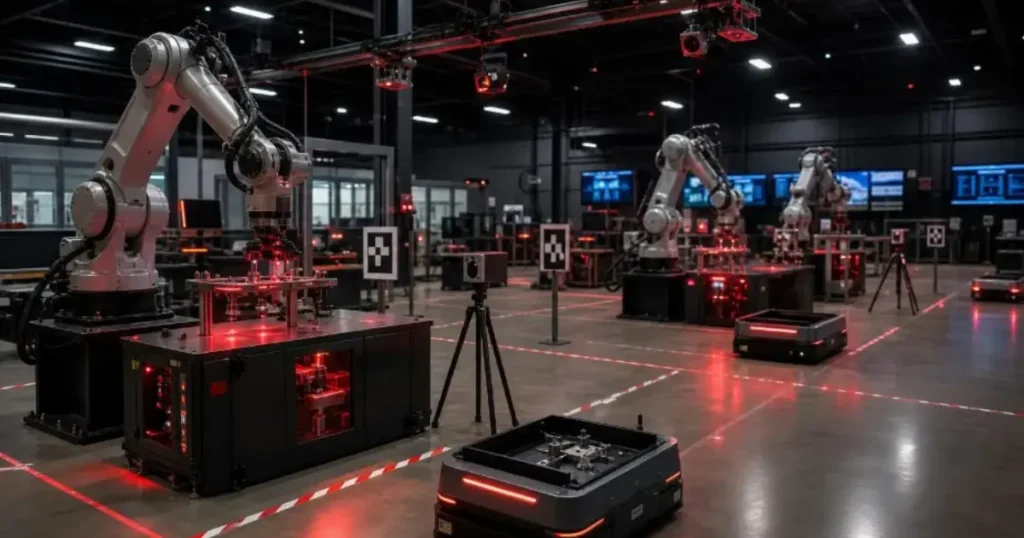
Training a model to operate in the real world requires information that represents how the real world actually behaves.
Images are useful, but they are rarely enough. A physical AI system may also need depth measurements, motion trajectories, force information, sensor readings, object states, and records of how humans interact with their surroundings.
Common data sources include:
- Camera and video streams
- LiDAR and depth information
- Robot motion and manipulation trajectories
- Spatial and 3D environment data
- Sensor and telemetry records
- Human-object interaction data
The value comes from combining these signals rather than treating each one in isolation.
For example, a robot may visually identify an object while using depth information to estimate its distance. Motion data can then help determine how the robot should reach, grasp, or move that object.
That combination turns perception into action.
Real-World Data Helps Close the Simulation Gap
Simulation plays an important role in robotics because developers can test large numbers of situations without constantly operating physical machines.
Still, simulated environments cannot reproduce every detail of reality.
Lighting changes. Surfaces have different levels of friction. Sensors produce noise. Objects appear in unusual positions. Human behavior is difficult to predict.
These differences create what robotics researchers often call the sim-to-real gap.
Real-world physical AI data helps developers identify where models trained in simulations behave differently after deployment. The information can then be used to refine training, evaluate performance, and expose the system to situations it has not previously encountered.
The goal is not necessarily to replace simulation. A more practical approach is to combine simulated and real-world data so that each covers the limitations of the other.
Where Physical AI Is Already Relevant
Physical AI is not limited to humanoid robots. Its underlying methods are relevant wherever artificial intelligence must understand physical conditions and take action.
Manufacturing and Warehousing
Industrial robots traditionally work well when tasks and surroundings remain predictable. AI-based perception can make automation more flexible when products, positions, or workflows change.
In warehouses, similar technology can support picking, sorting, inspection, and autonomous movement.
Autonomous Machines
Self-driving vehicles, delivery robots, drones, and other autonomous systems continuously interpret their surroundings.
They must distinguish objects, estimate movement, understand spatial relationships, and choose an appropriate response. These decisions depend heavily on the quality and diversity of the underlying physical data.
Healthcare and Service Robotics
Physical AI can also support machines designed to assist people directly. Service robots may need to navigate crowded spaces, manipulate everyday objects, or operate near humans.
These environments make accurate perception particularly important because small errors can have practical consequences.
Building a Better Data Foundation
As physical AI applications become more ambitious, developers face a straightforward problem: collecting useful real-world data takes time and specialized infrastructure.
Quantity alone does not solve it.
A large dataset containing repetitive situations may be less useful than a smaller dataset covering varied environments, objects, behaviors, and edge cases. Data provenance, annotation quality, sensor configuration, and collection conditions also matter when evaluating whether a dataset fits a particular model.
This has created a role for specialized data providers and platforms.
For instance, EGXO Data focuses on data resources for physical AI and artificial intelligence development. Such resources can complement internally collected or simulated datasets when teams need broader real-world scenarios for model training, testing, or evaluation.
The important question for developers is not simply, “How much data is available?” It is, “Does this data represent the conditions the system will actually face?”
Reliability Matters as Much as Capability
A successful laboratory demonstration does not automatically translate into a dependable real-world system.
Physical AI developers must test what happens when sensors fail, objects are partially hidden, environments change, or the machine encounters something outside its training distribution.
Therefore, evaluation should include unusual and difficult situations rather than only ideal operating conditions.
The National Institute of Standards and Technology AI Risk Management Framework also emphasizes areas such as validity, reliability, safety, security, transparency, and accountability when organizations assess AI systems.
For physical systems, these principles have direct operational relevance. An incorrect digital recommendation can be inconvenient; an incorrect physical action can have immediate consequences.
What Comes Next for Physical AI?
Better models will certainly matter, but physical AI is unlikely to advance through algorithms alone.
Progress will also depend on richer multimodal datasets, better simulation, improved sensors, stronger evaluation methods, and more representative real-world training examples. Developers will need to understand not only whether a model performs well, but also where and why it fails.
That makes data an engineering issue rather than simply a training input.
Conclusion
Physical AI gives artificial intelligence something it has traditionally lacked: a practical connection to the world around it.
For robots and autonomous machines, the best path forward is not simply to build larger models. It is to combine capable AI with diverse physical data, realistic testing, and careful evaluation. When those pieces work together, artificial intelligence becomes much more useful outside the screen.

Sandeep Kumar is the Founder & CEO of Aitude, a leading AI tools, research, and tutorial platform dedicated to empowering learners, researchers, and innovators. Under his leadership, Aitude has become a go-to resource for those seeking the latest in artificial intelligence, machine learning, computer vision, and development strategies.