


An AI health summary can turn scattered symptom notes, laboratory reports, medication lists, wearable readings, and appointment records into a single document. Instead of searching through multiple files before a consultation, a patient can review one organized timeline or briefing.
- What Is an AI Health Summary?
- Benefits of Using AI Health Summaries
- Limitations of AI Health Summaries
- Watch for AI Hallucinations
- Review Privacy and Security
- Popular Health Platforms
- The AI Health Summary Workflow
- What AI Can and Cannot Do
- Begin With the Purpose of the Appointment
- Trace Important Statements Back to Their Sources
- Check Every Detail That Can Be Verified
- Separate Observations From AI Interpretations
- How AI Health Summaries May Evolve in the Future
These summaries are becoming more relevant as AI adoption expands across healthcare. In a 2026 American Medical Association survey of 1,692 physicians, 81% said they used AI professionally, while 28% reported using it to generate chart summaries.
However, a polished AI patient summary is not automatically accurate. The system may misread a date, omit an allergy, confuse a reference range with a test result, or add an explanation that was never present in the original record.
Before sharing an AI-generated summary, treat it as an editable briefing rather than a diagnosis.
What Is an AI Health Summary?
An AI health summary is a condensed account of a person’s health information created with artificial intelligence. It may combine symptoms, medications, diagnoses, laboratory values, appointments, lifestyle notes, history, and questions for a healthcare provider.
The information can come from electronic health records, uploaded PDFs, photographs of prescriptions, voice notes, symptom diaries, patient portals, or conversations with an AI medical assistant. Some systems create a chronological timeline, while others generate a short narrative, structured report, or list of key events.
How AI Generates Health Summaries
An AI medical-record summary may involve several technologies working together.
Optical character recognition, commonly called OCR, extracts text from scanned reports, photographs, prescriptions, and PDF files. Speech-to-text technology performs a similar function for recordings, turning spoken descriptions or conversations into written text.
Both processes can introduce errors when the source contains poor image quality, handwriting, background noise, unfamiliar accents, or complex medical terminology.
Medical natural language processing, or medical NLP, then identifies information such as symptoms, medication names, dates, test values, diagnoses, and relationships between events. Large language models can use that extracted information to produce a readable AI patient summary, timeline, or table.
These technologies form part of the broader development of generative AI in healthcare. An overview of AI in healthcare software development provides further context on how predictive systems, language models, and clinical tools are being incorporated into healthcare platforms.
Some systems also use retrieval-augmented generation, or RAG. Rather than relying only on information learned during model training, a RAG system retrieves relevant material from selected documents before generating its answer. This may help ground a summary in the uploaded records, though it cannot guarantee every sentence is correct. A guide to retrieval-augmented generation explains how this process works.
Benefits of Using AI Health Summaries
The main benefits of AI health summaries include:
- Better organization: AI can bring information from messages, test reports, prescriptions, wearable applications, calendars, and handwritten notes into one structured summary.
- Improved recall: A reviewed summary can help patients remember when symptoms began, how often they occurred, what changed after a medication adjustment, and which questions to ask during the consultation.
- More focused communication: By presenting relevant details clearly, an AI-generated summary can help make doctor-patient discussions more efficient, especially when appointment time is limited.
- Easier pattern recognition: A timeline may show that certain events occurred during the same period, such as headaches alongside reduced sleep or fatigue following a prescription change.
- Better questions, not conclusions: These patterns can help patients prepare useful questions for their doctor, but they should not be treated as proof that one event caused another.
Limitations of AI Health Summaries
AI health summaries can save time and organize complex information, but they are not always reliable. The quality of the output depends on the accuracy of the source material, the technology used, and how well the system understands the medical context.
Key limitations include:
- Factual errors: AI may misread dates, medication doses, test values, units, or information extracted from scanned documents and voice recordings.
- Missing context: A system may identify a symptom or pattern without understanding relevant factors such as recent exercise, stress, illness, medication changes, or an existing medical condition.
- Symptom misinterpretation: Similar symptoms can have many possible causes. AI may place too much importance on one explanation or describe an uncertain relationship too confidently.
- Incomplete summaries: Important details, including allergies, adverse reactions, negative findings, or discontinued medications, may be omitted.
- Incorrect or fabricated information: Generative AI can produce unsupported statements, sometimes called hallucinations, even when the wording sounds professional and convincing.
- Limited clinical understanding: AI cannot perform a physical examination, assess a patient’s full medical history, or apply professional judgment in the same way as a qualified healthcare provider.
Watch for AI Hallucinations
AI can sometimes generate inaccurate or fabricated information, known as hallucinations. In a health summary, this may include an invented diagnosis, incorrect medication, a false test result, or an unsupported link between symptoms.
Before sharing the summary, compare important claims with the original records. Remove anything that cannot be verified, and rewrite uncertain conclusions as questions for the doctor. Human review is essential because confident wording does not guarantee accuracy.
Review Privacy and Security
Medical records contain sensitive personal information.
Before uploading them to an AI tool, check whether the data is encrypted, shared with third parties, used for model training, stored in another country, or permanently deletable.
Also confirm which privacy laws apply. Not every health app is covered by HIPAA, while GDPR gives additional protection to health data in the European Union. Review the service’s privacy policy instead of relying only on claims such as “secure” or “HIPAA-ready.”
(source: https://www.hhs.gov/hipaa/for-professionals/privacy/laws-regulations/index.html)
Popular Health Platforms
AI-assisted health information may be organized through consumer platforms such as Holivita and clinician documentation tools such as Abridge, Suki, and Nabla, patient portals, or general-purpose AI assistants such as ChatGPT and Google Gemini.
These tools serve different users and purposes, but any AI-generated health summary should be checked for accuracy, missing context, and unsupported conclusions before it is shared with a doctor.
The AI Health Summary Workflow
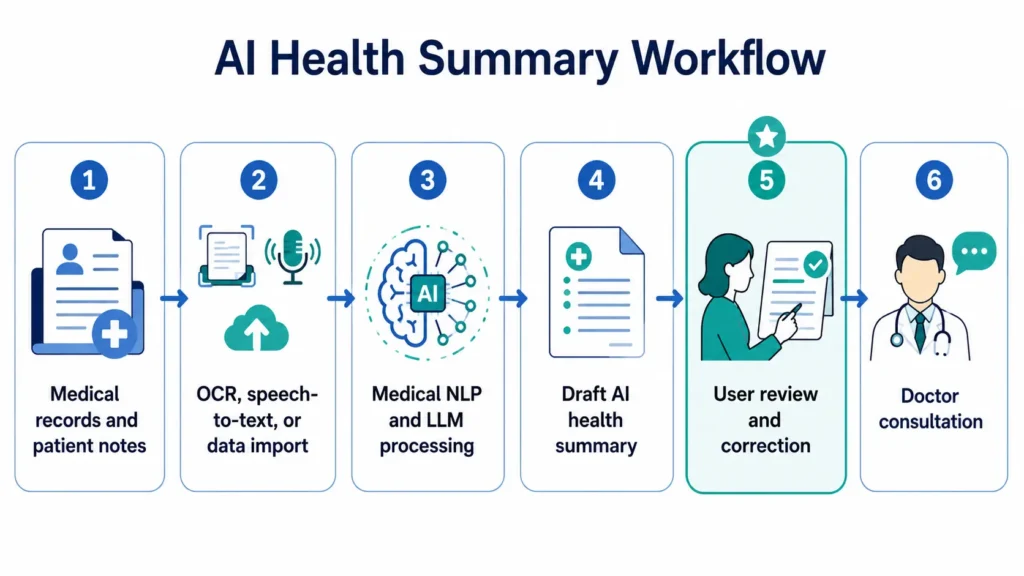
A typical workflow can be represented as:
What AI Can and Cannot Do
| AI can help with | AI cannot safely do on its own |
| Organizing health records and personal notes | Diagnose a disease |
| Summarizing lengthy documents | Prescribe or change treatment |
| Extracting dates, medications, and test values | Assess every emergency or clinical risk |
| Creating timelines and structured reports | Replace examination or diagnostic testing |
| Highlighting possible patterns | Prove that one event caused another |
| Preparing questions for an appointment | Replace professional clinical judgment |
Begin With the Purpose of the Appointment
Before editing the summary, write the main reason for the appointment in one sentence. It could be:
- “Recurring headaches for three weeks.”
- “Reviewing fatigue after a medication change.”
- “Following up on an abnormal laboratory result.”
- “Discussing steadily increasing blood-pressure readings.”
Trace Important Statements Back to Their Sources
Every medically significant statement should have an identifiable source.
It may have come from a laboratory report, prescription label, clinical note, wearable device, symptom diary, voice transcript, or information entered directly by the user.
Some AI tools provide references that connect sentences in the summary to their source documents. When those references are available, open them and compare the generated statement with the original wording.
Pay particular attention to sentences that sound diagnostic or explanatory.
A statement such as “The result indicates an infection” may be an AI interpretation rather than language taken from the laboratory report.
Do not accept a claim merely because it sounds clinical. When the source cannot be located, mark the statement as unverified.
Check Every Detail That Can Be Verified
Review the patient’s name, dates, medication doses, test values, units, allergies, diagnoses, and the order in which events occurred. Small-looking errors can materially change the meaning of a health record.
Medication information requires particular attention. “5 mg” and “50 mg” are not minor variations. Confirm the medication name, strength, formulation, frequency, start date, and whether the patient is still taking it.
Common AI extraction errors include:
- Dropping a decimal point from a test result
- Replacing one measurement unit with another
- Mistaking a report date for the date of the test
- Listing a discontinued medication as active
- Turning “no fever” into “fever”
- Assigning a family member’s condition to the patient
Separate Observations From AI Interpretations
A reliable summary should distinguish recorded facts from AI-generated conclusions. For example, “Sleep was reduced to approximately five hours on four nights” can be checked against a diary or wearable record, while “Poor sleep caused the headaches” assumes a connection that has not been medically confirmed.
A more neutral version is: “Reduced sleep and headaches occurred during the same week.” The possible link can then be raised as a question: “Could reduced sleep be contributing to the headaches?”
Avoid words such as “proves,” “indicates,” “caused by,” and “likely due to,” as they can make uncertain relationships sound conclusive.
Check for Missing Context
Make sure important symptoms include dates, frequency, duration, severity, and relevant changes such as new medication, illness, exercise, stress, or sleep disruption. A pattern may look meaningful when these surrounding details are missing.
Remove Information You Do Not Need to Share
Do not assume that every stored detail belongs in every appointment. Review the document for unrelated personal information, outdated notes, duplicated entries, and sensitive material that the clinician does not need for the present discussion.
Also check the service’s controls for editing, exporting, sharing, retention, and deletion.
Privacy rules vary between countries and services, so read the relevant policy rather than relying on a general “secure” label. Save or send only the version you have personally reviewed.
Convert Conclusions Into Questions
The final pass should produce a short list of questions.
Instead of sharing “My medication is causing fatigue,” write, “Could the timing of the fatigue be related to the medication change?”
Rather than accepting an AI-generated trend as meaningful, ask whether the pattern needs further investigation.
A good health summary does not speak for the doctor or the patient.
It reduces clutter, preserves useful context, and gives both people a clearer starting point. Review it carefully, correct what you can, mark uncertainty honestly, and use it to support a better conversation.
How AI Health Summaries May Evolve in the Future
Future healthcare AI systems may combine written notes, voice recordings, AI medical records, wearable data, and medical images within a single multimodal platform. This could help create more complete patient timelines, including changes in sleep, activity, heart rate, glucose levels, symptoms, and medication use.
These platforms may also offer sentence-level source references, confidence indicators, editing histories, and clearer distinctions between extracted facts and AI interpretations. Such features could make errors easier to detect, but they would not replace human verification or clinical judgment.
More information does not always produce a better summary. Additional data may provide useful context, but it can also increase privacy risks, irrelevant correlations, and the chance of misinterpretation.
Final Thoughts
A useful AI health summary does not speak for the patient or the doctor. It reduces clutter, preserves relevant context, and provides a clearer starting point for discussion. Review every important detail, trace claims back to their sources, look for hallucinations and omissions, and mark uncertainty honestly. Remove unnecessary information and rewrite unsupported conclusions as questions. The best summary is the one that presents accurate, relevant, and verifiable information clearly.
Frequently Asked Questions
What is an AI health summary?
An AI health summary is a condensed account of symptoms, medications, test results, medical events, or other health information created with AI.
Are AI health summaries accurate?
They can be accurate and useful, but reliability varies according to the source material, document quality, model, and system design. Important information should be compared with original records before the summary is shared.
Can AI summarize medical records?
AI can extract and organize information from clinical notes, laboratory reports, prescriptions, and other medical records.
Should doctors rely on AI-generated summaries?
An AI-generated summary may provide a useful starting point, but it should not replace the original medical record, clinical history, physical examination, diagnostic testing, or professional judgment.
Is it safe to upload medical records to an AI tool?
The safety of uploading medical records depends on the service’s privacy, security, storage, model-training, sharing, and deletion practices.
Can an AI health summary diagnose a condition?
A general AI summary should not be used to diagnose a disease. AI can organize information and help prepare questions, but diagnosis requires appropriate clinical evaluation by a qualified healthcare professional.
This article provides general information and is not a substitute for professional medical advice.

Sandeep Kumar is the Founder & CEO of Aitude, a leading AI tools, research, and tutorial platform dedicated to empowering learners, researchers, and innovators. Under his leadership, Aitude has become a go-to resource for those seeking the latest in artificial intelligence, machine learning, computer vision, and development strategies.