

Every time a new model launches, someone calls it “basically AGI.” That word gets thrown around so loosely it has almost lost its meaning. So what is artificial general intelligence, really, and how far are we from building it? This guide cuts through the hype and gives you a grounded, accurate answer, along with how AGI differs from the AI tools you already use every day.
What Is Artificial General Intelligence (AGI)?
Artificial general intelligence is a hypothetical form of AI that can understand, learn, and apply knowledge across any intellectual task a human can perform, not just the narrow task it was trained on. Unlike today’s AI, which excels at one domain at a time, AGI would reason, adapt, and transfer skills the way a person does. No system today meets this bar.
That single distinction, the ability to generalize across tasks without retraining, is what separates AGI from every AI product currently on the market, including the large language models you use daily.
AGI vs AI: What’s Actually Different
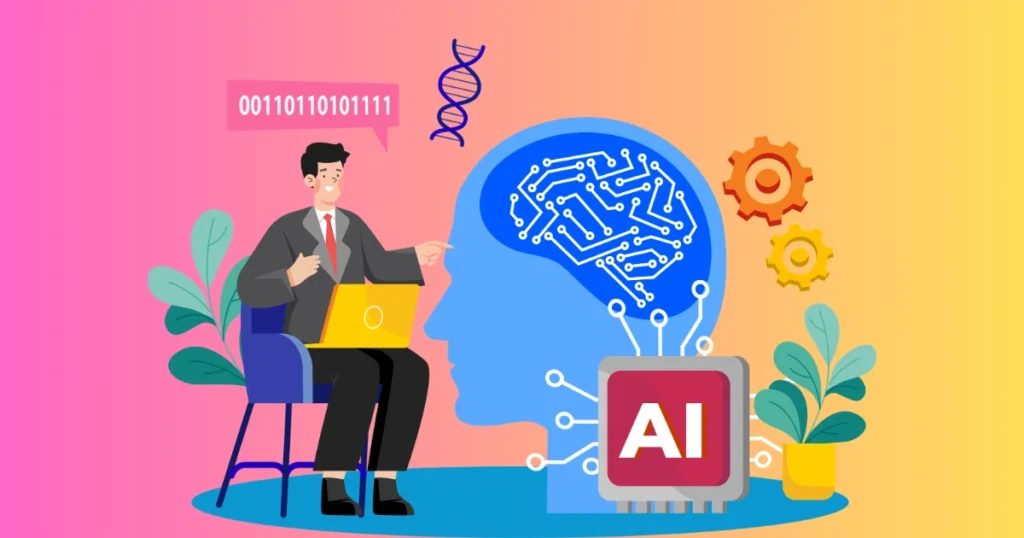
Regular AI, sometimes called narrow AI or weak AI, is built to do one job well. A spam filter, a recommendation engine, a fraud detection model, none of these can do anything outside their trained scope. Ask a chess engine to write an email and it simply cannot, because it was never built to.
AGI, by definition, wouldn’t have that ceiling. It would take what it learned playing chess and apply the underlying reasoning to an entirely different problem, the same way a person who’s good at chess can often pick up strategy games faster than someone with no background at all.
Here’s a mistake a lot of beginners make: assuming that because a model performs well on multiple tasks (say, writing code and summarizing documents), it must be “general.” Multi-tasking is not the same as generalizing. A model trained separately on 10 different tasks is still 10 narrow systems stitched together, not one system that reasons the way a human mind does.
Quick Comparison Table
| Factor | Narrow AI (Today) | Artificial General Intelligence (AGI) |
|---|---|---|
| Task scope | One domain or a fixed set of tasks | Any intellectual task, without retraining |
| Learning transfer | Limited, needs retraining per task | Transfers knowledge across domains |
| Reasoning | Pattern matching within trained scope | Human-like reasoning and adaptation |
| Real-world status | Exists and is widely deployed | Does not exist yet, as of 2026 |
| Examples | ChatGPT, Google Search ranking, spam filters | None confirmed; remains a research goal |
AGI vs Generative AI (ChatGPT, Gemini, Claude)
This is where most confusion happens, and it’s worth being direct about it: ChatGPT, Gemini, and Claude are not AGI, and none of the companies building them claim they are. These are generative AI systems, built to predict and generate text, images, or code based on patterns learned from massive datasets.
Generative AI can feel general because it handles a huge range of Artificial intelligence prompts, writing, coding, translating, summarizing. But under the hood, it’s still doing one core thing: predicting the next most likely token based on patterns in its training data. It doesn’t form goals, doesn’t have persistent memory of the world the way a person does, and doesn’t reason about problems it has never encountered in any similar form.
A useful way to think about it: generative AI is extremely broad, but it’s not the same as general intelligence. Breadth of output is not the same as depth of understanding.
Characteristics of Artificial General Intelligence
Researchers don’t fully agree on a single checklist, but most definitions converge on a few core artificial general intelligence characteristics:
- Cross-domain reasoning: Applying knowledge learned in one area to solve problems in a completely different one.
- Autonomous learning: Picking up new skills from limited examples, without needing millions of labeled training samples.
- Common sense understanding: Grasping cause and effect, physical constraints, and everyday logic that humans take for granted.
- Long-term planning: Setting and pursuing goals across extended time horizons, not just responding to a single prompt.
- Self-improvement: Identifying its own gaps and getting better without a human manually retraining it.
DeepMind’s widely cited “Levels of AGI” framework frames this as a spectrum rather than a single on/off switch, ranking systems from “no AI” up through “emerging,” “competent,” “expert,” “virtuoso,” and finally “superhuman” general intelligence. That framing is useful because it avoids the trap of treating AGI as one magic finish line.
Artificial General Intelligence Examples
Since AGI doesn’t exist yet, there are no confirmed real-world examples of it in operation. What’s more useful is understanding the reference points people use when discussing it:
- Hypothetical AGI: A system that could learn to diagnose a rare disease, then use similar diagnostic reasoning to debug a piece of software, without being separately trained for either task.
- Fictional depictions: Systems like HAL 9000 or Samantha from Her are often cited in public discussion, but these are creative works, not technical benchmarks, and shouldn’t be treated as accurate previews of real AGI.
- Closest real-world approximations: Large multimodal models that can handle text, images, and audio in one system get labeled “AGI-like” in headlines, but this is a marketing framing, not a technical one. They still lack autonomous goal-setting and true cross-domain transfer.
A common mistake here is treating benchmark scores (a model beating a human on a specific test) as proof of general intelligence. Passing a bar exam or a coding benchmark shows strong narrow performance, not generalized reasoning across unrelated domains.
How Close Are We to AGI in 2026?
Nobody credible is claiming AGI exists today. What has changed is the tone of the conversation. A few years ago, AGI was mostly a long-term academic topic. By 2026, major labs including OpenAI, Google DeepMind, and Anthropic openly discuss AGI as a near-to-medium-term possibility in their public statements, even while disagreeing sharply on timelines, which range from a few years to several decades depending on who you ask.
What’s actually happened is real progress in narrow generalization, models that transfer better across related tasks (like reasoning across text, code, and images) than earlier systems did. That’s meaningfully different from the full cross-domain autonomy that defines AGI. Progress in one area of AI research doesn’t automatically compound into progress on the others; planning, embodiment, and common-sense reasoning about the physical world remain much harder problems than text generation turned out to be.
If you’re evaluating claims about “AGI is here” in any headline, the practical test is simple: does the system show reasoning transfer to a genuinely novel task it wasn’t designed or fine-tuned for? Almost nothing on the market passes that test today.
How to Track AGI Progress Without Falling for the Hype
If you’re genuinely trying to follow AGI research rather than just react to headlines, a few habits separate a well-informed AI enthusiast from someone who just repeats whatever a thumbnail claims.
Start with primary sources over secondary coverage. Read the actual model cards, technical reports, and research papers that labs like OpenAI, Google DeepMind, and Anthropic publish, rather than relying only on news summaries that tend to compress nuance into a single dramatic sentence.
Watch for the specific claim being made, not just the word “AGI.” A lab saying a model shows “early signs of general reasoning on X benchmark” is a narrow, testable claim. A headline saying “AGI achieved” is not. Learn to spot the gap between the two.
A common mistake even engaged learners make is treating benchmark leaderboards as a proxy for general intelligence. Benchmarks measure performance on a fixed set of tasks. A model topping a leaderboard tells you it’s strong at those specific tasks, not that it has crossed into general, transferable reasoning.
Finally, follow the disagreement, not just the consensus. Serious researchers openly disagree on AGI timelines and even on whether current architectures can get there at all. That disagreement is a healthy sign of an unresolved scientific question, not a reason to dismiss the topic altogether.
Risks and Challenges of AGI
The discussion around AGI risk isn’t just science fiction paranoia; it’s an active area of technical research. The core concerns researchers raise include:
- Alignment: Making sure a system with broad capabilities actually pursues the goals its developers intend, rather than optimizing for something subtly different.
- Control: Ensuring humans retain meaningful oversight of a system that could, in theory, act and plan autonomously.
- Economic disruption: A system that can genuinely perform any intellectual task would affect far more job categories than today’s narrow automation does.
- Concentration of power: Whoever builds AGI first gains an outsized advantage, which is why several major labs have publicly committed to safety-focused development practices and staged rollouts.
This is also why serious labs test and release capabilities incrementally, rather than deploying a fully autonomous general system in one step. It’s a deliberate risk-management approach, not just a marketing pace.
Frequently Asked Questions
What is artificial general intelligence (AGI) in simple terms? AGI is an AI system that could learn and perform any intellectual task a human can, across any domain, without needing separate training for each one. It doesn’t exist yet as of 2026.
How is AGI different from AI? Regular AI is narrow, built and trained for a specific task or a fixed set of tasks. AGI would generalize across tasks the way a human mind does, applying knowledge learned in one area to solve problems in a completely unrelated one.
Is ChatGPT considered AGI? No. ChatGPT is a generative AI system that predicts likely text based on patterns in its training data. It’s broad in the range of prompts it can handle, but it doesn’t reason, plan, or transfer knowledge across domains the way AGI would.
When will AGI be achieved? There’s no consensus. Estimates from AI researchers and lab leaders range from a few years to several decades, and some researchers question whether current approaches can reach AGI at all.
What are examples of AGI today? There are none. No system currently meets the technical definition of AGI. What you see labeled “AGI-like” in headlines usually refers to broad, capable generative AI, not true general intelligence.
Is AGI dangerous? It could pose serious risks if built without strong safety and alignment work, which is why major AI labs treat AGI safety as an active research priority rather than an afterthought.
Conclusion
Artificial general intelligence is a system that could reason and learn across any task the way a human can, and it doesn’t exist yet. The AI tools you use today, including ChatGPT, Gemini, and Claude, are powerful generative systems, not general intelligence. Understanding this difference matters, whether you’re evaluating a vendor’s claims, planning your content strategy, or just trying to make sense of the next big AI headline. The honest answer in 2026 is that AGI remains a research goal, not a shipped product, and the smartest move is to build with the AI that’s actually available, while staying informed about where the research is genuinely heading.
External Source
- [Source: Google DeepMind — “Levels of AGI for Operationalizing Progress on the Path to AGI” | https://arxiv.org/abs/2311.02462]
- [Source: Stanford HAI — AI Index Report | https://aiindex.stanford.edu/report/]

Sandeep Kumar is the Founder & CEO of Aitude, a leading AI tools, research, and tutorial platform dedicated to empowering learners, researchers, and innovators. Under his leadership, Aitude has become a go-to resource for those seeking the latest in artificial intelligence, machine learning, computer vision, and development strategies.