

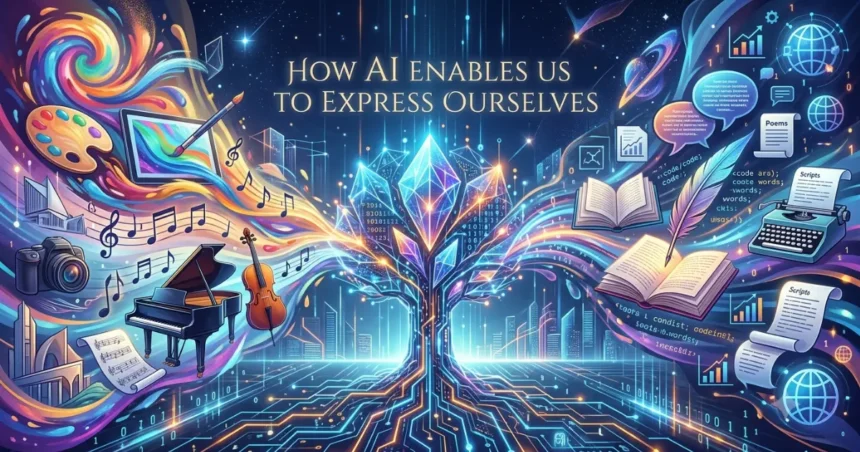
When thoughts are clear but words do not follow!
Most people feel this situation, where an idea is clear and fully formed in your mind, but when you try to express it verbally or write it down, you often feel lost for words. The concept remains the same, but your ability to transfer it to a piece of paper another person is at a deadlock.
It is a kind of friction and it has grown more common in daily life than before. The reason is that we are writing more text, captions, sales pitches, and postings than any previous generation. So, as we discuss, the gap is obvious between what we think and how we communicate it. Let us discuss in this article how AI helps us to express ourselves in a convenient yet effective manner.
Thinking is faster than Expression
If you are a writer, you know what content you want to write but still, you need to find a point to start. A designer can clearly picture a project, mood, color, or shape long before they are able to sketch it. A creator fully understands their concept but still spends hours deciding how to present it in a perfect and comprehensive manner.
None of this comes from a lack of skill; it is how the process works because ideas start messy and become clear as they develop. The difficult part is turning a raw idea into something that can actually be shaped and shared, and this is the stage where many people get stuck and where different AI tools are now starting to help us.
In the next section, we will explore how AI supports us to express our feelings, ideas, and messages through different types of content.
Writing is Easier
Writing tends to be where this gap shows up first and hardest. You can know your subject cold and still not know how to open the first paragraph.
This is especially true for freelancers and copywriters who understand a topic but need a faster route from scattered notes to an actual draft. When used well, AI tools can offer that starting structure, a rough shape to push against rather than a finished thought to copy.
The substance still has to come from the writer though. Tone, meaning, and the actual argument are decisions a person makes; the tool removes the friction of getting started and puts emotions to words.
Poetry and Emotional expression
Some feelings are not possible to express in simple sentences. A memory, a private moment, or emotions like heartache and joy usually cannot be captured entirely in phrases like “I felt sad” or “I felt happy.” This is exactly where poetry becomes meaningful, because it allows language to move beyond direct explanation and express yourself deeper.
Today, many people also use AI Poem Generator to support this process where they give the idea and the AI tool provides them with a poem which represents it. They do not replace the feeling itself but help give it a first form. A memory or emotion can be turned into a few lines that a person can then adjust, refine, or completely reshape. The emotion always belongs to the writer. The tool only helps turn a vague feeling into something they can work with.
AI in Music
A musician may have a mood in their mind but not know what sound, instrument or style fits it. Or a content creator wants background music but does not have an idea of where to start. AI can transform a mood or idea into music options in no time, allowing people to try beats, musical styles, and directions in seconds. Instead of starting from scratch, they can explore and adjust until something fits the feeling they want.
It makes the process go faster and easier, but the final decision and creative direction are still up to the composer.
Artists and AI
Designs usually starts as something private: a color palette, a layout, a vibe you can picture but can’t yet justify in words. Putting a few visual options on AI, side by side, makes the right direction obvious in a way that describing it never could.
Designers have always worked this way, sketching and testing before committing. AI has just sped up that loop; the eye making the final call is still a human one.
AI in Content Creation
Making content today is rarely just writing or just posting. It is planning, shooting, editing, and reading how an audience actually responds. A creator can have a smart idea and still lose hours to the logistics of producing it.
Different AI websites absorb that overhead; they don’t generate the insight; they just clear out some of the manual work standing between an idea and a finished piece, leaving more room for the thinking that actually matters. AI writing tools can provide you the head start in the form of research that you need to compile your final draft.
Conclusion
Every one of these forms of Artificial Intelligence does the same basic thing: it shortens the distance between having an idea and being able to express it. None of them supplies the idea itself but it puts our ideas one step closer to the final form.
That distinction matters a lot in self expression. The thought, the feeling, and the judgment about what is good are still entirely human. What is different now is how much friction has been removed from turning that thought into something real. People are not creating less originally; they are just losing less of the original idea on the way out with the help of AI.

Sandeep Kumar is the Founder & CEO of Aitude, a leading AI tools, research, and tutorial platform dedicated to empowering learners, researchers, and innovators. Under his leadership, Aitude has become a go-to resource for those seeking the latest in artificial intelligence, machine learning, computer vision, and development strategies.