
You have a working LLM and a business problem it still doesn’t solve well enough. The RAG vs fine-tuning decision is where most teams get stuck next, and most articles you’ve read just define both terms and shrug. This one skips the definitions-only approach and gives you the actual decision logic: what each method does to the model, what it costs in practice, and five concrete signals that tell you which one to build first.
What RAG Actually Does to Your Model
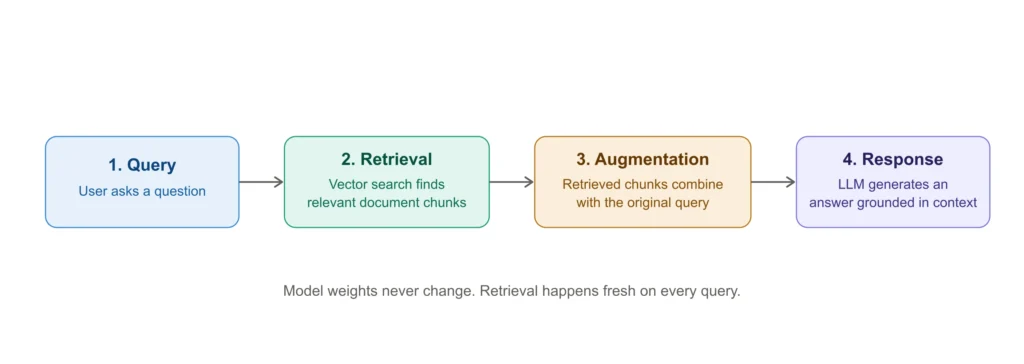
RAG leaves your model’s weights untouched. It works entirely at inference time: when a user sends a query, the system searches a connected knowledge base, pulls back the most relevant chunks, and stuffs them into the prompt before the model ever generates a response. The model isn’t smarter. It just has better notes in front of it.
That single fact explains almost everything else about RAG. Because nothing gets retrained, updating your knowledge base is as simple as adding a new document. A pricing change, a new product spec, or a policy update becomes available to the system the moment it’s indexed, not after your next training cycle.
The retrieval layer typically runs on a vector database that stores document chunks as embeddings, so search happens by meaning rather than exact keyword match. This is why RAG handles a question phrased one way when your source document phrases it differently.
Practical tip: the quality of your RAG system depends far more on chunking strategy and metadata than on which LLM you plug in. Teams obsess over model choice and neglect the retrieval pipeline, then wonder why answers feel shallow or miss context that’s technically in the knowledge base.
Where RAG wins by design: it can cite its sources. For compliance, legal, or any workflow where someone might ask “where did this answer come from,” RAG gives you a traceable path back to a document. Fine-tuned models can’t do this, because the “knowledge” is baked into weights with no pointer back to origin.

What Fine-Tuning Actually Does to Your Model
What Fine-Tuning Actually Does to Your Model
Fine-tuning changes the model itself. You take a pretrained model and run additional training passes on a smaller, labeled dataset specific to your task, and the model’s weights shift to reflect what it learned. Nothing is retrieved at inference time. Whatever the model knows, it knows because it was trained on it.
This makes fine-tuning the right tool for teaching a model how to behave, not what to know. Consistent output formatting, a specific tone of voice, domain jargon, or a narrow classification task (support ticket routing, sentiment tagging, contract clause extraction) are things fine-tuning handles well because they’re patterns, not facts that change weekly.
Full fine-tuning updates every parameter and needs serious GPU capacity. Parameter-efficient fine-tuning (PEFT), including techniques like LoRA, updates a small subset of parameters and gets you most of the performance gain on far cheaper hardware. If you’re testing whether fine-tuning is worth it for your use case, start with PEFT before committing to a full fine-tune.
Common mistake: teams fine-tune a model expecting it to “learn” their product documentation, then get frustrated when it hallucinates outdated specs six months later. Fine-tuning is not a database. AWS and Microsoft’s own documentation are explicit that fine-tuned models don’t reliably cite sources and shouldn’t be treated as a knowledge storage mechanism. If your information changes, fine-tuning locks in a snapshot that starts decaying the day training finishes.
RAG vs Fine-Tuning: Side-by-Side Comparison
| Factor | RAG | Fine-Tuning |
|---|---|---|
| What changes | Nothing in the model; context added at query time | Model weights, permanently |
| Best for | Facts that change often, need for citations | Behavior, tone, format, narrow classification tasks |
| Setup cost | Lower upfront; retrieval infrastructure only | Higher upfront; training data + compute |
| Per-query cost | Higher (retrieval + longer prompts) | Lower once trained |
| Knowledge freshness | Immediate, add a document and it’s live | Stale until next training run |
| Source attribution | Yes, traceable to documents | No, knowledge is opaque in the weights |
| Data requirement | A searchable knowledge base | 500 to 50,000+ labeled examples depending on task |
| Failure mode | Irrelevant or missing retrieved chunks | Overfitting, forgetting prior capabilities |
5 Signals That Tell You Which One to Use
Skip the “it depends” answer. Here’s the actual logic, in order of how much weight each signal should carry.
- How often does the underlying information change?Weekly or monthly changes point to RAG. Information that’s stable for a year or more can survive a fine-tuning cycle without going stale.
- Do you need to prove where an answer came from?Regulated industries (finance, healthcare, legal) almost always need RAG‘s citation trail. A fine-tuned model can’t show its work.
- Is the problem “what do you know” or “how do you behave”? Facts and current data point to RAG. Tone, format consistency, and task-specific reasoning point to fine-tuning.
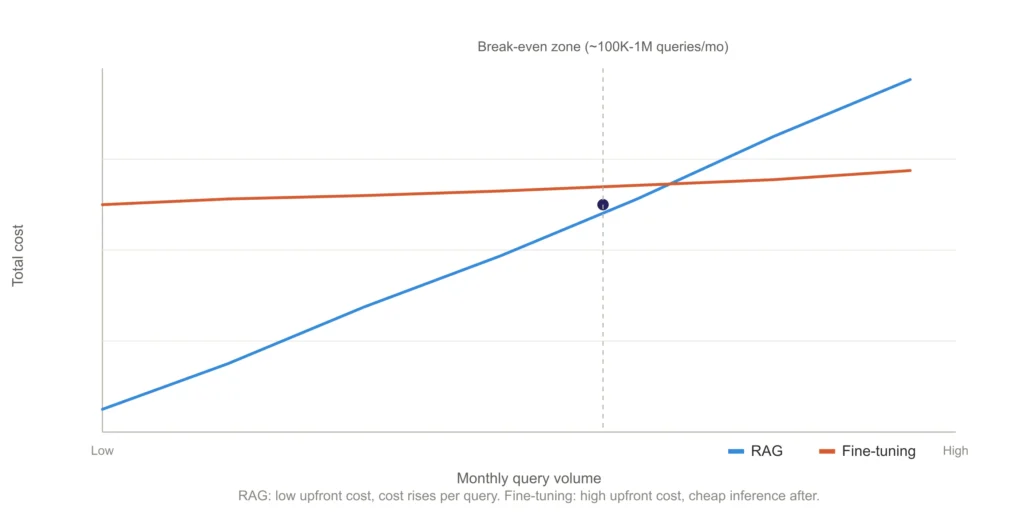
- What’s your query volume?At low to moderate volume, RAG’s per-query cost is manageable and its lower upfront investment wins. Past roughly 100K to 1M queries a month, fine-tuning’s lower per-query cost starts to outperform RAG’s cumulative retrieval overhead, depending on model size.
- Can the knowledge be indexed and searched cleanly?If your source material is messy, unstructured, or scattered across formats with no consistent structure, RAG‘s retrieval quality suffers before you even get to model choice. Sometimes the honest fix is document cleanup, not a bigger model.
If three or more of these point toward RAG, build that first. It’s cheaper to get wrong and easier to iterate on than a training run.
Cost Reality: What Each Approach Bills You For
RAG‘s costs are ongoing and usage-based: vector database hosting, embedding generation for every new document, and longer prompts at inference time because retrieved context adds tokens to every call. There’s no big upfront training bill, but the meter runs on every query.
Fine-tuning flips that structure. You pay upfront for data preparation and GPU-intensive training runs, then get comparatively cheap inference because your prompts stay short and the model doesn’t need retrieved context stuffed in. The catch is that any meaningful update to what the model knows means running that expensive training cycle again.
Direct takeaway: if your team is under 100K queries a month and your knowledge base changes regularly, RAG almost always wins on total cost. Above that volume, with stable knowledge and a narrow task, fine-tuning’s economics start to make more sense. Model this out with your actual query volume before committing either way. Don’t guess.
When You Need Both
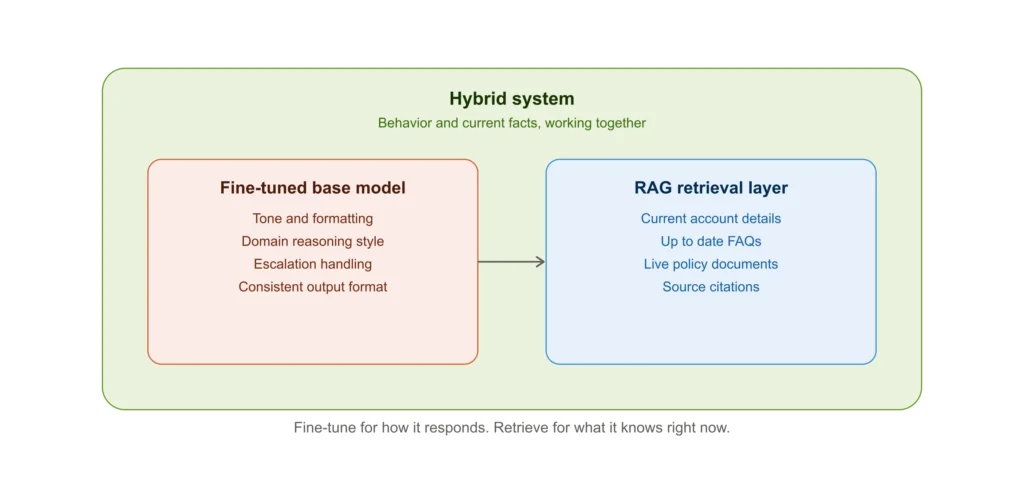
This isn’t an either/or decision as often as vendors make it sound. A growing pattern in production systems, especially in legal, financial, and healthcare AI, is fine-tuning a model on domain vocabulary and reasoning style, then layering RAG on top for factual grounding and citations.
A real-world shape of this: fine-tune a support chatbot on your company’s tone, formatting conventions, and how it should handle escalations. Then use RAG to pull in the actual account details, current FAQs, and up-to-date policy documents at query time. You get consistent behavior and current facts in one system.
Practical tip: don’t build this hybrid on day one. Start with RAG, evaluate where your failures actually come from (retrieval errors show up as missing or irrelevant chunks; generation errors show up when the right information is in the prompt but the model ignores it), and only add fine-tuning once you’ve confirmed the failure is behavioral, not informational.
Common Mistakes Teams Make
Treating fine-tuning as a knowledge upgrade. It’s a behavior upgrade. If your problem is “the model doesn’t know X,” fine-tuning is rarely the fix and RAG almost always is.
Skipping the retrieval pipeline audit before blaming the model. Most underperforming RAG systems have a chunking or metadata problem, not a model problem. Fix the pipeline before switching LLMs.
Fine-tuning on too little data and calling it done. Practical minimums run from around 500 to 2,000 high-quality examples for style and format tasks, up to 5,000 or more for genuine domain reasoning. Below that, you risk overfitting to quirks in a tiny dataset rather than learning generalizable patterns.
Assuming you need either at all. With current frontier models, well-structured prompt engineering alone handles a surprising share of use cases that teams assume need RAG or fine-tuning. Test the simplest option first.
FAQ
Is RAG better than fine-tuning?
Neither is universally better. RAG wins when your knowledge changes often and you need source attribution. Fine-tuning wins when you need consistent behavior, tone, or a narrow task performed at low per-query cost and high volume.
Can you use RAG and fine-tuning together?
Yes, and it’s increasingly common in production systems. Fine-tune for behavior and reasoning style, then use RAG to ground responses in current, citable information.
Does fine-tuning teach a model new facts?
Not reliably. Fine-tuning adjusts how a model behaves and reasons more than what it factually knows, and fine-tuned models can hallucinate outdated information with more confidence than a base model.
How much data do you need to fine-tune a model?
Roughly 500 to 2,000 examples for style or format adjustments, and 5,000 to 50,000 or more for genuine domain-specific reasoning tasks, depending on task complexity.
Is RAG expensive to run?
It has lower upfront cost than fine-tuning but ongoing per-query costs from retrieval and longer prompts. At high query volumes, this can eventually cost more than a fine-tuned model with cheap inference.
Do I need fine-tuning if I’m using a frontier model like GPT-5 or Claude?
Often no. Frontier models paired with solid prompt engineering and RAG handle most enterprise use cases without a training run.
Conclusion
The RAG vs fine-tuning decision comes down to one question before any other: is your problem about what the model knows, or how it behaves? Fast-changing facts and the need for source citations point to RAG. Consistent tone, format, and narrow task performance at scale point to fine-tuning. Most teams that get this wrong skip that question entirely and jump straight to picking a framework or a base model. Start with the five signals above, model your actual query volume against cost, and don’t be surprised if the right answer turns out to be both.

Sandeep Kumar is the Founder & CEO of Aitude, a leading AI tools, research, and tutorial platform dedicated to empowering learners, researchers, and innovators. Under his leadership, Aitude has become a go-to resource for those seeking the latest in artificial intelligence, machine learning, computer vision, and development strategies.