


I want to describe something that happened to me, because it explains why I’ve spent the last while measuring something most people haven’t thought to look at.
A colleague asked an AI assistant for options in a category I know well. The answer came back with three recommendations. Decent choices, actually. But the brand I would have put at the top of that list – the one with the best product and the strongest reputation in the industry – wasn’t mentioned at all. Not criticized. Not outranked. Just absent, as if it didn’t exist.
I checked. The brand’s website was fine. Its rankings were fine. What it didn’t have was what the AI engine was actually reading when it built that answer.
That gap – between being good and being surfaced – is the subject of this piece. Because AI answers now act as a front door for huge amounts of research and buying, and the rules for getting through that door are different from the rules you know.
How an AI answer actually gets built
When someone asks an assistant a question, the response comes from one of two places.
For timeless, well-documented topics, the answer comes from training data – the vast pile of text the model learned from. For anything current, specific, or commercial – which describes most of the questions that matter to businesses and professionals – the assistant searches the web first, reads what it finds, and composes the answer from those sources.
That second path is where the action is, and here’s the part people miss: the answer is only as good as the sources the engine chose to read. And the engines have clear preferences. They favor third-party corroboration – comparison articles, review platforms, forum discussions, industry roundups. They treat a consensus of independent sources as more trustworthy than any single voice, including the brand’s own website.
This creates a dynamic that would be familiar to anyone who’s watched how humans make decisions: the brands that surface are the brands the internet talks about consistently, not necessarily the brands with the best products or the biggest budgets. AI answers are a mirror of public consensus – retrieved in the moment, weighted toward whatever independent sources say most often and most recently.
The three layers of being “seen”
Another thing that confuses people: what it means to be visible in an AI answer. There are three distinct levels, and they behave very differently.
Mentioned – the answer names you. Fine, but passive.
Cited – the answer references your content as a source. Better; it means the engine actually read you.
Recommended – the answer suggests you as the right choice. This is the only layer that maps to buying behavior.
A brand can live at one level and be absent from the others. I’ve tracked brands that get open research on AI visibility mentioned constantly but never recommended, and brands that get recommended while a competitor’s page collects the citation. If you’re checking your own visibility, know which layer you’re measuring – otherwise you’re reading the weather when you think you’re reading the climate.
Why the same question gets different answers on different platforms
Ask three assistants the same question and you’ll often get three overlapping-but-different shortlists. That’s not malfunction; it’s architecture.
Different source pools. Each engine retrieves from a different mix of web sources. Google’s AI features lean on Google’s index; Perplexity searches broadly; others blend their own crawling with search partnerships. Different inputs, different answers.
Real randomness. These systems are probabilistic. Ask the same engine the same question twice and the answer shifts – research measuring this across AI search systems found that identical queries share only 29–50% of cited sources between runs. One answer is a sample. Patterns across many runs are the measurement.
Context and freshness. Location, account signals, and constant model updates all shift results.
Which brings me to the finding that changed how I think about the whole category – and the reason I’m writing this.
The finding: the shortlist is stable, even when the answers aren’t
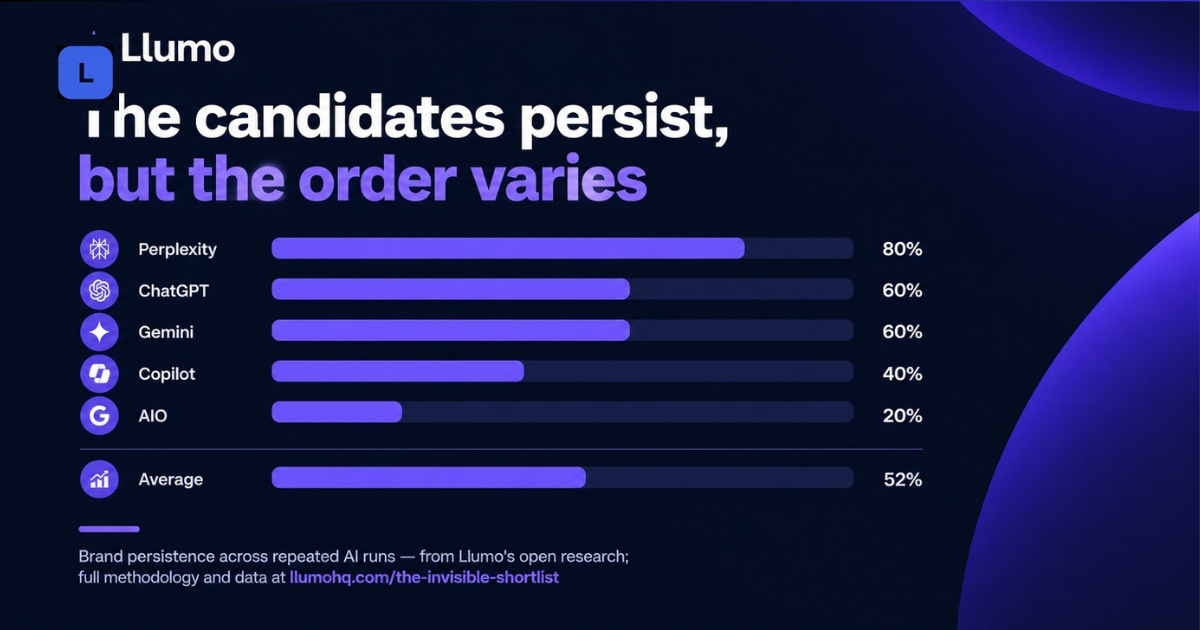
My team tracks brand visibility across AI platforms daily, and we published our methodology and results openly, because in this space I’d rather be checked than believed.
Here’s the headline: which brands appear in AI answers is far more stable than the day-to-day answers suggest. Across repeated runs, the same shortlist of candidates keeps appearing. What fluctuates is the order, the framing, the specific wording. The candidates persist; the order varies.
Think about what that means. If you’re on the shortlist for your category, you have a real, durable position – not a lucky answer. And if you’re not on it, no amount of tweaking a single blog post will change that by Friday; the fix is building the consistent third-party presence that gets a brand shortlisted at all. Reviews. Comparisons. Mentions across independent sources. Entity information that’s clear and consistent everywhere. The boring, durable stuff – which is almost reassuring, because the boring durable stuff has been the answer to every visibility question for twenty years.
How to check where you stand (about thirty minutes, no tools required)
Here’s the self-audit I’d suggest to anyone – business owner, creator, professional, doesn’t matter:
- Write down ten to fifteen questions people actually ask before choosing whatever you offer. Phrase them the way humans talk to assistants: “What’s the best [thing] for [situation]?” Not keywords.
- Run them through three assistants – ChatGPT, Gemini, and Perplexity cover the spread nicely.
- For each answer, log three things: mentioned, cited, or recommended? Which other names appeared? What sources did the answer draw from?
- Repeat monthly with the same questions. One pass is a snapshot. Three months of passes is a trend, and trends are what you can act on.
What you find will almost always fall into one of three situations. You’re consistently shortlisted – protect what got you there. You’re inconsistently present – the fix is usually third-party mentions and clearer entity signals. Or you’re absent – which is honest news, and fixable, but now you know the real starting line.
The bottom line
AI engines have quietly become an evaluation layer that sits on top of the web, and they run on consensus, retrieved in real time, from sources anyone can inspect. That’s not something to fear and it’s not something to game. It’s something to know – especially now, because the brands that understand how these shortlists get built will spend the next few years being recommended by machines that read the whole internet before answering.
The assistant is asking the internet about you. The only question that matters is whether you know what the internet says.

Musa Aykac is the founder of Llumo and has spent 20+ years in digital marketing across SEO, PPC, and analytics. His team publishes open research on how AI engines build recommendation shortlists.