Enterprise voice AI is moving beyond automated phone menus and basic text-to-speech tools. Businesses are increasingly using AI-powered voice agents to answer customer calls, automate sales conversations, support multilingual communication, and reduce repetitive work across contact centers.
- 1. PolyAI: Enterprise Voice Agents for Customer Service
- 2. ElevenLabs: Natural-Sounding Voice AI for Business Applications
- 3. Retell AI: Voice Agents for Sales and Customer Support
- 4. Microsoft Azure AI Speech: Enterprise Speech Infrastructure
- 5. Google Cloud Speech AI: Scalable Speech and Conversational Applications
- Enterprise Voice AI Platforms Compared
- How to Choose the Right Enterprise Voice AI Platform
- 1. Voice quality and conversational latency
- 2. Integration capabilities
- 3. Security and compliance
- 4. Scalability and reliability
- 5. Total cost of ownership
- 6. Human handoff
- The Future of Enterprise Voice AI in 2026
- Frequently Asked Questions
- 1. What is enterprise voice AI?
- 2. Which enterprise voice AI platform is best in 2026?
- 3. Can enterprise voice AI replace customer support agents?
- 4. Are enterprise voice AI platforms suitable for small businesses?
- 5. What industries use enterprise voice AI?
- 6. How much do enterprise voice AI platforms cost?
- 7. What should businesses check before deploying voice AI?
In 2026, enterprise teams have more choices than ever. Some platforms specialize in natural-sounding AI conversations, while others provide complete customer experience automation, developer APIs, and integrations with existing business systems.
Choosing the right platform requires more than comparing voice quality. Companies must consider scalability, security, integration capabilities, latency, customization, and the ability to transfer conversations to human employees when necessary.
Here are five enterprise voice AI platforms worth evaluating in 2026, along with their key features, advantages, and business applications.
1. PolyAI: Enterprise Voice Agents for Customer Service
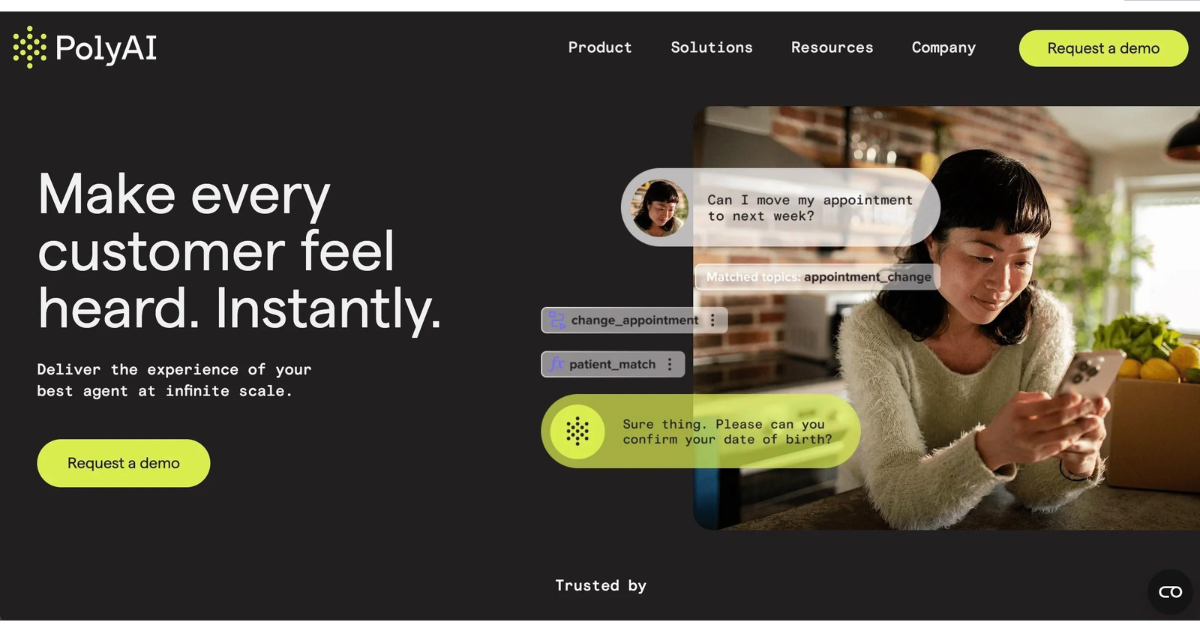
PolyAI is designed for organizations that want to automate customer conversations at scale without building every component of a voice agent internally.
The platform focuses on enterprise customer service, particularly businesses handling large volumes of inbound calls. Its voice agents can understand customer requests, respond conversationally, and connect with existing contact center systems.
Key features
- Conversational AI agents for inbound customer calls
- Enterprise contact center integrations
- Voice automation for customer support workflows
- Testing, version management, and operational controls
- Support for multilingual customer interactions
Why business teams should consider PolyAI
PolyAI is particularly relevant for companies with established customer service operations. Rather than replacing an entire contact center, businesses can introduce voice agents to handle common requests and route complex situations to human representatives.
The platform also provides enterprise-oriented development and operational capabilities, including controlled deployment workflows.
2. ElevenLabs: Natural-Sounding Voice AI for Business Applications
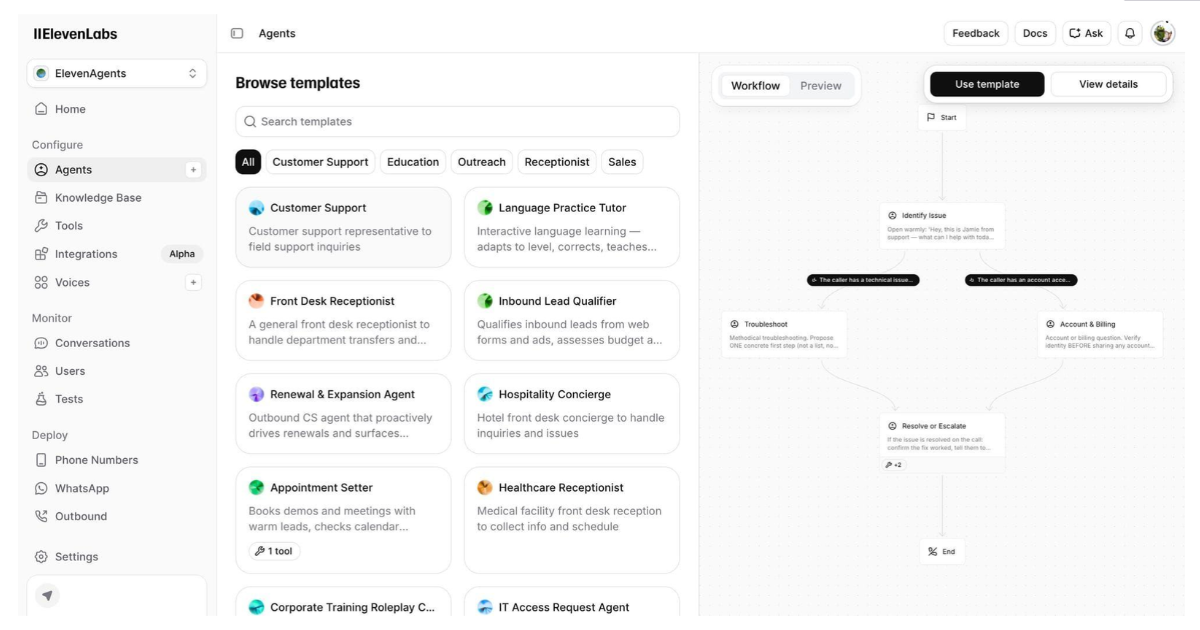
ElevenLabs is widely associated with realistic AI-generated speech, voice cloning, and multilingual audio. Its ElevenAgents platform extends these capabilities into conversational AI applications.
Businesses can use ElevenLabs to create voice agents that interact with customers, support communication workflows, and deliver branded voice experiences.
Key features
- Natural-sounding text-to-speech generation
- Voice cloning capabilities with appropriate permissions
- Conversational AI agents
- Multilingual speech generation
- APIs for integrating voice capabilities into applications
- Voice and transcription components for agent workflows
Why business teams should consider ElevenLabs
ElevenLabs is attractive to companies that prioritize voice quality and want to integrate speech generation into their products or customer interactions.
For example, a business could develop a voice-enabled customer assistant, create multilingual voice experiences, or incorporate conversational audio into an existing application.
ElevenLabs also offers enterprise options, although businesses should review the applicable security, retention, and contractual requirements before deploying it for sensitive conversations.
Best for: Businesses building voice-enabled products, customer-facing assistants, and branded conversational experiences.
3. Retell AI: Voice Agents for Sales and Customer Support
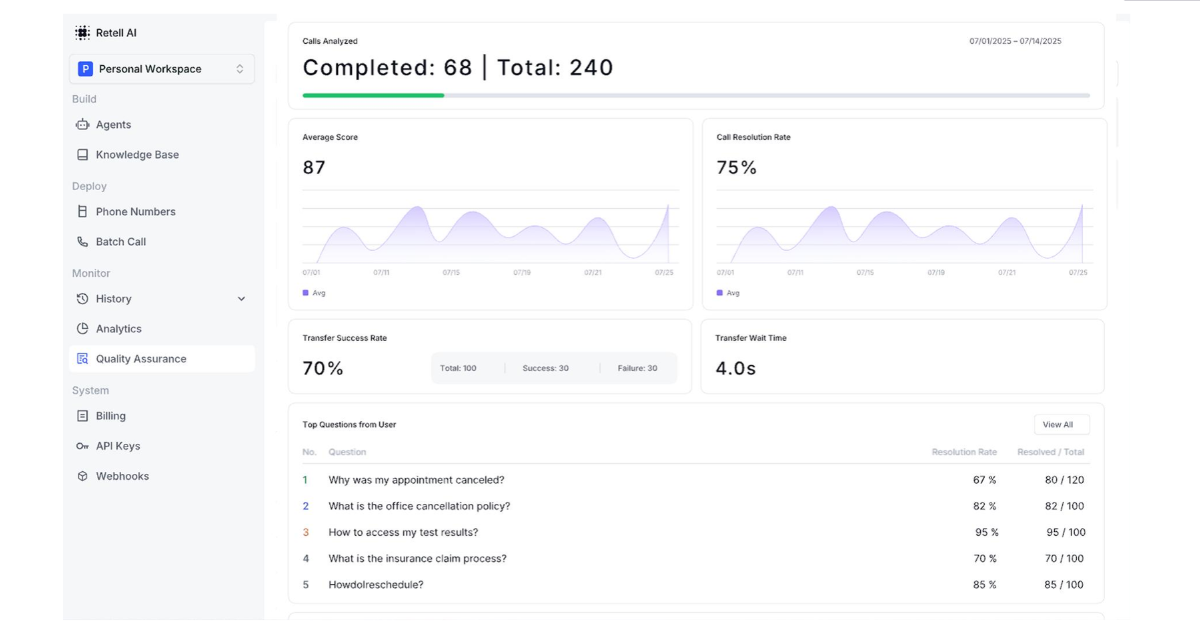
Retell AI focuses on building and deploying AI voice agents for real-time telephone conversations.
The platform is particularly useful for businesses that want to automate inbound and outbound calling without assembling every speech and telephony component independently.
Key features
- AI-powered inbound and outbound phone agents
- Real-time conversational voice
- Agent testing and simulation
- Call monitoring and analytics
- Integrations with external services and APIs
- Customizable voice and language model configurations
Why business teams should consider Retell AI
Retell AI can support workflows such as appointment scheduling, lead qualification, customer follow-ups, and answering frequently asked questions.
Its testing and simulation capabilities help teams evaluate conversational behavior before deploying agents to real customers. Enterprise customers can also explore additional access controls, infrastructure options, and contractual requirements.
Pricing depends on the models, voices, and other components used, so businesses should calculate total call costs rather than comparing a single headline rate.
Best for: Sales teams, customer support departments, appointment-based businesses, and companies developing telephone automation.
4. Microsoft Azure AI Speech: Enterprise Speech Infrastructure
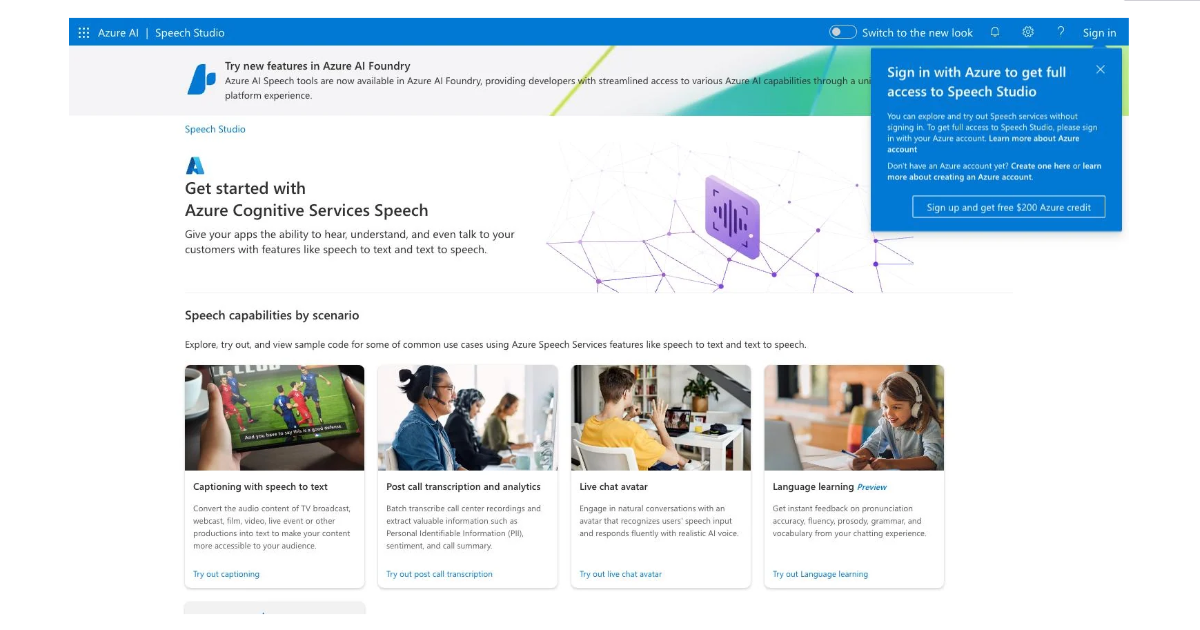
Microsoft Azure AI Speech is an enterprise speech technology offering that supports speech recognition, text-to-speech, speech translation, and voice-enabled application development.
Unlike fully managed voice agent platforms, Azure AI Speech primarily provides speech infrastructure. Businesses can combine it with Azure AI services, application logic, and other conversational AI components to build customized voice solutions.
Key features
- Speech-to-text and real-time speech recognition
- Text-to-speech generation
- Speech translation capabilities
- Custom speech options
- Voice-enabled application development
- Integration with Microsoft’s cloud ecosystem
Why business teams should consider Azure AI Speech
Azure AI Speech is a strong candidate for organizations already using Microsoft Azure and Microsoft enterprise technologies.
Companies can build voice-enabled applications while connecting speech capabilities to their existing cloud infrastructure, identity management, and business systems.
Azure also provides enterprise-oriented security and compliance documentation. However, specific certifications, deployment regions, and contractual coverage should be checked against the intended workload.
Best for: Microsoft-centric enterprises, developers, large organizations, and businesses building custom voice applications.
5. Google Cloud Speech AI: Scalable Speech and Conversational Applications
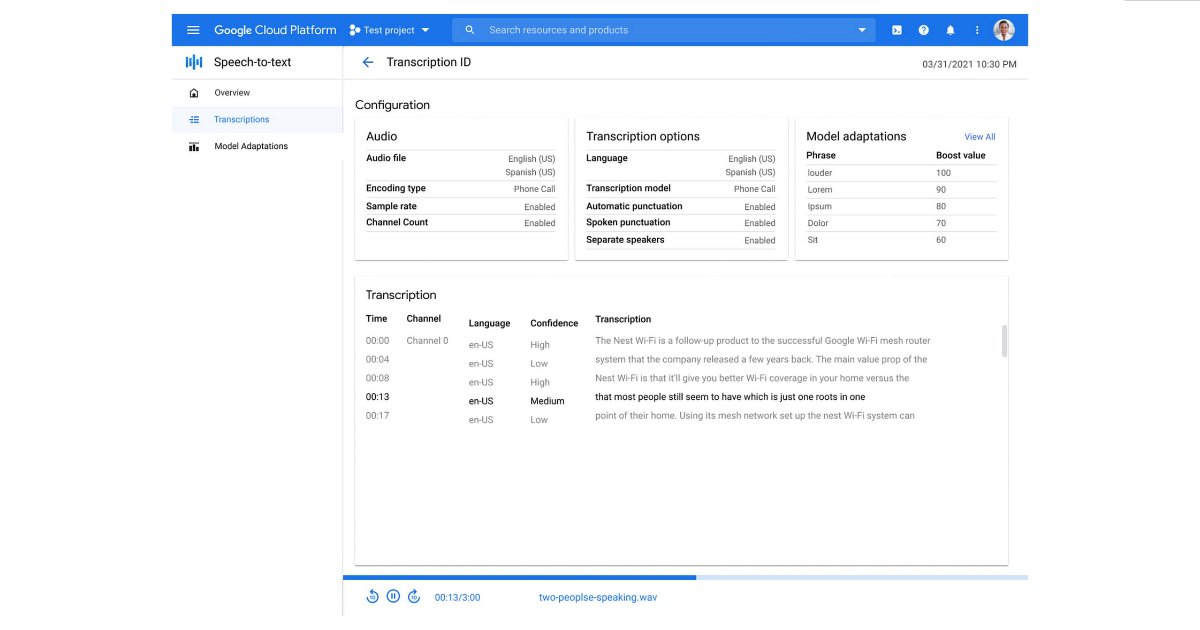
Google Cloud provides speech technologies that enterprises can integrate into customer service applications, communication systems, and AI-powered workflows.
Google Cloud Speech-to-Text and Text-to-Speech support the speech processing layer, while Dialogflow CX can provide conversational orchestration for virtual agents and customer service experiences.
Key features
- Speech-to-text capabilities
- Text-to-speech generation
- Speech processing for multilingual applications
- Conversational agent development with Dialogflow CX
- Integration with Google Cloud infrastructure
- APIs for custom enterprise applications
Why business teams should consider Google Cloud
Google Cloud is particularly useful for businesses that want to build scalable voice applications and connect speech technologies with cloud-based AI systems.
Organizations can use its speech capabilities for customer service automation, transcription, conversational interfaces, and voice-enabled business applications.
The platform’s suitability depends on language coverage, recognition accuracy, latency, and integration requirements. Teams should test these factors using actual customer audio before deployment.
Best for: Google Cloud customers, multilingual businesses, developers, and organizations building cloud-based conversational applications.
Enterprise Voice AI Platforms Compared
| Platform | Best use case | Platform approach |
|---|---|---|
| PolyAI | Customer service automation | Managed enterprise voice agents |
| ElevenLabs | Natural-sounding voice experiences | Speech and conversational AI |
| Retell AI | Sales and phone automation | Voice agent development |
| Microsoft Azure AI Speech | Custom enterprise voice applications | Speech infrastructure |
| Google Cloud Speech AI | Scalable speech applications | Cloud speech infrastructure |
This comparison reflects product positioning rather than a universal performance ranking. Each platform serves different technical and business requirements.
How to Choose the Right Enterprise Voice AI Platform
Selecting an enterprise voice AI platform requires evaluating how it will perform in real business environments. A successful demonstration does not necessarily indicate that a system is ready for thousands of customer conversations.
Before choosing a vendor, businesses should evaluate the following factors.
1. Voice quality and conversational latency
Test how naturally the AI speaks and responds. Delayed responses, interruptions, and robotic speech can negatively affect customer experience.
2. Integration capabilities
Check whether the platform connects with your CRM, help desk, contact center, scheduling software, and internal APIs.
3. Security and compliance
Review data retention, access controls, encryption, audit logs, and relevant compliance requirements. Healthcare, financial services, and other regulated businesses may require additional contractual safeguards.
4. Scalability and reliability
Evaluate concurrent call capacity, uptime commitments, failure recovery, and support availability.
5. Total cost of ownership
Consider speech generation, transcription, language models, telephony, integrations, monitoring, and human escalation costs.
6. Human handoff
Ensure the AI can transfer conversations to employees with appropriate context when customers need assistance beyond its capabilities.
The Future of Enterprise Voice AI in 2026
Enterprise voice AI is evolving from simple speech automation into more capable conversational systems.
Several developments are shaping adoption:
- Real-time conversational AI: Voice agents are becoming more responsive and natural during live conversations.
- Multilingual communication: Businesses can support customers across languages without building separate systems for every market.
- AI-powered customer service: Voice agents can manage routine requests and help employees focus on complex customer problems.
- Integration with business applications: Voice agents increasingly connect to CRM systems, scheduling tools, and internal databases.
- Human and AI collaboration: Organizations are combining automated conversations with employee assistance and escalation workflows.
The long-term opportunity is not simply replacing human conversations. It is making business communication more accessible, efficient, and scalable.
Conclusion
The best enterprise voice AI platform in 2026 depends on the organization’s business objectives and technical requirements.
PolyAI is worth evaluating for enterprise customer service automation, ElevenLabs for natural-sounding voice experiences, and Retell AI for phone-based sales and support workflows. Microsoft Azure AI Speech and Google Cloud Speech AI provide strong options for organizations building customized voice applications on cloud infrastructure.
Businesses should evaluate multiple vendors using real customer conversations, integration tests, and measurable operational outcomes before committing to a deployment.
Frequently Asked Questions
1. What is enterprise voice AI?
Enterprise voice AI uses artificial intelligence to understand spoken language, generate speech, and automate conversations across business applications, customer service systems, and telephone workflows.
2. Which enterprise voice AI platform is best in 2026?
There is no universally best platform. PolyAI, ElevenLabs, Retell AI, Microsoft Azure AI Speech, and Google Cloud Speech AI serve different business requirements, from managed customer service agents to custom speech infrastructure.
3. Can enterprise voice AI replace customer support agents?
Voice AI can automate repetitive customer requests and handle routine conversations. Human employees remain important for complex problems, sensitive situations, and decisions requiring judgment.
4. Are enterprise voice AI platforms suitable for small businesses?
Yes. Platforms such as Retell AI and ElevenLabs can be useful for smaller teams that need automated calls, customer assistance, or voice-enabled applications. Enterprise requirements and pricing vary by provider.
5. What industries use enterprise voice AI?
Common applications include healthcare, banking, retail, telecommunications, travel, insurance, and customer service operations.
6. How much do enterprise voice AI platforms cost?
Costs vary depending on call volume, speech processing, language model usage, telephony, integrations, and enterprise agreements. Some providers publish usage-based pricing, while others require customized contracts.
7. What should businesses check before deploying voice AI?
Businesses should test conversational accuracy, latency, security, integration reliability, scalability, call handling costs, and human escalation before launching a production system.

Sandeep Kumar is the Founder & CEO of Aitude, a leading AI tools, research, and tutorial platform dedicated to empowering learners, researchers, and innovators. Under his leadership, Aitude has become a go-to resource for those seeking the latest in artificial intelligence, machine learning, computer vision, and development strategies.