

ChatGPT’s free tier throttles you after a handful of messages, Plus locks you into $20/month for one model family, and r/ChatGPT is packed with threads about lost context, random refusals, and answers that feel inconsistent week to week. That’s why millions of users are shopping for alternatives in 2026.
- What Makes a Great ChatGPT Alternative
- The Best ChatGPT Alternatives, Ranked
- 1. NanoGPT — Best Overall ChatGPT Alternative (Editor’s Pick)
- 2. Poe (by Quora) — Best for Sampling Multiple Chatbots in One App
- 3. Perplexity — Best for Web Search & Cited Research
- 4. Google Gemini — Best for Google Ecosystem Users
- 5. Claude (Anthropic) — Best for Long-Form Writing & Coding
- Quick Comparison Table
- Which ChatGPT Alternative Should You Choose?
- Frequently Asked Questions
- What is the best free alternative to ChatGPT?
- Is there an AI that gives you access to Claude, GPT, and Gemini in one place?
- What AI is better than ChatGPT for research?
- Is Poe worth paying for in 2026?
- Do I need a subscription to use Claude, Gemini, or GPT models, or can I pay per use?
- Conclusion
This roundup ranks the top five — starting with NanoGPT, the only pick that gives you every other tool’s best model (Claude, Gemini, GPT-5.2, DeepSeek, and 1,000+ more) in one pay-as-you-go account instead of forcing you into a single vendor’s ecosystem.
What Makes a Great ChatGPT Alternative
Most roundups from Zapier and Lindy judge alternatives on a few standard criteria: does it do something better than ChatGPT, can you sign up and use it without technical setup, does it work reliably, and does it stay current as models update every few months.
There’s a gap almost every one of these lists misses: cost flexibility. Roundups compare tools purely on capability but skip over the fact that nearly all of them — Claude, Gemini, Perplexity, Copilot — lock you into a recurring $10–$20/month subscription per tool. Use three of them seriously, and you’re suddenly paying $30–$60+ a month just to have options.
This piece adds that pricing lens on top of the usual “best for X” framing, because for most people, the real decision isn’t just “which AI is smartest” — it’s “how many subscriptions am I willing to juggle.”
The Best ChatGPT Alternatives, Ranked
1. NanoGPT — Best Overall ChatGPT Alternative (Editor’s Pick)
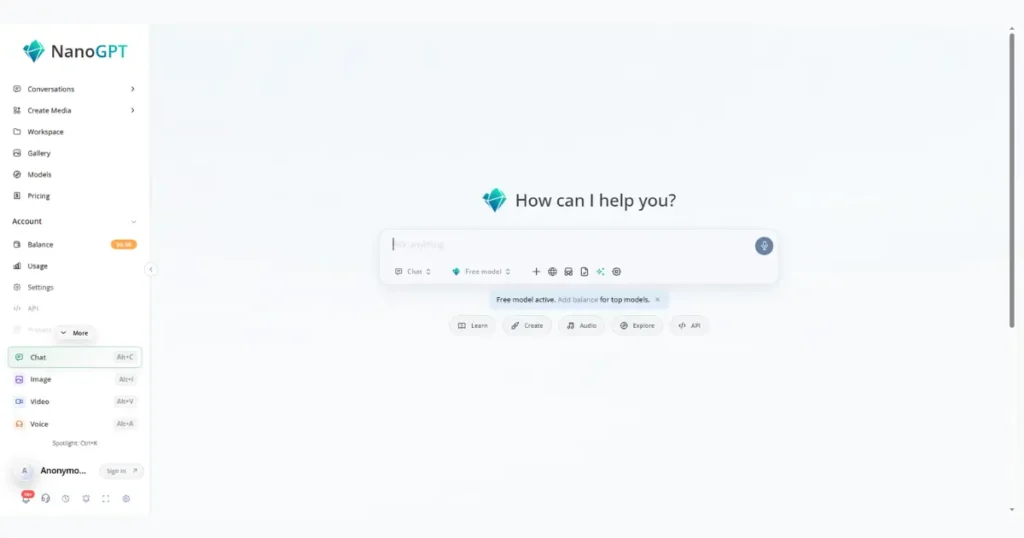
Instead of picking one alternative and living with its trade-offs, NanoGPT gives you access to over 1,000 models from a single account — including Claude 4.5 Opus, GPT-5.2, Gemini 3, DeepSeek, Llama, and dozens of image, video, and audio models. You’re never stuck choosing “Claude for writing OR Gemini for research” — you just use whichever one fits the task, in the same window.
The pricing model is where it really separates from the pack. There’s no mandatory monthly fee — you can start with a $0.10 crypto deposit or a $1 card minimum and pay only for what you use. API access is offered at list price with no markup, unlike aggregators that quietly add margin on top of the model’s actual cost. If you want predictable billing, an optional $12/month subscription exists, but it’s never required to get full access.
Privacy is another point most closed ecosystems can’t match. Chats are stored locally, and NanoGPT doesn’t train on user data — a meaningful difference from ChatGPT, Gemini, and Claude, which process everything server-side and use it to improve their own models.
For people who don’t want to manually decide between a dozen models every time they open a chat, Auto Model Selection routes your prompt to the best-fit model automatically. No more guessing whether Opus or Sonnet, GPT or Gemini, is the right call for a given task.
The same account also handles image, video, and audio generation — DALL-E, Flux, Runway, Kling, and voice tools — tasks that would otherwise mean separate subscriptions to Midjourney or ElevenLabs.
Best for: Anyone who wants ChatGPT-level (or better) capability across writing, coding, research, and media generation without paying for five different subscriptions or getting locked into one vendor’s model lineup.
2. Poe (by Quora) — Best for Sampling Multiple Chatbots in One App
Poe aggregates GPT, Claude, Gemini, and various open-source models in a single chat interface — conceptually similar to NanoGPT, but structured entirely around a points-based subscription rather than pay-per-use.
Current tiers run from a free plan (around 3,000 points/day) up through paid options starting near $5/month for 10,000 points/day, a mid-tier around $20/month, and a premium plan that Poe and outlets like TechCrunch have priced as high as $249.99/month for roughly 12.5 million points. Heavy users burn through points fast, since every model — especially premium ones like Claude Opus or GPT-5.2 — consumes a different amount per message.
The gap: unlike NanoGPT, Poe has no true pay-as-you-go, no-minimum option. You’re always buying a fixed monthly point allowance, whether you use it or not. Recent threads on r/PoeAI flag frustration with platform changes and a shrinking free tier.
Best for: Casual users who want to browser-test different chatbots without touching an API and don’t mind committing to a subscription.
3. Perplexity — Best for Web Search & Cited Research
Nearly every competitor roundup positions Perplexity as the top pick for research, and it’s easy to see why — it cites live sources and lets you restrict searches to the whole web, academic papers, or even Reddit threads.
Pricing sits at $20/month, or roughly $17/month if billed annually according to Perplexity’s own pricing page. The Pro tier unlocks unlimited Deep Research and lets you switch between GPT-5.2, Claude, Gemini, and Perplexity’s own Sonar model.
A standout feature is “Spaces” for organizing team research, plus the Comet browser for agentic web actions — though reviewers still describe Comet as “finicky” in real-world use.
Best for: Analysts, students, and researchers who need verifiable, source-backed answers rather than open-ended conversation.
4. Google Gemini — Best for Google Ecosystem Users
Gemini consistently ranks high in major roundups specifically because of its native integration with Gmail, Docs, Drive, Chrome, and Android. A “Personal Intelligence” feature even pulls context proactively from your Google apps to personalize responses.
Pricing starts free, with Google AI Plus at $7.99/month and higher Pro/Ultra tiers for advanced usage. Strong points include large context windows (up to 1M tokens), Nano Banana Pro image generation that reviewers call best-in-class, and a Gemini CLI/Agent mode for multi-file coding work.
The recurring critique: Gemini “lacks polish” compared to ChatGPT and has occasional bugs. Its best features are also tightly coupled to Google’s own suite — so the value drops fast if you’re not already living inside Gmail and Docs.
5. Claude (Anthropic) — Best for Long-Form Writing & Coding
Claude shows up as the top pick for “professionals” and “long-form writing” across nearly every roundup, thanks to more natural prose, careful safety design, and reasoning that holds together over long documents better than most competitors.
Pricing runs free to start, with Claude Pro at $17–20/month depending on billing cycle. Standout features include Artifacts (in-chat mini apps), Claude Code for developers, Claude Cowork for agentic file and app actions, and support for up to 1M-token context on select models.
The limitation that shows up in every review: no image generation, and heavier “Thinking” modes can slow responses and burn through tokens faster than expected.
Quick Comparison Table
| Tool | Best For | Pricing | Standout Feature | Key Limitation |
| NanoGPT | Overall flexibility & value | Pay-as-you-go from $0.10; optional $12/mo | 1,000+ models, no-markup API, privacy-first | Newer brand, less name recognition |
| Poe | Sampling multiple chatbots | $4.99–$249.99/mo (points-based) | Chat aggregator UX | No true pay-per-use option |
| Perplexity | Research with citations | $20/mo (~$17/mo annual) | Cited sources, Deep Research | Comet browser still buggy |
| Gemini | Google Workspace users | Free / $7.99/mo+ | Deep Google integration, huge context | Weak outside Google ecosystem |
| Claude | Long-form writing & coding | $17–20/mo | Artifacts, Claude Code, careful reasoning | No image generation |
Which ChatGPT Alternative Should You Choose?
If you want maximum model choice and don’t want to get locked into one AI company’s pricing or roadmap, NanoGPT is the clear pick — you get pay-per-use access to the same models everyone else charges a monthly fee for. If you like Quora’s chat aggregator UX and don’t mind a points-based subscription, Poe works fine for casual comparison shopping.
Choose Perplexity if your core job is verified research with citations, Gemini if you live inside Gmail, Docs, and Drive, and Claude if your day-to-day is long-form writing, coding, or multi-step reasoning.
Worth repeating: most users end up paying for two or three of these tools separately, which adds up to $40–$60+ a month combined. NanoGPT is the only option here that consolidates that spend into a single pay-per-use account — you’re not paying for access you don’t use, and you’re not stuck picking one model family and hoping it’s still the best one next year.
Frequently Asked Questions
What is the best free alternative to ChatGPT?
NanoGPT’s pay-as-you-go entry point — starting from a $0.10 deposit — is the closest thing to “free” without hitting a hard usage wall, since you only pay for what you actually use. Gemini and Claude also offer usable free tiers, though both throttle heavier usage.
Is there an AI that gives you access to Claude, GPT, and Gemini in one place?
Yes. NanoGPT and Poe both aggregate multiple model providers into one interface. The difference is billing: NanoGPT charges pay-per-use with no markup, while Poe requires a fixed monthly points subscription regardless of how much you actually use.
What AI is better than ChatGPT for research?
Perplexity is the most commonly recommended option for research because it cites live sources and supports filtered search across academic papers and the web. NanoGPT can also access research-capable models like Claude and GPT-5.2 without a separate subscription.
Is Poe worth paying for in 2026?
It depends on usage. Poe’s low-tier plans work fine for light, casual use, but heavier users of premium models like Claude Opus or GPT-5.2 tend to burn through points quickly, according to user reports on r/PoeAI. If you use AI daily, a pay-per-use model like NanoGPT’s often works out cheaper.
Do I need a subscription to use Claude, Gemini, or GPT models, or can I pay per use?
Through their own apps, Claude, Gemini, and ChatGPT all push you toward monthly subscriptions for full access. NanoGPT is one of the few ways to access the same underlying models on a strict pay-per-use basis, with no subscription requirement.
Conclusion
The “best” ChatGPT alternative really depends on the task — Perplexity for cited research, Gemini for Google Workspace, Claude for long-form writing and coding. But for anyone who doesn’t want to commit to a single ecosystem or stack multiple subscriptions just to have options, NanoGPT’s pay-as-you-go access to Claude, Gemini, GPT, and 1,000+ other models makes it the most flexible place to start.

Sandeep Kumar is the Founder & CEO of Aitude, a leading AI tools, research, and tutorial platform dedicated to empowering learners, researchers, and innovators. Under his leadership, Aitude has become a go-to resource for those seeking the latest in artificial intelligence, machine learning, computer vision, and development strategies.