



The accuracy number on every transcription tool is lying to you
Open any transcription tool’s landing page and you will see a percentage. 95%. 98%. Sometimes 99%. The number is meant to end the conversation before it starts, and for most buyers it works. You see 98%, you assume two errors per hundred words, you sign up.
The problem is that a single accuracy figure describes a lab condition that almost nobody records in. If you build with speech models, or you are just trying to pick a tool that will not embarrass you in front of a client, it helps to know what that number leaves out.
Word error rate is one number pretending to be several
Accuracy in transcription is usually the inverse of word error rate, or WER. WER counts substitutions, deletions, and insertions against a reference transcript, divides by the number of words, and reports the result. A WER of 5% gets marketed as 95% accuracy.
Here is the catch. WER is an average over whatever audio the vendor chose to test on. Run a model on clean, scripted, single-speaker American English read into a good microphone, and most serious engines from the last two years land somewhere in the mid-90s. That is the number you see advertised. It is real. It is also close to useless for predicting how the tool behaves on a four-person Zoom call with a contractor phoning in from a car.
The gap is wide. Independent benchmarks through 2026 keep finding the same pattern: engines that hit 96% on clean speech fall to the mid-80s once you add background noise, overlapping speakers, and unfamiliar accents. Nobody advertises the second number.
The four things the headline number hides
Ask these before you trust any converter.
Accents and dialects. A model is only as good as the range of voices in its training data. Engines trained mostly on North American and British speech degrade on strong regional accents and second-language speakers. If your recordings involve a global team, test with your actual voices, not the demo file.
Noise and microphone quality. Models trained on messy, real-world audio tolerate a bad mic better than clean-lab models, but none of them recover words that the microphone never captured. Garbage in, gaps out.
Crosstalk. When two people talk at once, recognition and speaker labeling both fall apart. This is the least solved problem in the field, and no vendor has quietly fixed it while you were not looking.
Diarization. Getting the words right is separate from getting who-said-what right. A transcript can be 95% accurate on words and still assign half the sentences to the wrong speaker. If your use case is interviews or meetings, diarization quality matters more than raw WER.
Post-processing is where 2026 tools actually differ
Raw recognition accuracy has mostly converged. The interesting differences now sit downstream of the transcript: punctuation restoration, speaker labeling, and the layer of language models that turn a wall of text into something with a summary, chapters, and action items.
This is worth testing directly, because it is where a tool saves you time or fails to. A clean transcript you still have to read end to end is only a modest upgrade over doing it yourself. A structured note you can skim in ninety seconds is a different product.
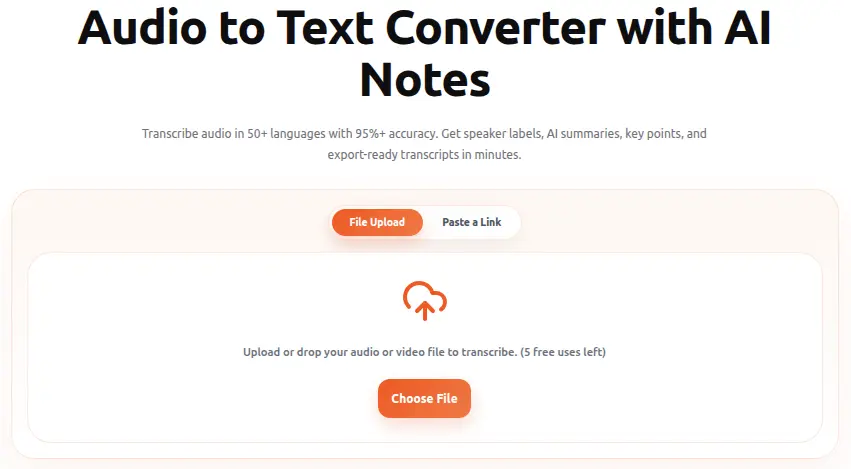
A consumer tool like Vomo’s audio to text converter is a reasonable way to see the whole chain in one place. You upload a file or paste a link, and it returns a speaker-labeled transcript with punctuation, then builds a summary and action items from a template matched to the content type. You can also query the transcript in plain language and get answers pulled from the text rather than invented. Whether that last part works well is exactly the kind of thing the accuracy percentage will never tell you.
Measure it against your own reference
If you want a number you can actually trust, make one. Take a recording that represents your real conditions, the messy multi-speaker kind, and produce a careful reference transcript for a few minutes of it by hand. Then run the same clip through each tool and count the substitutions, deletions, and insertions yourself. That gives you a WER on your audio, not the vendor’s, and it is the only figure that predicts how the tool behaves in production.
The extra step is that you also see where the errors cluster. If they pile up on names, that is a proper-noun problem you can fix with a glossary. If they pile up during crosstalk, no glossary saves you, and you have learned something the marketing page would never tell you.
The headline percentage was never exactly wrong. It was answering a question about clean, scripted, single-speaker audio, which is a question almost nobody in the real world is actually asking.