

The landscape of artificial intelligence has evolved dramatically. We’re no longer just building chatbots that respond to prompts and we’re creating autonomous AI agents that can observe, reason, plan, and execute complex tasks independently. This shift from reactive language models to proactive agentic systems represents one of the most significant transformations in applied AI.
- What Are Agentic AI Frameworks?
- Why Agentic AI Frameworks Matter for Developers
- 1. Reduced Engineering Overhead
- 2. Production Reliability
- 3. Scalability and Performance
- 4. Observability and Debugging
- 5. Community and Ecosystem
- Key Factors to Consider When Choosing an Agentic AI Framework
- Top Agentic AI Frameworks in 2026
- 1. LangGraph: Deterministic Workflow Control
- 2. CrewAI: Role-Based Multi-Agent Collaboration
- 3. AutoGen: Autonomous Multi-Agent Conversations
- 4. LlamaIndex: Knowledge-Centric AI Agents
- 5. Semantic Kernel: Enterprise-Grade AI Orchestration
- 6. Pydantic AI: Type-Safe Agent Development
- 7. Agno (formerly Phi-Data): Developer Experience First
- 8. Mastra: TypeScript-First Agent Framework
- 9. Smolagents: Minimal Code-Centric Approach
- 10. Google Agent Development Kit (ADK)
- Choosing the Right Agentic Framework
- Open Source AI Agent Frameworks: Why They Matter
- Transparency and Trust
- Community Innovation
- Flexibility and Customization
- Cost Efficiency
- Avoiding Vendor Lock-In
- AI Agent Development Frameworks: Best Practices
- 1. Start with Clear Objectives
- 2. Design for Observability
- 3. Implement Guardrails
- 4. Test Extensively
- 5. Optimize for Your Domain
- 6. Plan for Costs
- 7. Prioritize Security
- The Future of Agentic AI Frameworks
- Conclusion: Choosing Your Agentic AI Framework
But here’s the challenge: building production-ready AI agents from scratch is incredibly complex. You need to handle memory management, tool orchestration, multi-agent coordination, state control, and error handling and all while ensuring your system remains reliable and scalable.
That’s where agentic AI frameworks come in.
In this comprehensive guide, we’ll explore the top agentic AI frameworks available in 2026, helping you choose the right tools for building autonomous AI agents that deliver real-world value.
What Are Agentic AI Frameworks?
Before discussing specific frameworks, let’s clarify what makes a framework “agentic.”
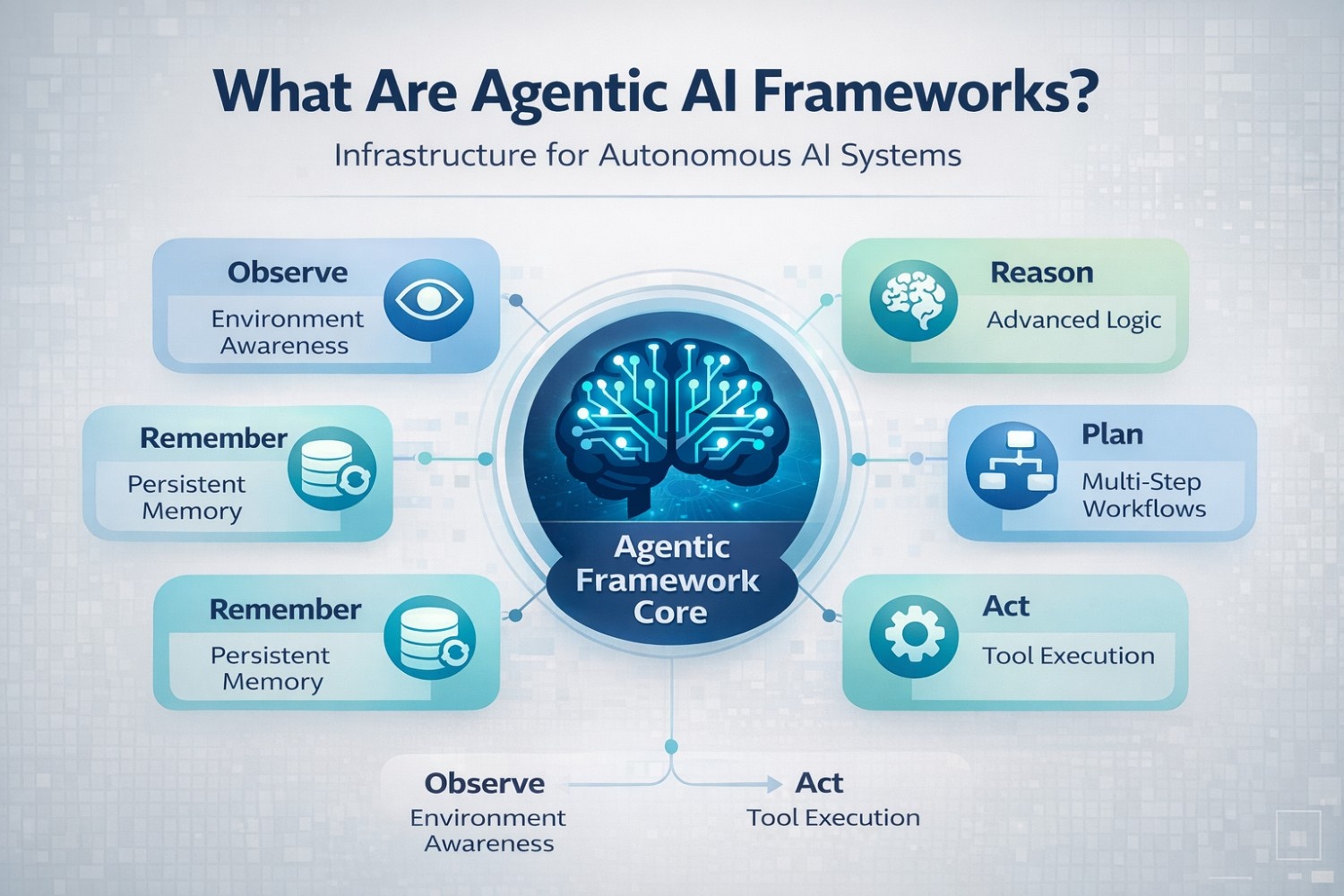
Agentic AI frameworks provide the foundational infrastructure needed to build AI systems that can:
- Observe their environment and gather relevant information
- Reason through complex problems using advanced logic
- Plan multi-step workflows to achieve specific goals
- Act autonomously by executing tasks and using tools
- Remember context across interactions through persistent memory
- Adapt their behaviour based on outcomes and feedback
Unlike traditional LLM applications that simply respond to prompts, agentic systems break down goals into actionable steps, decide which tools to use, maintain context over time, and adjust their strategies based on results.
These agentic AI frameworks eliminate the need to reinvent core components like memory management, tool calling, and task orchestration and allowing developers to focus on building unique agent capabilities rather than low-level plumbing.
Why Agentic AI Frameworks Matter for Developers
The shift from experimental demos to production-ready AI agents requires more than just clever prompting. Here’s why frameworks are essential:
1. Reduced Engineering Overhead
Frameworks provide pre-built abstractions for common patterns like memory persistence, tool integration, and agent coordination. This means you spend less time debugging custom implementations and more time building features.
2. Production Reliability
Building reliable agentic systems requires handling edge cases, managing state transitions, and implementing proper error recovery. Mature frameworks have already solved these problems through extensive testing and community feedback.
3. Scalability and Performance
As your agent systems grow in complexity, frameworks provide the architectural patterns needed to scale efficiently and whether you’re coordinating multiple agents or processing thousands of concurrent requests.
4. Observability and Debugging
Production AI agents need comprehensive monitoring, logging, and tracing capabilities. Modern frameworks integrate with observability tools to help you understand agent behaviour and diagnose issues quickly.
5. Community and Ecosystem
Popular frameworks come with extensive documentation, active communities, and rich ecosystems of integrations and accelerating development and providing solutions to common challenges.
Key Factors to Consider When Choosing an Agentic AI Framework
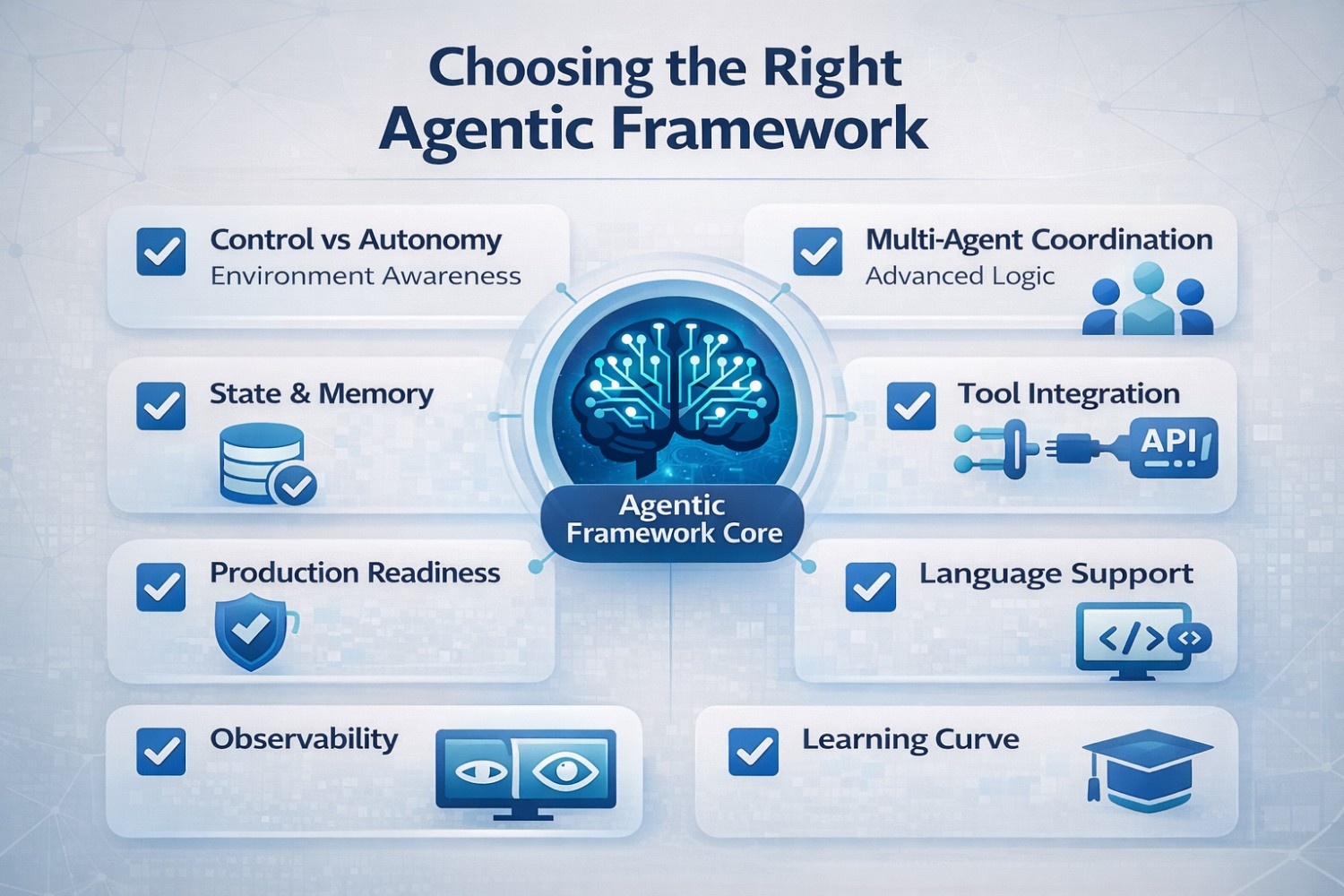
Not all frameworks are created equal. Here are the critical dimensions to evaluate:
- Control vs. Autonomy: Do you need deterministic workflows or flexible agent collaboration?
- Multi-Agent Coordination: How well does the framework handle multiple agents working together?
- State and Memory Management: Can agents maintain context across long conversations?
- Tool Integration: How easily can agents access external APIs and services?
- Production Readiness: Is the framework stable enough for enterprise deployment?
- Language Support: Does it work with your preferred programming language?
- Observability: Can you monitor and debug agent behaviour effectively?
- Learning Curve: How quickly can your team become productive?
Top Agentic AI Frameworks in 2026
Let’s explore the best agentic AI frameworks available today, examining their strengths, ideal use cases, and what makes each one unique.
1. LangGraph: Deterministic Workflow Control
LangGraph has emerged as the go-to framework for developers who need precise control over agent execution paths. Built by the team behind LangChain, it uses a graph-based architecture where agents navigate through explicitly defined nodes and edges.
Key Features:
- State-based graph execution with clear control flow
- Explicit branching and conditional logic
- Built-in check pointing and error recovery
- Strong debugging capabilities with visual workflow inspection
- Native integration with LangChain ecosystem
Best For:
- Production environments requiring predictable behaviour
- Regulated industries (healthcare, finance, legal)
- Complex multi-step workflows with branching logic
- Teams that prioritize reliability over agent autonomy
Developer Experience:
LangGraph has a steeper learning curve compared to higher-level frameworks, but developers appreciate the transparency and control it provides. The graph-based mental model makes it easier to reason about agent behaviour and debug issues in production.
GitHub: langchain-ai/langgraph
2. CrewAI: Role-Based Multi-Agent Collaboration
CrewAI takes a unique approach by modeling agentic systems as teams of specialized agents, each with defined roles and responsibilities. This framework excels when you need multiple agents collaborating on complex tasks.
Key Features:
- Role-based agent architecture (manager, researcher, writer, etc.)
- Task delegation and parallel execution
- Built-in memory and context sharing between agents
- Sequential and hierarchical workflow patterns
- Business-friendly abstractions
Best For:
- Content creation pipelines (research, writing, editing)
- Market research and competitive analysis
- Business process automation
- Teams thinking in terms of organizational workflows
Developer Experience:
CrewAI offers one of the most intuitive mental models and if you can describe your workflow as a team of specialists, you can build it with CrewAI. The framework abstracts away much of the complexity, making it accessible to developers new to agentic AI.
GitHub: joaomdmoura/crewAI
3. AutoGen: Autonomous Multi-Agent Conversations
Developed by Microsoft Research, AutoGen focuses on enabling autonomous conversations between multiple AI agents. It’s designed for scenarios where agents need to collaborate dynamically without rigid orchestration.
Key Features:
- Asynchronous multi-agent communication
- Event-driven architecture
- Flexible agent-to-agent conversations
- Support for human-in-the-loop interactions
- Customizable conversation patterns
Best For:
- Research and experimentation
- Scenarios requiring real-time agent collaboration
- Complex problem-solving through agent debate
- Teams exploring emergent agent behaviours
Developer Experience:
AutoGen provides significant freedom for agent collaboration, which can lead to creative solutions but also unpredictable behaviour. It’s particularly popular in research settings where exploration matters more than deterministic outcomes.
GitHub: microsoft/autogen
4. LlamaIndex: Knowledge-Centric AI Agents
LlamaIndex started as a data framework and has evolved into a powerful platform for building agents that need deep integration with proprietary data sources and knowledge bases.
Key Features:
- Extensive data connectors (APIs, databases, documents)
- Advanced indexing and retrieval pipelines
- RAG (Retrieval-Augmented Generation) optimization
- Query engines and retrieval strategies
- Agent integration with knowledge graphs
Best For:
- Enterprise knowledge assistants
- Document-heavy applications
- Customer support agents requiring access to internal documentation
- Research assistants working with large datasets
Developer Experience:
LlamaIndex shines when data access sits at the core of your agent’s capabilities. The framework provides sophisticated retrieval mechanisms that go far beyond simple vector search.
GitHub: run-llama/llama_index
5. Semantic Kernel: Enterprise-Grade AI Orchestration
Microsoft’s Semantic Kernel is designed for enterprise environments that need robust governance, security, and integration with existing business systems.
Key Features:
- Multi-language support (C#, Python, Java)
- Skills and planners architecture
- Enterprise security and compliance features
- Native Azure integration
- Memory stores and semantic functions
Best For:
- Enterprise copilots and productivity tools
- Organizations heavily invested in Microsoft ecosystem
- Regulated environments requiring strict governance
- .NET development teams
Developer Experience:
Semantic Kernel appeals to enterprise developers who need production-ready patterns, strong typing, and alignment with corporate IT standards.
GitHub: microsoft/semantic-kernel
6. Pydantic AI: Type-Safe Agent Development
Pydantic AI brings the same philosophy that made Pydantic and FastAPI popular to the world of AI agents: strong typing, validation, and developer experience.
Key Features:
- Type-safe agent definitions
- Automatic validation of inputs and outputs
- FastAPI-style developer experience
- Minimal abstraction with maximum transparency
- Built-in structured output handling
Best For:
- Python developers who value type safety
- Teams requiring strict validation and error handling
- Applications where predictable outputs are critical
- Developers who prefer explicit over implicit behaviour
Developer Experience:
Pydantic AI is beloved by developers who want to avoid “magic” abstractions. The framework is transparent, making it easy to understand exactly what’s happening at each step.
GitHub: pydantic/pydantic-ai
7. Agno (formerly Phi-Data): Developer Experience First
Agno focuses on providing an exceptional developer experience with clean abstractions, excellent documentation, and plug-and-play functionality.
Key Features:
- Clean, intuitive API design
- Comprehensive built-in features
- Multi-provider LLM support
- Optional managed platform for deployment
- Strong focus on developer productivity
Best For:
- Teams that want to move fast
- Developers who value clean documentation
- Projects requiring quick prototyping
- Teams exploring multiple LLM providers
Developer Experience:
Agno has one of the cleanest documentations in the space, making it easy to get started quickly. The framework strikes a good balance between simplicity and power.
GitHub: agno-ai/agno
8. Mastra: TypeScript-First Agent Framework
Mastra brings agentic AI to the JavaScript/TypeScript ecosystem, making it accessible to frontend developers and Node.js teams.
Key Features:
- Native TypeScript support
- Workflow orchestration
- RAG capabilities
- OpenTelemetry integration
- Frontend-friendly abstractions
Best For:
- JavaScript/TypeScript development teams
- Full-stack applications
- Teams building web-based AI experiences
- Developers in the Gatsby/React ecosystem
Developer Experience:
Mastra allows frontend developers to build sophisticated AI agents without leaving their preferred language and tooling.
GitHub: mastra-ai/mastra
9. Smolagents: Minimal Code-Centric Approach
Smolagents from Hugging Face takes a minimalist approach, using code execution rather than JSON for routing and tool calling.
Key Features:
- Code-based agent routing
- Direct access to Hugging Face model library
- Minimal abstraction layer
- Lightweight and fast
- CodingAgent for dynamic code execution
Best For:
- Quick automation tasks
- Developers who prefer code over configuration
- Teams already using Hugging Face models
- Projects that don’t need heavy orchestration
Developer Experience:
Smolagents is perfect for developers who want a bare-bones framework without unnecessary complexity. It’s fast to set up and easy to understand.
GitHub: huggingface/smolagents
10. Google Agent Development Kit (ADK)
Google’s ADK provides multi-agent orchestration capabilities optimized for the Gemini model ecosystem.
Key Features:
- Native Gemini integration
- Built-in session management
- Multi-agent coordination
- Strong unit test coverage
- Google Cloud integration
Best For:
- Teams using Google Cloud Platform
- Applications built on Gemini models
- Organizations in the Google ecosystem
- Projects requiring reliable, well-tested foundations
Developer Experience:
ADK is smaller and simpler than many alternatives, with strong reliability thanks to comprehensive testing.
Documentation: Google ADK Docs
Choosing the Right Agentic Framework
Open Source AI Agent Frameworks: Why They Matter
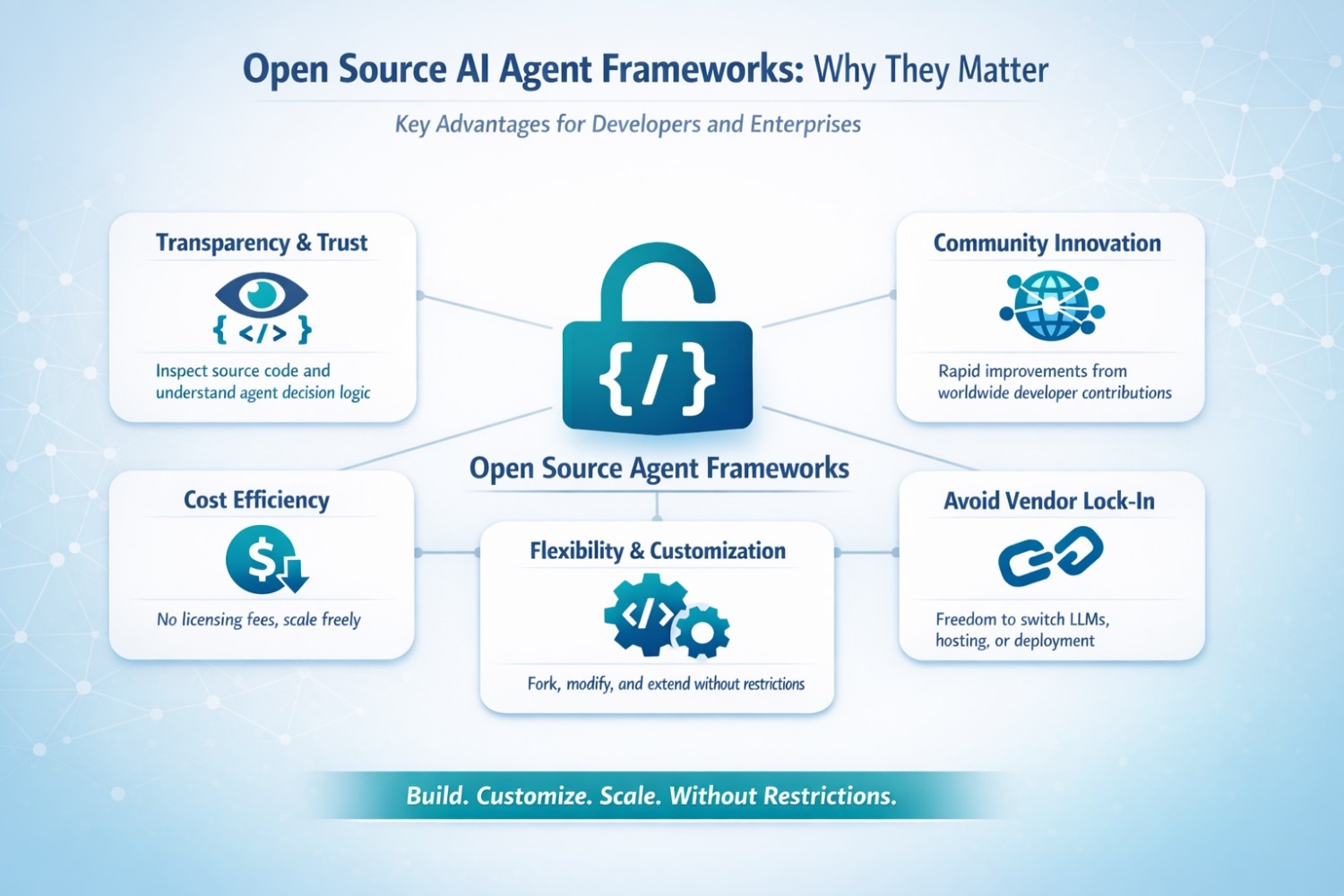
The frameworks discussed above are all open source, which provides several critical advantages for developers:
Transparency and Trust
You can inspect the source code to understand exactly how agents make decisions, which is crucial for debugging and building trust in production systems.
Community Innovation
Open source frameworks benefit from contributions by thousands of developers worldwide, leading to rapid innovation and diverse use cases.
Flexibility and Customization
You’re not locked into proprietary systems and you can fork, modify, and extend frameworks to meet your specific needs.
Cost Efficiency
No licensing fees mean you can experiment freely and scale without worrying about framework costs (though LLM API costs still apply).
Avoiding Vendor Lock-In
Open source frameworks give you the freedom to switch LLM providers, hosting platforms, or deployment strategies without rewriting your entire application.
AI Agent Development Frameworks: Best Practices
Regardless of which framework you choose, follow these best practices for building production-ready AI agents:
1. Start with Clear Objectives
Define what success looks like for your agent. What tasks should it handle? What level of autonomy is appropriate? Where should humans remain in the loop?
2. Design for Observability
Implement comprehensive logging, tracing, and monitoring from day one. You need visibility into agent decision-making to debug issues and improve performance.
3. Implement Guardrails
Set clear boundaries for agent behaviour. Define what actions require human approval, implement rate limiting, and establish fallback mechanisms for failures.
4. Test Extensively
AI agents are non-deterministic, making testing challenging. Use evaluation frameworks, create comprehensive test suites, and monitor behaviour in production.
5. Optimize for Your Domain
Generic agents rarely perform well. Fine-tune models, customize prompts, and optimize retrieval strategies for your specific use case and data.
6. Plan for Costs
LLM API calls can get expensive quickly, especially with multi-agent systems. Monitor costs, implement caching strategies, and optimize token usage.
7. Prioritize Security
Agents that can execute code or access sensitive data require robust security measures. Implement proper authentication, authorization, and data protection.
The Future of Agentic AI Frameworks
As we move through 2026, several trends are shaping the evolution of agentic AI frameworks:
- Improved Reliability: Frameworks are becoming more production-ready with better error handling and state management
- Enhanced Observability: Integration with monitoring tools is becoming standard
- Multi-Modal Capabilities: Agents are expanding beyond text to handle images, audio, and video
- Better Cost Management: Frameworks are implementing smarter caching and optimization strategies
- Standardization: Common patterns and interfaces are emerging across frameworks
- Enterprise Features: Governance, compliance, and security features are maturing
Conclusion: Choosing Your Agentic AI Framework
The best agentic AI framework for your project depends on your specific requirements:
- Need deterministic control?→ LangGraph
- Building multi-agent teams?→ CrewAI
- Exploring autonomous collaboration?→ AutoGen
- Working with proprietary data?→ LlamaIndex
- Enterprise deployment?→ Semantic Kernel
- Want type safety?→ Pydantic AI
- Prioritize developer experience?→ Agno
- Using TypeScript?→ Mastra
- Need minimal abstraction?→ Smolagents
- Building on Gemini?→ Google ADK
Remember, framework selection is a strategic decision, not just a tooling choice. The right framework will help you move from experimental demos to production systems that deliver measurable business value.
Start by building a simple proof of concept with 2-3 frameworks that match your requirements. Evaluate them based on your team’s expertise, production constraints, and long-term maintenance needs. The framework that feels most natural to your team and meets your reliability requirements is usually the right choice.
The era of agentic AI is here, and these frameworks are your foundation for building the next generation of intelligent, autonomous systems. Choose wisely, build thoughtfully, and create agents that truly augment human capabilities.
Ready to start building autonomous AI agents? Choose a framework from these guides and begin experimenting today. The future of AI is agentic, and the tools are ready for you to create something remarkable.

Hi, I’m Pragya.
I write about AI tools, digital trends, and emerging technologies in a way that’s simple, practical, and easy to apply. I enjoy exploring new AI platforms, testing their features, and breaking them down into clear guides that actually help people use them confidently.
My focus is not just on writing content, but on creating value. I believe powerful technology should feel accessible, not overwhelming. That’s why I aim to turn complex tools into actionable insights for creators, marketers, and growing online businesses.
I’m constantly learning, researching, and staying updated with the fast-moving AI space so readers always get relevant and useful information.