
Imagine: While you sleep, digital workers are analyzing your company’s financial data, scheduling your meetings, and even drafting responses to customer inquiries. No, this isn’t science fiction, it’s the reality of intelligent agents in 2026.
- What Is an Intelligent Agent in AI?
- The PEAS Framework: Understanding Intelligent Agent Design
- 4. Utility-Based Agents: The Value Optimizers
- Intelligent Agent Architecture: The Building Blocks
- Benefits and Challenges: The Double-Edged Sword
- How to Implement Intelligent Agents: A Practical Approach
- FAQs About Intelligent Agents in AI
These AI-powered entities are quietly transforming how businesses operate, how software functions, and how we interact with technology. Unlike their chatbot predecessors that simply responded to queries, today’s intelligent agents take action, make decisions, and learn from experience.
But what exactly makes these digital assistants so revolutionary? And how can your business harness their power to stay competitive in an increasingly automated world?
What Is an Intelligent Agent in AI?
An intelligent agent is a software entity (sometimes with hardware components) that perceives its environment through sensors, processes that information, makes autonomous decisions, and takes actions to achieve specific goals. Think of it as a digital employee that works 24/7, never needs coffee breaks, and continuously improves at its job.
Unlike traditional software that follows rigid instructions, intelligent agents can:
- Observe and interpret their surroundings through data inputs
- Make decisions based on goals and available information
- Take independent action without human intervention
- Learn and adapt from experience and feedback
- Collaborate with humans and other agents
As Deutsche Telekom discovered when implementing AI agents to manage employee HR inquiries, the fundamental difference between intelligent agents and conventional automation is contextual understanding. While traditional systems follow fixed rules, intelligent agents combine various AI technologies to interpret context, evaluate alternatives, and adapt their decisions dynamically.
The PEAS Framework: Understanding Intelligent Agent Design
When designing intelligent agents, AI engineers use the PEAS framework to define the agent’s capabilities:
- Performance measure: How success is evaluated
- Environment: Where the agent operates
- Actuators: How the agent executes actions
- Sensors: How the agent perceives its environment

This framework helps ensure the agent is properly equipped to handle its intended tasks and can effectively navigate its operational environment.
Types of Intelligent Agents: From Simple to Sophisticated
Intelligent agents come in various forms, each with different capabilities and applications. Understanding these types helps in selecting the right agent for specific business needs.
1. Simple Reflex Agents: The Digital Thermostats
Simple reflex agents operate on basic if-then rules. When they detect a specific condition, they execute a predefined response and no memory, no learning, just straightforward action.
Real-world example: Smart home thermostats that adjust temperature based on present thresholds.
“Simple doesn’t mean ineffective. For stable, predictable environments, these agents deliver reliable results without unnecessary complexity.”
2. Model-Based Reflex Agents: The Context-Aware Assistants
These agents maintain an internal representation of their environment, allowing them to make decisions based on both current inputs and their understanding of the world.
Real-world example: Home automation systems that adjust lighting based on time of day, occupancy patterns, and user preferences.
3. Goal-Based Agents: The Problem Solvers
Goal-based agents evaluate different actions based on how they contribute to achieving specific objectives. They consider future consequences and plan accordingly.
Real-world example: Route optimization systems for delivery companies that plan the most efficient paths while considering traffic, delivery windows, and vehicle constraints.
4. Utility-Based Agents: The Value Optimizers
These sophisticated agents assign values to different outcomes and make decisions by maximizing a utility function that represents preferences among various states.
Real-world example: Financial portfolio management systems that balance risk, return, and client preferences to optimize investment decisions.
5. Learning Agents: The Self-Improvers
Learning agents adapt their behaviour based on experience. They have dedicated components for learning from feedback and improving performance over time.
Real-world example: Customer service agents that analyse past interactions to improve response accuracy and customer satisfaction.
6. Multi-Agent Systems: The Collaborative Networks
These systems involve multiple autonomous agents that interact with each other, either collaboratively toward common goals or competitively for resources.
Real-world example: Supply chain optimization systems where different agents represent various stakeholders (suppliers, manufacturers, distributors) and coordinate to maximize efficiency.
7. LLM-Based Agents: The New Generation
A newer category emerging in 2025-2026, LLM-based agents leverage large language models as their core reasoning engine, enabling more natural interaction and complex task handling.
Real-world example: AI agents now handling multi-step customer interactions, coordinating operational processes, and managing exceptions in real time by orchestrating tools, APIs, and data sources.
Intelligent Agent Architecture: The Building Blocks
Understanding the architecture of intelligent agents helps in designing effective systems that can operate autonomously and adapt to changing conditions.
Core Components
- Perception System: Collects inputs from the environment (sensors, data feeds, user inputs)
- Knowledge Base: Stores information, rules, and models about the environment
- Reasoning Engine: Processes information and makes decisions
- Action System: Executes decisions through outputs or actions
- Learning Component: Updates knowledge and behaviour based on feedback

Modern AI agent architectures often use specialized agents for specific tasks rather than building one generalist system. This approach allows for more efficient processing and better results in complex environments.
Real-World Applications: Intelligent Agents in Action
Intelligent agents have moved beyond theoretical concepts to become practical solutions across various industries. Here are some notable real-world applications:
Business Operations
By 2026, 40% of enterprise applications are integrating AI agents into their workflows, according to Gartner research. These agents handle everything from calendar management to due diligence automation, delivering results in finance, legal, insurance, and operations.
Customer Service
Companies are deploying intelligent agents that analyze conversations in real-time, detect tone and sentiment, and suggest responses instantly. These agents also log notes, summarize outcomes, and update CRMs during calls, improving call quality and helping human agents handle customers with more confidence.
Healthcare
In medical settings, intelligent agents assist with:
- Clinical documentation during patient visits
- Disease identification by comparing symptoms with historical data
- Appointment scheduling and patient registration
- Drug discovery by analyzing research publications and molecular structures
Human Resources
Johnson & Johnson and other forward-thinking companies are using intelligent agents to:
- Write job listings aligned with company policies
- Schedule interviews and send follow-up communications
- Streamline employee onboarding processes
- Explain benefits and answer employee questions
- Analyze turnover risks and identify promotion candidates
Financial Services
Financial institutions leverage utility-based and learning agents for:
- Portfolio optimization based on risk profiles and market conditions
- Fraud detection by identifying unusual transaction patterns
- Risk assessment for loan applications
- Regulatory compliance monitoring
Manufacturing
In production environments, intelligent agents help with:
- Predictive maintenance to prevent equipment failures
- Quality control through visual inspection systems
- Supply chain optimization
- Production scheduling to maximize efficiency
Benefits and Challenges: The Double-Edged Sword
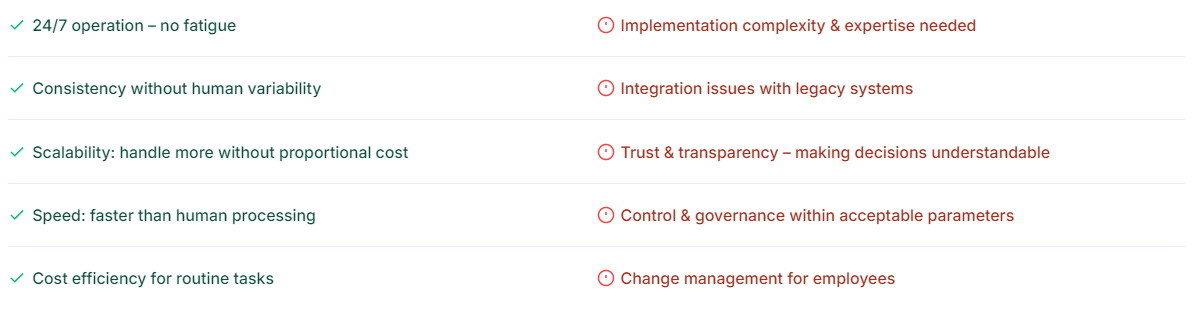
Benefits
- 24/7 Operation: Agents work continuously without fatigue or downtime
- Consistency: Deliver reliable results without human variability
- Scalability: Handle increasing workloads without proportional resource increases
- Speed: Process information and take action faster than humans
- Cost Efficiency: Reduce operational expenses for routine tasks
Challenges
- Implementation Complexity: Designing effective agents requires expertise and resources
- Integration Issues: Connecting agents with existing systems can be challenging
- Trust and Transparency: Making agent decision-making understandable to users
- Control and Governance: Ensuring agents operate within acceptable parameters
- Change Management: Helping employees adapt to working alongside intelligent agents
How to Implement Intelligent Agents: A Practical Approach
The most successful intelligent agent implementations share three characteristics:
- They solve narrow, well-defined problems
- They integrate with tools people already use
- They have clear success criteria that can be measured in hours saved or errors reduced
Implementation Steps
- Identify the Right Use Case: Start with high-value, repetitive tasks where automation would deliver clear benefits
- Start Simple: Begin with less autonomous agents before implementing more complex systems
- Ensure Data Quality: Agents are only as good as the data they work with
- Maintain Human Oversight: Keep appropriate human supervision, especially for critical decisions
- Measure and Refine: Track performance metrics and continuously improve the system
The Future of Intelligent Agents: What’s Next?
As we look beyond 2026, intelligent agents are poised to become even more integrated into our digital infrastructure. Key trends include:
- Greater Autonomy: Agents will handle increasingly complex tasks with less human oversight
- Improved Collaboration: Multi-agent systems will become more sophisticated in their coordination
- Enhanced Learning: Agents will learn more efficiently from fewer examples
- Broader Integration: Agents will connect across more systems and domains
- Natural Interaction: Communication with agents will become more conversational and intuitive
Conclusion: Embracing the Intelligent Future
Intelligent agents represent a fundamental shift in how we approach automation and decision-making. By understanding the different types of agents, their architectures, and appropriate applications, organizations can make informed decisions about implementing these powerful technologies.
Whether you’re just beginning to explore intelligent agents or looking to enhance existing systems, the key is to start with clear objectives, choose the right type of agent for your needs, and implement a solution that balances autonomy with control.
The businesses that thrive in the coming years won’t be those with the most employees, but those that most effectively combine human creativity with intelligent agent capabilities. The question isn’t whether to adopt this technology, but how quickly you can harness its potential to transform your organization.
FAQs About Intelligent Agents in AI
Q: How do intelligent agents differ from chatbots?
A: While chatbots primarily engage in conversation, intelligent agents take action to accomplish tasks. Chatbots respond; agents initiate.
Q: Can small businesses benefit from intelligent agents?
A: Absolutely! Many agent platforms offer affordable options that can automate routine tasks, allowing small business owners to focus on growth and strategy.
Q: How much technical knowledge do I need to implement intelligent agents?
A: Many modern platforms offer no-code or low-code options for creating agents, making the technology accessible to non-technical users.
Q: Are intelligent agents secure?
A: Security depends on implementation. Reputable platforms incorporate robust security measures, but it’s essential to evaluate any solution’s security features before deployment.
Q: How do I measure the ROI of intelligent agents?
A: Track metrics like time saved, error reduction, customer satisfaction improvements, and operational cost decreases to quantify the value of your intelligent agent implementation.

Hi, I’m Pragya.
I write about AI tools, digital trends, and emerging technologies in a way that’s simple, practical, and easy to apply. I enjoy exploring new AI platforms, testing their features, and breaking them down into clear guides that actually help people use them confidently.
My focus is not just on writing content, but on creating value. I believe powerful technology should feel accessible, not overwhelming. That’s why I aim to turn complex tools into actionable insights for creators, marketers, and growing online businesses.
I’m constantly learning, researching, and staying updated with the fast-moving AI space so readers always get relevant and useful information.