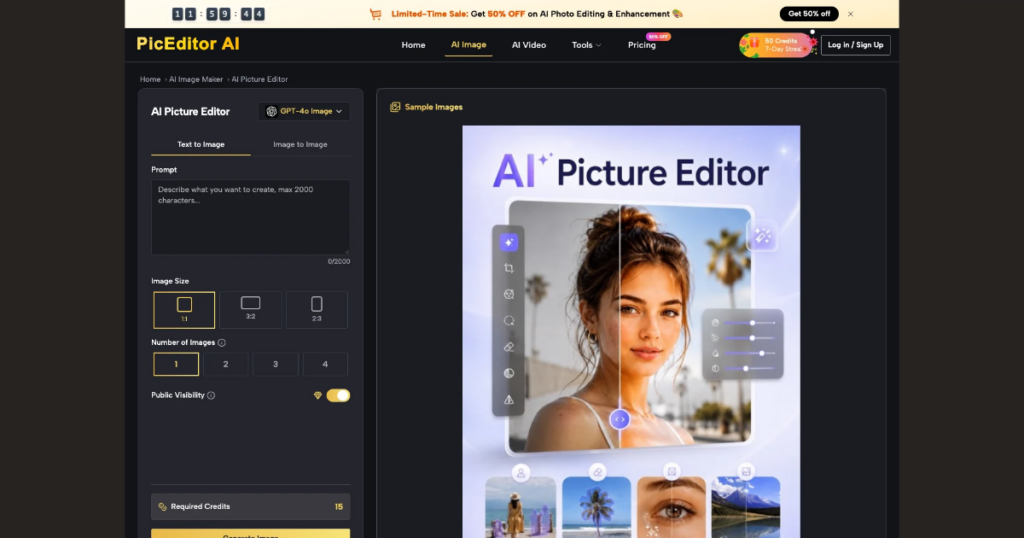
Modern visual teams constantly test new generative tools to cut turnaround times across digital campaigns. Evaluating an integrated AI Photo Editor reveals how multi-model routing and unified controls simplify iterative design while reducing software switching friction.
- Understanding The Architecture Behind Multi Model Visual Processing
- Analyzing Specialized Neural Engines Across Practical Editing Demands
- Model Selection Criteria Across Common Creative Workflows
- Realistic Limitations Before Pushing To Production
- Transforming Isolated Image Tasks Into A Cohesive Creative Pipeline
- FAQs
- 1. What is an AI photo editor?
- 2. What makes PicEditor different from traditional photo editing software?
- 3. Which AI models does PicEditor support?
- 4. How can AI photo editors improve creative workflows?
- 5. Can AI photo editors preserve product and character consistency?
- 6. What are the limitations of AI photo editing?
- 7. Is PicEditor suitable for professional creative teams?
In early implementations of artificial intelligence for computer graphics, users typically relied on single-purpose standalone utilities. One application specialized in upscaling, another handled background isolation, while separate platforms generated novel textures from text prompts. Navigating across several disconnected subscriptions created frustrating data handoffs, inconsistent color profiles, and fragmented brand assets. Examining contemporary creative environments demonstrates that the most meaningful evolution is not just higher resolution output, but the consolidation of diverse generative architectures within a single coordinated workspace.

Understanding The Architecture Behind Multi Model Visual Processing
At the center of modern generative image editing is the realization that no single neural network excels at every creative task. Light diffusion models optimized for lightning-fast preview generation often lack the compositional nuance required for realistic human portraits or complex product reflections. Conversely, heavy autoregressive or high-parameter models deliver remarkable detail but introduce processing latency that bogs down rapid exploratory brainstorming.
A unified workspace solves this structural mismatch by acting as a dynamic dispatch system. When an operator initiates an editing request, the platform routes specific instructions to specialized neural backends based on the nature of the requested transformation. PicEditor organizes this routing seamlessly behind an accessible user interface, allowing creators to switch between speed-focused iteration engines and high-fidelity restoration models without managing separate API keys or command line parameters.
This multi-model coordination is particularly evident when comparing generative fill against structural isolation. Background segmentation algorithms analyze contrast thresholds and depth gradients to cut out focal objects with clean edges, while adjacent diffusion models sample neighboring illumination cues to populate empty canvas sectors. By chaining these specialized systems together, the platform converts what once required twenty minutes of manual brushwork into an automated five-second pipeline.
Furthermore, contemporary workflows increasingly bridge static photography and short-form motion. When a finalized still graphic requires animation for social engagement, integrated platforms connect image outputs directly to video generation models such as Veo 3 and Kling 2.5. Rather than exporting stills, re-encoding formats, and opening an external video editor, creators can generate synchronized cinematic loops directly from their approved still canvas, preserving color fidelity and focal continuity across media types.
Analyzing Specialized Neural Engines Across Practical Editing Demands
A comprehensive assessment of current generative software requires examining how individual engine families behave when subjected to rigorous commercial briefs. Rather than treating artificial intelligence as a generic buzzword, experienced art directors evaluate specific model families for consistency, prompt adherence, and computational predictability.
Different client assignments introduce distinct technical hurdles. An e-commerce catalog update demands rigid adherence to true product geometry, while an editorial lifestyle feature calls for atmospheric lighting shifts and dynamic composition rebalancing. Selecting the appropriate model architecture ensures that processing credits deliver tangible visual value rather than erratic rendering attempts.
Preserving Identity And Subject Consistency With Nano Banana Engines
One of the persistent hurdles in generative image workflows has been character and subject drift. In early text-to-image experiments, re-rendering an existing subject with an altered background routinely altered facial structures, clothing textures, or product dimensions. The Nano Banana family addresses this issue by incorporating robust multi-reference conditioning, supporting up to four reference images simultaneously.
This capability allows creators to lock facial identity, brand mascots, or physical product silhouettes while completely changing environmental contexts, ambient lighting, or camera angles. For digital brand campaigns that require consistent spokesperson appearances across dozens of distinct visual scenarios, this stability eliminates the randomized guesswork that plagued earlier generative pipelines.
Executing Context Aware Fine Detail Corrections Through Flux Architectures
Where subject stability establishes continuity, precision manipulation requires deep semantic context awareness. The Flux model series, particularly variants like Flux Kontext Pro and Kontext Max, distinguishes itself through granular spatial comprehension and exceptional prompt adherence. When editors need to swap out a specific object inside a crowded composition or adjust subtle text elements within an existing graphic, Flux architectures calculate surrounding geometry with surgical accuracy.
Rather than applying blunt regional blurring, deploying a competent AI Image Editor powered by these architectures ensures that altered elements cast physically plausible shadows and maintain accurate surface reflections. The result is a coherent visual modification that integrates seamlessly with untouched photographic pixels.
Model Selection Criteria Across Common Creative Workflows
To maximize efficiency and budget allocation, creative teams must match specific project phases to appropriate model tiers. Utilizing a high-compute flagship engine for preliminary rough layout sketches wastes valuable credits, while relying on rapid lightweight models for final commercial hero assets risks subtle surface blurring.
The following evaluation matrix breaks down primary model categories, typical credit usage, and optimal production applications within the workspace.
| Model Family | Core Technical Strength | Credit Consumption Tier | Optimal Production Use Case |
| Seedream 4.0 / 5.0 Flash | Rapid generation cycles and swift ideation | Low (8 to 12 credits) | Rough concept exploration and moodboard layouts |
| Nano Banana 2 / Pro | Subject preservation and multi-reference stability | Moderate (12 to 16 credits) | Consistent character campaigns and recurring product stills |
| Flux Kontext Pro / Max | Contextual inpainting and precise object edits | High (12 to 16 credits) | Final client deliverables, text fixes, and complex composites |
| Veo 3.1 / Kling 2.5 | Integrated still-to-video motion synthesis | Premium (44 to 88 credits) | Animated social banners and motion hero displays |
Reviewing these functional tiers demonstrates why flexible credit systems prove superior to flat per-seat software models. PicEditor enables teams to allocate resources dynamically, spending minimal credits during early brainstorming phases and reserving premium processing queues for finalized marketing assets.
Cost accounting becomes transparent when each creative operation carries an explicit credit footprint. On entry-level subscriptions such as the Starter plan at $8.30 monthly billed annually for 10,000 credits, an organization can produce hundreds of polished assets while carrying over unspent balances into subsequent billing periods.
Routing Routine Image Iterations For Maximum Speed Efficiency
During the initial stages of campaign development, velocity matters more than pixel-perfect finish. Creators often generate twenty to thirty conceptual variations to test color schemes, composition framings, and narrative hooks. Leveraging fast models like Seedream allows art directors to review wide arrays of visual options in seconds, narrowing down creative direction before committing production budget to detailed polish.
Deploying High Fidelity Generation For Print And Packaging Standards
Once visual concepts receive stakeholder approval, attention shifts to resolving fine details. Transitioning assets into premium model pipelines enables 4K multi-resolution rendering, precise contour sharpening, and uncompressed commercial exports. At this stage, advanced texture synthesis eliminates telltale digital artifacts, delivering clean visual assets that satisfy demanding print, billboard, and high-DPI display standards.
High-resolution outputs also benefit from systematic noise reduction and tone curve calibration. Finalizing master images with dedicated neural enhancers ensures that dark gradients and delicate highlights reproduce cleanly without color banding across commercial press runs.
Realistic Limitations Before Pushing To Production

Despite impressive architectural advances, automated generative tools still encounter clear operational boundaries. Algorithms can struggle when processing dense legal disclaimers, micro-scale typography under eight points, or extremely complex overlapping biological limbs. Human art directors must inspect high-frequency edge details and brand trademarks at full zoom, discarding any iteration where generative smoothing compromises critical graphic data.
Transforming Isolated Image Tasks Into A Cohesive Creative Pipeline
The broader impact of modern generative editing platforms extends well beyond saving a few minutes on background removal. By unifying diverse model architectures, transparent credit economics, and intuitive prompt-driven interfaces, these tools democratize sophisticated image production for teams of all sizes.
Agile marketing departments, independent content creators, and enterprise design studios can now operate with unprecedented responsiveness. PicEditor provides an accessible bridge between complex artificial intelligence research and practical daily production needs, turning visual editing into an agile, highly iterative discipline where creative concepts reach publication without traditional technical friction.
As synthetic media capabilities continue to mature, the defining differentiator for creative studios will not be software ownership, but the speed of editorial refinement. Organizations that combine discerning visual taste with unified multi-model tools will consistently outperform competitors anchored to rigid, outdated manual pipelines.
FAQs
1. What is an AI photo editor?
An AI photo editor uses artificial intelligence to automate or enhance image editing tasks such as background removal, object replacement, image restoration, and visual generation.
2. What makes PicEditor different from traditional photo editing software?
PicEditor combines multiple AI models within one workspace, allowing users to perform different image editing and generation tasks without switching between separate tools.
3. Which AI models does PicEditor support?
The article mentions Seedream, Nano Banana, Flux Kontext, Veo, and Kling model families for image generation, editing, and video creation.
4. How can AI photo editors improve creative workflows?
AI photo editors can reduce repetitive editing tasks, speed up visual experimentation, simplify object removal, and help creators produce campaign assets more efficiently.
5. Can AI photo editors preserve product and character consistency?
Some AI models support reference-image conditioning, helping preserve subject identity, product appearance, and character consistency across different visual environments.
6. What are the limitations of AI photo editing?
AI photo editing can struggle with small typography, complex overlapping objects, detailed biological structures, and brand trademarks. Human review remains important for professional outputs.
7. Is PicEditor suitable for professional creative teams?
PicEditor may suit creative teams looking for multi-model image generation, editing, and integrated video workflows within a single platform. Professional teams should evaluate output quality, credit costs, and editing limitations before production use.

Sandeep Kumar is the Founder & CEO of Aitude, a leading AI tools, research, and tutorial platform dedicated to empowering learners, researchers, and innovators. Under his leadership, Aitude has become a go-to resource for those seeking the latest in artificial intelligence, machine learning, computer vision, and development strategies.