


Most construction sites, remote facilities, and outdoor events face the same problem: how do you secure a location that has no power, no network infrastructure, and no on-site staff?
- Why Traditional Mobile Surveillance Falls Short?
- What Makes a Solar Surveillance Trailer “Autonomous”?
- 1. Real-Time AI Detection at the Edge
- 2. Solar Power Enables True Independence
- 3. Cloud Integration for Centralized Monitoring
- 4. Automated Response Systems
- 5. Reducing False Alarms Through AI Precision
- 6. Data-Driven Security Insights
- 7. Real-World Use Cases
- Construction Sites
- Renewable Energy Farms
- Outdoor Events
- Critical Infrastructure
- The Future: Toward Fully Self-Managed Security Networks
Traditional solutions rely on security guards or temporary CCTV towers. Both are expensive, slow to deploy, and limited in effectiveness. Theft from construction sites alone costs the U.S. industry an estimated $300 million to $1 billion annually, according to the National Equipment Register. Equipment theft recovery rates remain below 25% in many states.
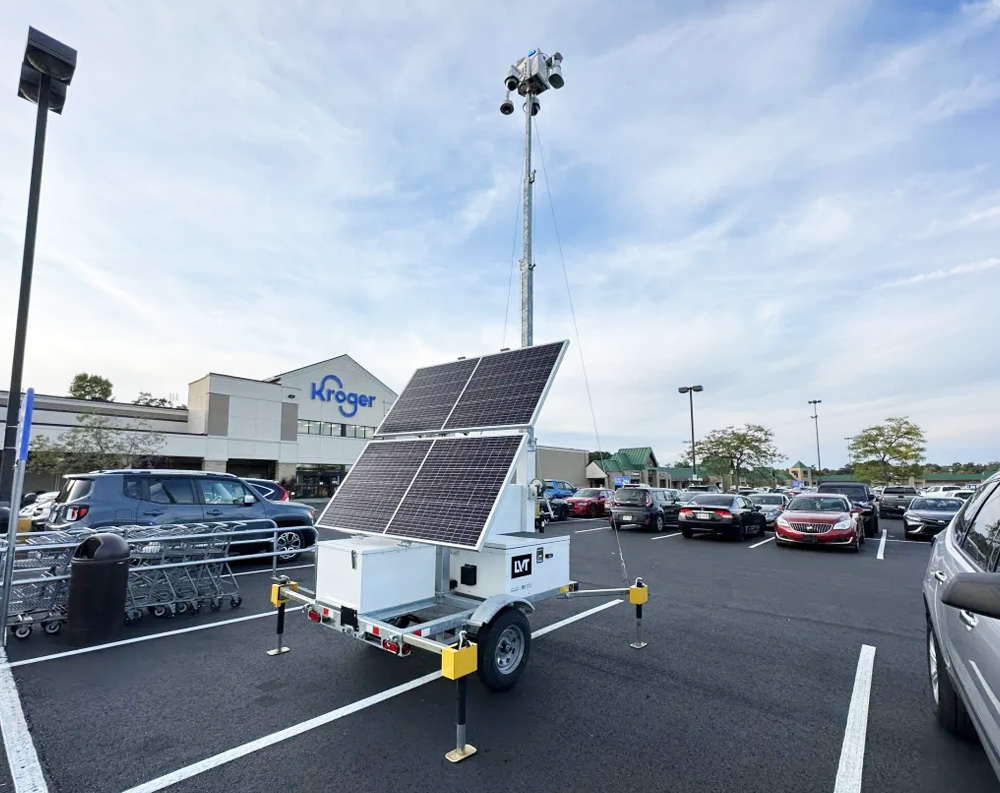
The solution emerging in 2026 is clear: AI-powered solar surveillance trailers. These mobile units are no longer just camera towers. They are becoming autonomous security systems capable of detecting threats, issuing alerts, and even triggering automated responses without human intervention.
This article breaks down how AI, solar power, and edge computing are transforming surveillance trailers into intelligent, self-sustaining security platforms.
Why Traditional Mobile Surveillance Falls Short?
Before understanding the AI revolution, it helps to understand the limitations of legacy systems.
Traditional mobile security trailers typically include:
- Pole-mounted cameras
- Diesel generators or wired power
- Local recording (DVR/NVR)
- Human monitoring
The problems are significant:
- High operational cost
A single overnight security guard can cost $20–$35 per hour. For a 12-hour shift, that’s $240–$420 per night. Over 30 days, this exceeds $7,000–$12,000 per month per site. - Reactive monitoring
Most systems only record footage. Incidents are discovered after theft occurs. - Power dependency
Generators require fuel, maintenance, and create noise pollution. - Delayed response times
Without AI alerts, security teams often respond too late.
AI-powered solar surveillance trailers solve these limitations by combining renewable energy with intelligent detection and cloud connectivity.
What Makes a Solar Surveillance Trailer “Autonomous”?
An autonomous security system performs three critical tasks without human intervention:
- Detect – Identify unusual or high-risk activity in real time
- Decide – Analyze whether the activity represents a threat
- Respond – Trigger alerts, alarms, or automated actions
AI enables all three.
Modern solar surveillance trailers integrate:
- High-definition IP cameras
- Edge AI processors
- Solar panels and battery banks
- LTE/5G connectivity
- Cloud-based dashboards
This architecture allows deployment in minutes, without trenching or wired power.
1. Real-Time AI Detection at the Edge
The most important innovation is edge-based AI processing.
Instead of streaming all footage to a cloud server for analysis, edge AI devices process video locally on the trailer. This reduces bandwidth usage and speeds up detection.
AI models can now identify:
- Human presence after hours
- Vehicles entering restricted zones
- Loitering behavior
- Weapon detection in high-risk areas
- Perimeter breaches
According to industry research from Omdia, the adoption of AI-enabled cameras is expected to account for over 60% of professional surveillance camera shipments by 2027.
Edge processing reduces false alarms. For example:
- Wind-blown debris no longer triggers alerts
- Wildlife movement is filtered out
- Authorized personnel can be recognized based on schedules
This dramatically improves response efficiency.
2. Solar Power Enables True Independence
Autonomy requires energy independence.
Modern solar surveillance trailers include:
- High-efficiency photovoltaic panels
- Lithium battery storage systems
- Smart energy management controllers
Solar eliminates the need for diesel generators. According to the U.S. Department of Energy, solar panel efficiency has improved more than 40% over the last decade, making continuous off-grid operation viable.
This enables:
- Silent operation
- Lower operating costs
- Reduced carbon footprint
- Deployment in remote environments
For construction firms managing multiple sites, the fuel savings alone can reach thousands of dollars per month.
3. Cloud Integration for Centralized Monitoring
While edge AI detects threats locally, cloud platforms provide centralized oversight.
Security managers can:
- View live feeds remotely
- Receive real-time alerts via mobile app
- Search footage using AI-assisted queries
- Monitor multiple sites from one dashboard
This is where modern platforms differentiate themselves.
For example, some solutions like Coram’s solar surveillance trailer integrate AI-powered detection with cloud-based monitoring. The system can transform any solar trailer into a smart surveillance unit that deploys in minutes and protects construction sites, remote assets, and outdoor events without trenching or dedicated security staff. Its AI detection analyzes video feeds in real time and sends intelligent alerts, allowing centralized monitoring across locations.
This type of integration demonstrates how AI and cloud connectivity combine to create operational autonomy.
4. Automated Response Systems
Autonomous security does not stop at detection.
Modern solar surveillance trailers can automatically:
- Activate floodlights
- Trigger sirens
- Issue voice warnings
- Send SMS/email alerts
- Notify law enforcement contacts
Studies show that audible warnings alone can deter up to 70% of intrusion attempts in monitored commercial environments.
This proactive approach reduces the likelihood of theft before it happens.
5. Reducing False Alarms Through AI Precision
False alarms are a major issue in traditional surveillance.
The Security Industry Alarm Coalition estimates that over 90% of traditional alarm activations are false alarms.
AI significantly reduces this rate by:
- Differentiating humans from animals
- Recognizing authorized access patterns
- Analyzing movement speed and direction
Lower false alarm rates mean:
- Faster response to real threats
- Reduced law enforcement fines
- Improved operational trust
6. Data-Driven Security Insights
Autonomous systems also generate analytics beyond immediate threats.
AI dashboards can provide:
- Heat maps of activity
- Entry pattern tracking
- Equipment movement logs
- Incident frequency reports
For project managers, this data helps:
- Identify high-risk time windows
- Optimize site access control
- Reduce insurance claims
Insurance providers increasingly favor monitored AI systems because they lower loss frequency.
7. Real-World Use Cases
Construction Sites
Construction equipment theft costs the industry up to $1 billion annually in the U.S. AI trailers monitor heavy machinery overnight without guards.
Renewable Energy Farms
Solar and wind farms are often located in remote areas. Autonomous surveillance ensures asset protection without grid power.
Outdoor Events
Music festivals and sporting events require temporary security infrastructure. AI-powered trailers deploy quickly and provide perimeter monitoring.
Critical Infrastructure
Utility substations and telecom towers rely on autonomous systems to prevent sabotage or vandalism.
8. The ROI of Autonomous Security
Comparing costs:
Security Guard (Night Shift)
- $25/hour × 12 hours = $300 per night
- $9,000 per month
AI Solar Surveillance Trailer (Estimated Monthly Cost)
- Equipment lease + monitoring = $1,500–$3,000 per month
Savings can exceed 50–70% per site.
When combined with reduced theft losses, ROI becomes clear.
Key Takeaways
- AI is transforming solar surveillance trailers from passive recording systems into autonomous security platforms
- Edge AI enables real-time detection without constant cloud streaming
- Solar power eliminates fuel dependency and supports remote deployment
- Automated deterrence reduces theft before it occurs
- False alarms decrease significantly with AI-driven analysis
- Centralized cloud dashboards allow multi-site monitoring
ROI can exceed 50% compared to traditional guard services
The Future: Toward Fully Self-Managed Security Networks
The next evolution includes:
- AI-powered drone integration
- Predictive risk modeling
- Cross-site threat correlation
- Autonomous dispatch systems
As AI models improve, surveillance trailers will require even less human oversight.
The broader security market is moving toward intelligent infrastructure, not just cameras. Solar-powered autonomous trailers are part of that shift.
Conclusion: Security Without Infrastructure
AI-powered solar surveillance trailers solve one of the most persistent security challenges: protecting locations without power, staff, or permanent infrastructure.
By combining edge AI, solar energy, cloud dashboards, and automated response mechanisms, these systems are redefining what “mobile security” means.
Instead of reacting to theft, organizations can now prevent it.
As AI adoption accelerates across physical security, the question is no longer whether autonomous systems will replace traditional guard models, but how quickly organizations will adapt.
What other industries do you think could benefit most from autonomous solar-powered security systems?

Sandeep Kumar is the Founder & CEO of Aitude, a leading AI tools, research, and tutorial platform dedicated to empowering learners, researchers, and innovators. Under his leadership, Aitude has become a go-to resource for those seeking the latest in artificial intelligence, machine learning, computer vision, and development strategies.