Generative AI, voice recognition, and natural language processing, these are some of the capabilities modern AI voice agents are equipped with, enabling them to resolve inquiries of the customers, carry out the actions based on the information provided to them and participate in dialogue.
- Development of Voice AI Over Time
- 1. Traditional IVR Systems
- 2. Rule-Based Voice Automation
- 3. Conversational Voice AI
- 4. Generative AI Voice Agents
- 5. Agentic AI Voice Agent
- How AI Voice Agents are Changing Business Calls
- 1. Handling Incoming Customer Calls
- 2. Automating Outbound
- 3. Connecting Phone Calls to Activate Workflows
- 4. Providing Around-the-Clock Assistance
- 5. Improving Conversations via Personalization
- FAQs
- 1. What are AI voice agents?
- 2. How have AI voice agents evolved over time?
- 3. How do AI voice agents help businesses manage calls?
- 4. What is the difference between traditional IVR and AI voice agents?
- 5. What are agentic AI voice agents?
- 6. Can AI voice agents integrate with CRM systems?
- 7. Can AI voice agents provide 24/7 customer support?
- 8. How do AI voice agents personalize customer conversations?
- 9. What are the main benefits of AI voice agents for businesses?
- 10. How can businesses get started with AI voice agents?
As a result, these agents are moving beyond basic call routing to become a more active part of customer service, sales and everyday activities. Let’s explore more about how this technology has evolved and what it means for businesses managing customer calls.
Development of Voice AI Over Time
Voice automation has gone through different stages of development, where each stage made automated phone interaction brighter and more useful.
1. Traditional IVR Systems
Traditional IVR systems have been the pioneers of business call automation, enabling businesses to interpret calls with the use of keypad menus and recorded messages. Customers could use predefined keystrokes where each key corresponded to a section so that they could hear messages advising them what to do next or figure out their account status.
2. Rule-Based Voice Automation
Layered with speech recognition and predefined conversational rules, these systems made interactions more natural. But their capabilities remained limited to programmed responses and specific workflows. For instance, a system only reacts when a client gives simple requests like checking the status of their order and inquiring about the billing department. However, it may struggle to provide an exact response when a customer expresses the requests differently.
3. Conversational Voice AI
Thanks to the combination of natural language processing, speech recognition, and machine learning, AI-powered phone calls have become more sophisticated and human-like. Voice AI has learned to comprehend numerous spoken forms of one common inquiry to better process the oral inquiry, and to produce an answer stemming from communication. For example, when a client calls regarding delayed items, the voice AI system determines the request and gives an appropriate response only if it has access to all the data and integrations.
4. Generative AI Voice Agents
Rather than relying exclusively on prerecorded messages, Generative AI systems generate replies based on the customer’s questions and the information available to them. This way, they produce context-aware and flexible responses. When a client wants to know something regarding their invoicing, for example, the due date for payment or contact details alteration, it voice AI agent will not just take every question separately but remember what was previously addressed to make the request more natural.
5. Agentic AI Voice Agent
Here comes the latest development– agentic AI voice agents, built by combining the conversation abilities with task execution. Conversely, the nature of such systems may allow voice agents to inform customers of the necessary information and define further action plans. For example, an intelligent calling agent may record necessary details from a customer and check the salesperson’s availability for a meeting.
How AI Voice Agents are Changing Business Calls
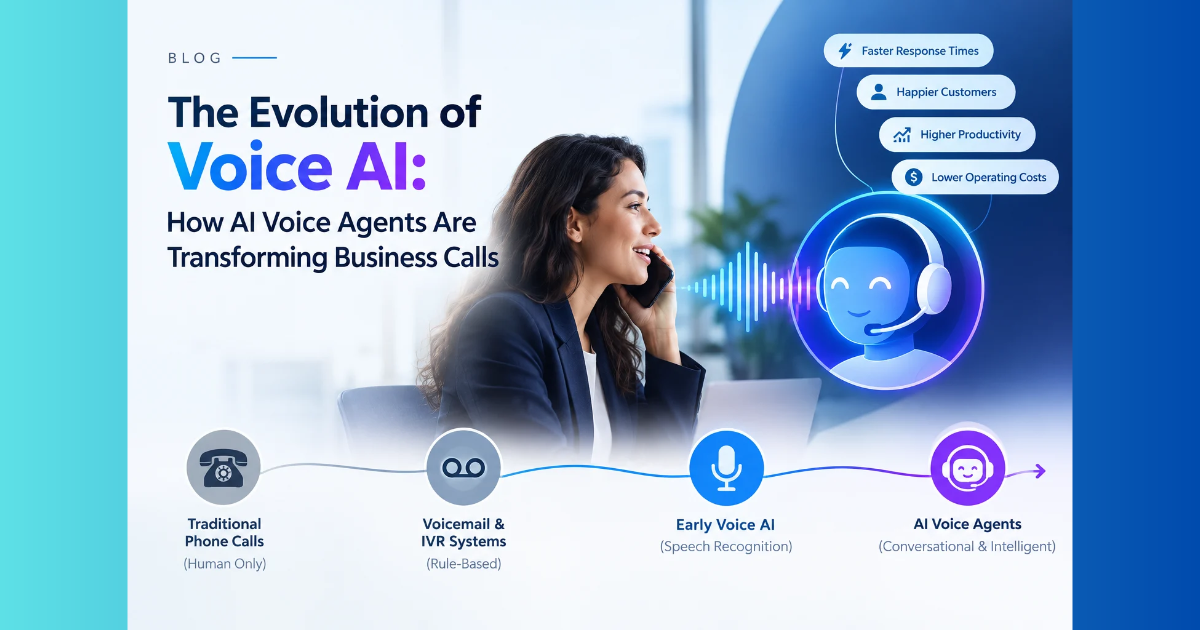
The companies can now take advantage of voice automation technology that allows them to manage customer communications during the entire customer lifecycle starting from the first sales call till the post-sale support.
1. Handling Incoming Customer Calls
Incoming calls tend to have similar inquiries regarding an appointment confirmation, changing an order, clarifying information about services, etc. AI voice agents can handle any of these interactions without requiring a representative to answer every call. This means that the company can attend to phone calls more effectively while the agents concentrate on other cases which would actually require their involvement.
2. Automating Outbound
Outgoing calls play an important role in a company’s business because they are helpful in keeping track of payments, making follow-up calls about sales, reminding the customer about his appointment, and getting feedback. With AI voice assistants, companies have the ability to do all this, ask more queries, give information, and take down notes. Not only that, but companies can even reach out to new customers, understand their needs and assign a salesperson to reach out to them further.
3. Connecting Phone Calls to Activate Workflows
Usually, there is follow-up work after a phone call, such as lead update, creation of a new case, assignment of a task, or reporting on the result of the phone call. With the application of AI integrated with CRM, it is now possible to gather information during telephone conversations. For instance, Salesforce offers a voice assistant that can edit relevant contact information during a call, raise a support request, log a call, and follow up on activities. In a nutshell, it reduces the need for manual data input and provides additional access to information on calling.
4. Providing Around-the-Clock Assistance
There is no limit to the time when customers can contact the companies. This makes it important for businesses to provide support beyond standard working hours. Automated calling helps companies provide assistance without restrictions on time. However, being constantly available doesn’t mean that an automated system is able to resolve every issue. Companies must have some guiding rules about escalation in cases of complexity of the issues, sensitivity of the requests, or need for a human assistant.
5. Improving Conversations via Personalization
The main thing for personalized conversations is data quality, appropriate access rights, and integration of the voice agent with the business application. When the voice AI is connected to CRM and some other systems, it will be able to collect customer data for personal responses without the customers having to repeat the data. A support agent, for instance, can check the open case, analyze its status, and explain further actions, mentioning the customer’s previous query.
Conclusion
The development of AI technology has progressed from fixed menus all the way to more complex conversational AI technologies that allow interactions between customers and tasks executions within the business. In the form of agentic AI voice agents, it is transforming AI business communication by connecting natural conversation with real-time data, automated workflows, and task execution.
Using this technology allows enhancing the relationship with customers and ensuring better interaction while reducing the workload. But the main thing is that you need to pick up the right use case and integrate conversational voice AI into the system of your business. With GirikVoice, you can go to the next level of intelligent calls.
FAQs
1. What are AI voice agents?
AI voice agents are AI-powered systems that communicate with people through spoken conversations. They can understand customer requests, provide relevant responses, and perform tasks when connected to the appropriate business systems.
2. How have AI voice agents evolved over time?
Voice automation has progressed from traditional interactive voice response (IVR) systems and rule-based automation to conversational AI, generative AI voice agents, and agentic systems capable of executing tasks.
3. How do AI voice agents help businesses manage calls?
AI voice agents can answer incoming calls, handle common customer inquiries, make appointment reminders, follow up with leads, collect information, and update connected business systems.
4. What is the difference between traditional IVR and AI voice agents?
Traditional IVR systems typically rely on keypad menus and predefined options. AI voice agents can understand natural speech, interpret customer intent, and respond more flexibly based on available information and integrations.
5. What are agentic AI voice agents?
Agentic AI voice agents combine conversational capabilities with task execution. Depending on their tools and permissions, they can perform actions such as updating CRM records, creating support tickets, and scheduling meetings.
6. Can AI voice agents integrate with CRM systems?
Yes. AI voice agents can integrate with compatible CRM systems to retrieve customer information, record call outcomes, update contact details, and trigger follow-up workflows, subject to configured access permissions.
7. Can AI voice agents provide 24/7 customer support?
AI voice agents can operate outside normal business hours and handle supported requests at any time. Complex, sensitive, or unresolved issues should have a clear escalation path to a human representative.
8. How do AI voice agents personalize customer conversations?
When connected to authorized customer data, AI voice agents can use details such as previous interactions, open support cases, and appointment information to provide more relevant responses without repeatedly asking customers for the same information.
9. What are the main benefits of AI voice agents for businesses?
Key benefits include faster call handling, reduced repetitive work, more consistent customer interactions, improved lead follow-up, extended service availability, and better coordination between phone conversations and business workflows.
10. How can businesses get started with AI voice agents?
Businesses should begin by identifying a specific use case, such as appointment scheduling, lead qualification, or customer support. They can then select a suitable voice AI solution, integrate the required systems, establish privacy and escalation rules, and test the agent before deployment.

Sandeep Kumar is the Founder & CEO of Aitude, a leading AI tools, research, and tutorial platform dedicated to empowering learners, researchers, and innovators. Under his leadership, Aitude has become a go-to resource for those seeking the latest in artificial intelligence, machine learning, computer vision, and development strategies.