
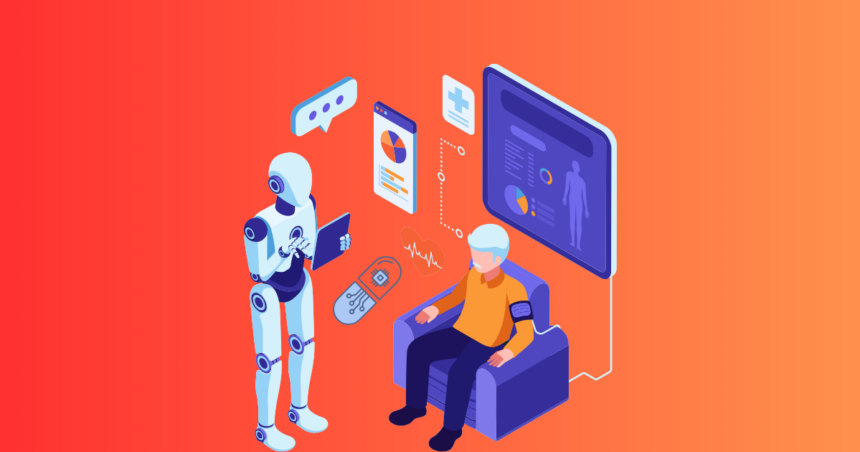
AI in Health Care is transforming the health insurance sector in strong and viable means. With increasingly complex healthcare systems and continuously growing customer expectations, insurers are feeling pressure to provide faster services, reasonable prices, and customized cover.
It is AI in Health Care that is able to help deliver on these demands. Artificial intelligence is assisting insurers to work more efficiently, as well as enhance the customer experience, by assisting them accelerate claims processing and create smarter insurance policies.
Claims Processing: The Need to Have Speed
Claims processing has always been one of the largest issues in health insurance. Conventionally, claims did involve the manual review of medical records, policy checks and multi-level approvals. This would normally take days or even weeks and this would frustrate policyholders who would require prompt reimbursement of medical bills.

The concept of AI in Health Care has transformed this process in a dramatic way. Within seconds, machine learning algorithms have become able to read medical bills, hospital records and insurance policy details. Optical character recognition technologies are used to extract information in a scanned document and automated systems are used to cross claims with policy terms. This contributes greatly in minimizing human intervention in the case of routine, and accelerates approvals.
Simple and low-risk claims are processed within seconds with the assistance of AI-powered automation. Customers are paid faster and administrative delays are minimized by the insurers. Increasing the speed of claims processing will help to enhance customer satisfaction and create trust between the insurers and policyholders.
Minimizing The Mediocre and Maximizing the Accurate
When claims are handled by hand, it broadens the possibilities of a human error. Such little errors in the data recording or document checking may result in wrong payouts and denial of claims. The AI reduces these risks through repetitive algorithms to process information.
Machine learning algorithms receive historical claims information and detect behavioral patterns of legitimate and not legitimate submissions. This assists insurers to identify anomalies early enough and enable fair claims to be compensated correctly. Companies are able to save time and resources and deliver a more pleasant experience to the customer by eliminating errors.
Smarter Fraud Detection
Health insurance fraud is a critical problem that escalates expenses among all people. Exaggerated treatment, fraudulent claims, and billing practices may incur billions of dollars of losses annually. Manual audits as well as random inspections were commonly used in the traditional fraud detection methods which were not very effective.
AI in Health Care also creates predictive analytics that are capable of detecting suspicious behavior in real-time. Advanced algorithms process large data sets in order to identify abnormal behavior, including claims of the same treatment being made multiple times or abnormal billing behavior of specific providers. When a potentially risky situation is detected, the system identifies the claim to be investigated.
Individualized and intelligent Policy Design
In addition to making claims faster, AI in Health Care is also changing the process of creating health insurance policies. Previously, insurers tended to use general classifications in determining risk and pricing. This would occasionally lead to policies which were not necessarily in line with the health requirements of an individual.
The personalization of underwriting is made possible by AI. Through the study of medical history, lifestyle data and even data acquired using wearable devices; machine learning models can analyze the risk more precisely. This enables the insurers to make policies which are specific to individual persons as opposed to generalized assumptions.
As an illustration, an individual with a good lifestyle and fitness tracker price might be offered superior premiums. Simultaneously, AI will be able to detect persons with a greater risk and prescribe preventative health services. This results in more reasonable pricing and intelligent coverage.
Promoting Preventive Healthcare
AI in Health Care is assisting the health insurance change their care mode to prevention rather than reactive. Insurers are now employing the predictive models to help them identify the possible health risks early, as opposed to waiting until illness has happened.
With medical record and lifestyle data examination, AI systems will be able to identify the onset of a chronic illness, including diabetes or heart disease. This can then be provided through wellness programs, health reminders or preventive screenings by insurers. Preventive care lowers the medical expenses in the long-term and enhances health in general.
This is a preventative measure that is favorable to the insurers and policyholders alike. Businesses save costly long-term claims and individuals are provided with assistance, which helps them to remain healthier.
Improving Customer Interaction
The insurance industry is getting increasingly concerned with customer engagement. Virtual assistants and chatbots are AI-based software that offers real-time assistance in answering questions about the policy, updating claims, and explaining cover. It is a 24/7 system that is convenient and provides a fast solution.
AI in Health Care is also useful in customer behavior and preferences analysis by the insurers. Knowing the needs of members, the companies will be able to make specific recommendations to the members, upgrade the policies and give advice about health management. One to one communication enhances customer loyalty and strengthens relationships.
Enhancing Operating Effectiveness
Health insurance entails a lot of repetitive procedures such as checking documents, compliance verification and data input. Most of these activities are automated by AI in Health Care and make operations less expensive and more productive.

Robotic process automation is used to facilitate routine administrative duties and leave the staff to deal with strategic planning and complex cases. This enhances general efficiency and makes insurers stay afloat in the market which is rapidly changing.
Difficulties and Accountable Enactment
Although there are tremendous benefits of AI in Health Care , there are also challenges. The issue of data privacy is also significant since the health information is very sensitive. To safeguard personal data, insurers should have a robust cybersecurity level and adhere to regulatory norms.
The other issue is the bias in algorithms. In the case of using AI models that are trained on partial or biased data, they can deliver unfair outcomes. To be ethical, companies should be able to offer transparency, fairness and frequent monitoring of AI systems.
Future of AI in Health care
The use of AI in health insurance will be further extended. Live health tracking, wearable devices, risk modeling, and bespoke digital apps will gain more popularity. AI will enable a more integrated healthcare ecosystem whereby insurers, providers and patients are working in sync with one another.
Conclusion
AI in Health Care is changing health insurance by accelerating the speed of claims processing and intelligent policy design. It minimizes waste of time, error reduction, enhances fraud prevention and encourages preventive healthcare. Simultaneously, it allows individual coverage and enhances efficiency of operation. Despite the need to address certain issues like privacy of data and ethical issues, the net benefit of AI in Health Care is beneficial and transformational.

Dinesh Suthar is an AI and technology writer who explores the latest trends in artificial intelligence, emerging tools, and digital innovation. He simplifies complex tech topics into practical insights for businesses, marketers, and tech enthusiasts.