
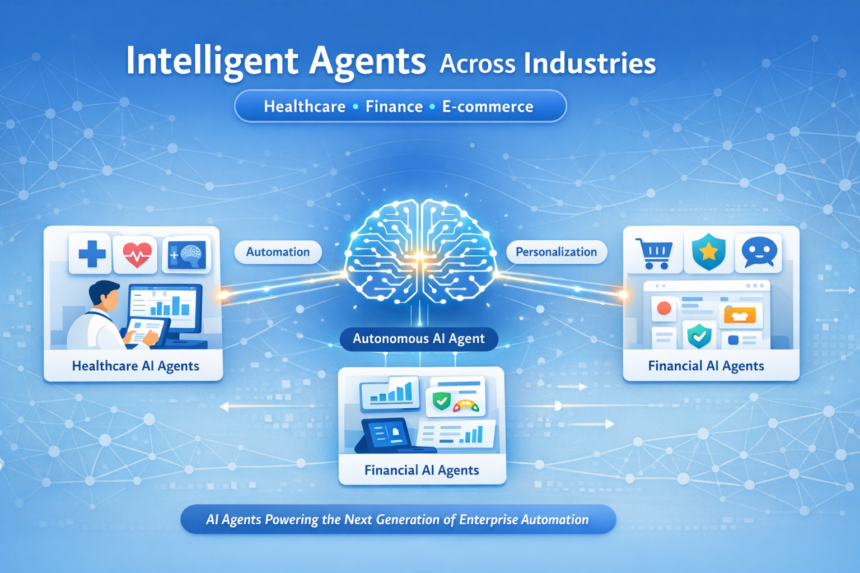
The evolution from reactive AI systems to proactive intelligent agents marks one of the most significant shifts in enterprise technology. Unlike traditional rule-based automation or simple chatbots, intelligent agents possess autonomy, adaptability, and the ability to coordinate complex multi-step workflows with minimal human intervention.
- What Makes Intelligent Agents Different?
- Applications of Intelligent Agents in Healthcare: From Diagnostics to Patient Care
- Clinical Decision Support and Diagnostics
- Patient Monitoring and Remote Care
- Virtual Health Assistants and Administrative Automation
- Applications of Intelligent Agents in Finance: Risk, Compliance, and Decision Augmentation
- Credit Underwriting and Risk Assessment
- Fraud Detection and AML Compliance
- Wealth Management and Portfolio Optimization
- Applications of AI Agents in E-commerce: Personalization and Autonomous Shopping
- Agentic Commerce and Product Discovery
- Conversational Commerce and Support Automation
- Hyper-Personalization at Scale
- Technical Architecture Considerations for Developers
- Data Infrastructure and Integration
- Agent Orchestration and Multi-Agent Systems
- Governance, Security, and Compliance
- Model Training and Continuous Learning
- The Future of Intelligent Agents: What Developers Should Prepare For
- Conclusion: Building the Intelligent Agent Future
For developers building next-generation applications, understanding the applications of intelligent agents across different industries isn’t just academic and it’s essential for architecting systems that can compete in an AI-driven marketplace. This deep dive explores how intelligent agents in healthcare, intelligent agents in finance, and AI agents in e-commerce are solving real-world problems, along with technical considerations for implementation.
What Makes Intelligent Agents Different?
Before exploring industry use cases of intelligent agents, let’s establish what distinguishes them from conventional AI systems:
Autonomy: Intelligent agents make independent decisions and execute tasks without constant human oversight. They don’t just respond to queries and they proactively identify problems and take action.
Adaptability: Through reinforcement learning and continuous feedback loops, these agents refine their strategies based on real-time data, market fluctuations, and changing conditions.
Coordination: Modern agents interact with other AI systems, APIs, databases, and external services to execute comprehensive workflows that span multiple systems and data sources.
This combination of capabilities positions intelligent agents as transformative infrastructure rather than incremental improvements to existing automation.
If you’re new to the concept, you might first want to understand how intelligent agents actually work, including the PEAS framework, environment types, and decision models that power agent-based AI systems.
Applications of Intelligent Agents in Healthcare: From Diagnostics to Patient Care
The healthcare industry faces mounting pressure from rising patient volumes, administrative burdens, and the need for personalized care. Intelligent agents in healthcare are addressing these challenges through autonomous, data-driven decision support systems.
Clinical Decision Support and Diagnostics
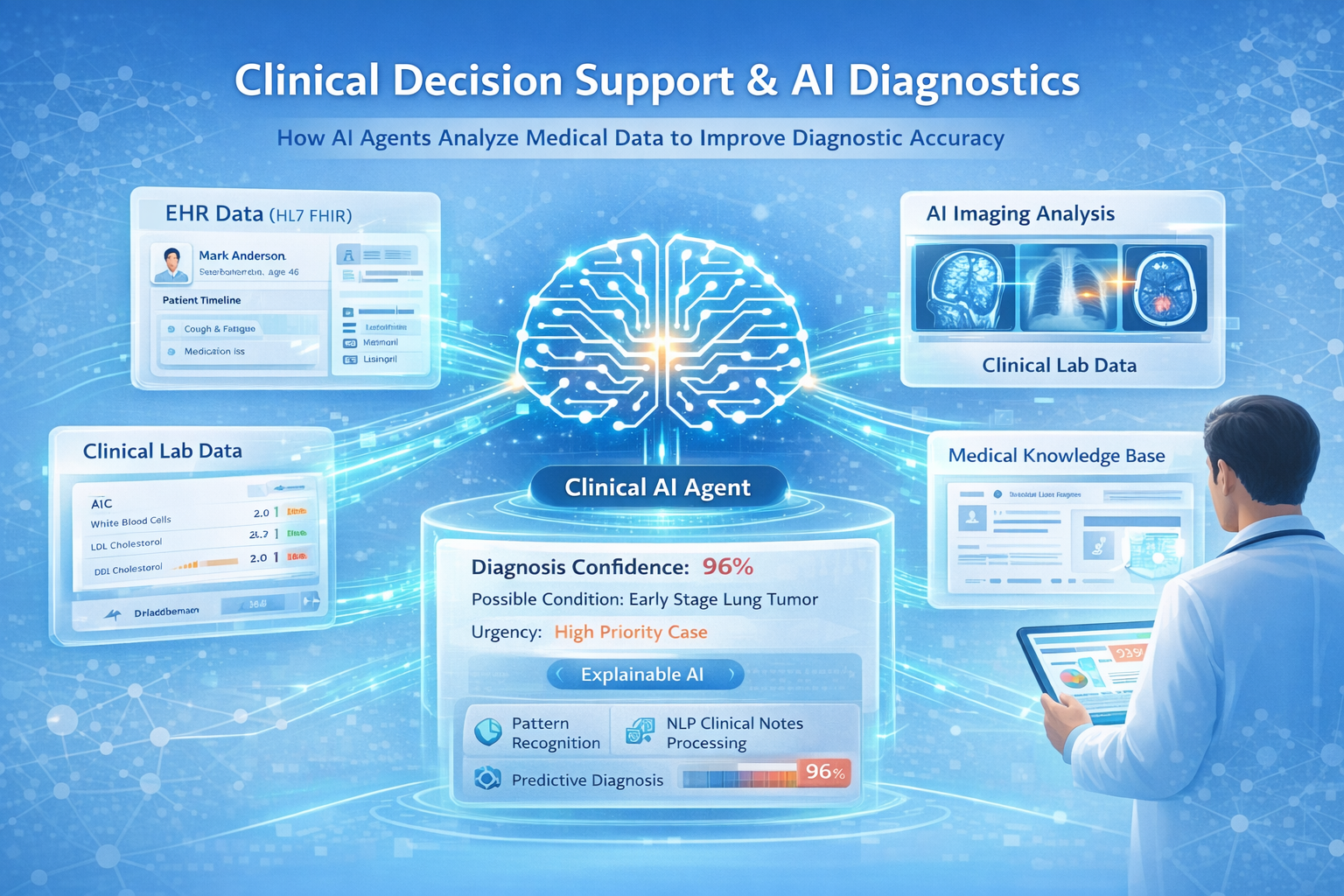
AI agents are revolutionizing diagnostic accuracy by analyzing vast datasets of patient histories, lab results, medical imaging, and clinical literature in real-time. Unlike static diagnostic tools, these agents continuously learn from new cases and medical research, improving their recommendations over time.
For developers, this means building systems that can:
- Integrate with Electronic Health Records (EHR) through HL7 FHIR APIs
- Process unstructured medical data using Natural Language Processing (NLP)
- Implement machine learning pipelines that comply with HIPAA regulations
- Design explainable AI systems where diagnostic reasoning can be audited
Real-world impact: AI agents trained on medical imaging datasets can identify anomalies like tumors, fractures, or infections with precision that rivals or exceeds human radiologists, while pre-screening images to flag urgent cases.
Patient Monitoring and Remote Care
Intelligent agents enable continuous patient monitoring through IoT integration with wearable devices. These systems collect real-time data on heart rate, blood pressure, glucose levels, and other vital signs, autonomously alerting healthcare providers to abnormalities.
From a development perspective, this requires:
- Edge computing capabilities for real-time data processing
- Secure data transmission protocols (TLS 1.3, end-to-end encryption)
- Anomaly detection algorithms that minimize false positives
- Integration with clinical alert systems and provider dashboards
Virtual Health Assistants and Administrative Automation
AI agents are handling appointment scheduling, medication reminders, treatment plan guidance, and even preliminary patient triage before virtual consultations. On the administrative side, they’re automating billing, claims management, and report generation and tasks that traditionally consume significant staff time.
Technical consideration: Healthcare agents require sophisticated identity verification, consent management systems, and audit trails to ensure compliance with regulations like GDPR and CCPA.
Applications of Intelligent Agents in Finance: Risk, Compliance, and Decision Augmentation
Financial services institutions are deploying intelligent agents in finance to shift from rule-based automation to intelligent decision augmentation. The stakes are high: these systems handle credit decisions, fraud detection, and portfolio management involving billions of dollars.
Credit Underwriting and Risk Assessment
AI agents are transforming credit underwriting by autonomously evaluating borrower solvency in real-time, analyzing financial structures, and continuously refining risk models based on new data. Unlike traditional models that require manual recalibration, these agents adapt to rapidly shifting economic conditions.
For developers building financial agents, key considerations include:
- Implementing retrieval-augmented generation (RAG) for accessing financial databases
- Building multi-agent frameworks where specialized agents handle different aspects of risk assessment
- Ensuring model explainability for regulatory compliance
- Creating robust audit trails for every autonomous decision
Fraud Detection and AML Compliance
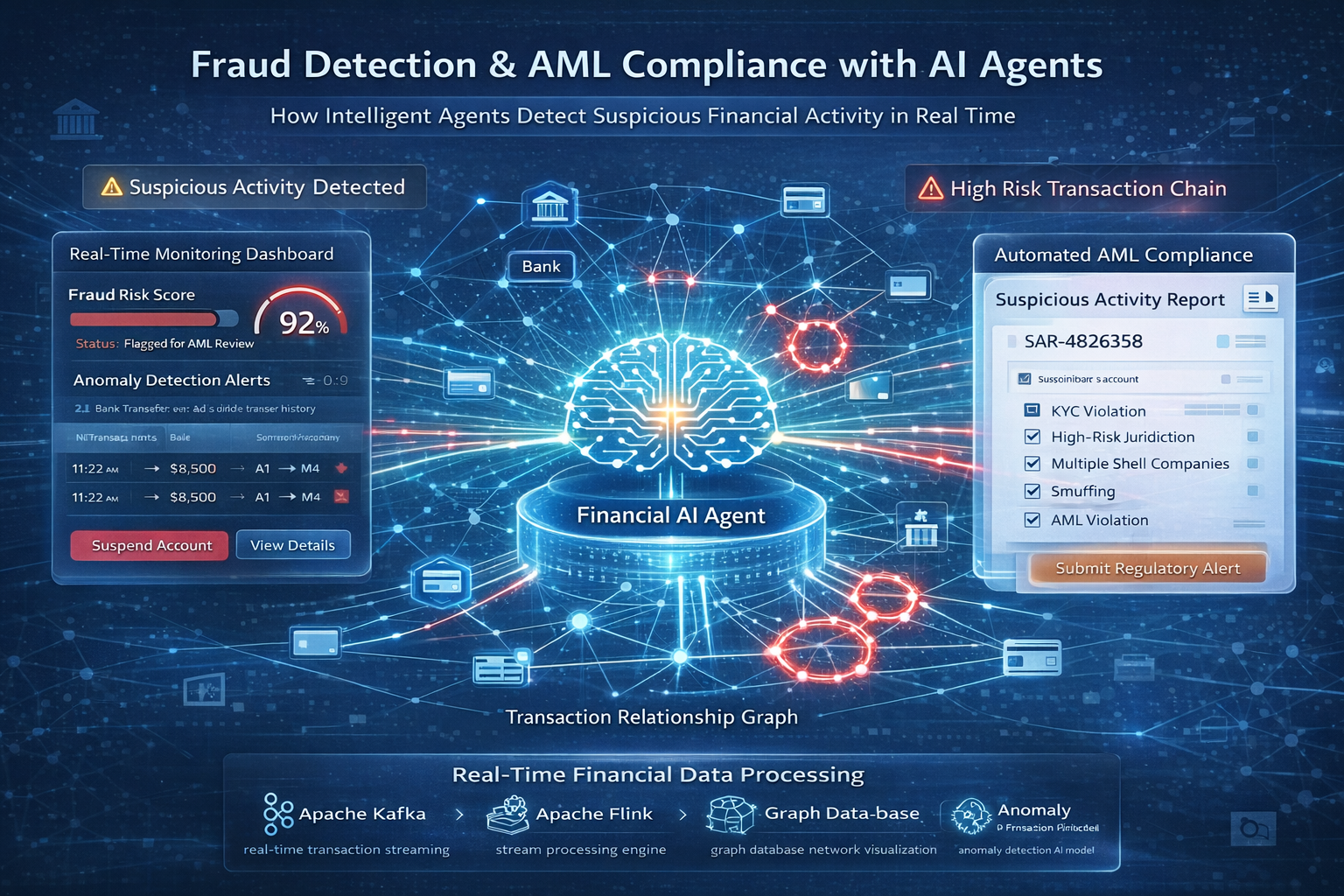
Anti-Money Laundering (AML) compliance and fraud detection represent high-impact use cases where intelligent agents excel at pattern recognition across massive transaction datasets. These agents can identify suspicious activities by analyzing transaction patterns, customer behaviour, and external risk signals in real-time.
Implementation insight: Financial institutions are achieving 21% adoption of Gen AI in risk and compliance operations, leading the industry in this domain.
Technical requirements include:
- Real-time stream processing (Apache Kafka, Apache Flink)
- Graph databases for relationship mapping (Neo4j, Amazon Neptune)
- Anomaly detection models with low latency requirements
- Integration with regulatory reporting systems
Wealth Management and Portfolio Optimization
AI agents are autonomously monitoring markets, detecting non-obvious correlations, and optimizing portfolio allocations without human intervention. These systems can trigger pre-approved trades, adjust risk models dynamically, and provide automated compliance reporting.
Performance data: Early adopters report that users consume 60% more research while cutting task completion times by 30%, with over 90% of AI interactions focused on high-value analytics.
Applications of AI Agents in E-commerce: Personalization and Autonomous Shopping
The e-commerce landscape is experiencing a fundamental transformation as AI agents in e-commerce move beyond simple product recommendations to autonomous shopping experiences. By 2025, approximately 92% of businesses are using generative AI to enhance e-commerce experiences.
Agentic Commerce and Product Discovery
Agentic commerce represents a paradigm shift where AI agents act as personal shopping concierges, understanding user intent, context, and preferences to deliver deeply researched recommendations. These agents don’t respond to marketing narratives and they scan structured, machine-readable product data for price, availability, ratings, and features.
Real-world example: Instacart’s “Ask Instacart” feature allows shoppers to describe needs in natural language (“I’m hosting a taco night”), instantly receiving tailored grocery lists.
For developers, this means:
- Building product catalogues with rich, structured metadata
- Implementing semantic search using vector databases (Pinecone, Weaviate)
- Creating APIs designed for agent-to-agent communication
- Developing real-time inventory visibility systems
Conversational Commerce and Support Automation
Conversational AI agents in e-commerce demonstrate conversion rates of 12.3% and nearly four times higher than traditional browsing experiences at 3.1%. When returning customers engage with AI chat tools, they spend 25% more than those who don’t.
These agents handle everything from product discovery to post-purchase support across multiple languages and channels, with some platforms automating up to 80% of repetitive customer inquiries.
Hyper-Personalization at Scale
Modern AI agents analyze purchasing patterns, browsing history, and customer preferences to deliver individualized experiences. Research indicates that 78% of customers are more likely to repurchase from brands offering personalized content.
Technical implementation: Retail-trained agents understand inventory management, product lifecycles, and seasonal demand and not just keywords. They adapt search results, re-rank products using stock levels and margins, and personalize navigation for different customer segments.
Technical Architecture Considerations for Developers
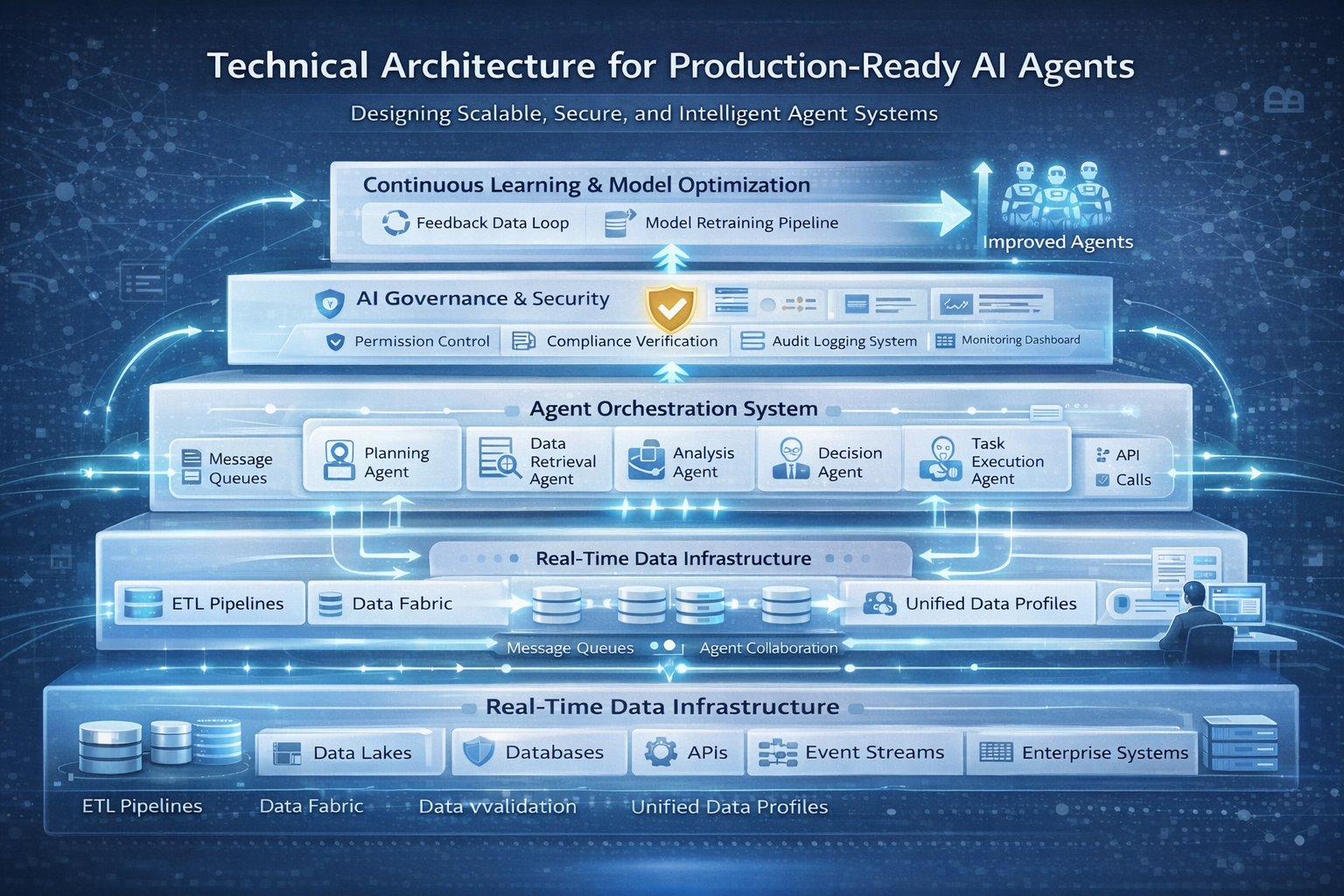
Building production-ready intelligent agents requires careful architectural decisions:
Many developers also confuse intelligent agents with traditional machine learning systems. If you’re unsure about the differences, our guide on intelligent agents vs machine learning vs deep learning breaks down how these paradigms differ in architecture and real-world applications.
Data Infrastructure and Integration
Agents require access to comprehensive, real-time data. This means:
- Implementing data fabrics that enable seamless information flow
- Building robust ETL pipelines for structured and unstructured data
- Ensuring data quality through validation and accuracy verification
- Creating unified customer/patient/client profiles across systems
Agent Orchestration and Multi-Agent Systems
Complex use cases often require multiple specialized agents working together:
- Design microservices-style architectures where agents handle specific functions
- Implement message queues for agent-to-agent communication
- Build coordination layers that manage agent interactions
- Create fallback mechanisms for when agents encounter edge cases
Governance, Security, and Compliance
Autonomous systems require additional safeguards:
- Implement strict permission boundaries and compliance checks
- Build comprehensive audit trails for every agent action
- Design human-in-the-loop workflows for high-stakes decisions
- Create monitoring systems that detect unexpected agent behaviour
Model Training and Continuous Learning
Effective agents learn from real-world performance:
- Implement feedback loops that capture agent performance metrics
- Build retraining pipelines that incorporate new data
- Use reinforcement learning for agents that optimize over time
- Ensure model versioning and rollback capabilities
The Future of Intelligent Agents: What Developers Should Prepare For
The trajectory of intelligent agents points toward several emerging trends:
Multi-Agent Ecosystems: Different AI agents will collaborate and interact, creating networks where specialized agents handle specific domains while coordinating on complex tasks.
Federated Learning: Agents will learn from decentralized data while maintaining privacy and compliance and critical for healthcare and finance applications.
Emotional Intelligence: Future agents will recognize emotions and provide empathetic communication, particularly valuable in healthcare and customer service contexts.
Autonomous Procurement: B2B applications will see agents that identify suppliers, evaluate quotes, source materials, and manage complex purchasing workflows without human intervention.
Conclusion: Building the Intelligent Agent Future
The applications of intelligent agents across healthcare, finance, and e-commerce demonstrate that we’ve moved beyond experimental technology to essential infrastructure. These systems are delivering measurable improvements: 30% faster task completion, 60% increased research consumption, 12.3% conversion rates, and 80% automation of routine tasks.
For developers, the opportunity is clear: organizations that build robust, compliant, and effective intelligent agent systems will gain significant competitive advantages in delivering accurate, efficient, and personalized experiences.
Success requires more than technological adoption and it demands AI fluency, robust governance frameworks, and architectures designed for autonomous operation from the ground up. The institutions and platforms that master intelligent agent development won’t just participate in the AI revolution and they’ll define it.
Ready to build intelligent agents for your organization? Explore our AI guides.

Hi, I’m Pragya.
I write about AI tools, digital trends, and emerging technologies in a way that’s simple, practical, and easy to apply. I enjoy exploring new AI platforms, testing their features, and breaking them down into clear guides that actually help people use them confidently.
My focus is not just on writing content, but on creating value. I believe powerful technology should feel accessible, not overwhelming. That’s why I aim to turn complex tools into actionable insights for creators, marketers, and growing online businesses.
I’m constantly learning, researching, and staying updated with the fast-moving AI space so readers always get relevant and useful information.