
If you’ve been building AI systems, you’ve probably faced this question: Should your agent react instantly to inputs, or should it think, plan, and reason before acting? This isn’t just a theoretical debate, it’s a fundamental design decision that affects everything from performance to user experience.
- What Are Reactive Agents in AI?
- Understanding Deliberative Agent Architecture
- Core Components of Deliberative Agents
- How Deliberative Agents Make Decisions
- Real-World Applications
- Strengths of Deliberative Agents
- Challenges
- Reactive vs Deliberative Agents: Key Differences
- Hybrid Intelligent Agents: The Best of Both Worlds
- Decision-Making Strategies in AI Agents: Implementation Considerations
- 1. Task Complexity Assessment
- 2. Performance Requirements
- 3. Development and Maintenance
- 4. Integration with Existing Systems
- Choosing the Right Agent Type for Your Project
- Decision Guide
- The Future of AI Decision Strategies
- Conclusion
The choice between reactive vs deliberative agents shapes how your AI system processes information, makes decisions, and interacts with its environment. In this comprehensive guide, we’ll break down both approaches, explore hybrid architectures, and help you understand which decision-making strategy fits your specific use case.
Whether you’re developing chatbots, autonomous systems, or intelligent agents in healthcare and finance , understanding these architectural patterns is crucial for building effective AI solutions in 2026.
What Are Reactive Agents in AI?
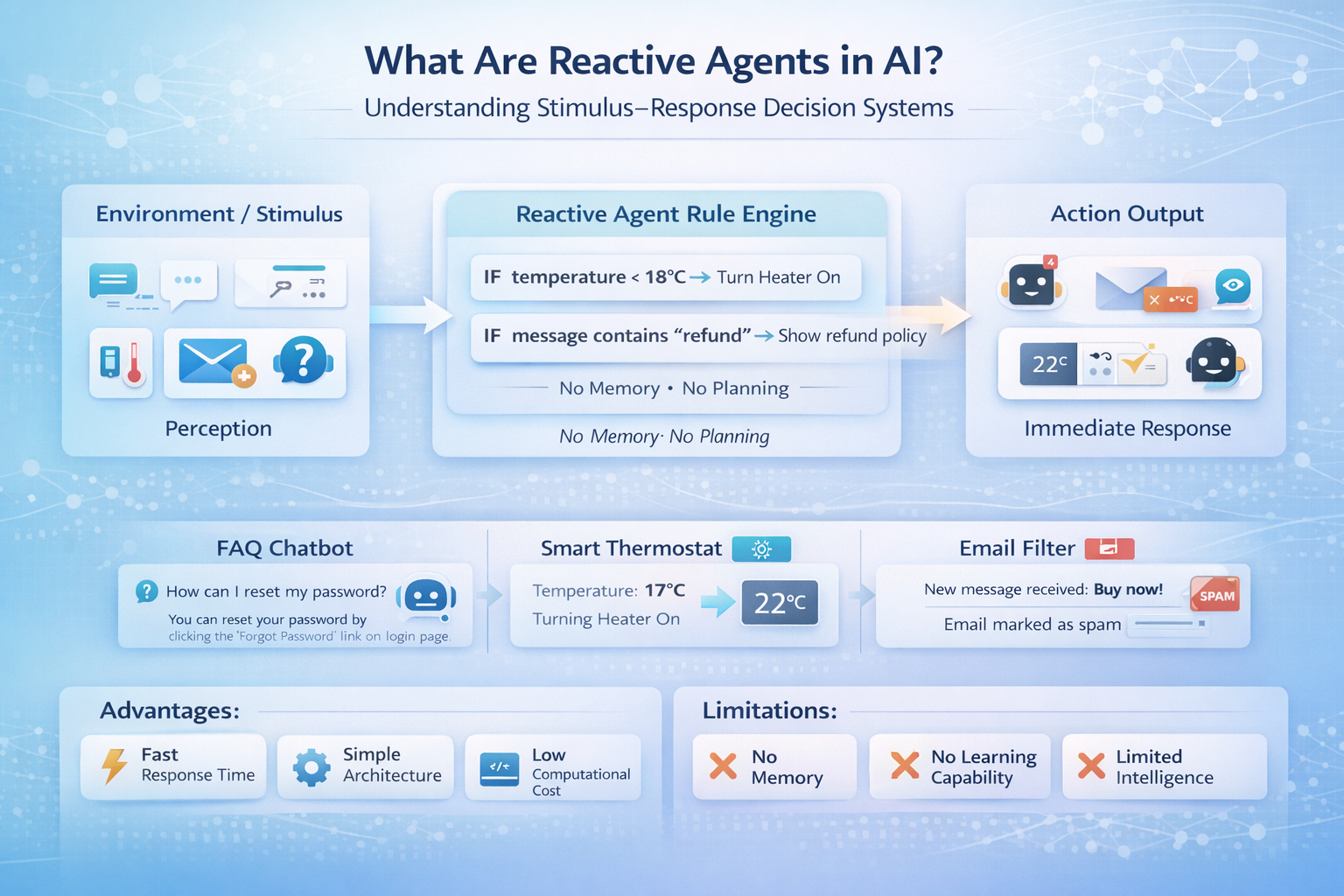
Reactive agents are the simplest form of intelligent agents. They operate on a direct stimulus-response model and think of them as the “reflexes” of the AI world. When they receive an input, they immediately produce a predefined output without any internal reasoning, memory, or planning.
Key Characteristics of Reactive Agents
- No Internal State or Memory: Reactive agents don’t remember past interactions or maintain context between sessions
- Immediate Response: They deliver lightning-fast responses with minimal computational overhead
- Rule-Based Logic: Operate on “if-this-then-that” conditions without complex reasoning
- Environment-Dependent: Their behaviour is entirely determined by current perceptions, not historical data
Real-World Examples
A classic reactive agent example is a basic FAQ chatbot that matches user queries to predefined responses. When you type “What’s your refund policy?”, it instantly retrieves a canned answer without analyzing your purchase history or sentiment.
Other examples include:
- Thermostat systems that adjust heating based solely on current temperature readings
- Email filters that automatically label messages based on sender or keywords
- Simple customer support bots handling routine inquiries
If you’re familiar with simple reflex agents and their architecture , reactive agents follow the same fundamental principle and perception directly maps to action.
Advantages of Reactive Agents
- Speed: Minimal latency makes them ideal for real-time applications
- Simplicity: Easy to design, test, and deploy
- Low Resource Requirements: Require minimal computational power
- Predictability: Behaviour is consistent and easy to debug
Limitations
- No Learning Capability: Can’t adapt to new situations or improve over time
- Context Blindness: Unable to consider past interactions or future implications
- Limited Intelligence: Struggle with ambiguous or complex scenarios
- Scalability Issues: Adding new rules becomes unwieldy as complexity grows
Understanding Deliberative Agent Architecture
Deliberative agents represent a more sophisticated approach to AI decision-making. Unlike their reactive counterparts, these agents maintain an internal model of the world, reason through problems, and plan sequences of actions to achieve long-term goals.
Core Components of Deliberative Agents
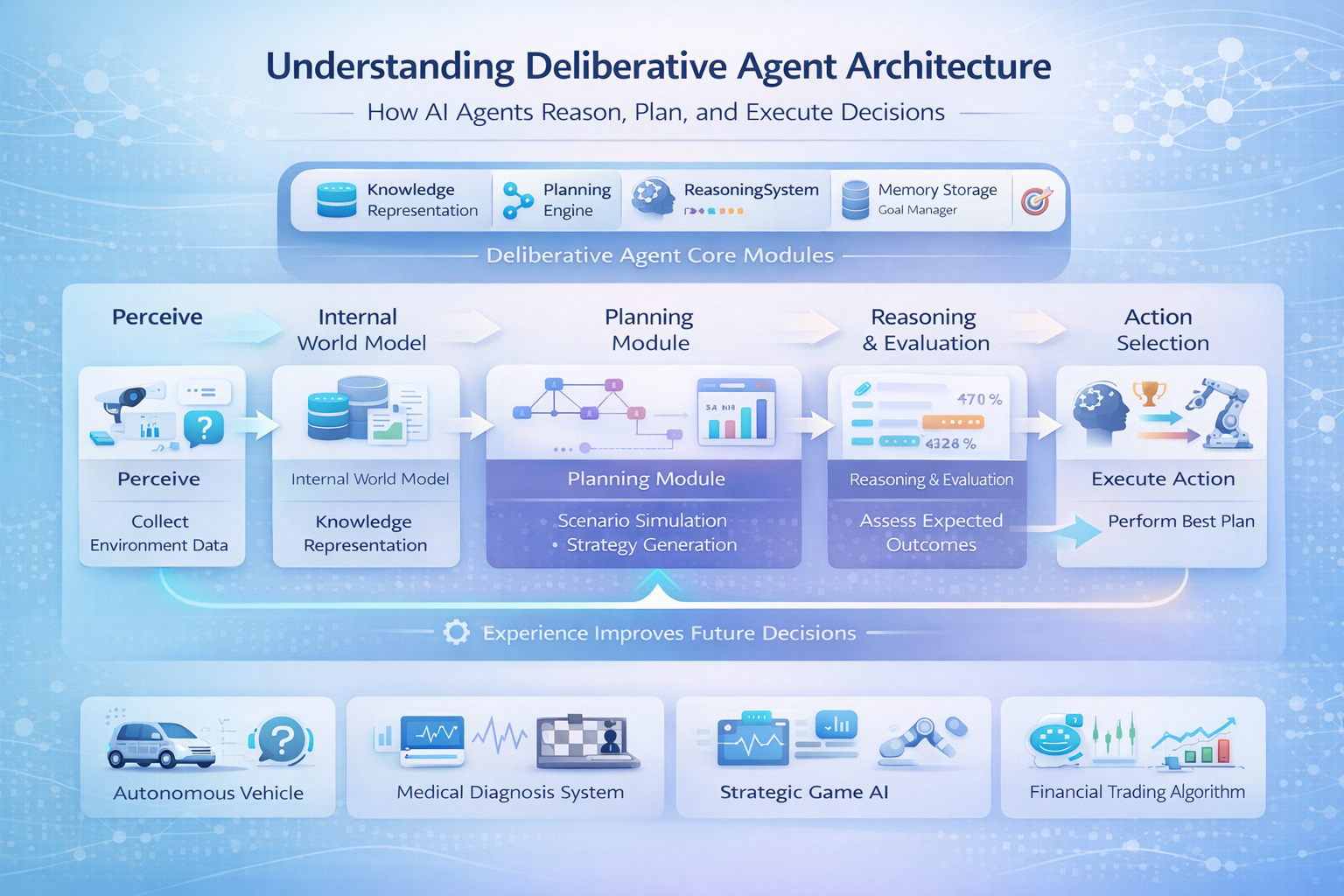
Deliberative architecture typically includes:
- Knowledge Representation: Internal models that store information about the environment
- Planning Module: Algorithms that evaluate multiple action sequences
- Reasoning Engine: Logic systems that analyze cause-and-effect relationships
- Memory Systems: Both short-term and long-term storage for context retention
- Goal Management: Mechanisms to define, prioritize, and pursue objectives
This architecture aligns closely with what we discussed in our guide on how intelligent agents work using PEAS and decision-making frameworks .
How Deliberative Agents Make Decisions
Deliberative agents follow a more complex decision-making process:
- Perceive → Gather information from environment
2. Model → Update internal world representation
3. Plan → Generate multiple action sequences
4. Evaluate → Assess outcomes of each plan
5. Select → Choose optimal action based on goals
6. Execute → Perform selected action
7. Learn → Update model based on results
This thoughtful approach makes them ideal for goal-based and utility-based agent implementations where strategic planning is essential.
Real-World Applications
Autonomous vehicles are prime examples of deliberative agents. They process sensor data, predict obstacle movements, evaluate multiple route options, and plan safe trajectories and all while considering traffic rules, passenger comfort, and fuel efficiency.
Other applications include:
- Strategic game AI that plans multiple moves ahead
- Supply chain optimization systems that forecast demand and adjust inventory
- Medical diagnosis assistants that reason through symptoms and test results
- Financial trading bots that analyze market trends and execute complex strategies
Strengths of Deliberative Agents
- Complex Problem Solving: Handle multi-step tasks requiring strategic thinking
- Adaptability: Adjust behaviour based on changing conditions
- Explainability: Can articulate reasoning through chain-of-thought processes
- Goal Optimization: Work toward long-term objectives, not just immediate responses
Challenges
- Higher Computational Cost: Require significant processing power
- Increased Latency: Planning takes time, which may not suit real-time applications
- Complexity: More difficult to build, test, and maintain
- Potential for Over-Planning: Can get stuck in analysis paralysis
Reactive vs Deliberative Agents: Key Differences
| Aspect | Reactive Agents | Deliberative Agents |
| Response Time | Immediate | Delayed (planning required) |
| Memory | None | Short-term and long-term |
| Decision Making | Rule-based | Reasoning and planning |
| Complexity | Simple | Complex |
| Adaptability | Fixed behavior | Learning and adaptation |
| Best For | Predictable environments | Dynamic, uncertain environments |
| Computational Cost | Low | High |
| Context Awareness | None | Full historical context |
Understanding these differences is crucial when comparing intelligent agents vs machine learning vs deep learning approaches .
Hybrid Intelligent Agents: The Best of Both Worlds
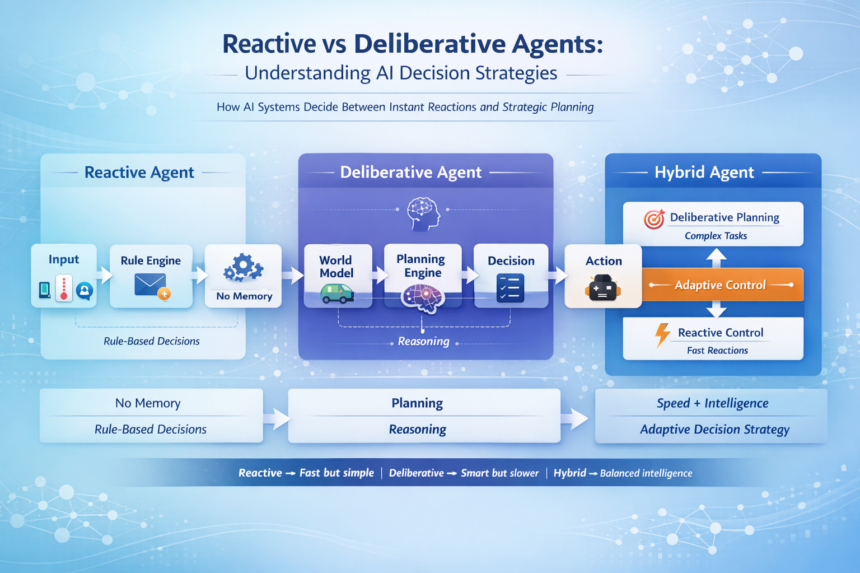
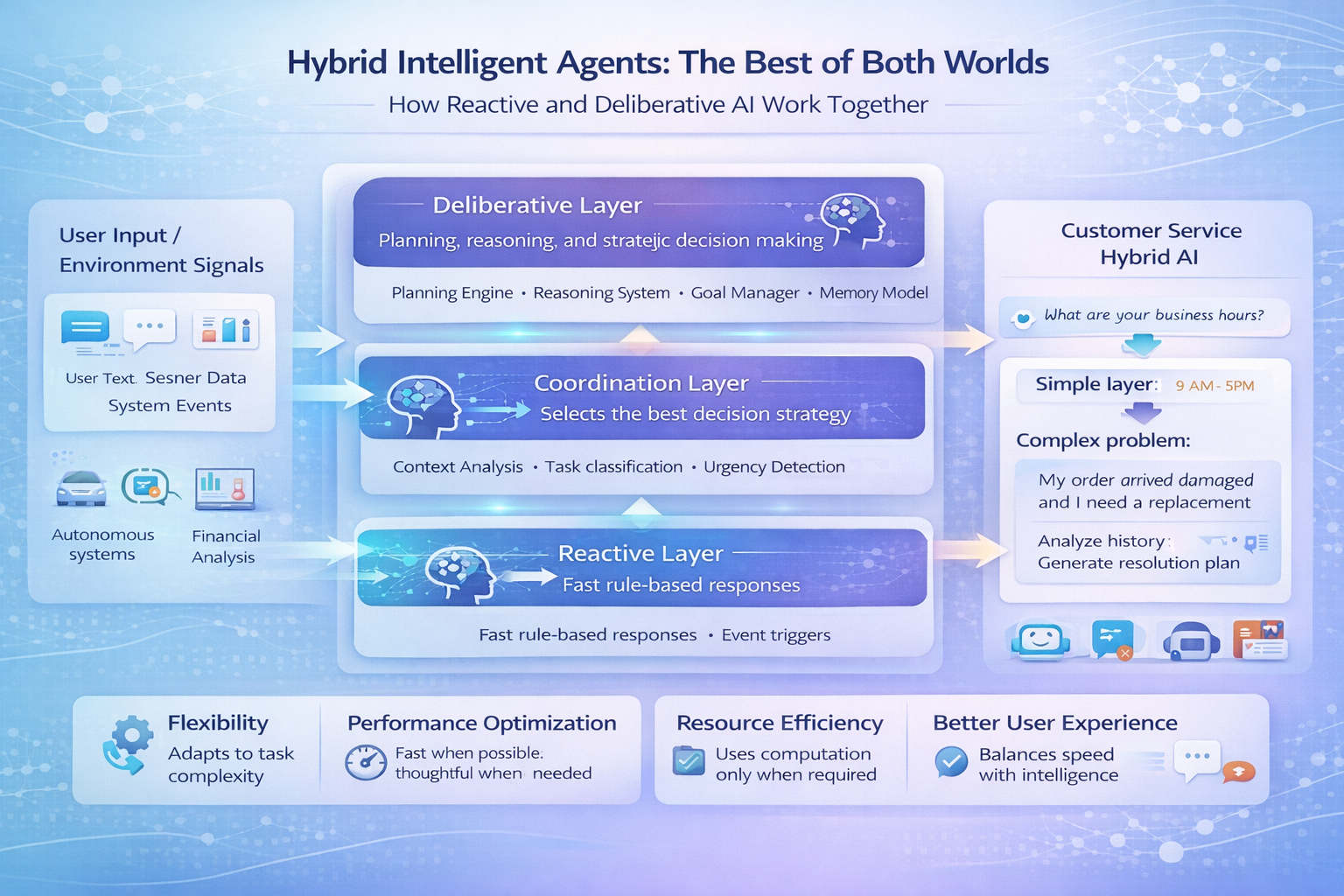
In practice, most production AI systems don’t fit neatly into either category. Hybrid intelligent agents combine reactive and deliberative approaches to balance speed with intelligence.
How Hybrid Architecture Works
Hybrid agents typically implement a layered architecture:
- Reactive Layer(Bottom): Handles immediate, time-critical responses
- Deliberative Layer(Top): Manages complex planning and reasoning
- Coordination Layer(Middle): Decides which layer should handle each situation
This architecture allows the agent to:
- React quickly to simple, well-defined inputs
- Deliberate when tasks require strategic planning
- Switch between modes based on context and urgency
Practical Example: Customer Service Agent
Consider a modern AI agent system handling customer support:
- Reactive Mode: Instantly answers “What are your business hours?” with a direct response
- Deliberative Mode: Analyzes a complex complaint, reviews purchase history, checks warranty status, and formulates a personalized resolution strategy
- Hybrid Coordination: Determines which mode to use based on query complexity
Benefits of Hybrid Approaches
- Flexibility: Adapts to varying task complexity
- Performance Optimization: Fast when possible, thoughtful when necessary
- Resource Efficiency: Allocates computational power where it’s needed
- User Experience: Balances responsiveness with quality
This hybrid model is increasingly common in modern agentic AI frameworks and real-world intelligent agent applications .
Decision-Making Strategies in AI Agents: Implementation Considerations
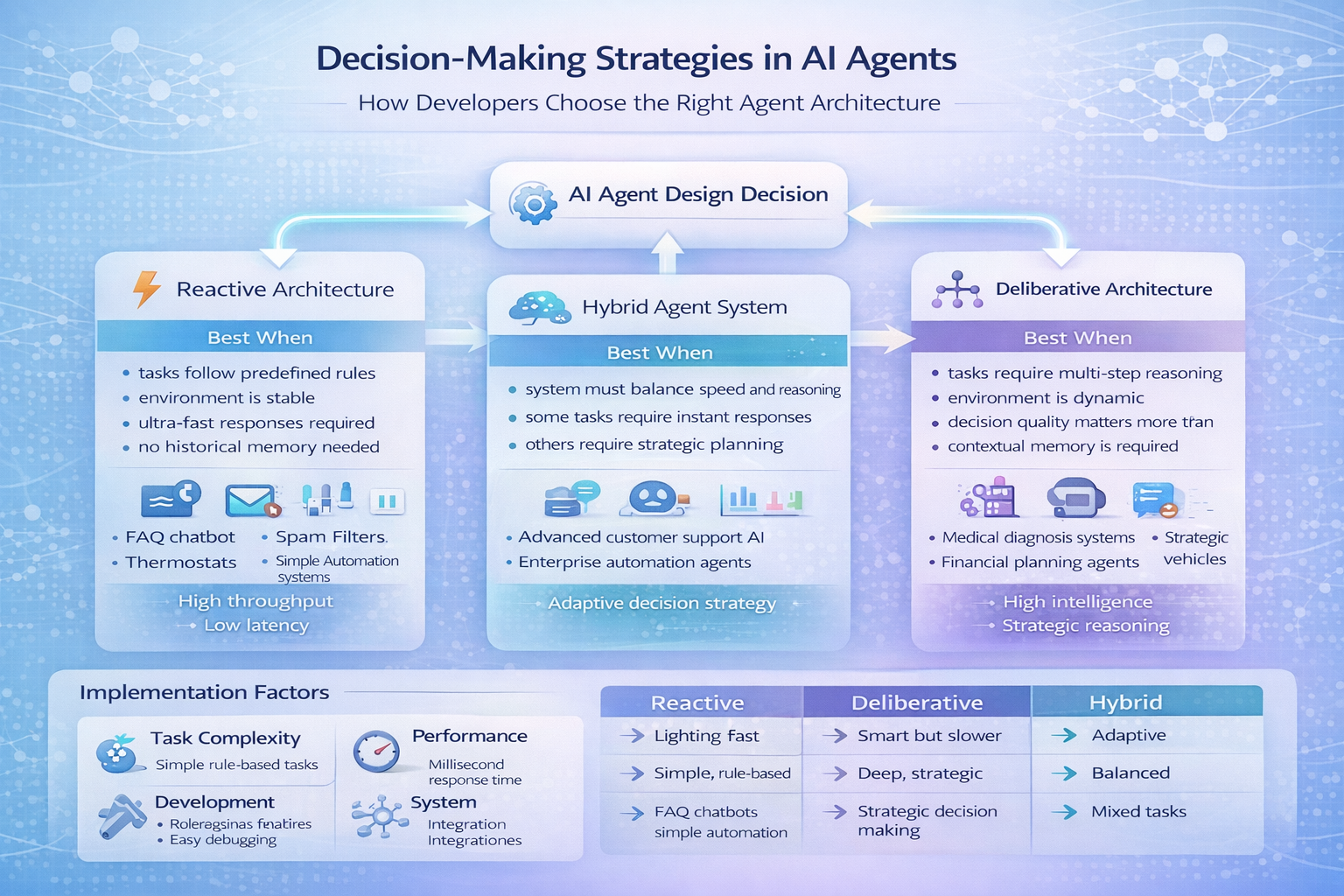
As a developer, choosing the right agent architecture requires careful consideration of several factors:
1. Task Complexity Assessment
Choose Reactive When:
- Tasks follow clear, predefined rules
- Environment is stable and predictable
- Speed is the primary requirement
- No historical context is needed
Choose Deliberative When:
- Tasks require multi-step planning
- Environment is dynamic and uncertain
- Quality of decision matters more than speed
- Context and memory are essential
2. Performance Requirements
Reactive agents excel in high-throughput, low-latency scenarios. If you’re building systems that need to handle thousands of requests per second with millisecond response times, reactive architecture is your friend.
Deliberative agents shine when decision quality trumps speed. For applications like medical diagnosis or financial planning, the extra processing time is justified by better outcomes.
3. Development and Maintenance
From a practical standpoint:
Reactive agents are easier to:
- Implement using simple rule engines or finite state machines
- Test with straightforward input-output validation
- Debug when behaviour is unexpected
- Scale horizontally across multiple instances
Deliberative agents require:
- Sophisticated planning algorithms (A*, STRIPS, etc.)
- Knowledge representation frameworks (ontologies, knowledge graphs)
- Robust testing frameworks for complex scenarios
- More careful monitoring and observability
4. Integration with Existing Systems
Consider how your agent will interact with your tech stack. Real-world intelligent agent examples show that hybrid approaches often work best because they can integrate with both legacy rule-based systems and modern AI infrastructure.
Choosing the Right Agent Type for Your Project
Here’s a decision framework to guide your choice:
Start with These Questions:
Decision Guide
Industry-Specific Recommendations
- E-commerce: Hybrid agents for product recommendations (reactive for browsing, deliberative for checkout optimization)
- Healthcare: Deliberative agents for diagnosis, reactive for appointment scheduling
- Finance: Deliberative for trading strategies, reactive for fraud detection alerts
- Customer Support: Hybrid architecture balancing quick responses with complex issue resolution
For more context on industry applications, check out our guide on intelligent agents in healthcare, finance, and e-commerce .
The Future of AI Decision Strategies
As we move through 2026, the line between reactive and deliberative agents continues to blur. Modern autonomous agent systems increasingly implement adaptive architectures that dynamically adjust their decision-making strategy based on:
- Available computational resources
- Task urgency and importance
- User preferences and context
- Historical performance data
The rise of multi-agent systems also introduces new possibilities, where specialized reactive and deliberative agents collaborate, each handling tasks suited to their strengths.
Conclusion
Understanding reactive vs deliberative agents isn’t just academic, it’s a practical necessity for building effective AI systems. Reactive agents offer speed and simplicity for well-defined tasks, while deliberative agents provide the reasoning and planning capabilities needed for complex scenarios. Hybrid approaches combine both, delivering flexibility and performance.
The key is matching your architecture to your specific requirements. Consider task complexity, performance needs, development resources, and user expectations. Most modern applications benefit from hybrid architectures that react when appropriate and deliberate when necessary.
As you continue exploring what intelligent agents are and how they work , remember that the best architecture is the one that solves your specific problem effectively. Start simple, measure performance, and evolve your approach as requirements grow.
Ready to explore AI agent development? Explore our comprehensive guides on AI vs intelligent agents and discover the top agentic AI frameworks to bring your vision to life.
What’s your experience with reactive and deliberative agents? Share your thoughts and questions in the comments below!

Hi, I’m Pragya.
I write about AI tools, digital trends, and emerging technologies in a way that’s simple, practical, and easy to apply. I enjoy exploring new AI platforms, testing their features, and breaking them down into clear guides that actually help people use them confidently.
My focus is not just on writing content, but on creating value. I believe powerful technology should feel accessible, not overwhelming. That’s why I aim to turn complex tools into actionable insights for creators, marketers, and growing online businesses.
I’m constantly learning, researching, and staying updated with the fast-moving AI space so readers always get relevant and useful information.