
Remember when ChatGPT launched in November 2022 and we thought conversational AI was the pinnacle of artificial intelligence? That feels like ancient history now.
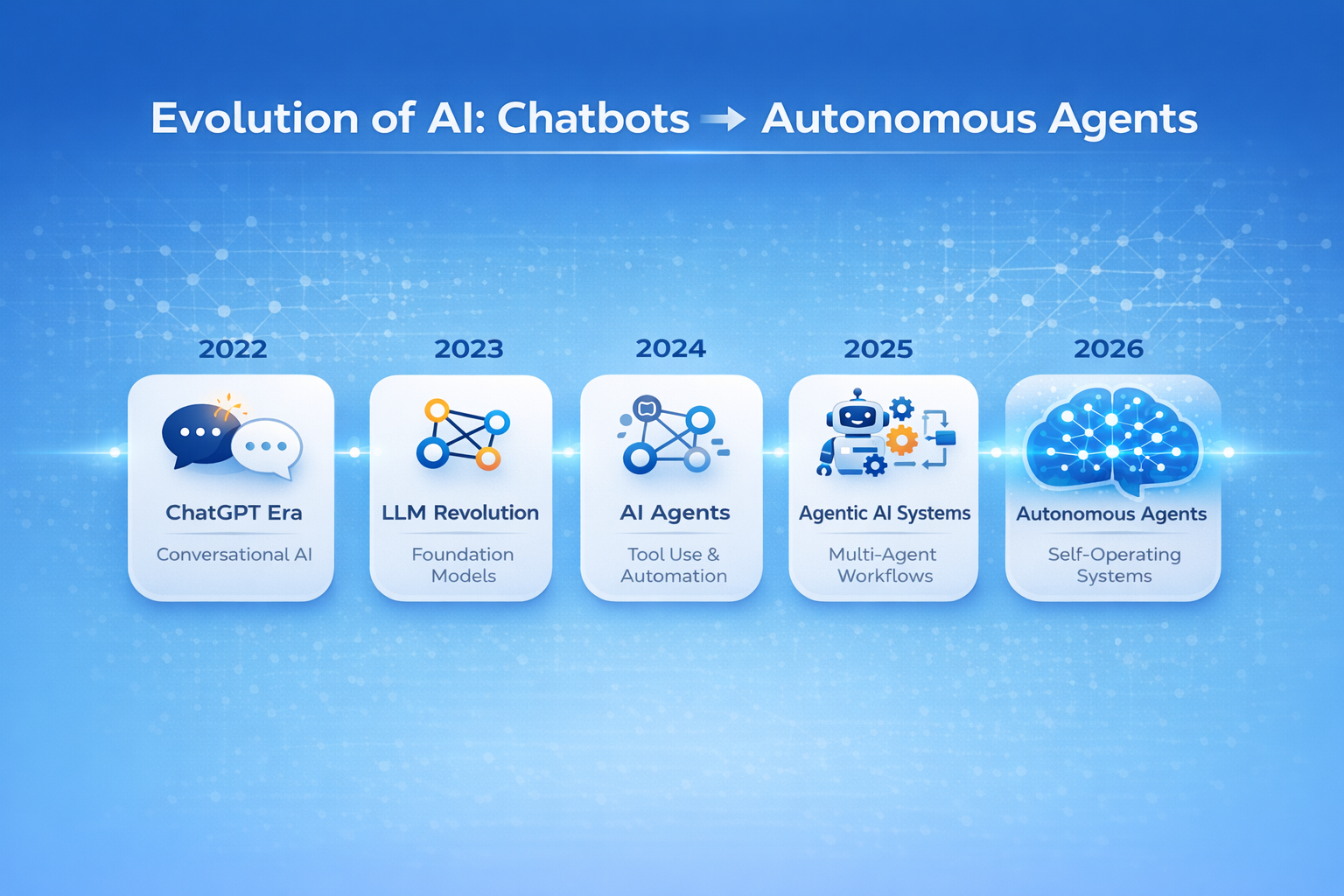
- The Evolution: From Chatbots to Autonomous Agents
- 2022: ChatGPT – The Spark
- 2023: The LLM Explosion – The Engine Room
- 2024: AI Agents – The Shift to Action
- 2025: Agentic AI – The System
- 2026: The Year of Skills and Specialization
- What Are Modern AI Agents?
- LLM Agents: The Foundation of Modern Intelligence
- Autonomous Intelligent Agents: Beyond Conversation
- Agentic AI Systems: The Enterprise Revolution
- The Agentic AI Market Explosion
- Key Trends Shaping Agentic AI in 2026
- Industry-Specific Agentic AI Adoption
- AI Powered Autonomous Agents: Real-World Impact
- Customer Service Transformation
- Healthcare Documentation Revolution
- Retail Revenue Optimization
- Financial Services Efficiency
- Manufacturing Predictive Intelligence
- Building Modern AI Agents: Frameworks and Tools
- The Challenges: What Can Go Wrong
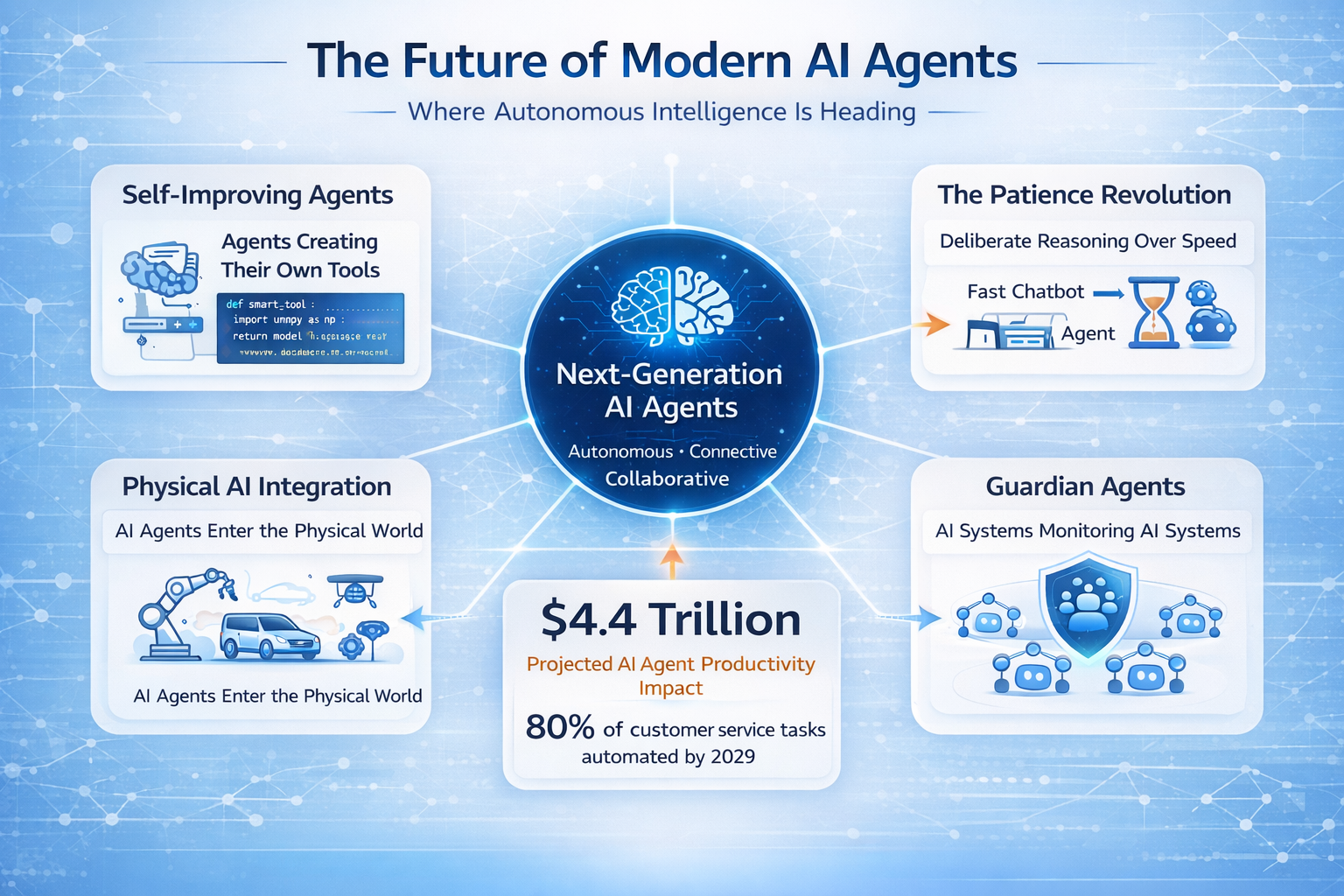
- The Future: Where Modern AI Agents Are Heading
- Self-Improving Agents
- The Patience Revolution
- Physical AI Integration
- Guardian Agents
- Agentic AI Contributing $4.4 Trillion
- Practical Guidance: Getting Started with Modern AI Agents
- Step 1: Identify High-Impact Use Cases
- Step 2: Build the Foundation
- Step 3: Start Small, Measure Everything
- Step 4: Design for Human-Agent Collaboration
- Step 5: Scale What Works
- Conclusion
In just four years, we’ve witnessed one of the most dramatic technological shifts in computing history. We’ve moved from AI that simply answers questions to modern AI agents that autonomously plan, reason, execute complex workflows, and collaborate with other agents and all while you sleep.
The numbers tell a compelling story: The global AI agents market reached $7.63 billion in 2025 and is projected to explode to $182.97 billion by 2033, growing at a staggering 49.6% CAGR. But market size only scratches the surface. What’s truly revolutionary is how these systems are fundamentally changing the nature of work itself.
By 2026, 52% of enterprises using generative AI have already deployed agents to production, not pilots, not experiments, but real systems doing real work. Even more striking: 85% of organizations have integrated AI agents into at least one workflow, and 93% of IT leaders plan to introduce autonomous agents within the next two years.
This isn’t hype. This is the largest shift in enterprise technology since the internet itself.
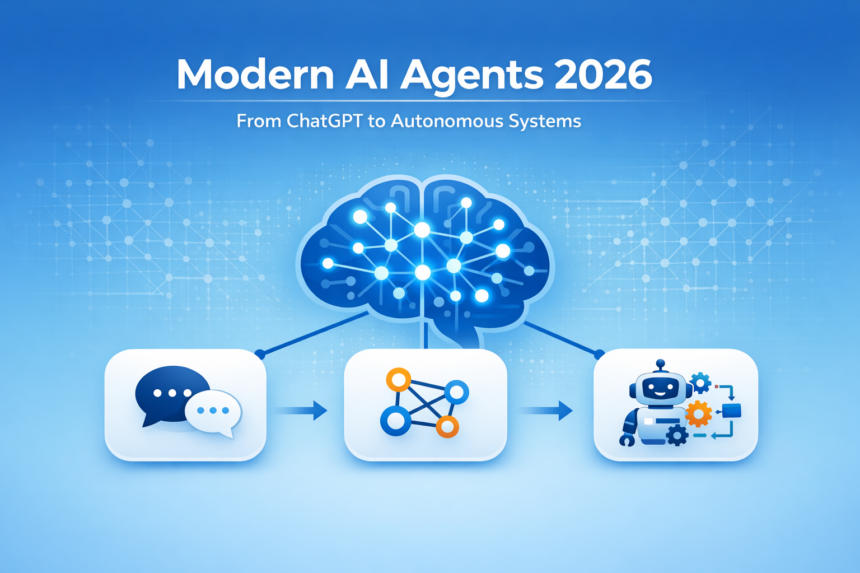
This comprehensive guide takes you from ChatGPT’s conversational roots to today’s sophisticated autonomous intelligent agents, exploring LLM agents, agentic AI systems, and the AI powered autonomous agents reshaping industries. Whether you’re a developer building these systems or a business leader evaluating their potential, understanding this evolution is no longer optional and it’s essential for survival.
The Evolution: From Chatbots to Autonomous Agents
To understand where we are, we need to trace the trajectory that brought us here.
2022: ChatGPT – The Spark
November 2022 marked the moment AI became accessible to everyone. ChatGPT demonstrated that conversational interfaces could unlock massive capability without requiring technical expertise. The focus was simple: interaction. You ask, it answers.
Key Limitation: Purely reactive. Every interaction started from scratch. No memory, no planning, no action beyond generating text.
2023: The LLM Explosion – The Engine Room
2023 was the year of the foundation model race. We saw an explosion of increasingly powerful large language models, GPT-4, Claude, PaLM 2, Llama 2, and dozens more. The focus shifted to scale, capability, and multimodality.
Key Advancement: Models could now process images, understand context better, and handle longer conversations. But they were still fundamentally reactive systems waiting for human prompts.
2024: AI Agents – The Shift to Action
2024 marked the critical inflection point. AI moved from passive chatbots to active entities. Systems began using tools, browsing the web, writing and executing code, and planning multi-step workflows autonomously.
OpenAI released function calling, then Assistants API. Anthropic introduced Claude with tool use. Google launched Gemini with native multimodality and action capabilities. The paradigm shifted from “AI that answers” to “AI that does.”
Key Advancement: Agents could now perceive their environment, use external tools, and execute plans without constant human intervention.
2025: Agentic AI – The System
2025 brought maturation and integration. Single agents evolved into coordinated multi-agent systems capable of handling complex enterprise workflows. The focus shifted from “Can AI do this task?” to “How do we orchestrate hundreds of agents working together?”
Anthropic released Model Context Protocol (MCP) in November 2024, which became the de facto industry standard for agent-tool communication. Google introduced Agent-to-Agent (A2A) protocol for inter-agent communication. The infrastructure for autonomous systems solidified.
Key Advancement: Reliable, production-grade agent systems that enterprises could trust with mission-critical workflows.
2026: The Year of Skills and Specialization
We’ve arrived at 2026, and the frontier has shifted again. The focus is no longer on building more powerful general-purpose models. Instead, we’re seeing the rise of hyper-specialized AI agents with deep domain expertise and the emergence of orchestration as the critical human skill.
Modern AI agents in 2026 don’t just follow instructions and they apply genuine expertise in forensic accounting, complex logistics, biotechnology research, and countless other specialized domains.
What Are Modern AI Agents?
Modern AI agents are autonomous software systems that perceive their environment, reason about available options, make decisions, take actions, and learn from outcomes and all without requiring explicit human instructions for each step.
If you want to understand the fundamental concept behind these systems, explore our guide on intelligent agents in artificial intelligence where we explain agent types, architecture, and real-world examples.
Defining Characteristics of 2026 AI Agents
Autonomous Decision-Making
Unlike traditional software that follows predefined rules, modern agents make contextual decisions based on goals, environmental conditions, and learned experience. They don’t just execute and they think.
Multi-Step Planning and Reasoning
Today’s agents decompose complex objectives into subtasks, create execution plans, and adapt those plans when conditions change. A customer service agent doesn’t just answer questions and it diagnoses issues, coordinates with backend systems, and resolves problems end-to-end.
Tool Use and Integration
Modern agents seamlessly integrate with external systems through APIs, databases, and specialized tools. They can search the web, query databases, execute code, send emails, update CRMs, and coordinate with other agents and all autonomously.
Memory and Context Management
Unlike early chatbots that forgot everything between conversations, modern agents maintain persistent memory. They remember past interactions, learn user preferences, and build knowledge over time.
Learning and Adaptation
Advanced agents improve through experience. They analyze outcomes, identify patterns, and refine their strategies without explicit reprogramming.
Collaboration Capabilities
Perhaps most significantly, 2026 agents can work together. Multi-agent systems coordinate specialized agents, one for research, another for analysis, a third for execution and creating capabilities no single agent could achieve alone.
LLM Agents: The Foundation of Modern Intelligence
LLM agents represent the most significant category of modern AI agents, leveraging large language models as their cognitive core while adding planning, tool use, and autonomous execution capabilities.
If you’re new to AI systems, it’s helpful to understand how intelligent agents differ from other AI approaches like machine learning and deep learning. We break down these differences in our guide on intelligent agent vs machine learning vs deep learning.
How LLM Agents Work
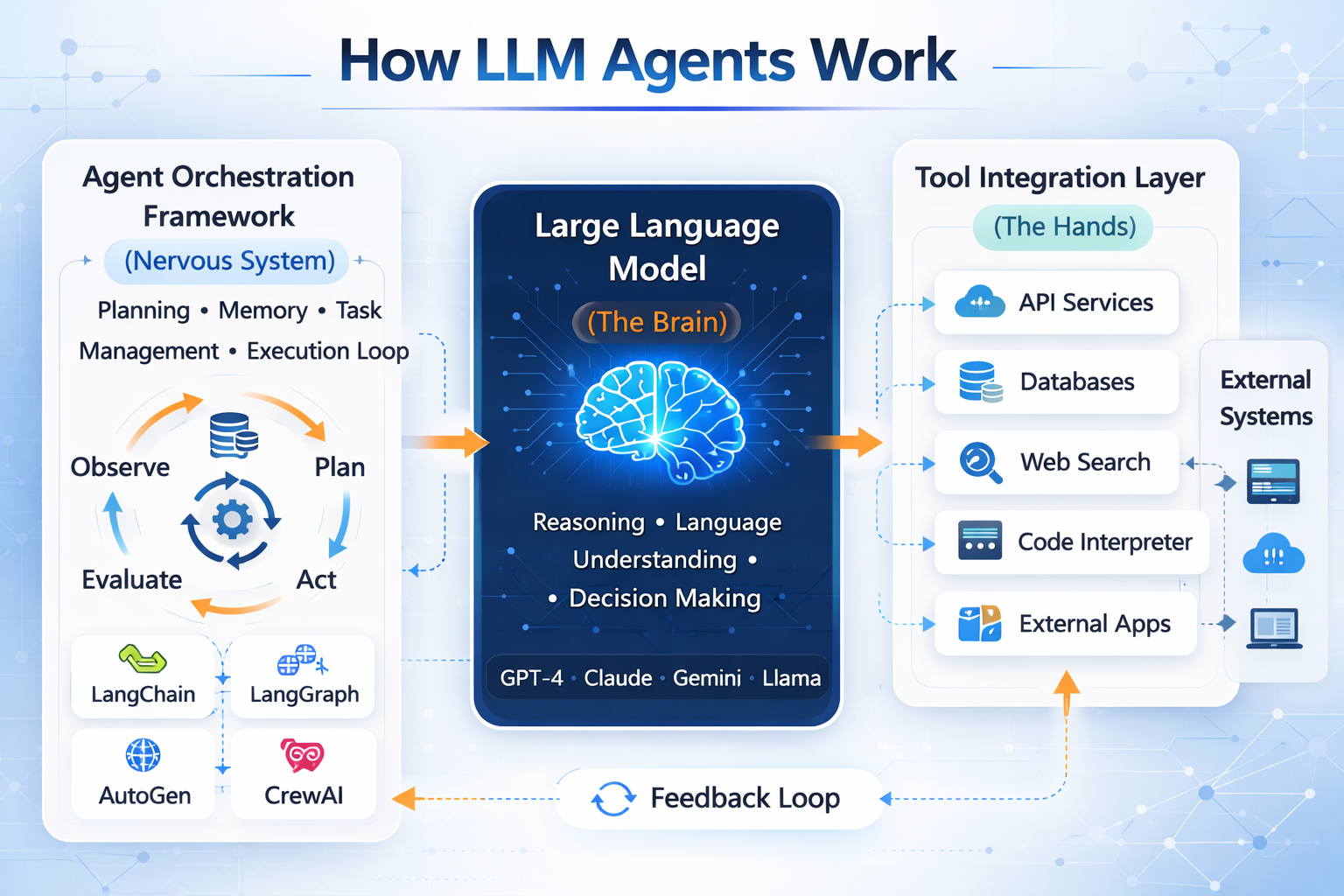
At their core, LLM agents combine three essential components:
- Large Language Model (The Brain)
The foundation model provides reasoning, language understanding, and decision-making capabilities. Models like GPT-4, Claude Opus, Gemini, and others serve as the “brain” that processes information and determines actions.
- Tool Integration Layer (The Hands)
This layer connects the LLM to external systems, APIs, databases, search engines, code interpreters, and specialized tools. It’s what transforms a conversational model into an action-taking agent.
- Orchestration Framework (The Nervous System)
The orchestration layer manages the agent’s workflow: perceiving the environment, planning actions, executing tools, evaluating outcomes, and iterating until goals are achieved. Frameworks like LangChain, LangGraph, AutoGen, and CrewAI provide this infrastructure.
The ReAct Pattern: Reason and Act
Modern LLM agents typically follow the ReAct (Reason and Act) pattern, which creates a continuous loop:
- OBSERVE → Perceive current state and available information
- REASON → Analyze situation and determine next action
- ACT → Execute chosen action using appropriate tools
- EVALUATE → Assess outcome and update understanding
- REPEAT → Continue until goal is achieved
This pattern enables agents to handle complex, multi-step tasks that require iterative problem-solving.
Real-World LLM Agent Examples
ChatGPT Agent Mode (Operator)
OpenAI consolidated its “Operator” project into ChatGPT as Agent Mode, equipped with a virtual browser and computer use capabilities. It can autonomously navigate websites, click buttons, fill forms, and execute complex multi-step workflows.
A developer tested it with: “Research and compile a 20-page market report on AI coding assistants, including pricing, features, and G2 reviews.” The agent visited 30+ websites, extracted data, cross-referenced information, compiled everything into a structured document, and cited every source and all autonomously in 45 minutes.
Salesforce Agentforce
Agentforce uses the Atlas Reasoning Engine to power autonomous agents that integrate directly with CRM data. These agents don’t search for context and they’re born with it, having immediate access to customer history, preferences, and business logic.
The platform enables agents to handle complex service claims, qualify sales leads, and manage multi-step customer journeys without human intervention. Organizations using Agentforce report handling 80% of common customer service issues autonomously.
GitHub Copilot Workspace
Moving beyond code completion, GitHub’s agentic system can now understand issues, plan solutions, write code across multiple files, create tests, and submit pull requests and handling the entire development workflow from specification to implementation.
Autonomous Intelligent Agents: Beyond Conversation
Autonomous intelligent agents represent the next evolution beyond LLM agents and systems that operate independently over extended periods, managing complex workflows with minimal human oversight.
What Makes Agents Truly Autonomous?
Goal-Directed Behaviour
Autonomous agents work toward defined objectives rather than responding to individual prompts. You don’t tell them how to accomplish a task, you tell them what outcome you need, and they figure out the how.
Extended Operation
These agents can run for hours, days, or even weeks, managing long-running processes without constant supervision. They monitor conditions, take actions when appropriate, and escalate to humans only when necessary.
Self-Correction and Error Recovery
When autonomous agents encounter errors or unexpected conditions, they don’t simply fail. They analyze the problem, try alternative approaches, and adapt their strategies.
Proactive Action
Unlike reactive chatbots, autonomous agents monitor conditions and take initiative. A fraud detection agent doesn’t wait for you to ask about suspicious activity and it continuously monitors transactions and alerts you when anomalies appear.
Autonomous Agent Architectures
Single-Agent Systems
These deploy one sophisticated agent to handle a complete workflow. They’re simpler to implement and manage, making them ideal for well-defined, specialized tasks.
Use Case Example: A healthcare documentation agent that listens to doctor-patient conversations, generates clinical notes, updates electronic health records, and schedules follow-ups and all autonomously. AtlantiCare deployed such a system and saw 80% adoption among providers, with a 42% reduction in documentation time (saving 66 minutes per day).
Multi-Agent Systems
These coordinate multiple specialized agents, each handling specific aspects of a complex workflow. One agent might handle research, another analysis, a third execution, and a fourth quality control.
Use Case Example: A mortgage servicing company deconstructed their critical business process and designed a multi-agent framework with an “orchestrator” agent coordinating specialist agents for document analysis and data retrieval, plus “governance” agents ensuring accuracy. This symbiotic workflow created value neither humans nor AI could achieve alone.
Hierarchical Agent Systems
These implement a pyramid structure with micro-agents handling atomic functions at the base, tool integrators in the middle, and orchestrator agents at the apex managing delegation and escalation.
This architecture mirrors microservices in software design, providing modularity, fault isolation, and scalability.
Agentic AI Systems: The Enterprise Revolution
Agentic AI systems represent the enterprise-grade implementation of autonomous agents and production-ready platforms that handle mission-critical workflows at scale.
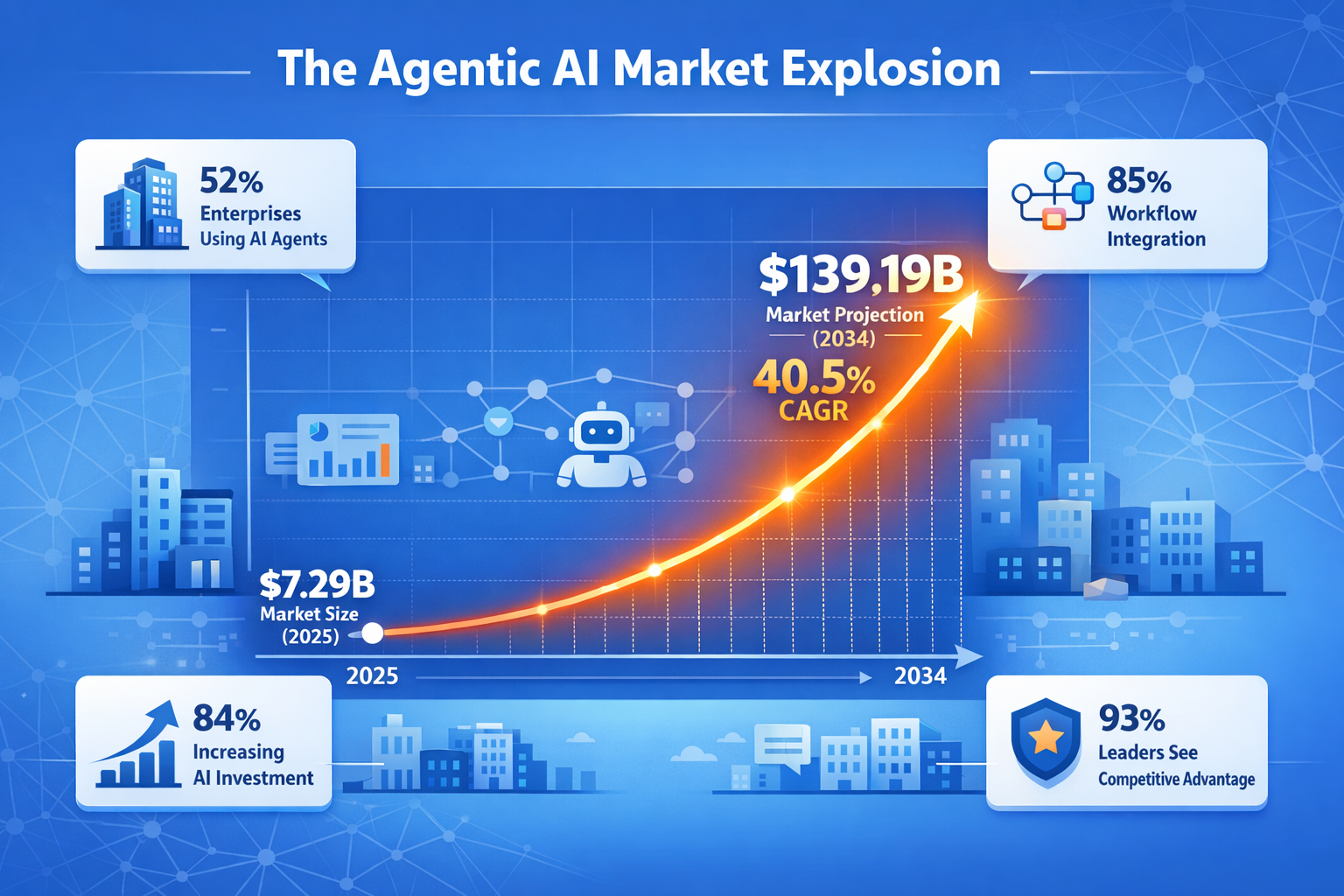
The Agentic AI Market Explosion
The numbers are staggering:
- Global agentic AI market: $7.29 billion in 2025, projected to reach $139.19 billion by 2034 (40.50% CAGR)
- Enterprise adoption: 52% of enterprises using generative AI have deployed agents to production
- Workflow integration: 85% of organizations have integrated AI agents into at least one workflow
- Investment growth: 84% of enterprises plan to increase AI agent investments in 2026
- Competitive advantage: 93% of business leaders agree that scaling AI agents within the next year will be a key competitive advantage
Key Trends Shaping Agentic AI in 2026
- Every Employee Becomes an Orchestrator
The most critical human skill in 2026 isn’t doing the task, it’s orchestrating AI agents that execute the work. Worker access to AI rose by 50% in 2025, and the number of companies with ≥40% of projects in production is set to double in six months.
- Agents for Every Workflow
The era of single-purpose chatbots is ending. 2026 is about workflow automation, agents that handle multi-step processes end-to-end. By 2028, 33% of enterprise software applications will include agentic AI, enabling 15% of day-to-day work decisions to be made autonomously.
- Protocol Standardization
Model Context Protocol (MCP) and Agent-to-Agent (A2A) protocols are becoming industry standards, enabling seamless agent-tool and agent-agent communication. This standardization is accelerating development and interoperability.
- Vertical Specialization
The shift from general-purpose foundation models to specialized agents built for specific roles is accelerating. Healthcare agents, financial services agents, legal research agents, and coding agents offer higher accuracy and deeper integration than generalist systems.
- Multi-Agent Orchestration
Organizations are moving from single-purpose agents to coordinated systems of specialized agents that collaborate on complex workflows. This mirrors the evolution from monolithic applications to microservices architecture.
Industry-Specific Agentic AI Adoption
Healthcare: 68% Already Using AI Agents
Healthcare leads in agent adoption, with 84% of survey respondents comfortable with AI making end-to-end autonomous decisions for specific processes. AI applications in healthcare are generating up to $150 billion in annual savings by 2026.
Financial Services: $97 Billion Investment by 2027
Financial services firms project investments across banking, insurance, capital markets, and payments to reach $97 billion by 2027. 70% of financial services executives believe AI will directly contribute to revenue growth.
Retail: 41% Already Investing
41% of retail organizations are already investing in AI agents for case management and service operations. By 2028, AI-powered agents will handle 20% of interactions at digital storefronts.
IT and Cyber security: 53% Deployed
53% of US businesses deploying AI agents use them in IT and cyber security. Agentic AI is set to dominate IT budget expansion, exceeding 26% of global IT spending and reaching $1.3 trillion by 2029.
AI Powered Autonomous Agents: Real-World Impact
Let’s examine how AI powered autonomous agents are delivering measurable business value across industries.
Want to see how these systems operate in practice? Explore these real world intelligent agent examples that show how AI agents are used across industries like finance, healthcare, and automation.
Customer Service Transformation
The Challenge: A telecommunications company handled 100,000+ support tickets monthly, with 40% being routine inquiries that still required human agents.
The Solution: They built a hybrid agent combining goal-based planning (for multi-step troubleshooting), utility-based optimization (for routing complex cases), and learning (for continuous improvement).
The Results:
- 65% of routine tickets fully automated
- 30% reduction in average resolution time
- 22% improvement in customer satisfaction scores
- Agents freed to handle complex, high-value interactions
Healthcare Documentation Revolution
The Challenge: Healthcare providers spent excessive time on administrative documentation, reducing patient interaction time and contributing to burnout.
The Solution: AtlantiCare deployed an agentic AI-powered clinical assistant with ambient note generation capabilities.
The Results:
- 80% adoption rate among 50 providers who tested it
- 42% reduction in documentation time
- 66 minutes saved per day per provider
- Providers can focus on patient care rather than paperwork
Retail Revenue Optimization
The Challenge: A Forbes-recognized retailer needed to optimize customer communication and reduce store call volume while increasing sales.
The Solution: Partnered with OneReach.ai to implement AI-driven communication strategy with agents handling phone calls, SMS marketing, and customer contact centre operations.
The Results:
- 7% increase in new sales calls
- $77 million improvement in annual gross profit
- 47% reduction in calls to stores
- NPS score of 65 (indicating high customer satisfaction)
Financial Services Efficiency
The Challenge: Bradesco, an 82-year-old Latin American bank, needed to prevent fraud and improve customer service efficiency.
The Solution: Implemented agentic AI use cases for fraud prevention and personal concierge services for customers.
The Results:
- 17% of employee capacity freed up
- 22% reduction in lead times
- Improved fraud detection and prevention
- Enhanced customer experience
Manufacturing Predictive Intelligence
The Challenge: A grocery retailer needed to optimize inventory management to reduce waste and ensure product availability.
The Solution: Deployed AI agents analyzing sales data, weather patterns, and local events to predict demand and optimize stock levels.
The Results:
- Over 90% prediction accuracy
- Right products at right stores at right time
- Significant reduction in waste
- Improved customer satisfaction through better availability
Building Modern AI Agents: Frameworks and Tools
The ecosystem for building modern AI agents has matured significantly. Here are the leading platforms and frameworks shaping development in 2026.
If you’re planning to build your own autonomous systems, check out our detailed guide on agentic AI frameworks in 2026 that compares the most powerful platforms used to develop production-ready AI agents.
Agent Development Frameworks
LangChain & LangGraph
LangChain remains the most popular framework for building LLM-powered agents, offering modular components for chains of reasoning and retrieval. LangGraph extends this with directed-graph framework supporting state management and concurrent agent workflows and perfect for orchestrating complex multi-agent interactions.
Best For: Complex reasoning chains, RAG applications, multi-agent orchestration
Microsoft AutoGen
Provides a streamlined interface for creating chat-based, collaborative agents. Excellent for rapid prototyping and conversational agent development with built-in support for multi-agent conversations.
Best For: Conversational agents, rapid prototyping, multi-agent collaboration
CrewAI
Specifically designed for multi-agent collaboration, enabling teams of specialized agents to work together on complex tasks. Each agent has defined roles, goals, and tools, coordinated by a crew manager.
Best For: Task delegation, role-based agent systems, collaborative workflows
Anthropic Claude with MCP
Claude’s integration with Model Context Protocol provides standardized tool use and context management. MCP servers enable what your agents can do, making security and capability management explicit and controllable.
Best For: Secure enterprise deployments, standardized tool integration, governance
OpenAI Assistants API
Provides persistent threads, built-in retrieval, code interpreter, and function calling. Simplifies building stateful agents that maintain context across conversations.
Best For: Stateful conversational agents, code execution, document analysis
Enterprise Agent Platforms
Salesforce Agentforce
Enterprise-grade platform with deep CRM integration, Atlas Reasoning Engine for sophisticated decision-making, and Einstein Trust Layer for security and governance.
Google Cloud Vertex AI Agents
Fully managed platform for building, deploying, and monitoring agents at scale with built-in grounding, safety controls, and enterprise integration.
Microsoft Copilot Studio
Low-code platform for building custom copilots and agents integrated with Microsoft 365, Dynamics 365, and Azure services.
IBM watsonx Orchestrate
Enterprise automation platform combining AI agents with RPA, workflow automation, and business process management.
The Challenges: What Can Go Wrong
Despite the tremendous potential, deploying autonomous intelligent agents comes with significant challenges that organizations must navigate.
The Three Critical Mistakes
- Building on a Cracked Foundation
The most common mistake is introducing agentic AI into environments with underlying technical debt. AI acts as a powerful amplifier and when introduced into weak or fragmented systems, it doesn’t fix the system; it amplifies its flaws.
Solution: Build a unified, vertically integrated AI stack with proper data governance, security, and infrastructure before deploying agents.
- Agent Sprawl
In the rush to innovate, organizations empower teams to experiment with AI, resulting in uncontrolled proliferation of siloed, insecure, and duplicative agents. This creates technical debt, multiplies security vulnerabilities, and prevents building a cohesive system.
Solution: Implement a repeatable blueprint with centralized governance, standardized tools, and coordinated development.
- Automating the Past
Organizations use AI for incremental efficiencies instead of orchestrating fundamentally new, more dynamic futures. They automate existing processes rather than reimagining workflows around agent capabilities.
Solution: Redesign core workflows around human-agent collaboration rather than simply automating existing tasks.
Security and Governance Challenges
Hallucination Risk
Agents can generate plausible but incorrect information, especially when operating autonomously over extended periods. Murphy’s Law applies: if an agent can make a mistake, it eventually will.
Solution: Implement guardrails, confidence thresholds, human-in-the-loop for high-stakes decisions, and comprehensive logging.
Tool Security
Real agentic AI security isn’t about the LLMs, it’s about the tools. If MCP allows undesirable actions (deleting code, modifying repositories), you can be sure they will eventually happen.
Solution: Follow the principle of minimum required permissions. Control what agents can do through tool configuration, not just system prompts.
Governance Lag
Agentic AI usage is poised to rise sharply, but oversight is lagging: only one in five companies has a mature model for governance of autonomous AI agents.
Solution: Implement governance frameworks from day one with logging, auditing, human oversight mechanisms, and clear escalation paths.
The ROI Reality Check
While CEO expectations for AI-driven growth remain high in 2026, workforces are grappling with more sober reality. Gartner research finds that only one in 50 AI investments deliver transformational value, and only one in five delivers any measurable return on investment.
The difference between success and failure? Clear business objectives, proper foundation, strategic implementation, and realistic expectations.
The Future: Where Modern AI Agents Are Heading
As we look beyond 2026, several trends will shape the evolution of modern AI agents.
Self-Improving Agents
By early 2026, AI agents are beginning to write their own tools. When an agent identifies a missing capability (e.g., “Need Instagram video summarization”), it writes Python code for the tool, tests it, and adds it to its available capabilities and all with minimal human involvement.
The Patience Revolution
The most important metric in AI right now isn’t speed, it’s patience. While the industry obsesses over latency, a fascinating anomaly has appeared: the smartest models take longer to complete tasks because they persist rather than hallucinate.
GPT-4 (June 2023) had an inferred time horizon of ~24 minutes. Claude Opus 4.6 (February 2026) has an inferred time horizon of ~38 hours and 100x longer. Why? Because when it encounters a roadblock, it doesn’t hallucinate a solution; it writes code to test hypotheses, iterates on approaches, and genuinely solves problems.
This signals the fundamental shift from “Chatbot” to “Agent”, from fast thinking (System 1) to deliberate reasoning (System 2).
Physical AI Integration
More than half of companies (58%) report at least limited use of physical AI today, and that figure is set to reach 80% in two years. AI agents are moving beyond digital workflows into the physical world through robotics, autonomous vehicles, and industrial automation.
Examples include collaborative robots on assembly lines, inspection drones with automated response capabilities, autonomous forklifts, and warehouse automation systems.
Guardian Agents
A new category of “guardian agents” focused on safety, compliance, and oversight is emerging. These agents monitor other agents, ensuring they operate within defined boundaries and escalate when necessary. Guardian agents are projected to capture 10-15% of the agentic AI market by 2030.
Agentic AI Contributing $4.4 Trillion
AI agents could contribute $4.4 trillion in productivity growth, with at least 15% of day-to-day work decisions made autonomously. By 2029, agentic AI will autonomously resolve 80% of common customer service issues without human intervention.
Practical Guidance: Getting Started with Modern AI Agents
If you’re ready to deploy modern AI agents in your organization, follow this strategic framework.
Step 1: Identify High-Impact Use Cases
Start with processes that are:
- High-volume: Repeated frequently enough to justify automation
- Well-defined: Clear inputs, outputs, and success criteria
- Data-rich: Sufficient historical data for training and evaluation
- Lower-risk: Not mission-critical initially while you build confidence
Examples: Customer inquiry routing, document processing, data entry, report generation, meeting summarization.
Step 2: Build the Foundation
Before deploying agents, ensure you have:
- Clean, accessible data: Agents are only as good as the data they access
- Secure infrastructure: Proper authentication, authorization, and audit trails
- Integration capabilities: APIs and connectors to systems agents need to access
- Governance framework: Policies, oversight mechanisms, and escalation paths
Step 3: Start Small, Measure Everything
Launch a minimum viable agent focused on measurable results. More than 74% of executives whose organizations introduce agentic AI see returns on their investment in the first year, but only when they start with concrete, measurable objectives.
Metrics to track:
- Task completion rate and accuracy
- Time saved per task
- Error rates and failure modes
- User satisfaction scores
- ROI and cost savings
Step 4: Design for Human-Agent Collaboration
The goal isn’t to replace humans, it’s to redesign workflows around human-agent collaboration. Deconstruct critical business processes and design multi-agent frameworks with orchestrator agents coordinating specialist agents and governance agents ensuring accuracy.
Step 5: Scale What Works
Once you’ve proven value with initial use cases, expand systematically:
- Add complementary use cases that leverage existing infrastructure
- Build reusable components and patterns
- Document learning and best practices
- Train teams on agent orchestration skills
Conclusion
The journey from ChatGPT’s conversational interface to today’s autonomous intelligent agents represents one of the most significant technological shifts in modern history. We’ve moved from AI that answers questions to AI that autonomously executes complex workflows, collaborates with other agents, and continuously improves through experience.
Modern AI agents in 2026 are not experimental technology and they’re production systems delivering measurable business value across every industry. With 52% of enterprises already deploying agents to production, 85% integrating them into workflows, and 93% of IT leaders planning implementation within two years, the question isn’t whether to adopt agentic AI, it’s how quickly you can do so strategically.
LLM agents provide the cognitive foundation, leveraging large language models for reasoning while adding planning, tool use, and autonomous execution. Agentic AI systems bring enterprise-grade reliability, security, and orchestration.AI powered autonomous agents deliver the business outcomes and reduced costs, improved efficiency, enhanced customer experiences, and competitive advantages.
The market is responding with explosive growth: from $7.63 billion in 2025 to a projected $182.97 billion by 2033. But success requires more than just deploying technology. It demands building proper foundations, avoiding agent sprawl, redesigning workflows around human-agent collaboration, and implementing robust governance.
The organizations that understand this early, that learn to orchestrate AI agents effectively, that build on solid foundations, that reimagine work rather than simply automating the past, are building 10x advantages while everyone else debates which chatbot sounds more human.
The revolution isn’t coming. It’s here. The only question is: are you building the future, or watching from the sidelines?

Hi, I’m Pragya.
I write about AI tools, digital trends, and emerging technologies in a way that’s simple, practical, and easy to apply. I enjoy exploring new AI platforms, testing their features, and breaking them down into clear guides that actually help people use them confidently.
My focus is not just on writing content, but on creating value. I believe powerful technology should feel accessible, not overwhelming. That’s why I aim to turn complex tools into actionable insights for creators, marketers, and growing online businesses.
I’m constantly learning, researching, and staying updated with the fast-moving AI space so readers always get relevant and useful information.