
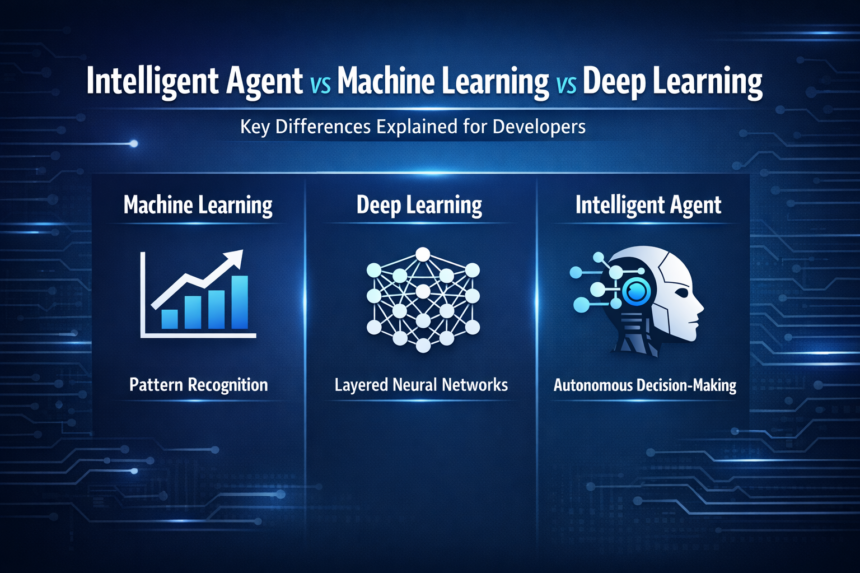
The AI landscape has become increasingly complex, with terms like “intelligent agents,” “machine learning,” and “deep learning” often used interchangeably, yet they represent fundamentally different approaches to artificial intelligence. This confusion costs organizations millions in misallocated resources and failed implementations.
- The AI Hierarchy: Understanding the Relationship
- What is Artificial Intelligence (AI)?
- What is Machine Learning (ML)?
- What is Deep Learning (DL)?
- What Are Intelligent Agents?
- Machine Learning vs Intelligent Agents: Key Differences
- Deep Learning vs AI Agents: Understanding the Distinction
- AI vs Intelligent Agents: The Broader Context
- Real-World Comparison: Three Examples
- Choosing the Right Technology: A Developer’s Framework
- The Future: Convergence and Integration
- Practical Guidance for Developers
- Building with Machine Learning
- Building with Deep Learning
- Building Intelligent Agents
- Hybrid Approach (Recommended)
- Conclusion
The reality? These technologies exist on a spectrum of capability and autonomy. Understanding their distinctions isn’t just academic and it’s critical for making informed technology decisions. In 2025, the global AI agents market alone is valued at $7.63 billion and is projected to reach $182.97 billion by 2033, growing at a CAGR of 49.6%. Yet many organizations are still deploying the wrong tool for their use case.
This guide cuts through the confusion by clearly defining intelligent agent vs machine learning, exploring how deep learning vs AI agents differ, and providing developers with practical frameworks for choosing the right technology for their specific problems.
The AI Hierarchy: Understanding the Relationship
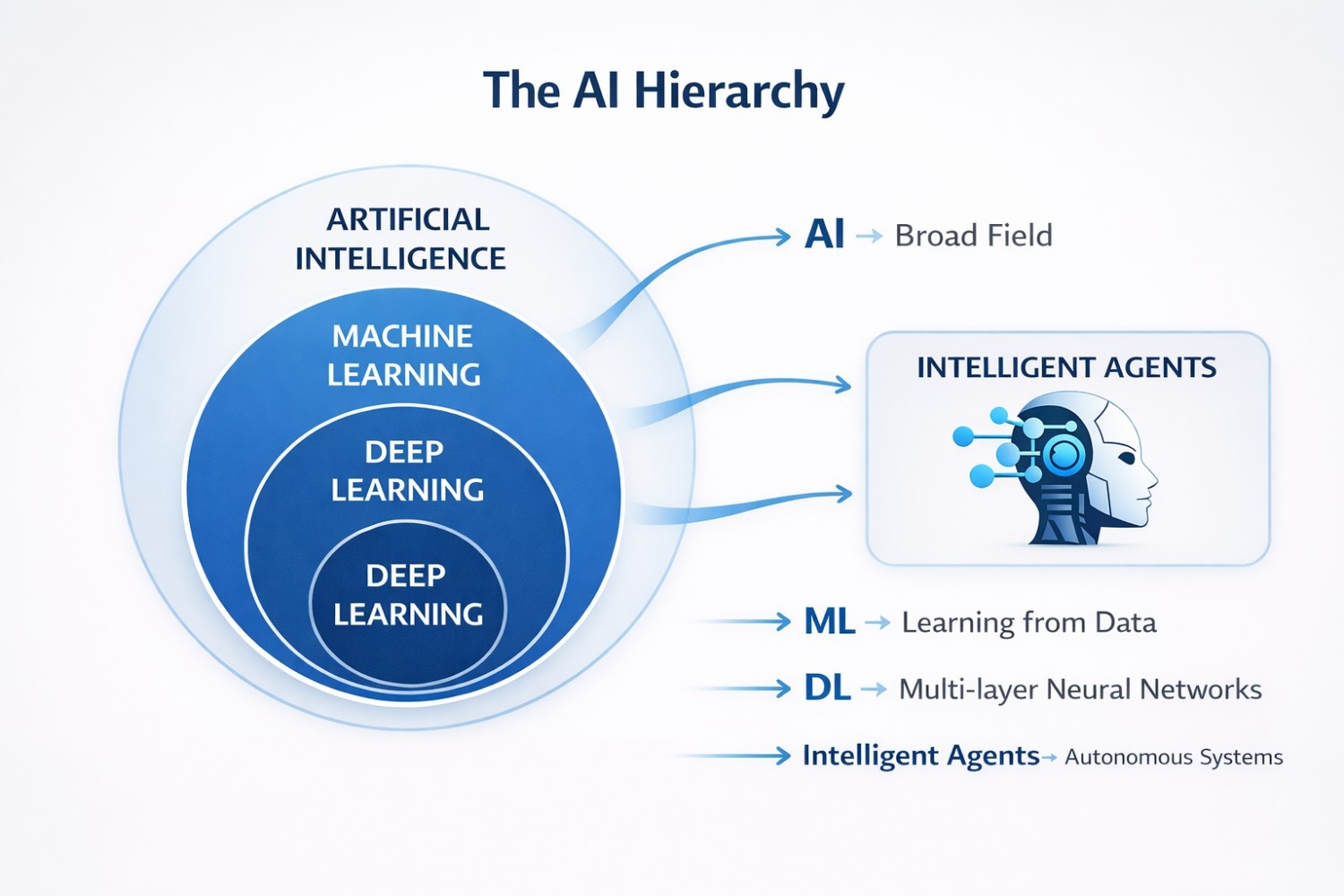
Think of AI as a nested hierarchy rather than separate silos:
AI (Artificial Intelligence) is the broadest umbrella and the entire field focused on creating systems that perform tasks requiring human-like intelligence. It encompasses everything from simple rule-based systems to sophisticated autonomous agents.
Machine Learning (ML) is a subset of AI that enables systems to learn from data without explicit programming. Instead of hardcoding rules, ML algorithms identify patterns in data and improve through experience.
Deep Learning (DL) is a specialized branch of ML that uses multi-layered neural networks inspired by the human brain to extract complex patterns from massive datasets.
Intelligent Agents represent a different dimension and they’re systems that combine perception, reasoning, and autonomous action. An intelligent agent can leverage ML or DL as components, but the defining characteristic is autonomy and goal-directed behaviour.
The key insight: AI defines the goal, ML defines the learning process, DL defines the depth of learning, and intelligent agents define the autonomy level.
What is Artificial Intelligence (AI)?
Artificial Intelligence refers to any system designed to perform tasks that typically require human intelligence. This includes reasoning, learning, perception, problem-solving, and decision-making. AI is intentionally broad and it’s the umbrella concept.
Characteristics of AI systems:
- Perform intelligent tasks autonomously or semi-autonomously
- Adapt to new situations and environments
- Process and interpret information
- Make decisions based on available data
- Improve performance over time (in some implementations)
Examples of AI:
- Chatbots and virtual assistants
- Recommendation systems
- Autonomous vehicles
- Medical diagnosis systems
- Fraud detection platforms
The distinction between AI vs intelligent agent is important: all intelligent agents are AI systems, but not all AI systems are intelligent agents. A spam filter is AI but not an agent. A self-driving car is both AI and an intelligent agent.
What is Machine Learning (ML)?
Machine Learning is a methodology within AI where systems learn patterns from data rather than following explicit instructions. Instead of programming every rule, developers provide data and let algorithms discover the patterns themselves.
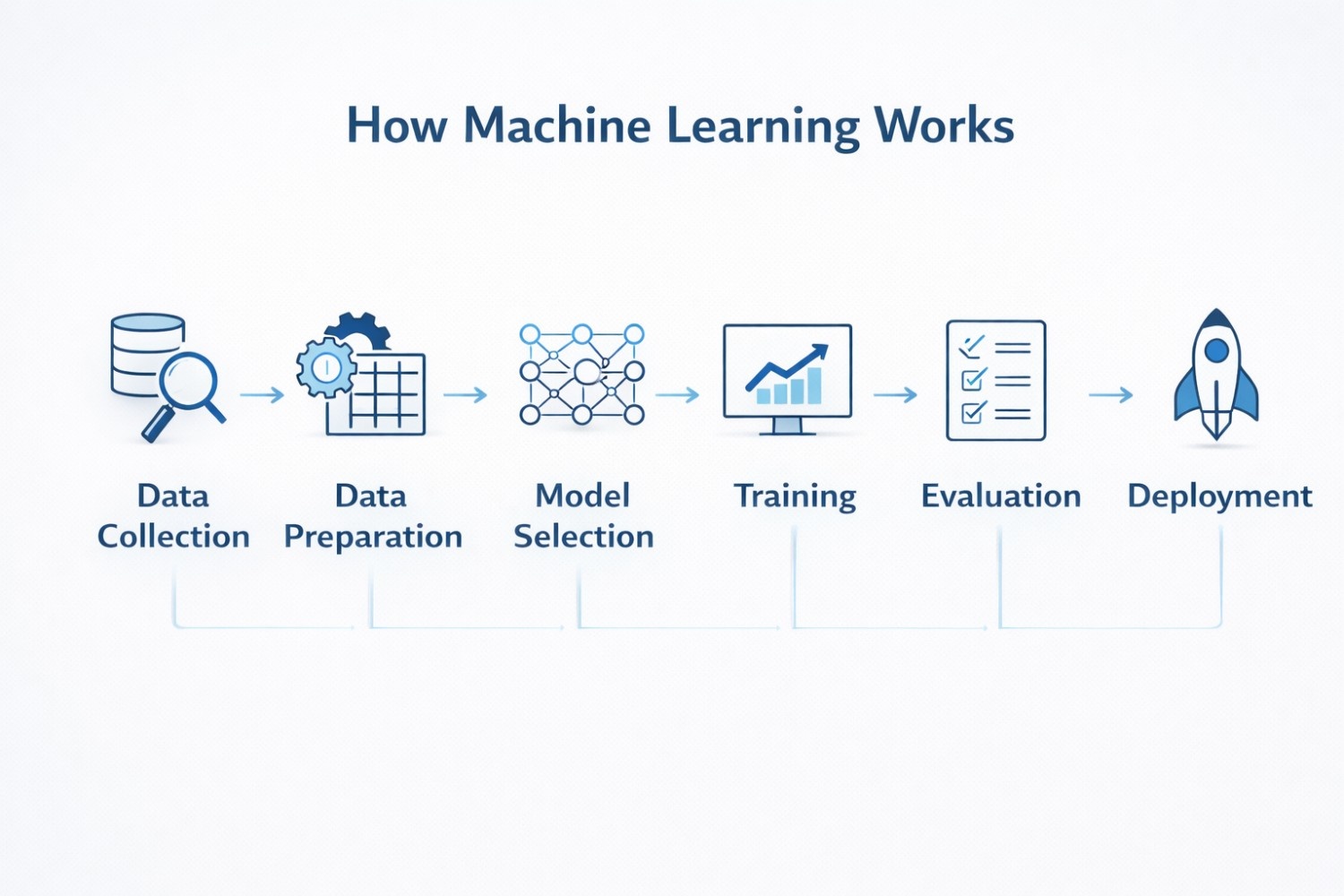
How Machine Learning Works:
- Data Collection– Gather relevant datasets
- Data Preparation– Clean and format data for training
- Model Selection– Choose appropriate algorithms (linear regression, decision trees, support vector machines, etc.)
- Training– Algorithm analyzes data and builds a mathematical model
- Evaluation– Test model accuracy on new data
- Deployment– Use trained model for predictions
Three Main Types of Machine Learning:
Supervised Learning trains on labelled data where desired outputs are provided. The model learns mappings between inputs and correct answers. Examples include email spam detection, medical diagnosis, and credit risk assessment. This approach works well with smaller datasets and is highly interpretable.
Unsupervised Learning works with unlabelled data, discovering hidden patterns and structures without predefined categories. Applications include customer segmentation, anomaly detection, and data clustering. This is valuable when you don’t know what patterns exist in your data.
Reinforcement Learning trains agents through reward signals as they interact with environments. The system learns optimal strategies through trial and error. This powers game-playing AI, robotic control, and autonomous decision-making systems.
Key Characteristics of Machine Learning:
- Works with smaller to medium-sized datasets
- Requires manual feature engineering in traditional ML
- More interpretable and explainable than deep learning
- Can run on standard CPUs
- Faster training and inference times
- Requires less computational power
Real-World ML Applications:
- Fraud detection in financial transactions
- Customer churn prediction
- Recommendation engines (Netflix, Amazon)
- Predictive maintenance in manufacturing
- Email filtering and spam detection
What is Deep Learning (DL)?
Deep Learning is an advanced subset of machine learning that uses artificial neural networks with multiple layers to automatically extract complex features from raw data. These layered networks are inspired by the structure of the human brain.
How Deep Learning Works:
Neural networks consist of interconnected layers of artificial neurons. Each neuron receives inputs, applies weights and biases, and passes the result through an activation function to the next layer.
Network Architecture:
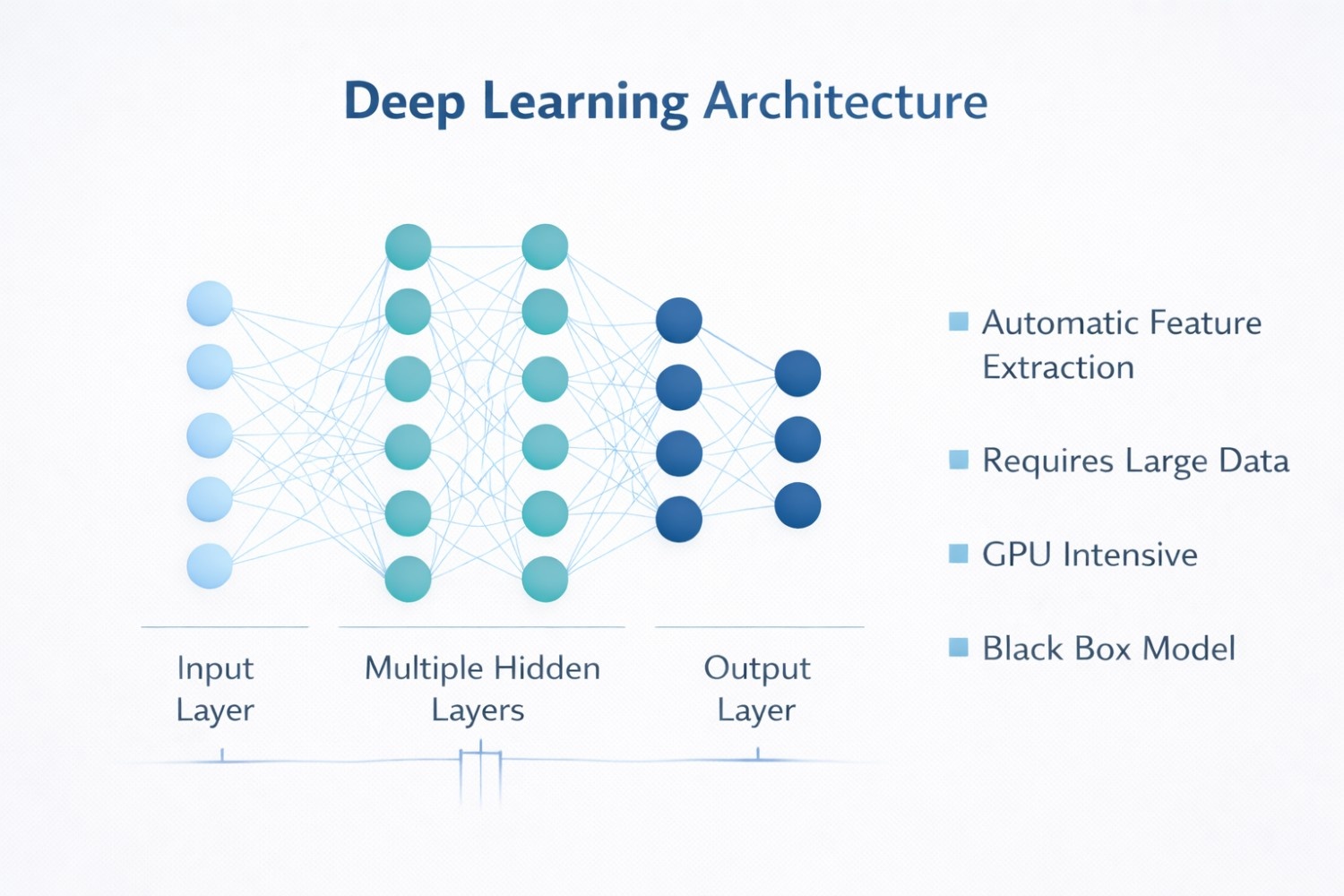
- Input Layer– Receives raw features (images, text, sensor data)
- Hidden Layers– Multiple layers that transform inputs into increasingly abstract representations. Early layers detect simple features (edges in images), while deeper layers identify complex patterns (objects, concepts).
- Output Layer– Produces final predictions or classifications
The power of deep learning comes from this layered approach. Each layer learns to represent data at a different level of abstraction, enabling the network to discover complex nonlinear relationships that traditional ML algorithms miss.
Key Characteristics of Deep Learning:
- Requires large amounts of data (typically thousands to millions of examples)
- Automatically extracts features without manual engineering
- Highly complex models that are difficult to interpret (“black box” problem)
- Requires specialized hardware (GPUs, TPUs) for training
- Longer training times but faster inference
- Excels with unstructured data (images, audio, video, text)
Deep Learning Architectures:
Convolutional Neural Networks (CNNs) specialize in image and video processing. They use convolutional layers to detect spatial patterns, making them ideal for computer vision tasks like facial recognition, object detection, and medical image analysis.
Recurrent Neural Networks (RNNs) process sequential data like text and time series. They maintain memory of previous inputs, making them suitable for language translation, speech recognition, and stock price prediction.
Transformers revolutionized natural language processing by using attention mechanisms to process entire sequences in parallel. They power modern large language models like GPT, Claude, and Gemini.
Real-World Deep Learning Applications:
- Autonomous vehicles (perception and decision-making)
- Medical image analysis and diagnosis
- Natural language processing and chatbots
- Facial recognition and biometric systems
- Generative AI (image generation, text generation)
- Speech recognition and voice assistants
What Are Intelligent Agents?
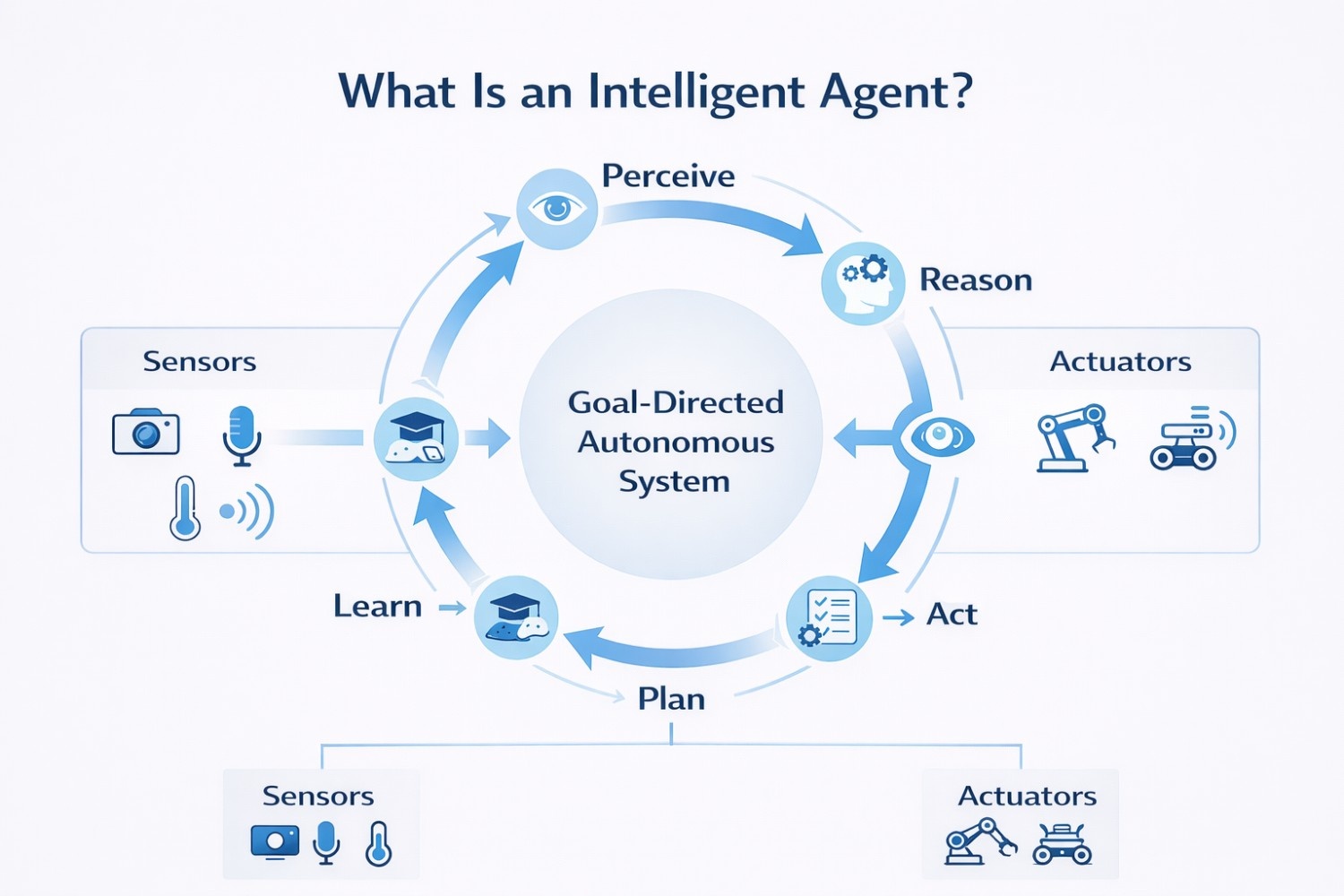
An intelligent agent is fundamentally different from ML and DL and it’s an architectural approach rather than a learning methodology. An intelligent agent is an autonomous system that perceives its environment, reasons about available options, makes decisions, and takes actions to achieve specific goals.
Defining Characteristics of Intelligent Agents:
Autonomy– Agents make decisions and take actions without requiring explicit human instructions for each step. They operate independently within defined parameters.
Goal-Directed Behaviour– Agents work toward specific objectives, planning sequences of actions to achieve those goals.
Environmental Interaction– Agents perceive their environment through sensors and influence it through actuators or tools.
Reasoning and Planning– Agents decompose complex tasks into subtasks, create action plans, and adjust strategies based on feedback.
Memory and Learning– Agents maintain context across interactions, learning from experience to improve future decisions.
Tool Use– Modern agents can invoke external systems, APIs, databases, and specialized tools to accomplish tasks.
Types of Intelligent Agents:
Simple Reflex Agents operate on condition-action rules without maintaining state. A thermostat is a simple reflex agent and if temperature < target, turn on heat.
Model-Based Reflex Agents maintain an internal model of the world, tracking how past actions affect the environment. A robot navigating a room remembers obstacle locations.
Goal-Based Agents evaluate which actions lead to desired goal states and plan accordingly. They can reason about future consequences of current actions.
Utility-Based Agents maximize a utility function, making trade-offs between competing objectives. A delivery drone might balance speed, fuel efficiency, and safety.
Learning Agents improve performance over time through experience. They consist of a performance element (determines actions), learning element (improves knowledge), critic (evaluates actions), and problem generator (suggests exploration).
Curious how these agent types actually work behind the scenes? We’ve broken each one down in detail in a separate guide with real examples, practical explanations, and deeper insights. If you want to truly understand how decision-making evolves from simple rules to learning systems, that’s the next read.
Machine Learning vs Intelligent Agents: Key Differences
The distinction between machine learning vs intelligent agents is crucial for developers:
| Aspect | Machine Learning | Intelligent Agents |
| Primary Function | Learn patterns from data | Perceive, reason, and act autonomously |
| Decision-Making | Based on trained model outputs | Based on goals, reasoning, and planning |
| Autonomy Level | Limited; requires human direction | High; operates independently toward goals |
| Adaptability | Adapts through retraining on new data | Adapts in real-time through reasoning |
| Tool Integration | Typically standalone | Integrates with external systems and APIs |
| Interpretability | Varies (high for traditional ML, low for DL) | More transparent decision-making process |
| Use Case | Pattern recognition, prediction | Complex task automation, autonomous operation |
| Example | Spam filter, recommendation engine | Autonomous vehicle, AI assistant agent |
When to Use Machine Learning:
- You have labelled data and clear input-output relationships
- You need pattern recognition or prediction
- Interpretability is important
- You want to minimize computational costs
- Tasks are well-defined and don’t require autonomous decision-making
When to Use Intelligent Agents:
- Tasks require autonomous decision-making and planning
- You need real-time adaptation to changing conditions
- Complex workflows with multiple steps and dependencies
- Integration with multiple external systems is necessary
- Goal-directed behaviour is essential
- Human oversight should be minimal
Deep Learning vs AI Agents: Understanding the Distinction
The comparison deep learning vs AI agents highlights different dimensions of AI:
Deep Learning is a learning technique and it’s about how systems extract patterns from data. Deep learning excels at perception tasks: understanding images, processing text, recognizing speech.
AI Agents are autonomous systems and they’re about how systems make decisions and take action. Agents excel at planning, reasoning, and coordinating complex workflows.
The Relationship:
Modern intelligent agents often incorporate deep learning as a component. For example:
- An autonomous vehicle uses deep learning for perception (detecting pedestrians, reading traffic signs) but uses agent reasoning for navigation decisions (when to turn, brake, accelerate)
- A customer service agent might use deep learning for natural language understanding but agent reasoning for deciding which tools to invoke and how to resolve issues
- A medical diagnosis system uses deep learning for image analysis but agent reasoning for treatment planning
Key Differences:
| Aspect | Deep Learning | Intelligent Agents |
| Focus | Pattern extraction from data | Autonomous decision-making and action |
| Data Requirements | Very high (millions of examples) | Variable; depends on reasoning approach |
| Interpretability | Low (black box) | Higher (reasoning is traceable) |
| Real-Time Adaptation | Limited without retraining | High; adapts through reasoning |
| Computational Needs | High (GPUs/TPUs) | Moderate to high |
| Strengths | Perception, pattern recognition | Planning, reasoning, autonomous operation |
| Weaknesses | Requires massive data, not interpretable | Can be complex to design and control |
AI vs Intelligent Agents: The Broader Context
AI vs intelligent agent is somewhat of a false dichotomy and intelligent agents are a type of AI system. However, the distinction matters:
Traditional AI systems(including most ML and DL applications) are reactive. They respond to inputs and produce outputs based on training or programming. A chatbot waits for your question before responding.
Intelligent Agents are proactive. They monitor conditions, anticipate needs, and take autonomous action. An AI agent might proactively monitor your spending patterns, detect unusual activity, and alert you without being asked.
The Shift in 2025:
Enterprise spending on generative AI reached $37 billion in 2025 and a 3.2x increase from 2024. But the most significant shift isn’t in spending; it’s in architecture. Organizations are moving from monolithic, general-purpose models to distributed systems of specialized agents that reason, coordinate, and execute complex workflows autonomously.
According to PwC’s AI Agent Survey (May 2025), AI agent adoption is gaining strong momentum: 35% of organizations report broad adoption, 27% have limited adoption, and 17% have fully implemented agents company-wide.
Real-World Comparison: Three Examples
Example 1: Email Management
Traditional Machine Learning Approach:
A spam filter uses supervised learning trained on labelled emails. It learns patterns distinguishing spam from legitimate mail. The model is static and it only improves when retrained on new data.
Deep Learning Approach:
A deep learning model processes email text and metadata through neural networks, capturing complex linguistic patterns. It’s more accurate than traditional ML but requires massive training data and is harder to interpret.
Intelligent Agent Approach:
An AI agent monitors your email patterns, learns your preferences, automatically categorizes messages, flags suspicious senders, suggests responses, and even drafts replies. It adapts in real-time based on your feedback and behaviour.
Example 2: Customer Service
Machine Learning:
A classification model predicts customer issue categories. Routing is rule-based. No learning from individual interactions.
Deep Learning:
A transformer model understands customer intent through natural language processing. Generates contextually appropriate responses. Still reactive and waits for customer input.
Intelligent Agent:
An AI agent proactively monitors customer accounts, predicts issues before they occur, routes complex problems intelligently, maintains conversation context across channels, and escalates to humans when necessary. It learns from each interaction and improves recommendations.
Example 3: Manufacturing
Machine Learning:
Predictive maintenance model trained on historical sensor data predicts equipment failures. Requires manual intervention to act on predictions.
Deep Learning:
Deep neural networks process complex sensor streams, identifying subtle failure patterns. More accurate but computationally expensive.
Intelligent Agent:
An autonomous agent continuously monitors equipment, predicts maintenance needs, automatically schedules maintenance windows, coordinates with supply chain for parts, and optimizes production schedules around maintenance. It adapts to changing production demands and learns from maintenance outcomes.
Choosing the Right Technology: A Developer’s Framework
Step 1: Define Your Problem
Is your primary need pattern recognition or prediction?
→ Machine Learning or Deep Learning
Do you need autonomous decision-making and planning?
→ Intelligent Agent
Do you need to process unstructured data at scale (images, video, text)?
→ Deep Learning
Do you need interpretability and explainability?
→ Traditional Machine Learning
Step 2: Assess Your Resources
Data Availability:
- Limited data (< 10,000 examples) → Traditional ML
- Medium data (10K-1M examples) → ML or shallow DL
- Large data (> 1M examples) → Deep Learning
Computational Resources:
- Standard CPU sufficient → Traditional ML
- GPU available → Deep Learning or complex agents
- Distributed infrastructure → Agents with multiple components
Team Expertise:
- ML specialists → Machine Learning
- Deep learning researchers → Deep Learning
- Systems engineers → Intelligent Agents
Step 3: Evaluate Complexity vs. Benefit
Simple, well-defined tasks→ Traditional ML
Complex pattern recognition→ Deep Learning
Multi-step workflows requiring reasoning→ Intelligent Agents
Combination of above→ Hybrid approach (agents using ML/DL components)
The Future: Convergence and Integration
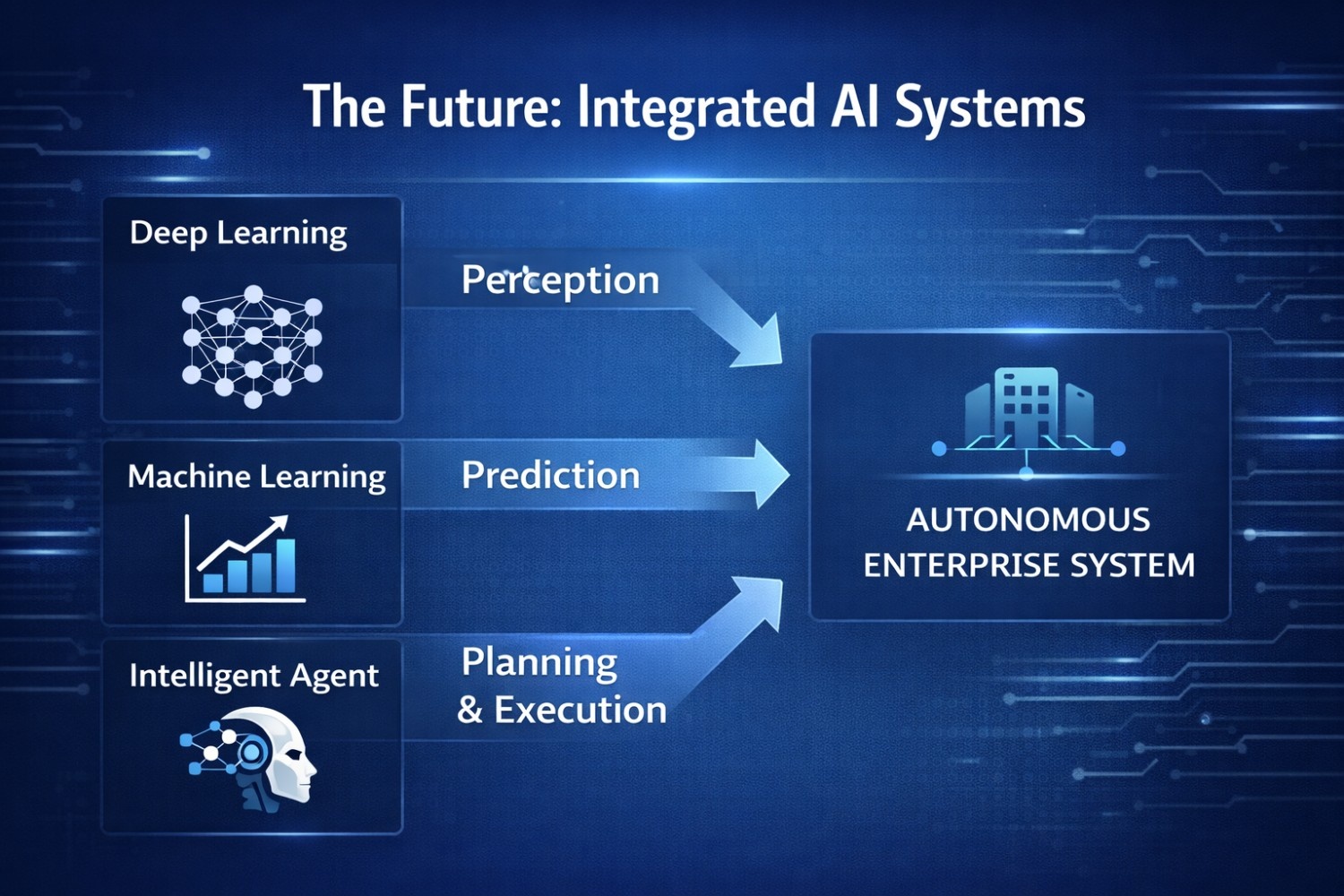
The future of AI isn’t about choosing between these technologies and it’s about intelligent integration. Modern systems combine all three:
Agentic AI represents the emerging frontier where intelligent agents leverage both machine learning and deep learning as components within a larger autonomous system.
Examples of Integration:
- Autonomous Vehicles: Deep learning for perception (detecting objects), machine learning for prediction (forecasting pedestrian movement), intelligent agents for planning (route optimization, safety decisions)
- Healthcare Diagnosis: Deep learning for medical image analysis, machine learning for risk prediction, intelligent agents for treatment planning and patient coordination
- Supply Chain Optimization: Machine learning for demand forecasting, deep learning for anomaly detection in complex data, intelligent agents for autonomous coordination and decision-making
The market is responding. The agentic AI market is growing at 46.3% CAGR, projected to reach $52.62 billion by 2030 from $7.84 billion in 2025.
Practical Guidance for Developers
Building with Machine Learning
Use established frameworks like scikit-learn, TensorFlow, or PyTorch. Focus on feature engineering, data quality, and model validation. Start with simpler models before moving to complex ones.
Building with Deep Learning
Leverage pre-trained models (transfer learning) to reduce data requirements. Use frameworks like TensorFlow, PyTorch, or JAX. Invest in GPU infrastructure. Monitor for overfitting with large models.
Building Intelligent Agents
Use agent frameworks like LangChain, LlamaIndex, AutoGen, or CrewAI. Design clear goal definitions and success metrics. Implement human-in-the-loop oversight. Start with well-defined use cases before expanding to complex workflows.
Hybrid Approach (Recommended)
Combine technologies strategically:
- Use deep learning for perception and feature extraction
- Use machine learning for prediction and classification
- Use intelligent agents for reasoning, planning, and autonomous execution
This approach leverages the strengths of each technology while mitigating weaknesses.
Conclusion
Understanding the differences between intelligent agent vs machine learning, deep learning vs AI agents, and AI vs intelligent agents is essential for building effective AI systems in 2025 and beyond.
Machine Learning excels at learning patterns from data and making predictions. It’s interpretable, efficient, and works well with moderate amounts of data.
Deep Learning excels at extracting complex patterns from massive unstructured datasets. It powers modern breakthroughs in perception and generation but requires significant computational resources.
Intelligent Agents excel at autonomous decision-making, planning, and coordinating complex workflows. They represent the future of enterprise AI, enabling systems that think and act independently toward defined goals.
The most powerful AI systems don’t choose between these technologies and they integrate them. An intelligent agent might use deep learning for perception, machine learning for prediction, and agent reasoning for planning and execution.
As you evaluate AI solutions for your organisation, ask yourself: What problem am I solving? Do I need pattern recognition, autonomous decision-making, or both? What resources do I have available? The answers will guide you toward the right technology choice.
The future belongs to developers and organisations that understand not just what these technologies can do, but when and how to use them effectively.

Hi, I’m Pragya.
I write about AI tools, digital trends, and emerging technologies in a way that’s simple, practical, and easy to apply. I enjoy exploring new AI platforms, testing their features, and breaking them down into clear guides that actually help people use them confidently.
My focus is not just on writing content, but on creating value. I believe powerful technology should feel accessible, not overwhelming. That’s why I aim to turn complex tools into actionable insights for creators, marketers, and growing online businesses.
I’m constantly learning, researching, and staying updated with the fast-moving AI space so readers always get relevant and useful information.