

Introduction
Disposition becomes a recurring plant problem because surplus is a constant byproduct of upgrades, shutdowns, line changes, and storeroom resets. The scale of what is sitting in U.S. manufacturing makes the stakes clear.
U.S. manufacturers held about $946.811 billion in inventories in September 2025. When even a small portion of that turns into excess, duplication, or obsolescence, the recovery opportunity is real.
Despite this, disposition remains slow and largely manual. Most teams work from incomplete asset lists with missing nameplates, limited specifications, and unclear equipment conditions. Approvals span operations, maintenance, procurement, finance, and EHS, creating friction at every step. As delays compound, buyers apply discounts, momentum is lost, and many plants default to bulk liquidation or scrap simply to free up space.
This is where AI begins to change the equation.
In this article, we explore how AI is making industrial asset disposition easier by reducing friction, improving visibility, and supporting faster, more informed disposition decisions.
What Industrial Asset Disposition Means
Industrial asset disposition is the process of identifying surplus items, deciding the best outcome for each one, executing that decision, and recovering value. That value can show up as cash recovered through resale or liquidation, or as cost avoided when an asset is redeployed internally instead of replaced with new spend. Done well, disposition also prevents value loss that comes from storage, handling, and obsolescence.
In real plants, “assets” include more than large machines. Disposition often involves surplus equipment (motors, pumps, drives, skids, conveyors), MRO inventory, spare parts, tooling and fixtures, and retired line components like panels and controls.
The objective isn’t simply to clear space, it’s to optimize net recovery (after fees, freight, and labor), speed (time-to-decision and time-to-cash), and risk control (avoiding downtime, safety issues, and compliance surprises).
Why Traditional Disposition Is So Hard
Traditional disposition is hard because the process is built on gaps, limited visibility into what’s actually surplus, slow cross-functional decisions, and execution complexity that adds time and cost.
When asset data is incomplete, and ownership is unclear, buyers price in risk, internal approvals drag on, and the “easy” option becomes clearing space fast instead of maximizing recovery.
Here are some reasons:
- Poor visibility: Messy lists, inconsistent naming, missing nameplates, photos, and specs
- Slow internal decisions: competing priorities across Ops, Maintenance, Procurement, and Finance
- Buyer uncertainty discount: Incomplete information leads to lower offers and more no-bid scenarios
- Execution friction: Rigging, freight coordination, load-out planning, and compliance checks
- Poor Disposition Channel Selection: Assets sit and depreciate—or get scrapped quickly as the default path to clear space.
How Enterprises are Using AI To Make Industrial Disposition Easier
Many manufacturers sit on large volumes of unused MRO inventory and idle capital equipment. This surplus represents tied-up working capital, ongoing carrying costs, and avoidable environmental impact. Despite advances in digital manufacturing and automation, disposition often remains manual, fragmented, and reactive.
While agentic AI systems are increasingly applied to production planning, maintenance, and quality, far fewer organizations apply the same level of intelligence to asset disposition. As a result, valuable equipment and materials remain underutilized or are disposed of without a clear recovery strategy.
Below are the key areas where Enterprises uses AI agents to reduce friction, improve visibility, and support more effective industrial asset disposition.
1. Parse Massive Inventories
Industrial disposition usually starts with messy inputs. Inventory data is spread across ERP, CMMS, spreadsheets, and site-level trackers. Even when a list exists, it often has duplicates, inconsistent naming, and missing fields that slow everything down. That is why the first job is simple: turn raw data into a usable inventory view.
When allowed to connect to ERP systems, Amplio’s AI agents can pull large inventory datasets directly and parse them at scale. They normalize item descriptions, reconcile duplicates, and structure records into consistent categories and attributes. This creates a decision-ready baseline faster than manual cleanup and reduces the chance that high-value assets get overlooked or misclassified early in the process.
2. Scan Global Secondary Markets
AI agents scan global secondary markets to understand what industrial assets are really selling for and how quickly they move. Instead of relying on static pricing or guesswork, the agents use live market signals across thousands of categories, including price ranges, buyer demand, and liquidity.
Large enterprises combines those external signals with internal disposition data to estimate recovery potential before taking action. This helps teams prioritize what matters and make market-backed decisions, rather than defaulting to scrap simply to clear space.
3. Disposition Pathway Modeling
Using external and internal data, AI agents model the optimal path for every surplus asset sitting unused in a manufacturing facility. The goal is to make asset disposition decisions based on value, liquidity, and real execution constraints, so outcomes are consistent.
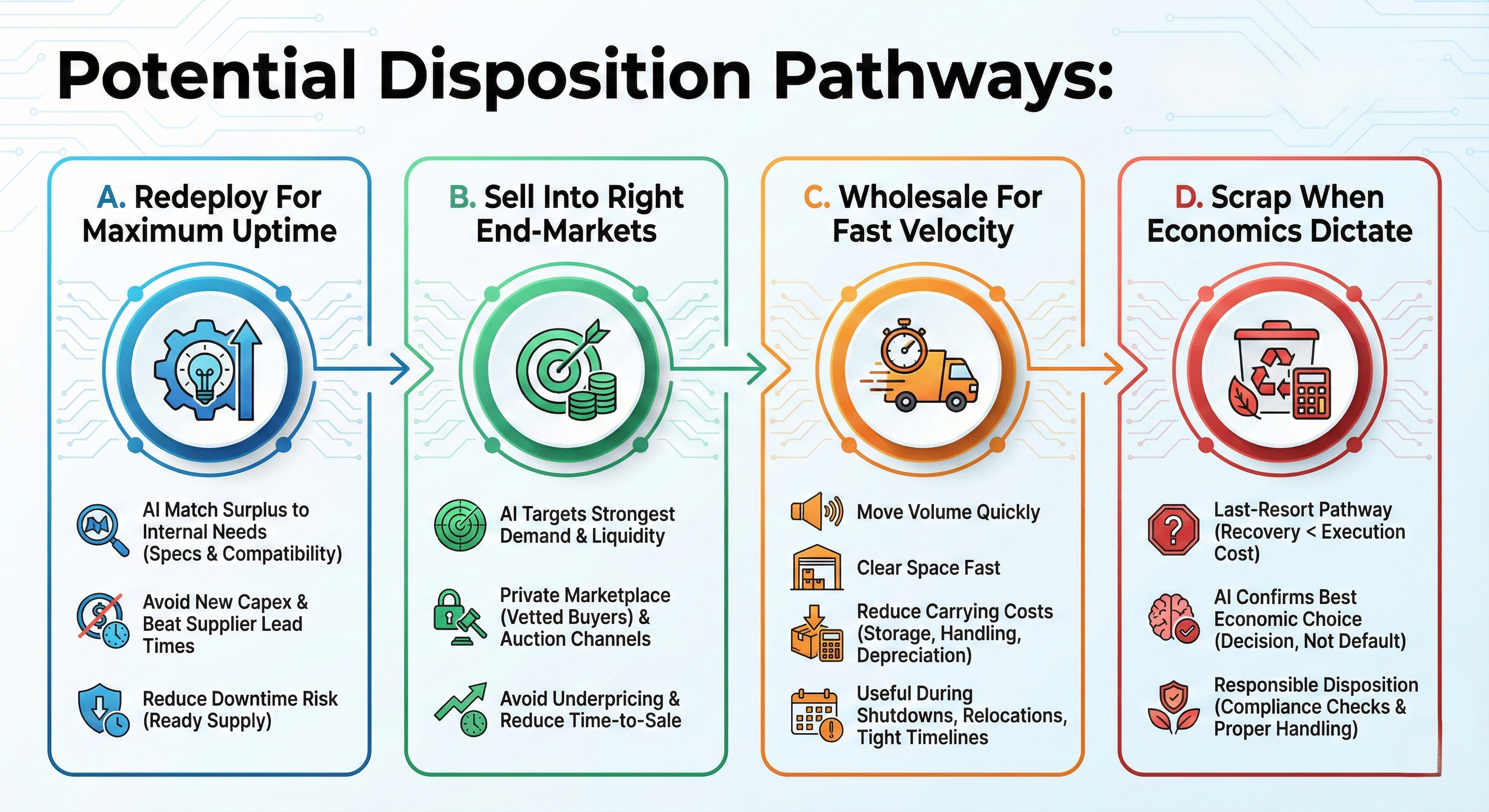
Potential Disposition Pathways:
a. Redeploy For Maximum Uptime
Amplio’s AI prioritizes redeployment first by matching surplus assets to internal needs across lines or facilities using specs and compatibility signals. This helps keep usable equipment and parts in production instead of being treated as excess.
Redeployment avoids new capex, beats supplier lead times, and reduces downtime risk by turning idle surplus into a ready supply where it creates the most uptime.
b. Sell Into Right EndMarkets
When redeployment is not viable, Amplio’s AI routes assets to the end-markets with the strongest demand and liquidity. Instead of “listing everywhere,” it targets the buyer groups and channels most likely to convert, including Amplio’s private marketplace for vetted industrial buyers and auction channels when competitive bidding and speed make sense.
This approach helps avoid underpricing in the wrong channel and reduces time-to-sale by placing assets where buyers are already active.
c. Wholesale For Fast Velocity
When speed matters more than maximizing price, Amplio can route assets to a wholesale pathway. This moves volume quickly, clears space fast, and reduces carrying costs from storage, handling, and depreciation. It is useful during shutdowns, relocations, or tight timelines where a slower sale would create more operational cost.
d. Scrap When Economics Dictate
Scrap is the last-resort pathway when the recovery value cannot justify the execution cost. Amplio’s AI helps confirm when scrap is truly the best economic choice, so it happens by decision, not default. When scrapping is necessary, Amplio emphasizes responsible disposition through compliance checks and proper handling.
4. Execute Disposition Projects
Disposition only creates value when it gets executed. Amplio runs the disposition project to move surplus assets out of the facility, so the work does not stall after appraisal and routing. This includes coordinating the practical steps required for removal, from scheduling around plant constraints to planning how assets will be handled and shipped.
Execution also means making the final outcome real. Assets routed for sale are prepared for go-to-market, and items that are not economical to recover are disposed of responsibly.
By managing the coordination and follow-through, Amplio helps manufacturers clear space, reduce excess inventory, and keep production lines more efficient.
Conclusion
Industrial asset disposition is not a cleanup activity. It is a recovery and circularity challenge that becomes costly when decisions are based on incomplete information or assumptions. When managed deliberately, disposition can protect capital, reduce waste, and improve supply chain resilience.
Agentic AI can extend beyond the four walls of the plant to support this outcome. When applied to asset disposition, it brings the same discipline used in production planning to decisions around redeployment, resale, and recovery. Instead of relying on guesswork, manufacturers gain access to real market signals, pricing behavior, and demand patterns across global secondary markets.

Sandeep Kumar is the Founder & CEO of Aitude, a leading AI tools, research, and tutorial platform dedicated to empowering learners, researchers, and innovators. Under his leadership, Aitude has become a go-to resource for those seeking the latest in artificial intelligence, machine learning, computer vision, and development strategies.