
Here’s a question that keeps popping up in AI development circles: Are cognitive agents and intelligent agents the same thing, or are we talking about two distinct concepts? If you’ve been building AI systems, you’ve probably encountered both terms and sometimes used interchangeably, sometimes positioned as completely different paradigms.
- What Are Intelligent Agents? A Quick Refresher
- What Are Cognitive Agents? Understanding the Cognitive Layer
- Cognitive Architecture in AI: The Building Blocks
- Classic Cognitive Architectures
- Modern Cognitive Architectures for AI Agents
- The Forms-Functions-Dynamics Framework
- Cognitive Agent vs Intelligent Agent: The Key Differences
- Architectural Differences
- AI Cognition Models: How Cognitive Agents Think
- Symbolic Cognition Models
- Connectionist Cognition Models
- Hybrid Cognition Models
- Embodied Cognition Models
- Cognitive Intelligent Systems: Real-World Applications
- Enterprise Automation and Decision Support
- Healthcare and Medical Diagnosis
- Autonomous Research and Knowledge Work
- Collaborative Multi-Agent Systems
- Building Cognitive Agents: Practical Considerations for Developers
- 1. Memory Architecture Design
- 2. Reasoning Engine Selection
- 3. Learning Mechanisms
- 4. Explainability and Transparency
- 5. Integration with Existing Systems
- Challenges in Cognitive Agent Development
- 1. Computational Complexity
- 2. Knowledge Acquisition Bottleneck
- 3. Brittleness and Robustness
- 4. Evaluation and Benchmarking
- 5. Ethical and Safety Considerations
- The Future of Cognitive Agents in 2026 and Beyond
- 1. From Retrieval to Generative Memory
- 2. Autonomous Memory Management
- 3. Multimodal Cognitive Processing
- 4. Collective Cognitive Systems
- 5. World Model Integration
- Conclusion: Choosing Between Cognitive and Intelligent Agents
The confusion is understandable. Both cognitive agents and intelligent agents perceive their environment, make decisions, and take actions. Both leverage AI to solve complex problems. Yet there’s a subtle but crucial distinction that affects how you design, implement, and deploy these systems.
In 2026, as we build increasingly sophisticated autonomous AI agent systems , understanding the cognitive agent vs intelligent agent debate isn’t just academic, it’s practical. The architecture you choose impacts everything from memory management to reasoning capabilities to how your agent learns and adapts over time.
This guide cuts through the confusion, exploring cognitive architecture in AI, examining AI cognition models, and revealing the real difference between cognitive and intelligent agents. Whether you’re architecting enterprise AI systems or building specialized agents for specific domains, this clarity will help you make better design decisions.
What Are Intelligent Agents? A Quick Refresher
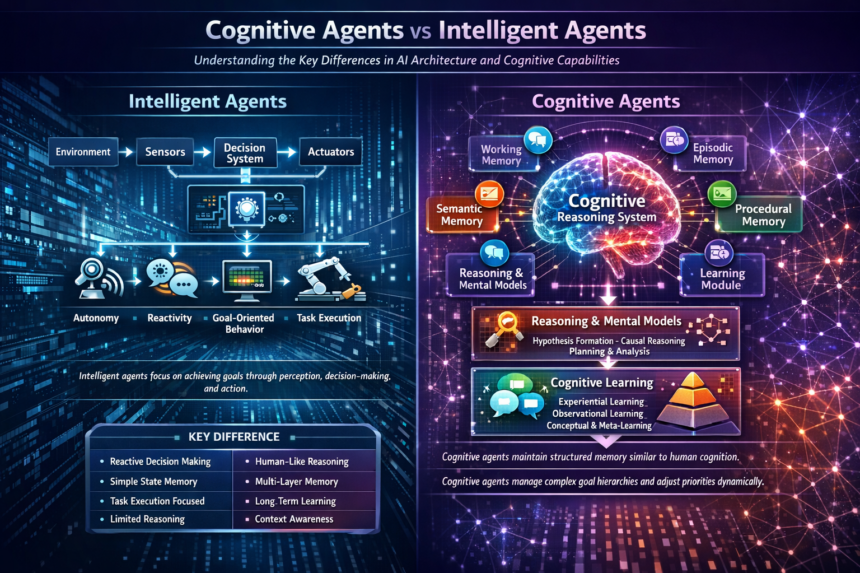
Before we dive into cognitive agents, let’s establish a baseline. An intelligent agent is any system that perceives its environment through sensors, processes that information, and takes actions through actuators to achieve specific goals.
The key characteristics of intelligent agents include:
- Autonomy: Operating independently without constant human intervention
- Reactivity: Responding to environmental changes in real-time
- Proactivity: Taking initiative to achieve goals, not just reacting to stimuli
- Social ability: Interacting with other agents or humans when necessary
We’ve covered this extensively in our guide on what intelligent agents are and how they work , but the essential point is this: intelligent agents are defined by their behaviour and capabilities, not by how they achieve those capabilities.
An intelligent agent could use:
- Simple rule-based logic
- Statistical machine learning models
- Deep neural networks
- Symbolic reasoning systems
- Or any combination of these approaches
The “intelligence” comes from the agent’s ability to achieve goals in complex, dynamic environments and regardless of the underlying mechanism. This is why we can have different types of intelligent agents ranging from simple reflex agents to sophisticated learning agents, all falling under the same conceptual umbrella.
What Are Cognitive Agents? Understanding the Cognitive Layer
Cognitive agents represent a specific subset of intelligent agents that incorporate human-like cognitive processes into their architecture. They don’t just perceive and act and they think, remember, reason, and learn in ways that mirror human cognition.
The Defining Characteristics of Cognitive Agents
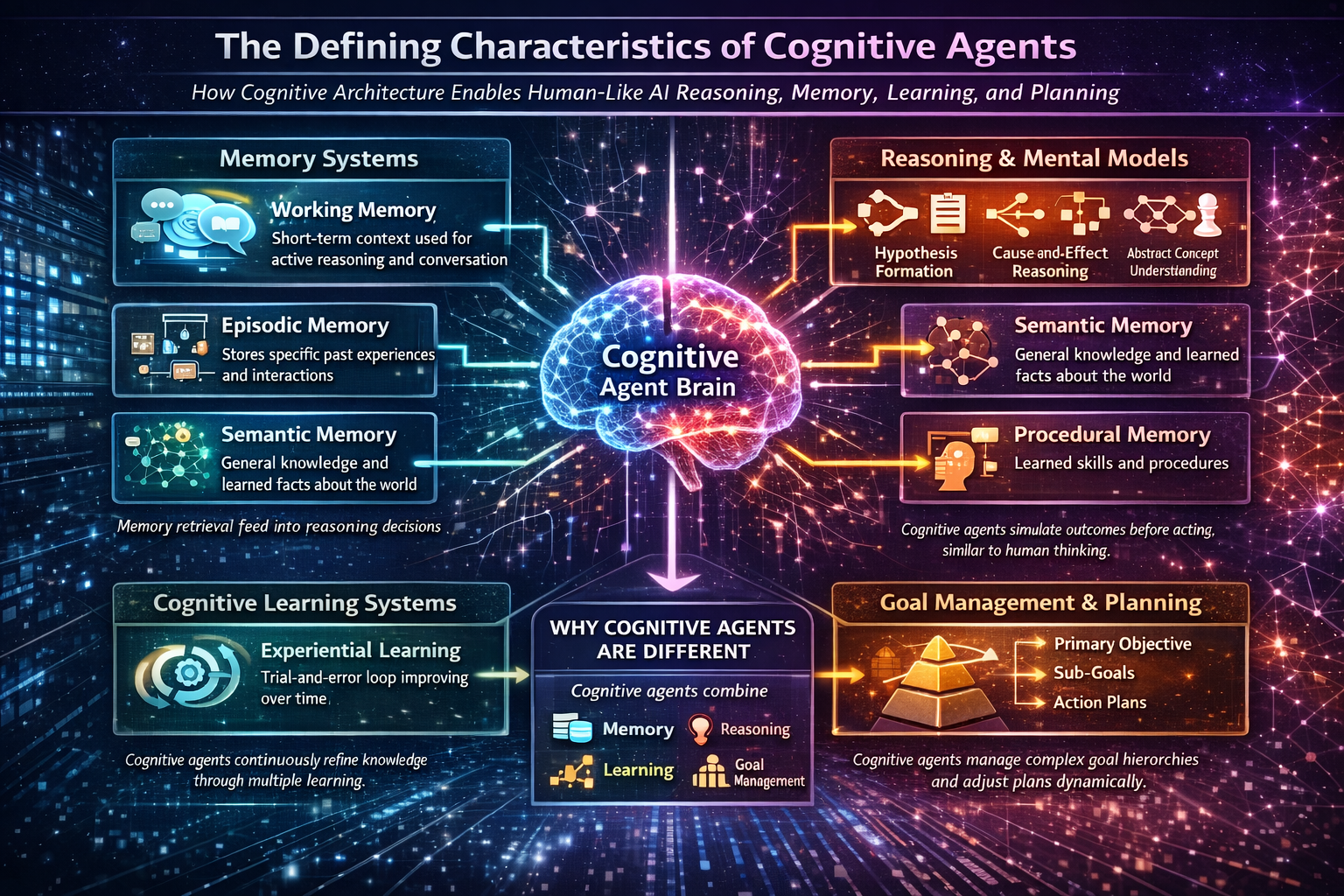
What sets cognitive agents apart is their cognitive architecture and the internal structure that enables human-like mental processes:
- Memory Systems
Cognitive agents maintain multiple types of memory, similar to human cognition:
- Working Memory: Short-term context for current tasks (like keeping track of a conversation)
- Episodic Memory: Specific experiences and events (“I encountered this error pattern last Tuesday”)
- Semantic Memory: General knowledge and facts (“Python uses zero-based indexing”)
- Procedural Memory: Skills and procedures (“How to debug a memory leak”)
This multi-layered memory architecture enables cognitive agents to maintain context across long interactions, recall relevant past experiences, and apply learned procedures—capabilities that go beyond simple data retrieval.
- Reasoning and Mental Models
Cognitive agents build and maintain internal models of their environment, other agents, and even themselves. They don’t just react to inputs; they:
- Form hypotheses about cause and effect
- Simulate potential outcomes before acting
- Understand abstract concepts and relationships
- Apply analogical reasoning to novel situations
- Learning and Adaptation
While many intelligent agents can learn, cognitive agents specifically employ learning mechanisms inspired by human cognition:
- Experiential learning: Improving through trial and error
- Observational learning: Acquiring knowledge by watching others
- Conceptual learning: Forming abstract categories and generalizations
- Meta-learning: Learning how to learn more effectively
- Goal Management and Planning
Cognitive agents don’t just pursue single objectives and they manage complex goal hierarchies, resolve conflicts between competing goals, and dynamically adjust priorities based on context.
This sophisticated goal management is what we explored in our guide on goal-based, utility-based, and learning agents , but cognitive agents take it further by incorporating metacognitive awareness—they can reason about their own reasoning process.
Cognitive Architecture in AI: The Building Blocks
To truly understand cognitive agents, we need to examine cognitive architecture in AI and the structural framework that enables cognitive processes.
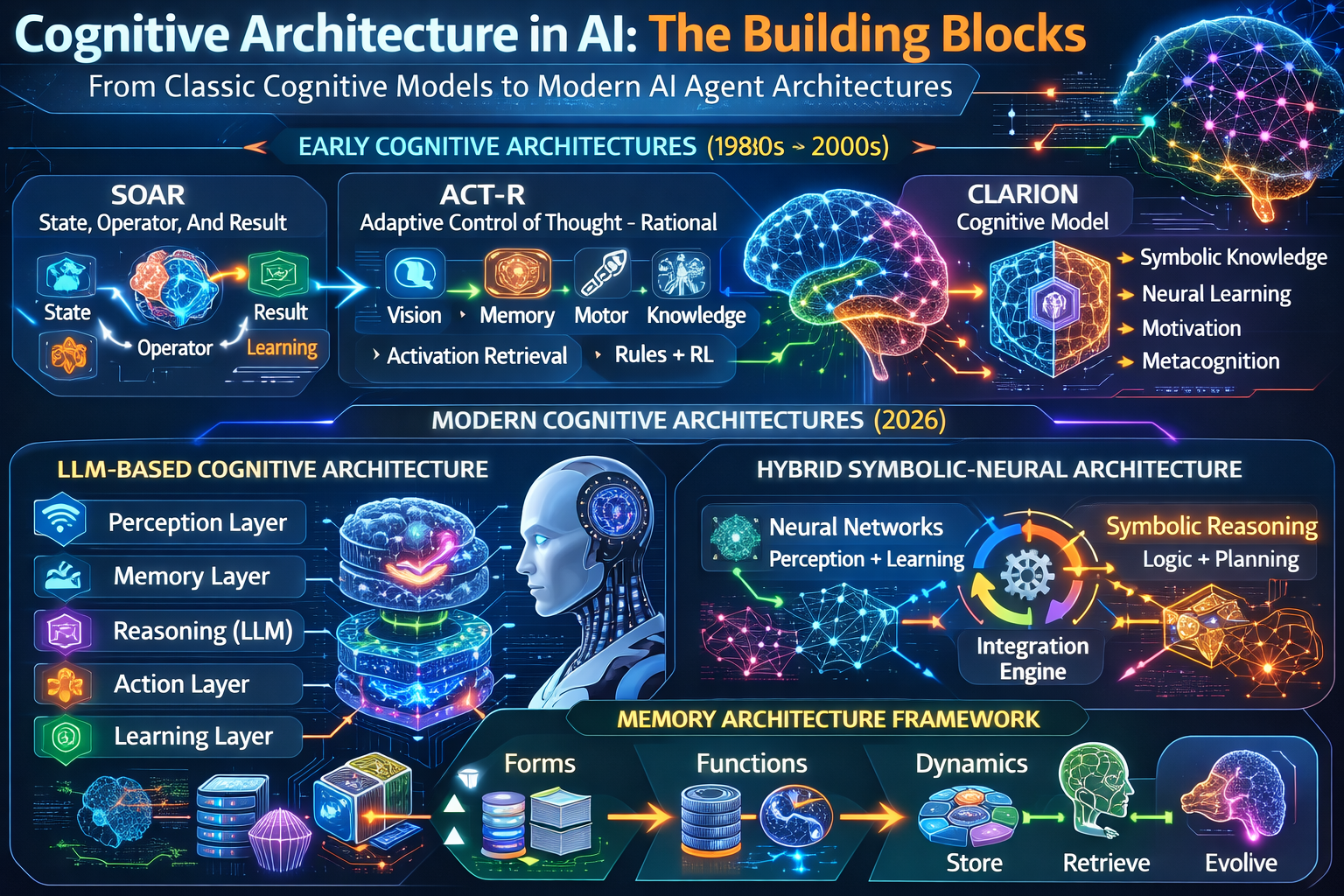
Classic Cognitive Architectures
Several established cognitive architectures have influenced modern AI agent design:
SOAR (State, Operator, And Result)
Developed in the 1980s, SOAR models human problem-solving through:
- A unified memory system
- Production rules for decision-making
- Chunking mechanisms for learning
- Impasse-driven subgoaling
ACT-R (Adaptive Control of Thought – Rational)
ACT-R focuses on modelling human cognitive processes with:
- Separate modules for different cognitive functions (vision, motor, declarative memory)
- Activation-based memory retrieval
- Production rules for procedural knowledge
- Learning through practice and reinforcement
CLARION (Connectionist Learning with Adaptive Rule Induction On-line)
CLARION combines:
- Implicit (subsymbolic) and explicit (symbolic) knowledge
- Bottom-up and top-down learning
- Motivation and metacognitive processes
Modern Cognitive Architectures for AI Agents
In 2026, cognitive architectures have evolved to leverage modern AI capabilities:
LLM-Based Cognitive Architectures
Modern cognitive agents often use large language models as their reasoning core, wrapped in cognitive layers:
- Perception Layer: Processes multimodal inputs (text, images, sensor data)
- Memory Layer: Manages short-term context and long-term knowledge storage
- Reasoning Layer: The LLM performs inference, planning, and decision-making
- Action Layer: Executes decisions through tool use and API calls
- Learning Layer: Updates memory and refines strategies based on outcomes
Hybrid Symbolic-Neural Architectures
Combining the strengths of symbolic AI (explicit reasoning, interpretability) with neural networks (pattern recognition, generalization):
- Neural networks handle perception and pattern matching
- Symbolic systems manage logical reasoning and planning
- Integration layers translate between representations
This hybrid approach addresses limitations of pure neural or pure symbolic systems, creating more robust cognitive intelligent systems.
The Forms-Functions-Dynamics Framework
Recent research proposes viewing cognitive agent memory through three dimensions:
Forms: How information is represented
- Token-level (explicit text, structured data)
- Parametric (encoded in model weights)
- Latent (vector embeddings, hidden states)
Functions: What memory does
- Storage and retrieval
- Consolidation and abstraction
- Forgetting and pruning
Dynamics: How memory evolves
- Formation (what gets stored)
- Evolution (how memories change over time)
- Retrieval (how memories are accessed)
This framework provides a systematic way to design memory systems for cognitive agents, ensuring they can handle long-horizon tasks without the “goldfish effect” of forgetting crucial context.
Cognitive Agent vs Intelligent Agent: The Key Differences
Now we can address the core question: What’s the difference between cognitive and intelligent agents?
Conceptual Relationship
Think of it this way: All cognitive agents are intelligent agents, but not all intelligent agents are cognitive agents.
Cognitive agents are a specialized subset that specifically incorporate human-like cognitive processes. It’s similar to how all squares are rectangles, but not all rectangles are squares.
Architectural Differences
| Aspect | Intelligent Agents (General) | Cognitive Agents (Specific) |
|---|---|---|
| Memory | May have simple state storage | Multi-layered memory systems (working, episodic, semantic) |
| Reasoning | Any decision-making approach | Human-like reasoning with mental models |
| Learning | Optional; various methods | Cognitive learning mechanisms (experiential, observational) |
| Self-Awareness | Not required | Metacognitive capabilities |
| Goal Management | Single or multiple goals | Complex goal hierarchies with conflict resolution |
| Adaptability | May be fixed or adaptive | Continuous adaptation through cognitive processes |
| Interpretability | Varies widely | Often designed for explainability |
Practical Implementation Differences
Intelligent Agent Example: Simple Reflex Agent
A thermostat is an intelligent agent and it perceives temperature, has a goal (maintain target temperature), and takes action (heating/cooling). But it’s not cognitive. It has no memory of past temperature patterns, no reasoning about why temperature changed, no learning from experience.
Cognitive Agent Example: Personal AI Assistant
A sophisticated personal assistant like those we’re seeing in modern AI agent systems exhibits cognitive characteristics:
- Memory: Remembers your preferences, past conversations, and learned patterns
- Reasoning: Understands context (“When you say ‘the meeting,’ you mean the 3 PM client call”)
- Learning: Adapts to your communication style and priorities over time
- Planning: Breaks down complex requests into multi-step action sequences
- Metacognition: Can explain its reasoning and adjust strategies when approaches fail
The assistant doesn’t just respond to commands and it thinks about how to help you most effectively.
When Does the Distinction Matter?
For developers, understanding this distinction is crucial when:
- Designing System Architecture
If you need human-like reasoning and long-term memory, you’re building a cognitive agent and need appropriate cognitive architecture. If you just need goal-directed behaviour, a simpler intelligent agent architecture may suffice.
- Selecting Frameworks and Tools
Some agentic AI frameworks are optimized for cognitive architectures with built-in memory management and reasoning modules. Others focus on simpler agent patterns.
- Managing Computational Resources
Cognitive agents typically require more computational resources due to their sophisticated memory and reasoning systems. Understanding whether you truly need cognitive capabilities helps optimize resource allocation.
- Setting Realistic Expectations
Calling something a “cognitive agent” implies specific capabilities. If your system doesn’t actually reason, remember, and learn in human-like ways, it’s misleading to use that label.
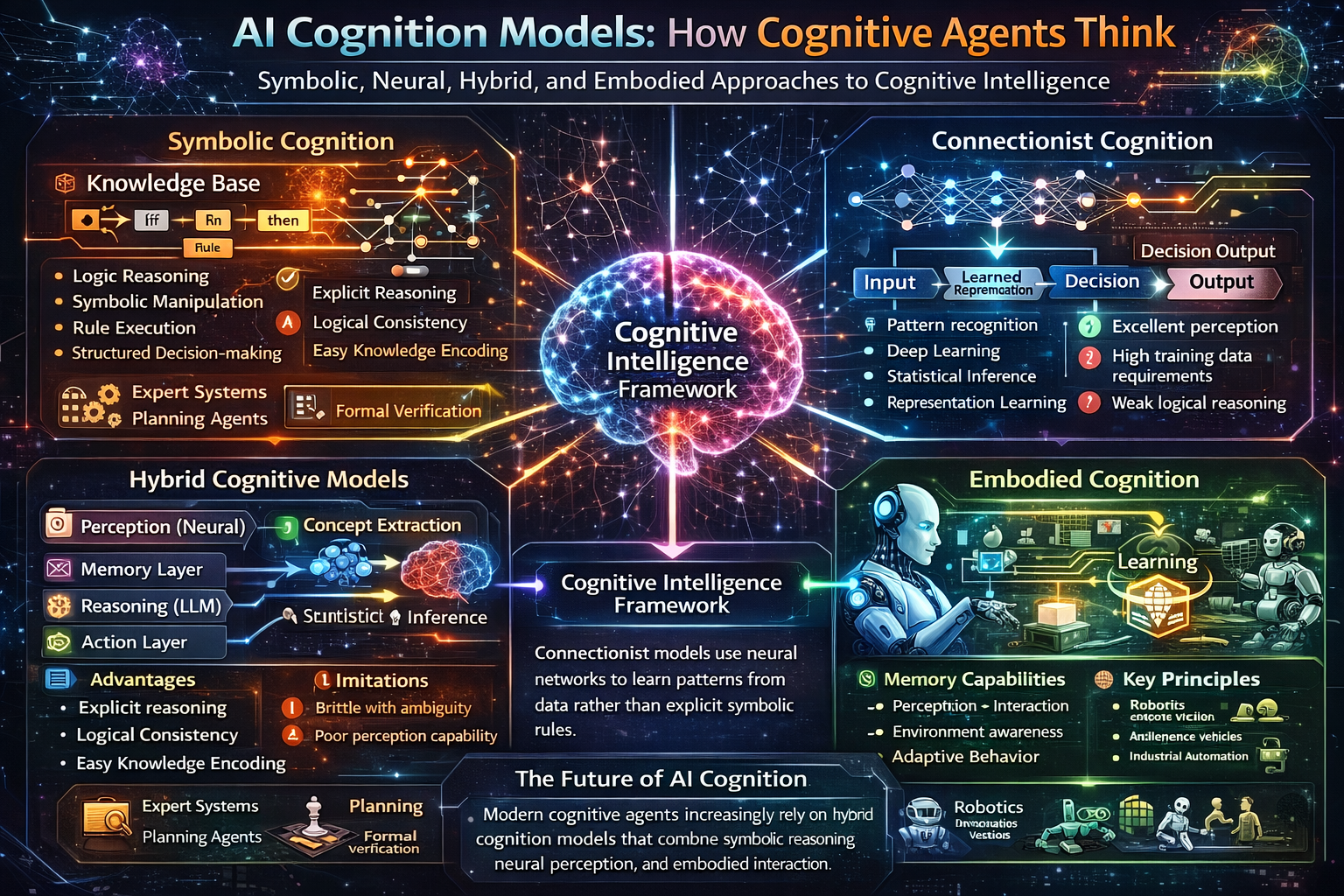
AI Cognition Models: How Cognitive Agents Think
AI cognition models define how cognitive agents process information and make decisions. Understanding these models helps developers implement effective cognitive architectures.
Symbolic Cognition Models
Based on the physical symbol system hypothesis, these models represent knowledge as symbols and manipulate them through logical rules:
Advantages:
- Explicit, interpretable reasoning
- Strong logical consistency
- Easy to encode domain expertise
Limitations:
- Brittle in ambiguous situations
- Difficulty handling uncertainty
- Struggles with perceptual tasks
Use cases: Expert systems, planning agents, formal verification
Connectionist Cognition Models
Neural network-based approaches that learn patterns from data:
Advantages:
- Excellent pattern recognition
- Handles ambiguity and noise well
- Learns from examples without explicit programming
Limitations:
- “Black box” reasoning
- Requires large training datasets
- Difficulty with logical reasoning and planning
Use cases: Perception, natural language understanding, pattern classification
Hybrid Cognition Models
Modern cognitive agents increasingly use hybrid approaches that combine symbolic and connectionist elements:
Neural-Symbolic Integration:
- Neural networks handle perception and pattern matching
- Symbolic systems manage reasoning and planning
- Integration mechanisms translate between representations
Example Architecture:
Perception (Neural) → Concept Extraction (Hybrid) → Reasoning (Symbolic) → Action Planning (Hybrid) → Execution (Neural)
This hybrid approach is becoming standard in enterprise cognitive agents, as it combines the strengths of both paradigms while mitigating their individual weaknesses.
Embodied Cognition Models
These models emphasize that cognition emerges from interaction with the physical environment:
- Perception and action are tightly coupled
- Cognitive processes are shaped by bodily constraints
- Intelligence is situated in environmental context
Cognitive Intelligent Systems: Real-World Applications
Cognitive intelligent systems that incorporate true cognitive architectures are transforming enterprise operations in 2026. Let’s explore practical applications where cognitive capabilities provide clear advantages over simpler intelligent agents.
Enterprise Automation and Decision Support
Cognitive agents in business process automation go beyond simple task execution:
Customer Service Agents:
- Maintain conversation history across multiple interactions
- Understand customer intent through contextual reasoning
- Learn individual customer preferences over time
- Adapt communication style to customer personality
Unlike simple chatbots that treat each interaction independently, cognitive customer service agents remember past issues, understand relationship history, and provide personalized support that improves with each interaction.
Financial Analysis Agents:
- Build mental models of market dynamics
- Reason about causal relationships between events
- Learn from past predictions to improve accuracy
- Explain reasoning behind investment recommendations
These capabilities are essential in applications across finance and other industries , where explainability and contextual understanding are critical.
Healthcare and Medical Diagnosis
Cognitive diagnostic agents exhibit characteristics that simple intelligent agents cannot match:
- Differential diagnosis reasoning: Considering multiple hypotheses simultaneously and updating probabilities as new evidence emerges
- Case-based reasoning: Recalling similar past cases to inform current diagnosis
- Explanation generation: Articulating the reasoning process for medical professionals
- Continuous learning: Incorporating new medical research and clinical outcomes
This mirrors how human physicians think and maintaining differential diagnoses, drawing on experience, and reasoning through uncertainty.
Autonomous Research and Knowledge Work
Cognitive research agents can:
- Formulate research questions based on knowledge gaps
- Design experiments to test hypotheses
- Synthesize findings across multiple sources
- Generate novel insights through analogical reasoning
These agents don’t just retrieve information and they think about information, forming connections and generating new knowledge.
Collaborative Multi-Agent Systems
When multiple cognitive agents work together, their cognitive architectures enable sophisticated collaboration:
- Shared mental models: Agents develop common understanding of goals and environment
- Theory of mind: Agents model other agents’ knowledge and intentions
- Negotiation and conflict resolution: Agents reason about competing objectives and find compromises
- Collective learning: Knowledge gained by one agent benefits the entire system
This level of collaboration requires cognitive capabilities beyond what simpler intelligent agents can achieve.
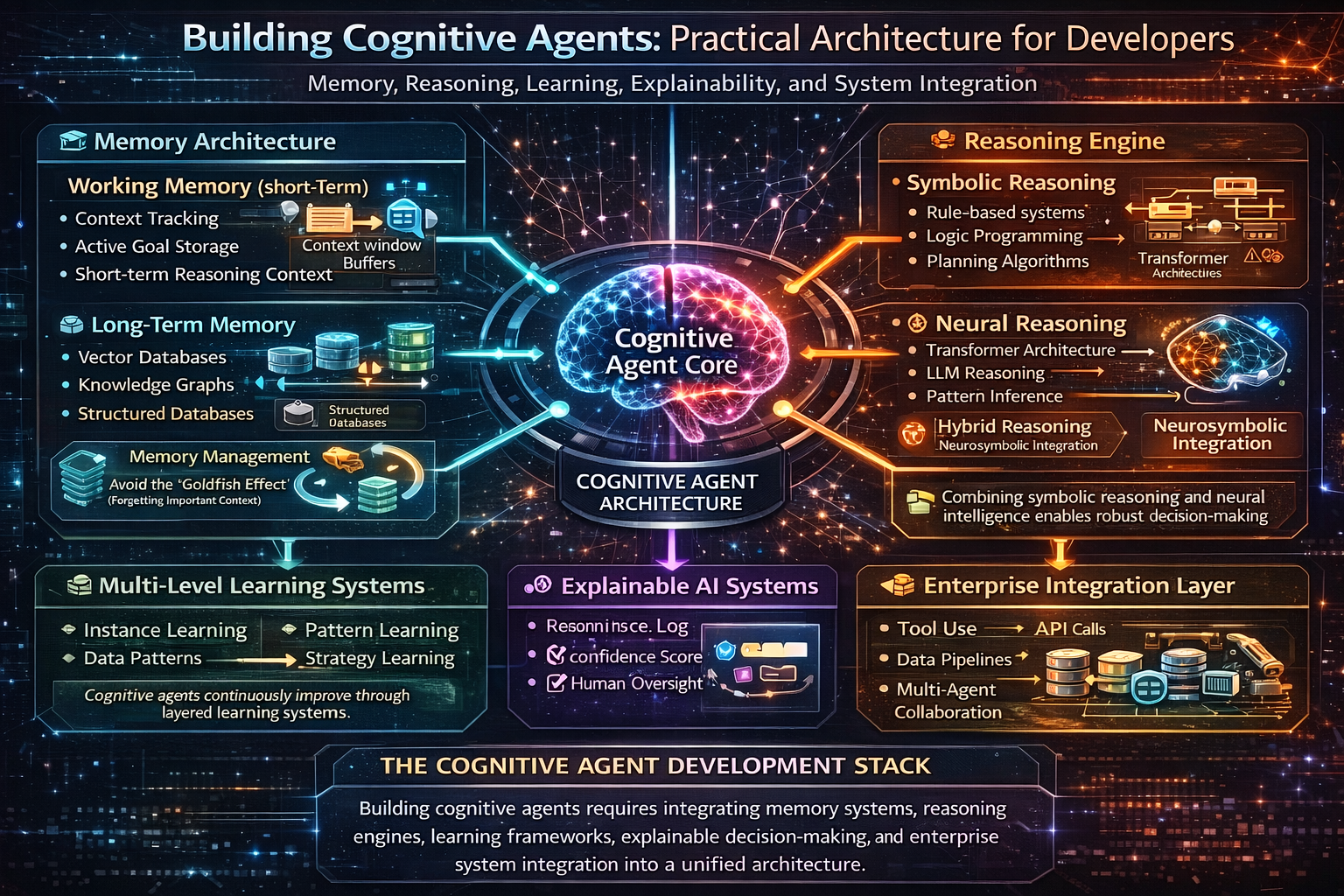
Building Cognitive Agents: Practical Considerations for Developers
If you’re ready to build cognitive agents rather than simpler intelligent agents, here are key considerations:
1. Memory Architecture Design
Cognitive agents require sophisticated memory systems:
Short-term/Working Memory:
- Store current context and active goals
- Implement attention mechanisms to focus on relevant information
- Manage capacity limits (humans have ~7 items in working memory)
Long-term Memory:
- Choose appropriate storage (vector databases, knowledge graphs, relational databases)
- Implement efficient retrieval mechanisms
- Design consolidation processes that move important information from short to long-term storage
- Build forgetting mechanisms to prevent memory bloat
Memory Management:
- Automatic memory formation (what gets stored?)
- Memory evolution (how do memories change over time?)
- Retrieval policies (when and what to recall?)
Without proper memory architecture, your agent will suffer from the “goldfish effect” and forgetting crucial context and repeating mistakes.
2. Reasoning Engine Selection
Choose reasoning approaches based on your domain:
For structured domains with clear rules:
- Symbolic reasoning with logic programming
- Planning algorithms (STRIPS, HTN planning)
- Rule-based expert systems
For ambiguous, data-rich domains:
- Neural reasoning with transformer models
- Probabilistic reasoning with Bayesian networks
- Reinforcement learning for sequential decision-making
For complex domains requiring both:
- Hybrid architectures combining symbolic and neural approaches
- Neurosymbolic integration frameworks
3. Learning Mechanisms
Implement learning at multiple levels:
Instance-level learning: Remember specific experiences
Pattern-level learning: Extract generalizations from multiple instances
Strategy-level learning: Improve problem-solving approaches
Meta-learning: Learn how to learn more effectively
This multi-level learning is what distinguishes cognitive agents from simpler learning agents.
4. Explainability and Transparency
Cognitive agents should be able to explain their reasoning:
- Maintain reasoning traces showing how conclusions were reached
- Generate natural language explanations of decisions
- Provide confidence levels and uncertainty estimates
- Allow humans to inspect and correct internal models
This transparency is crucial for trust and adoption, especially in high-stakes domains like healthcare and finance.
5. Integration with Existing Systems
Cognitive agents need to interact with enterprise infrastructure:
- Data access: Connect to databases, APIs, and knowledge repositories
- Tool use: Execute actions through existing software systems
- Human collaboration: Provide interfaces for human oversight and intervention
- Multi-agent coordination: Communicate with other agents in the ecosystem
For practical frameworks supporting these integrations, see our guide on top agentic AI frameworks in 2026 .
Challenges in Cognitive Agent Development
Building cognitive agents presents unique challenges beyond those of simpler intelligent agents:
1. Computational Complexity
Cognitive processes, maintaining multiple memory systems, performing complex reasoning, managing goal hierarchies, require significant computational resources. Balancing cognitive sophistication with performance is an ongoing challenge.
2. Knowledge Acquisition Bottleneck
Cognitive agents need substantial knowledge to reason effectively. Acquiring, structuring, and maintaining this knowledge remains difficult, especially in specialized domains.
3. Brittleness and Robustness
Despite their sophistication, cognitive agents can fail in unexpected ways when encountering situations outside their training or knowledge base. Building robust cognitive systems that gracefully handle uncertainty is challenging.
4. Evaluation and Benchmarking
How do you measure whether an agent is truly “cognitive”? Standard benchmarks often fail to capture cognitive capabilities like long-term memory, contextual reasoning, and metacognition. Developers need better evaluation frameworks.
5. Ethical and Safety Considerations
Cognitive agents that reason, remember, and learn raise unique ethical questions:
- Privacy concerns around long-term memory of personal information
- Bias in reasoning and decision-making
- Accountability when cognitive agents make mistakes
- Transparency in complex reasoning processes
These challenges require careful consideration during design and deployment.
The Future of Cognitive Agents in 2026 and Beyond
As we progress through 2026, several trends are shaping the evolution of cognitive agents:
1. From Retrieval to Generative Memory
Rather than simply retrieving stored memories, future cognitive agents will generate likely memories based on compressed latent representations and more like human memory reconstruction than database queries.
2. Autonomous Memory Management
Cognitive agents will manage their own memory systems, deciding what to store, when to consolidate, and what to forget and without manual programming of these processes.
3. Multimodal Cognitive Processing
Cognitive agents will process and reason across text, images, audio, and sensor data in unified cognitive architectures, enabling richer understanding and more sophisticated reasoning.
4. Collective Cognitive Systems
Multiple cognitive agents will share knowledge and reasoning capabilities, creating “hive mind” systems where learning by one agent benefits all and while maintaining appropriate privacy and security boundaries.
5. World Model Integration
Rather than just remembering facts, cognitive agents will maintain running simulations (world models) of their environment, enabling predictive reasoning and counterfactual thinking.
These advances will blur the line between AI and intelligent agents , creating systems with increasingly human-like cognitive capabilities.
Conclusion: Choosing Between Cognitive and Intelligent Agents
So, are cognitive agents and intelligent agents the same? The answer is nuanced: cognitive agents are a specialized type of intelligent agent that incorporates human-like cognitive processes and memory systems, reasoning mechanisms, learning capabilities, and metacognitive awareness.
Understanding the cognitive agent vs intelligent agent distinction helps you make better architectural decisions:
Choose simpler intelligent agents when:
- Tasks are well-defined with clear input-output mappings
- Real-time performance is critical
- Computational resources are limited
- Explainability is less important
- The environment is relatively stable
Choose cognitive agents when:
- Tasks require contextual understanding and memory
- Human-like reasoning and explanation are needed
- Learning and adaptation over time are essential
- Complex goal management is required
- The system must collaborate naturally with humans
The cognitive architecture in AI you select and whether symbolic, connectionist, or hybrid, should align with your domain requirements and available resources.AI cognition models provide the theoretical foundation, but practical success depends on thoughtful implementation that balances sophistication with performance.
As we’ve seen in real-world applications across industries , both cognitive and simpler intelligent agents have their place. The key is matching the agent type to the problem at hand, rather than assuming more cognitive sophistication always equals better results.
For developers building the next generation of AI systems, understanding these distinctions isn’t just theoretical and it’s the foundation for creating agents that truly deliver value. Whether you’re implementing intelligent agents in healthcare, finance, or e-commerce , or exploring real-world intelligent agent examples , clarity about cognitive versus intelligent agents will guide your design decisions.
The future of AI isn’t just about building intelligent systems and it’s about building systems that think, remember, and reason in ways that complement and enhance human cognition. That’s the promise of cognitive agents.
What’s your experience building cognitive agents? Have you encountered situations where cognitive capabilities made a critical difference? Share your insights in the comments below!

Hi, I’m Pragya.
I write about AI tools, digital trends, and emerging technologies in a way that’s simple, practical, and easy to apply. I enjoy exploring new AI platforms, testing their features, and breaking them down into clear guides that actually help people use them confidently.
My focus is not just on writing content, but on creating value. I believe powerful technology should feel accessible, not overwhelming. That’s why I aim to turn complex tools into actionable insights for creators, marketers, and growing online businesses.
I’m constantly learning, researching, and staying updated with the fast-moving AI space so readers always get relevant and useful information.