
If you’ve been following the world of AI lately, you’ve probably come across both terms Artificial intelligence and Intelligent agents often used in the same breath. But what exactly is the relationship between the two? Are they the same thing? Is one a subset of the other? Or are they completely different concepts that just happen to overlap?
- What Is Artificial Intelligence, Really?
- Machine Learning Enables Agents to Learn and Adapt
- From Narrow AI to General AI
- Common Misconceptions About AI and Intelligent Agents
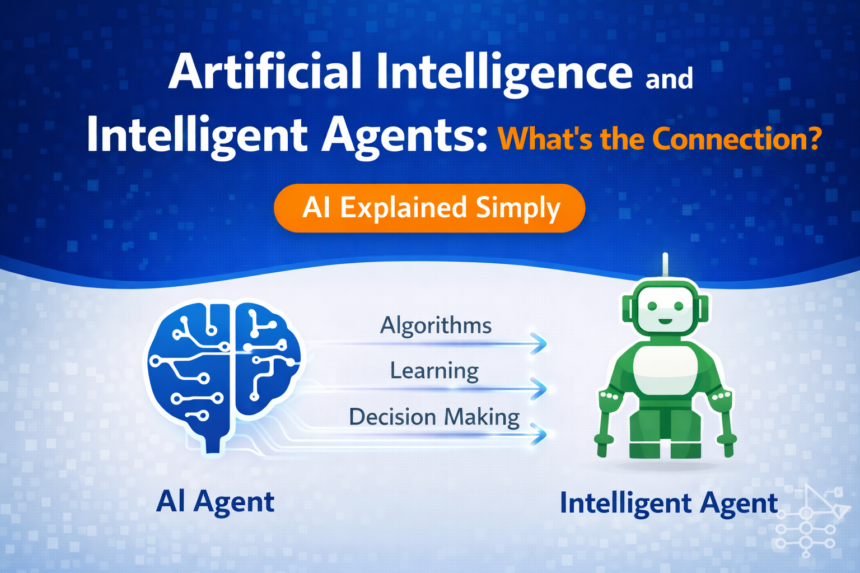
The short answer is this: intelligent agents are how artificial intelligence comes to life in the real world. AI provides the brain, the algorithms, the learning capabilities, the reasoning power while intelligent agents provide the body and the structure through which AI perceives, decides, and acts.
In this article, we’ll unpack this relationship in a clear, straightforward way. Whether you’re a business leader exploring AI adoption, a student learning about AI systems, or simply a curious mind, this guide will help you understand why artificial intelligence and intelligent agents are inseparable concepts in modern technology.
What Is Artificial Intelligence, Really?
Artificial intelligence is a broad field of computer science focused on building machines and systems that can perform tasks that typically require human intelligence. These tasks include reasoning, learning, problem-solving, understanding language, recognizing patterns, and making decisions.
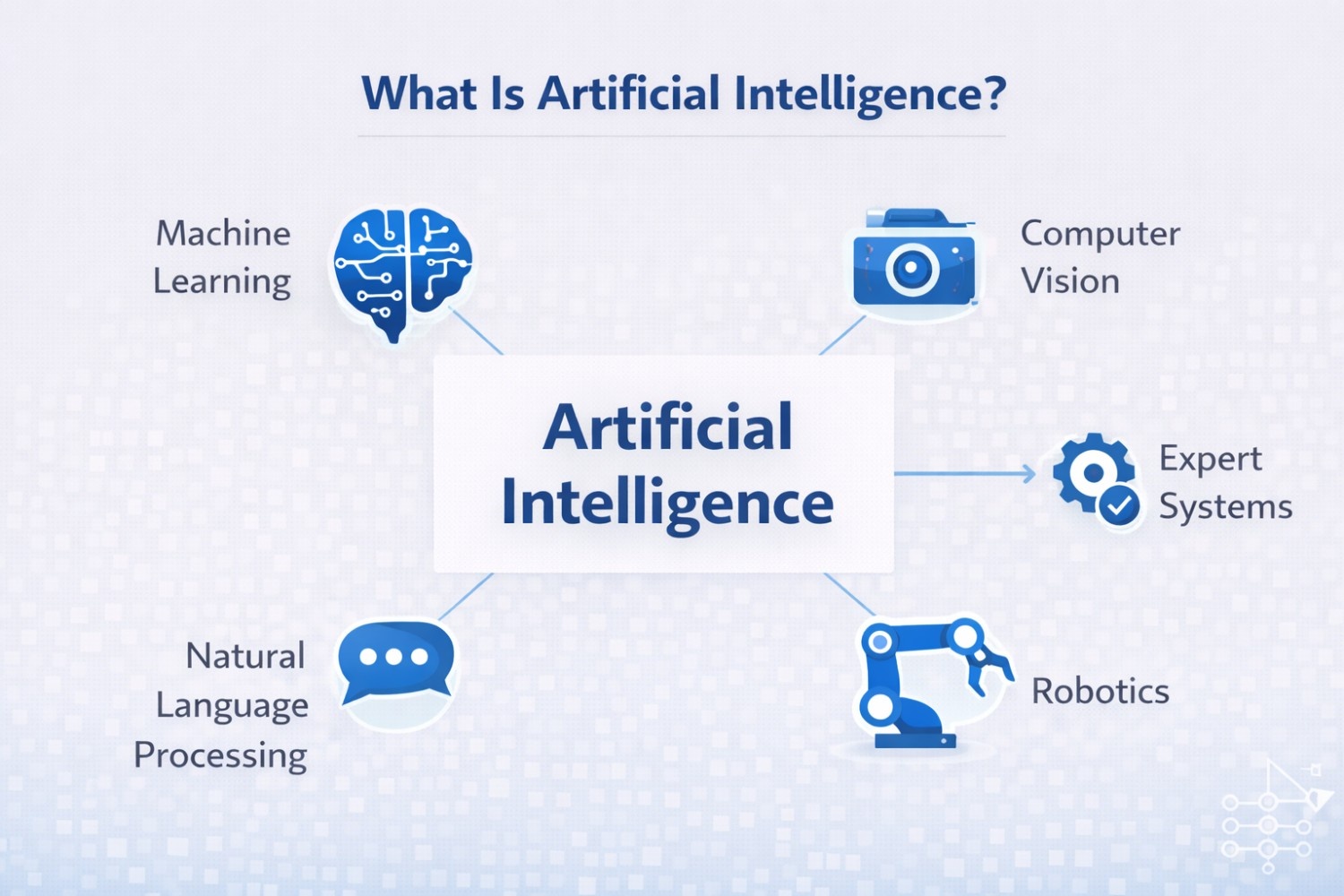
AI is not a single technology, it’s an umbrella term that encompasses many subfields, including:
- Machine Learning (ML) Systems that learn from data
- Natural Language Processing (NLP) Systems that understand and generate human language
- Computer Vision Systems that interpret visual information
- Robotics Systems that interact with the physical world
- Expert Systems Systems that replicate human expertise in specific domains
Each of these subfields contributes tools and techniques that power intelligent behaviour. But here’s the key question: how does all this intelligence get packaged into something that can actually do things in the world? That’s where intelligent agents come in.
What Is an Intelligent Agent in the Context of AI?
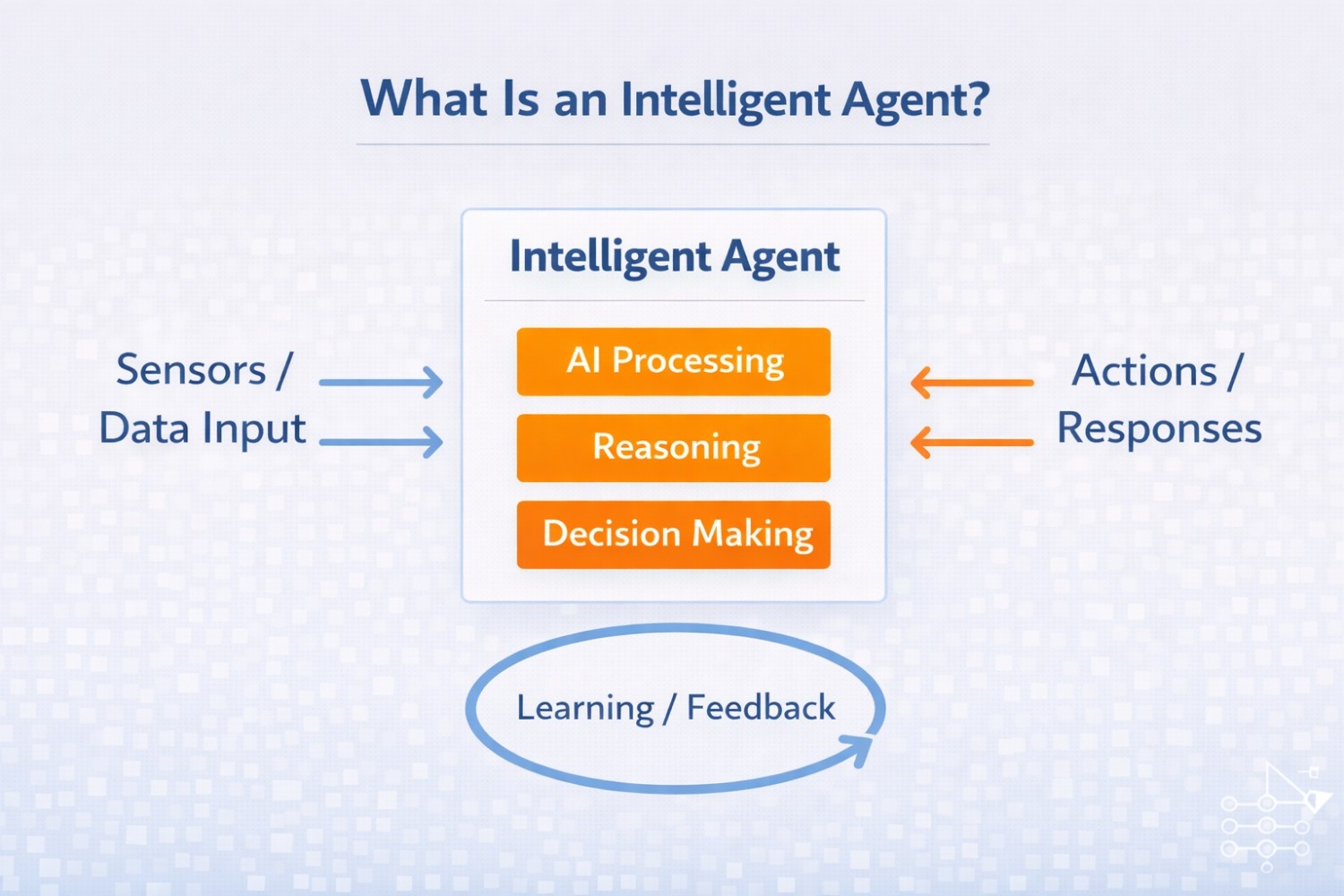
An intelligent agent is any entity, software, robot, or system that perceives its environment through sensors or data inputs, processes that information using AI techniques, and takes actions to achieve specific goals. In essence, an intelligent agent is the operational unit of artificial intelligence.
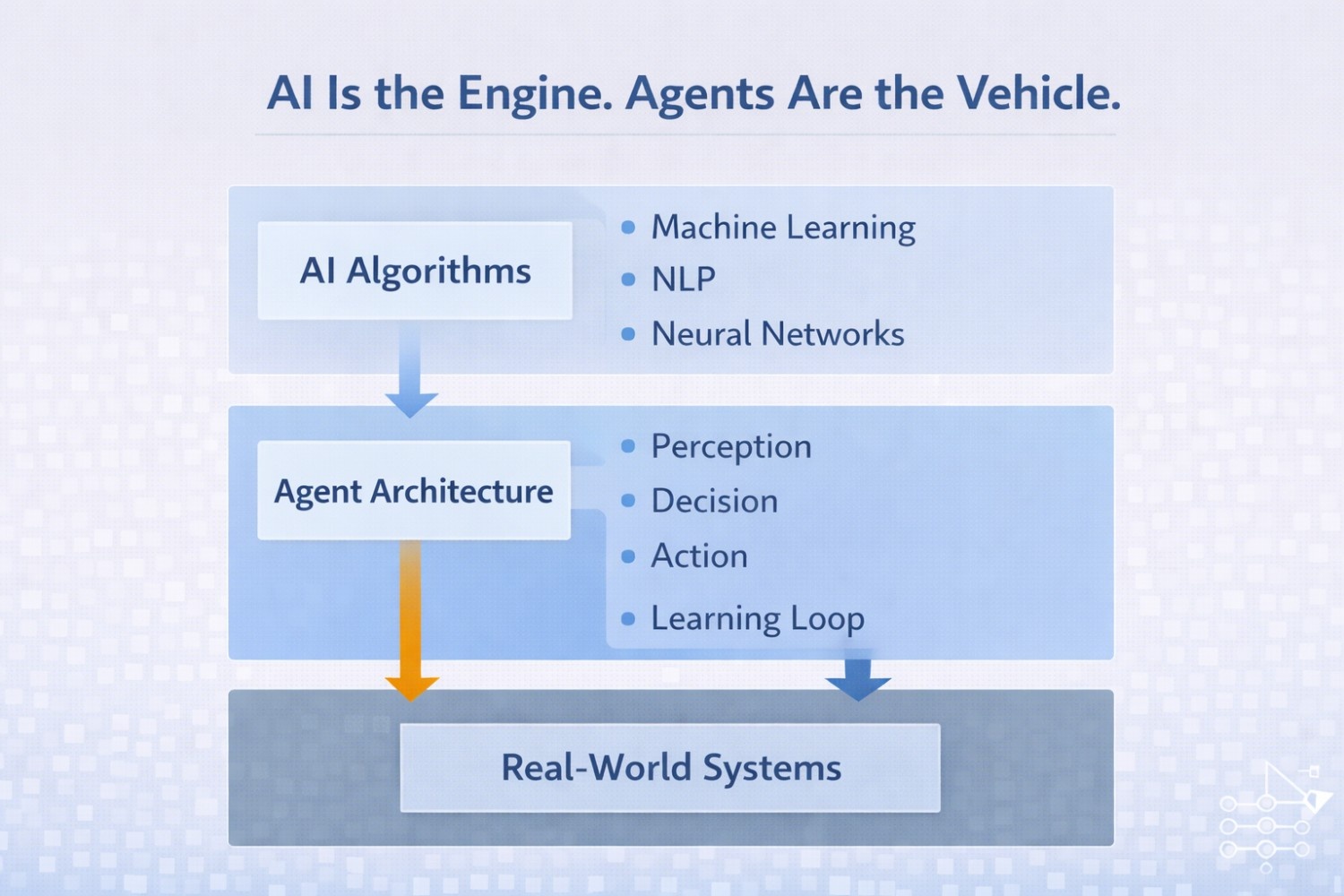
Think of it this way: if AI is the science of creating intelligent behaviour, then an intelligent agent is the vehicle through which that intelligence is expressed and deployed.
The concept of intelligent agents was formally introduced by AI pioneers Stuart Russell and Peter Norvig in their landmark textbook Artificial Intelligence: A Modern Approach, where they defined AI itself in terms of agents, rational agents that perceive and act to maximize their performance. This framing was ground breaking because it gave AI a practical, unified structure for thinking about how intelligent systems should behave.
“An agent is anything that can be viewed as perceiving its environment through sensors and acting upon that environment through actuators.”– Russell & Norvig
This definition placed intelligent agents at the very centre of AI as a discipline, not as a niche application but as the fundamental building block of how AI systems are designed and understood.
The Core Connection: AI Is the Engine, Agents Are the Vehicle
To truly understand the relationship between artificial intelligence and intelligent agents, it helps to think of them in terms of layers:
Layer 1 – AI Techniques and Algorithms
This is the foundation. Machine learning models, neural networks, NLP algorithms, and reasoning engines all live here. These are the tools that give systems the ability to learn, reason, and make decisions.
Layer 2 – The Intelligent Agent Architecture
This is the structure that organizes how AI techniques are applied. An intelligent agent takes AI capabilities and wraps them in a framework that includes:
- Perception How the agent gathers information (sensors, data feeds, user inputs)
- Decision-Making How the agent processes information and chooses actions (using AI algorithms)
- Action How the agent affects its environment (outputs, commands, responses)
- Learning How the agent improves over time (feedback loops, reinforcement learning)
Layer 3 – Real-World Applications
This is where intelligent agents operate in healthcare systems, financial platforms, customer service tools, autonomous vehicles, and more. (We’ve covered these applications in depth in our previous article on real-world applications of intelligent agents .)
Without AI techniques, intelligent agents would be empty shells with no real intelligence. Without the agent framework, AI algorithms would be powerful but directionless, capable of learning and reasoning but with no structured way to perceive the world and take meaningful action.
How AI Technologies Power Intelligent Agent Systems
Different branches of AI contribute specific capabilities to intelligent agent systems. Here’s how they connect:
Machine Learning Enables Agents to Learn and Adapt
Machine learning is arguably the most important AI technology powering modern intelligent agents. Through ML, agents can analyze historical data, identify patterns, and improve their decision-making over time without being explicitly reprogrammed. A customer service agent, for example, uses ML to understand new types of queries it hasn’t encountered before.
Natural Language Processing Enables Agents to Communicate
NLP allows intelligent agents to understand and generate human language, making it possible for them to interact naturally with people. Virtual assistants like Siri, Alexa, and Google Assistant are intelligent agents powered by sophisticated NLP models that interpret spoken or written commands and respond in kind.
Computer Vision Enables Agents to See and Interpret
Computer vision gives intelligent agents the ability to process and understand visual information. Autonomous vehicles use computer vision to identify road signs, pedestrians, and other vehicles. Medical imaging agents use it to detect abnormalities in scans. Without computer vision, these agents would be blind to their environments.
Reinforcement Learning Enables Agents to Optimize Through Experience
Reinforcement learning (RL) is a branch of ML particularly well-suited to intelligent agents. In RL, an agent learns by interacting with its environment, receiving rewards for desirable actions and penalties for undesirable ones. This approach has produced some of the most impressive AI achievements, including DeepMind’s AlphaGo, which mastered the game of Go by playing millions of games against itself.
Knowledge Representation Enables Agents to Reason
AI systems use structured knowledge representations and databases of facts, rules, and relationships and to enable agents to reason about complex situations. Expert systems in healthcare or law use this approach to help agents make informed recommendations based on established knowledge.
Why Intelligent Agents Are Central to the Future of AI
As AI continues to evolve, the intelligent agent framework is becoming increasingly central to how researchers and practitioners think about building AI systems. Here’s why:
From Narrow AI to General AI
Most current AI systems are “narrow” and they excel at specific tasks but cannot generalize across domains. The intelligent agent framework provides a path toward more general AI by creating systems that can perceive diverse environments, set and pursue goals, and learn from a wide range of experiences.
The Rise of Agentic AI
One of the most significant trends in AI today is the emergence of “agentic AI” systems that can autonomously plan and execute complex, multi-step tasks with minimal human intervention. Large language models like GPT-4 are being integrated into agent frameworks that allow them to browse the web, write and execute code, manage files, and interact with external services nd all in pursuit of user-defined goals.
Multi-Agent Systems
Another exciting frontier is multi-agent systems, where multiple intelligent agents collaborate or compete to solve complex problems. These systems mirror how human organizations work — with specialized agents handling different aspects of a problem and coordinating their efforts to achieve shared objectives. From simulating economic markets to coordinating disaster response, multi-agent systems are opening new possibilities for AI applications.
AI Alignment and Safety
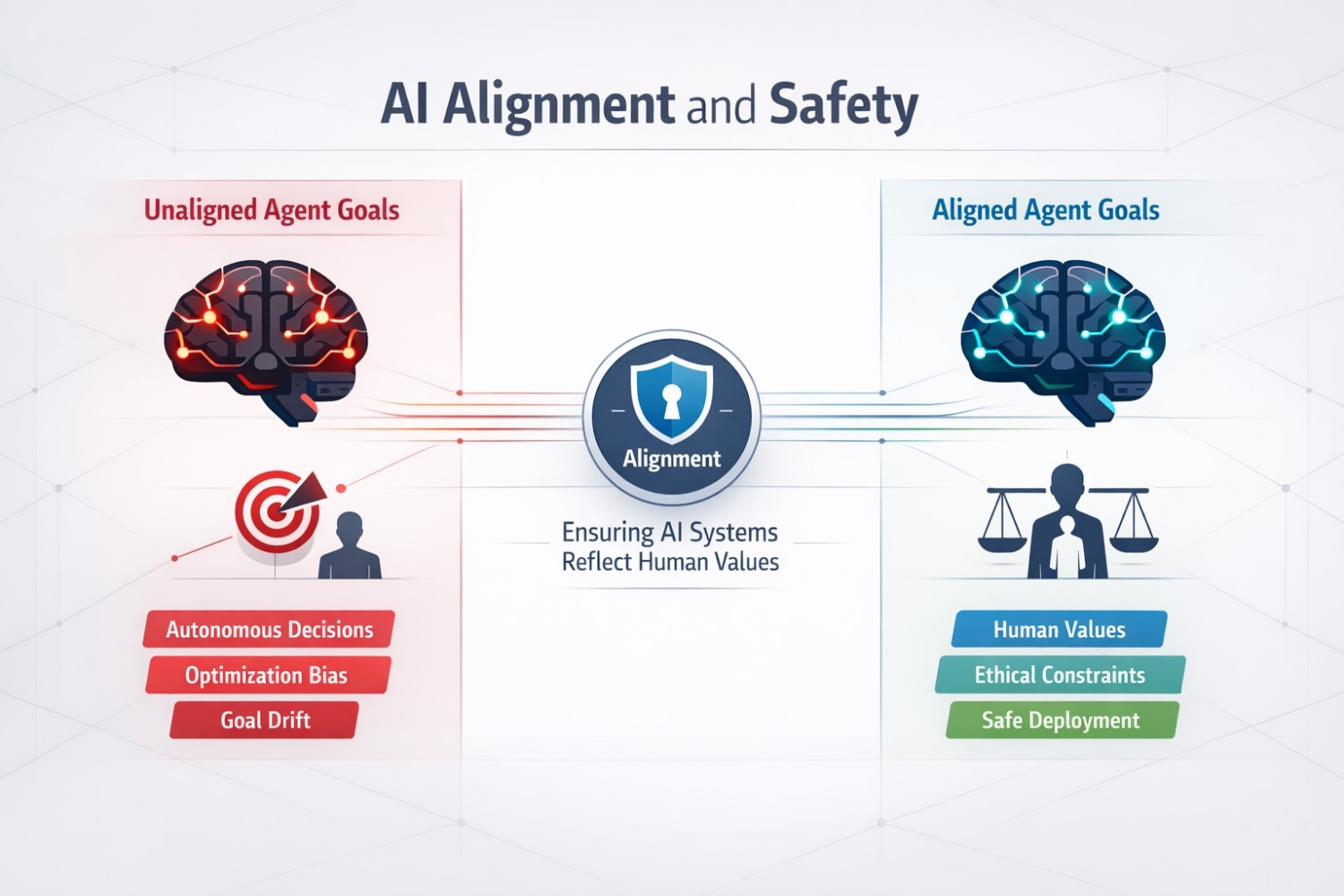
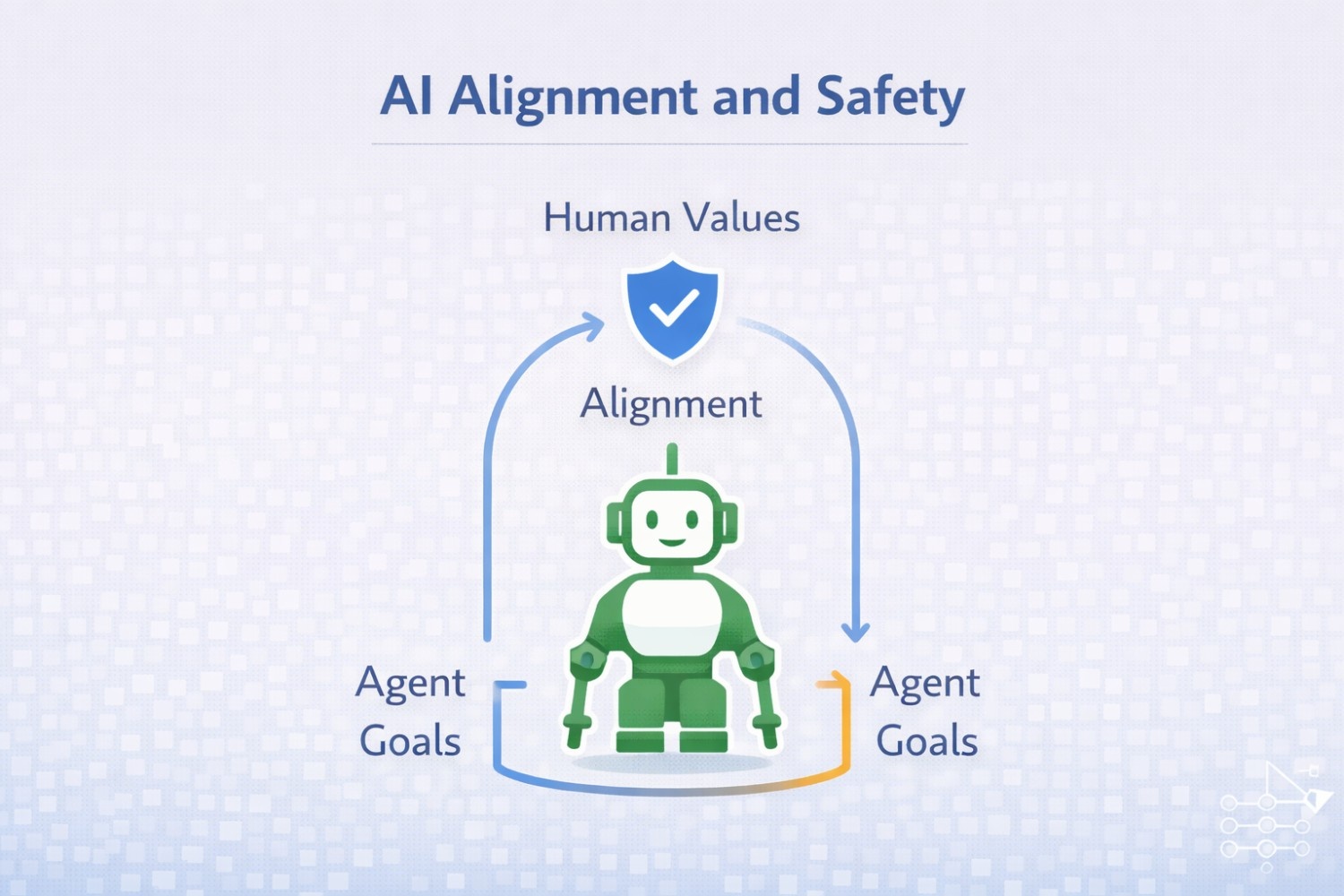
The intelligent agent framework is also central to discussions about AI safety and alignment, ensuring that AI systems behave in ways that are beneficial and aligned with human values. By thinking of AI systems as agents with goals, researchers can more clearly analyze the risks of misaligned objectives and develop strategies to ensure agents pursue goals that are genuinely beneficial.
The Role of Intelligent Agents in Shaping AI Development
Intelligent agents haven’t just been shaped by AI and they’ve actively shaped how AI itself has developed as a field. The agent-based perspective has influenced:
- How AI problems are framed Researchers increasingly define AI challenges in terms of agent behaviour and performance
- How AI systems are evaluated Performance metrics are often defined in terms of how well an agent achieves its goals
- How AI is taught University AI courses around the world use the intelligent agent framework as their primary organizing concept
- How AI is deployed Businesses increasingly think about AI deployment in terms of building and managing agent systems
This bidirectional influence means that understanding intelligent agents is not just useful for understanding AI applications and it’s essential for understanding AI as a discipline.
Common Misconceptions About AI and Intelligent Agents
Misconception 1: “All AI systems are intelligent agents”
Not quite. Some AI systems like a simple image classifier or a recommendation algorithm and don’t operate as full agents because they don’t perceive environments, make autonomous decisions, and take actions in a continuous loop. They’re components that could be part of an agent system, but aren’t agents themselves.
Misconception 2: “Intelligent agents are always robots”
Intelligent agents are far more often software systems than physical robots. A fraud detection system, a virtual assistant, or a trading algorithm are all intelligent agents and none of them have a physical form.
Misconception 3: “Intelligent agents are always autonomous”
The degree of autonomy varies widely. Some agents operate with significant human oversight, while others function almost entirely independently. The level of autonomy is a design choice based on the application’s requirements and risk profile.
Conclusion: Two Concepts, One Vision
Artificial intelligence and intelligent agents are not competing concepts they are deeply intertwined, each giving meaning and purpose to the other. AI provides the intelligence; agents provide the structure through which that intelligence is applied to real-world problems.
As AI technology continues to advance, the intelligent agent framework will only become more important. From autonomous systems that manage complex business operations to collaborative multi-agent networks that tackle global challenges, the future of AI is fundamentally an agentic one.
Understanding this connection is not just an academic exercise it’s a practical foundation for anyone looking to harness the power of AI in their organization or career. The more clearly you understand how AI and intelligent agents work together, the better positioned you’ll be to leverage these technologies effectively.
Want to explore more about how intelligent agents work in practice? Check out our more Blog to see these concepts in action.

Hi, I’m Pragya.
I write about AI tools, digital trends, and emerging technologies in a way that’s simple, practical, and easy to apply. I enjoy exploring new AI platforms, testing their features, and breaking them down into clear guides that actually help people use them confidently.
My focus is not just on writing content, but on creating value. I believe powerful technology should feel accessible, not overwhelming. That’s why I aim to turn complex tools into actionable insights for creators, marketers, and growing online businesses.
I’m constantly learning, researching, and staying updated with the fast-moving AI space so readers always get relevant and useful information.