
If you are using Customer Relationship Management Software to manage your business, then it must be the backbone of every sales call, follow-up, and deal closure. Businesses that have worked with Zoho Consulting Services know how the right CRM setup can either accelerate growth or quietly hold a team back.
- What is a Cloud-Based CRM?
- Why Is On-Premise CRM Starting to Show Its Age?
- 1. Limited Integration Capabilities
- 2. High Total Cost of Ownership (TCO)
- 3. Infrastructure Dependency
- 4. Upgrade Complexity
- How Cloud-Based Architecture Drives Performance
- How Cloud-Based CRM Changes the Whole Game
- 1. Lean and Flexible Pricing Model
- 2. Enterprise Mobility & Omni Channel Support
- 3. Seamless Integration Across the System
- 4. Scaling Feels Natural
- 5. Data Security
- Cost Model: CAPEX vs OPEX
- Top Cloud-Based CRM Software
- 1. Zoho CRM Plus
- 2. Salesforce CRM
- 3. Hubspot CRM
- 4. Freshworks CRM
- 5. Microsoft Dynamics 365
- 6. BIGContacts
- What to Look for in a Cloud Based CRM?
- Ready to Move to a CRM That Works for Your Business
Now, imagine what if that backbone is going down for two to three days, even for hours, because of the server issue, or your IT team member is waiting days or weeks to get access because the setup is too complicated.
In these cases, CRM stops being a support system and starts holding the businesses back. This is where the difference between on-premises and cloud-based CRM becomes clear.
In 2025, cloud CRMs dominate the market, accounting for 80% of all CRM sales, with 60% of businesses actively preferring them.
In 2026, businesses need to move forward with a Cloud-Based CRM that works powerfully and efficiently in the background while your team stays focused on what actually matters.
What is a Cloud-Based CRM?
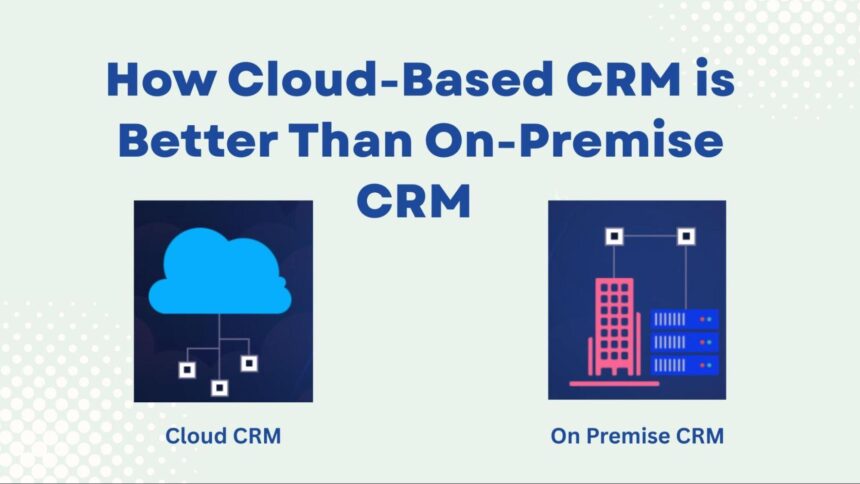
A Cloud-Based CRM is a customer relationship management system that operates on multi-tenant or single-tenant architecture hosted on remote servers. You don’t have to install and maintain software on your own; you can access it from any device, anywhere, and at any time through a browser or app.
Your team can access everything they need, from managing contacts and sales pipelines to customer support and reporting, in real time, without being tied to a specific machine or office. The vendor is in charge of the infrastructure, updates, and security. You just sign in and get to work. It sounds easy because it is. And that is where the value really starts.
Why Is On-Premise CRM Starting to Show Its Age?
When it was first designed, on-premise CRM made very much sense in its time. But nowadays, businesses work very differently from how they did years ago, and on-premises CRM systems were not built to keep up with the speed.
1. Limited Integration Capabilities
Most legacy systems use point-to-point integration, which is harder to scale and maintain. Many on-premises systems don’t have a modern API-first ecosystem built-in.
2. High Total Cost of Ownership (TCO)
The long-term cost comes from the following, while the initial licensing costs are high:
- Managing security
- IT personnel dependency
- Upgrade cycles
- Infrastructure maintenance
3. Infrastructure Dependency
Setting up an on-premises deployment requires special hardware, database management, planning for disasters, and network setup.
4. Upgrade Complexity
System upgrades usually mean downtime, regression testing, and making sure that custom modules still work with the new version. This makes versions split up and slows down new ideas.
How Cloud-Based Architecture Drives Performance
The way cloud CRM systems are built inside is what makes them work well.
Most platforms use a microservices architecture, which means that different functions run as separate services. This means that if one part fails, the whole system doesn’t fail.
They also work on a distributed infrastructure, which means that data and apps are stored in different places. If one server goes down, another one takes over with as little trouble as possible.
Load balancing makes sure that user requests are spread out evenly, which stops the system from getting too busy when a lot of people are using it.
Data replication is another important thing to think about. Cloud systems keep several copies of data in different places. This makes things more available and helps users in different places get to things faster.
How Cloud-Based CRM Changes the Whole Game
1. Lean and Flexible Pricing Model
Cloud-based CRM follows a subscription-based, pay-as-you-go model, which allows businesses to only pay for the number of users or features they need.
This helps in removing the need for huge upfront investment for licenses, and as the business grows, CRM can also scale without requiring major infrastructure changes.
2. Enterprise Mobility & Omni Channel Support
Cloud-based CRM is designed for how businesses work at present. It allows users to access the CRM from anywhere through tablets, mobile devices, or desktops without any setup dependency.
It brings multiple channel systems into one single system where live chat, calls, emails, social media interaction, and other messaging platforms can be tracked within the CRM.
3. Seamless Integration Across the System
Cloud-based CRM platforms are built with integration in mind. Most systems follow an API-first approach, which allows them to integrate easily with other tools.
Many platforms also offer pre-built integrations, which eliminates the need for custom development and helps in faster setup.
Some integrations include:
- Customer support tools
- Marketing automation platforms
- Accounting and billing software
- E-commerce systems
- Communication platforms
4. Scaling Feels Natural
As your business grows, it is very important for the CRM system you are using to grow with it, too. With Cloud-Based CRM, it is always easy to add a new module, change workflows, add new users, update permissions, etc.
This helps in speeding up without interrupting the business processes, your team picks up the system faster, complains less, and gets to work sooner when change management is this easy. It gets easier to train as resistance goes down and results come faster.
5. Data Security
Every business asks about security before moving to the other cloud, and it’s very normal. Best Cloud-Based CRM companies spend more on security than most businesses can afford to do on their own.
Below are the technical layers included:
- Role-based access control (RBAC) for users
- Encrypted at rest and in transit
- Automated backups
- Penetration testing
- Multi-factor authentication (MFA)
Cost Model: CAPEX vs OPEX
| Aspect | On-Premises CRM | Cloud-Based CRM |
|---|---|---|
| Initial Investment | High | Low |
| Maintenance | Internal | Vendor management |
| Cost Type | Capital Expenditure (CAPEX) | Operational Expenditure (OPEX) |
| Scaling Cost | High and slow | Flexible and incremental |
Top Cloud-Based CRM Software
1. Zoho CRM Plus
- Unified sales, marketing, customer service, analytics, etc.
- AI feature (Zia) for strong & advanced automation.
- Affordable compared to other tools.
- Flexible & made for growing businesses.
2. Salesforce CRM
- Large-scale API ecosystem with integration.
- Centralized data model for connected sales, marketing, services, etc.
- AI layer (Einstein) embedded into the system.
- Ideal for large-scale businesses with multiple teams.
3. Hubspot CRM
- Suitable for startups and small to mid-sized teams.
- Built-in automation for smarter work.
- Simple and easy-to-use interface.
- Shared data across sales, marketing, service, etc.
4. Freshworks CRM
- Modern interface with built-in features.
- Easy setup with minimal technicality.
- AI-driven insights for lead scoring.
- Works well for mid-sized companies.
5. Microsoft Dynamics 365
- Built on unified data connecting CRM & ERP
- Deep integration with Teams, Outlook, etc.
- Ideal for companies already using the Microsoft ecosystem.
- Strong reporting and analytics capabilities.
6. BIGContacts
- Centralized contact management with complete history of interactions, notes, and activities.
- Built-in email integration to track conversations and automate follow-ups.
- Task and pipeline tracking to manage deals and stay on top of daily activities.
- Cloud-based access, allowing teams to work from anywhere without setup or infrastructure.
What to Look for in a Cloud Based CRM?
Always evaluate your requirements first, as it is necessary to know what you want from the system. Many businesses explore a professional Zoho Implementation Partner to understand CRM platforms better.
Here are some points to consider before buying a CRM:
- Begin with how easy it is to use; if your team doesn’t use a CRM, it’s just an expensive list of contacts. Find a platform with an easy-to-use interface that doesn’t need weeks of training to use.
- Look at the integration ecosystem. Your CRM should work well with the email, marketing, and billing systems you already use.
- Be honest when you look at how scalable it is. Will the platform be able to grow with your business over the next three to five years without having to switch?
- Check the vendor’s security credentials, compliance certifications, and history of uptime.
Ready to Move to a CRM That Works for Your Business
Most businesses now manage customer relationships through cloud-based CRM as it removes the burden of infrastructure, reduces ongoing maintenance, and allows teams to work without interruptions.

Sandeep Kumar is the Founder & CEO of Aitude, a leading AI tools, research, and tutorial platform dedicated to empowering learners, researchers, and innovators. Under his leadership, Aitude has become a go-to resource for those seeking the latest in artificial intelligence, machine learning, computer vision, and development strategies.