

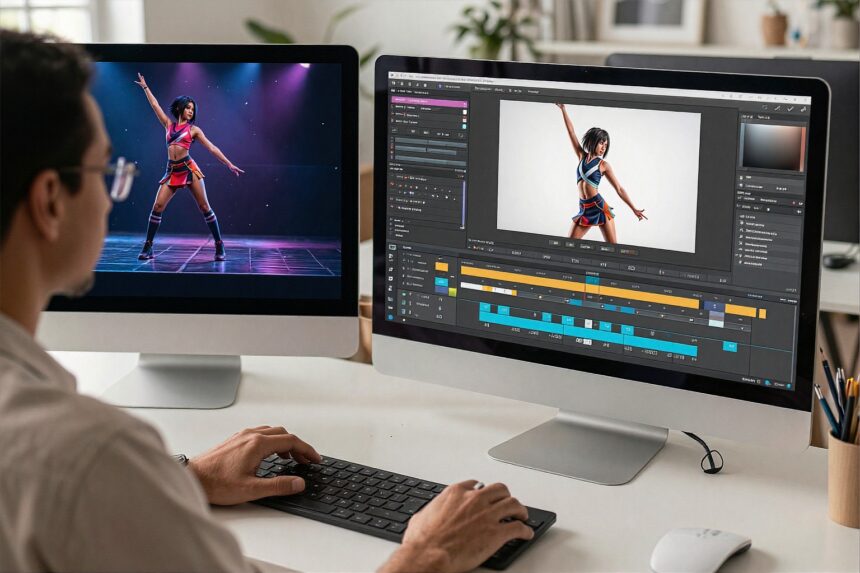
A year ago, I still felt that a lot of AI video demos were built to impress people for five seconds. They looked flashy, but they did not always fit into an actual content workflow. What changed for me in 2026 was simple: I stopped asking whether a tool could generate motion at all, and started asking whether the result was usable enough to post, test, and build on.
That shift is happening across the market. Major AI video platforms are putting more emphasis on controllability, visual fidelity, and creator workflows instead of pure novelty, which tells me the category is maturing. In practice, that means I now care more about motion quality, timing, loopability, and how easily I can turn one short clip into something that feels complete.
When I need to create quick movement from a still character or portrait, I usually start with an AI dance maker. It gives me a faster way to test movement-heavy ideas without building every step from scratch. GoEnhance also offers an effective AI video generator, and in my own workflow it has been one of the easier options for getting motion that looks polished without dragging me into a long edit cycle.
What surprised me, though, is that generation is only half the story now. The real value often comes later, when I decide whether a short clip deserves a second life.
AI Video Feels Different Now Because the Goal Is No Longer Just “Generate Something”
I noticed this change most clearly when I compared how I worked on short-form content six months apart. Earlier, I was happy if a clip looked interesting for a moment. Now I want something I can actually post to a social feed, repurpose into a campaign asset, or extend into a more watchable sequence.
That is not just my impression. AI video companies are openly framing their products around production-ready creation and creative control rather than one-off spectacle. For someone like me, who looks at tools through the lens of publishing and reuse, that matters more than marketing language ever could.
Motion-First Content Still Wins Attention Faster Than Static Visuals
I spend a lot of time looking at what actually stops people from scrolling. Motion still has an advantage, especially when it has rhythm. Dance clips, character movements, looping gestures, and stylized body motion all create a kind of instant readability that static images rarely match.
That is why AI dance content keeps showing up in creator workflows. It is not only about entertainment. I have seen it work for anime-style characters, stylized portraits, mascots, and brand-friendly avatar content. Even when the final output is short, movement gives the content more perceived value.
From my side, the biggest benefit is speed. I can test several directions quickly, see which movement pattern feels natural, and drop the weak ideas before spending too much time on them.
The More Interesting Trend Is What Happens After the First Clip
A lot of AI-generated clips are still short. That is fine for experimentation, but not always enough for posting. Once I started making more content with these tools, I ran into the same problem again and again: the first result was interesting, but it ended too soon.
That is where extension started to matter far more than I expected.
I do not mean extension as a gimmick. I mean the practical ability to improve pacing, give a clip room to breathe, and make it feel less like a test render and more like a finished asset. Broader media coverage around unified AI creation studios reflects this exact market direction: creators want connected workflows, not isolated tricks.
When a short motion clip has real potential, I would rather extend it than recreate the whole thing from zero. In those cases, I look for an AI video extender free workflow so I can evaluate timing and continuity before I commit to a more polished final version.
My Working Pattern Has Become: Generate Motion, Judge Fast, Extend Only What Earns It
This is the approach that has saved me the most time lately.
| Step | What I do | Why it helps |
| Initial concept test | Generate a short motion idea | I can validate whether the concept has energy |
| Motion review | Check body rhythm, facial readability, loop feel | Weak clips are obvious early |
| Selective extension | Extend only the best-performing clip | I avoid overworking mediocre results |
| Final refinement | Trim, post, or adapt for a platform | The content feels intentional |
That workflow sounds simple, but it changed the quality of my output. I stopped treating every generated clip as precious. Instead, I began treating short AI video like a draft stage. Once I did that, extension became useful in a very grounded way.
Better Tools Also Mean I Have to Be More Careful
One thing I cannot ignore this year is the trust issue around AI video. The more believable these outputs become, the more careful I need to be with source material, character likeness, and implied authenticity. Recent disputes around AI video and copyright make that concern hard to dismiss.
I take that seriously in my own process. If I am working from someone’s face, a recognizable style, or a branded visual identity, I think about permission before I think about polish. That is part of using these tools responsibly, and frankly, it is also part of building content that can survive long term without creating unnecessary risk.
What I Actually Take Away From This Shift
The part of AI video that feels most real to me in 2026 is not the wow factor. It is the growing practicality. I can create movement faster, evaluate ideas earlier, and turn a strong short clip into something more usable without rebuilding everything from scratch.
That is why I see dance generation and video extension as a natural pair now. One helps me find motion that works. The other helps me give that motion enough room to become publishable.
For my own workflow, that combination has been far more valuable than any headline about the “future of AI video.” The future is less abstract when a tool helps me make better content today.

Sandeep Kumar is the Founder & CEO of Aitude, a leading AI tools, research, and tutorial platform dedicated to empowering learners, researchers, and innovators. Under his leadership, Aitude has become a go-to resource for those seeking the latest in artificial intelligence, machine learning, computer vision, and development strategies.