
Picture a factory floor where robots don’t just follow pre-programmed instructions and they observe, learn, adapt, and make decisions in real-time. A welding robot detects a material defect mid-operation and automatically adjusts its parameters. A logistics robot reroutes itself when it encounters an unexpected obstacle. A humanoid assistant learns new tasks by watching human workers, then replicates those movements with precision.
- What Are Intelligent Agents in Robotics?
- Robot Agent Architecture: How Intelligence Meets Mechanics
- AI Agents in Industrial Robotics: Transforming Manufacturing
- The Physical AI Revolution
- Real-World Applications in Manufacturing
- The Economics of Robotics AI Agents
- Autonomous Robot Intelligence: Beyond the Factory Floor
- Building Robotics AI Agents: Developer Considerations
- The Future of Intelligent Agents in Robotics
- Humanoid Robots Enter Production
- Agentic AI Ecosystems
- Foundation Models for Robotics
- Edge AI and Distributed Intelligence
- Digital Twins and Virtual Commissioning
- Conclusion
This isn’t science fiction. It’s the reality of intelligent agents in robotics transforming industries in 2026.
While traditional robots execute fixed sequences of commands, modern robotics AI agents bring genuine intelligence to mechanical systems. They perceive their environment through sensors, reason about optimal actions, learn from experience, and autonomously achieve goals and all while operating in the unpredictable, dynamic conditions of real-world environments.
In this comprehensive guide, we’ll explore how intelligent agents are revolutionizing robotics, the architectures that make them work, and the practical applications reshaping manufacturing, logistics, healthcare, and beyond.
What Are Intelligent Agents in Robotics?
Intelligent agents in robotics are AI systems embedded within robotic platforms that enable autonomous perception, decision-making, and action execution. Unlike conventional robots that blindly follow programmed routines, these agents continuously sense their environment, process information, reason about situations, and adapt their behaviour to achieve specific objectives.
The Core Components
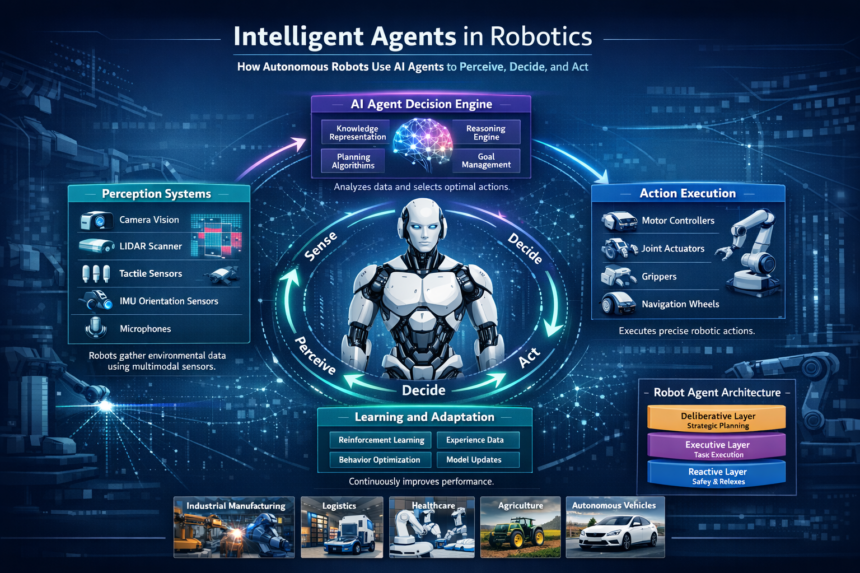
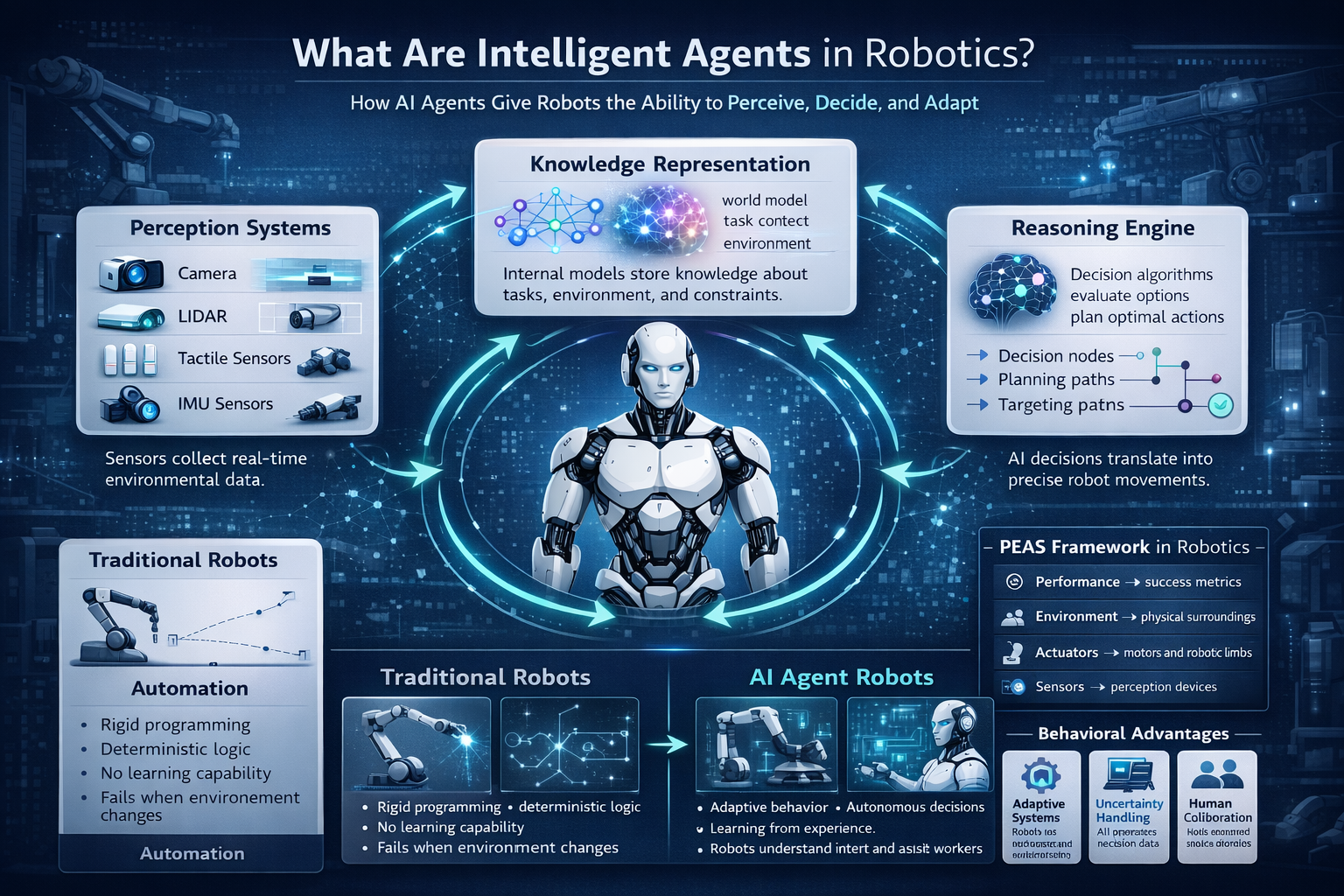
A robotics AI agent typically consists of:
- Perception Systems: Sensors (cameras, LiDAR, tactile sensors, IMUs) that gather environmental data
- Knowledge Representation: Internal models storing information about the world, tasks, and constraints
- Reasoning Engine: Decision-making algorithms that evaluate options and plan actions
- Action Execution: Motor control systems that translate decisions into physical movements
- Learning Mechanisms: Adaptive systems that improve performance through experience
This architecture aligns with the fundamental PEAS framework (Performance, Environment, Actuators, Sensors) that defines how intelligent agents interact with their surroundings.
How They Differ from Traditional Robotics
Traditional industrial robots operate on deterministic programs, if X happens, do Y. They’re incredibly precise but inflexible. Change the environment slightly, and they fail.
Robotics AI agents, by contrast:
- Adapt to variations in materials, lighting, object positions, and environmental conditions
- Handle uncertainty when sensor data is noisy or incomplete
- Learn new skills without complete reprogramming
- Make autonomous decisions when facing novel situations
- Collaborate with humans by understanding intent and context
This shift from automation to autonomy represents one of the most significant advances in robotics history and it’s powered entirely by intelligent agent architectures.
Robot Agent Architecture: How Intelligence Meets Mechanics
Understanding robot agent architecture is crucial for developers building autonomous systems. The architecture determines how robots process information, make decisions, and execute actions in real-time.
Layered Architecture Approach
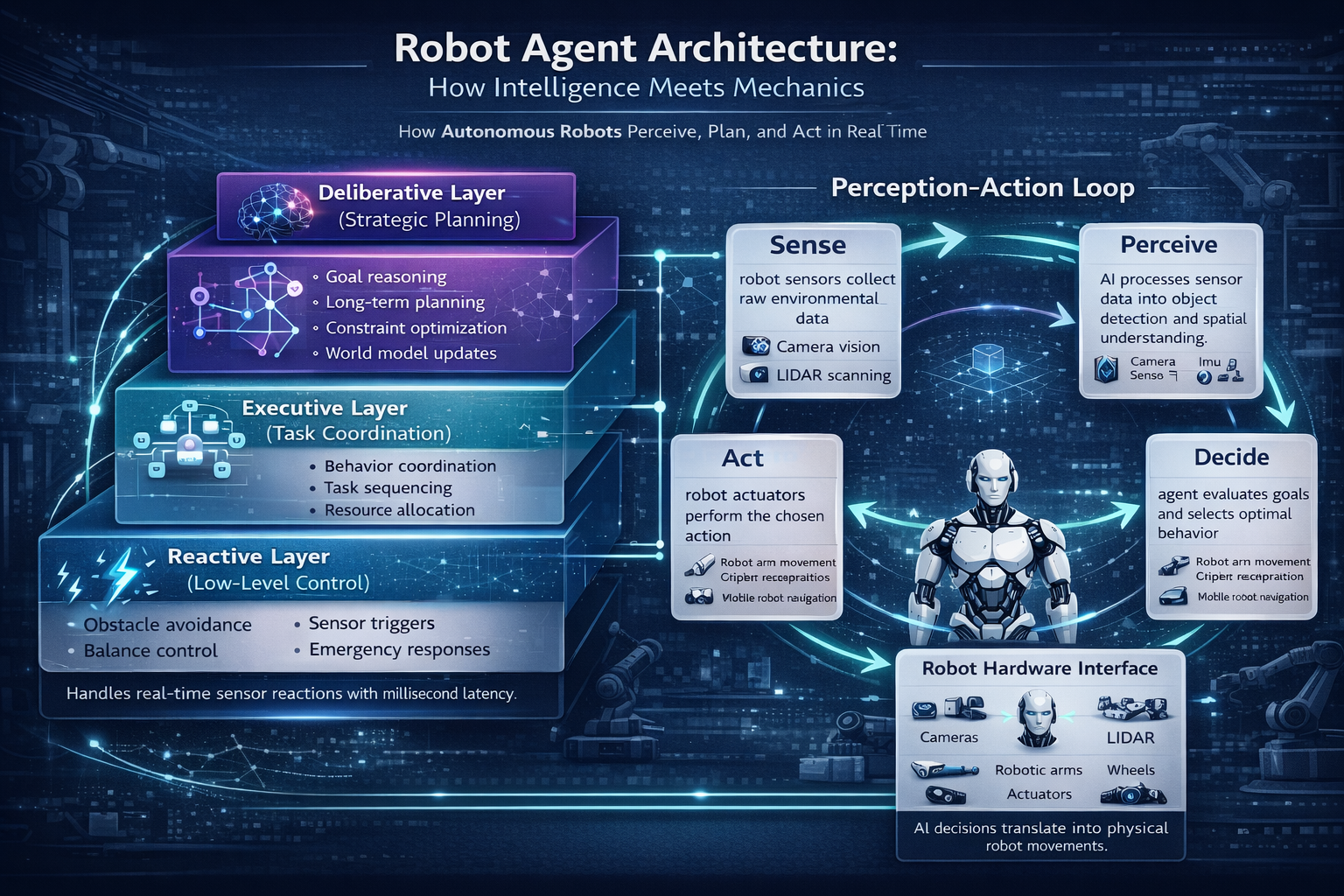
Most modern robotics AI agents implement a hierarchical, layered architecture that balances reactive speed with deliberative intelligence:
- Reactive Layer (Low-Level Control)
- Handles immediate responses to sensor inputs
- Manages collision avoidance, balance, and safety reflexes
- Operates with minimal latency (milliseconds)
- Example: Emergency stop when detecting an obstacle
- Executive Layer (Task Coordination)
- Coordinates multiple behaviours and skills
- Manages task sequencing and resource allocation
- Monitors execution and handles exceptions
- Example: Orchestrating pick-and-place operations
- Deliberative Layer (Strategic Planning)
- Performs long-term planning and optimization
- Reasons about goals, constraints, and trade-offs
- Learns from experience and updates world models
- Example: Planning optimal warehouse navigation routes
This layered approach allows robots to react instantly to critical situations while simultaneously planning complex, multi-step operations and much like how goal-based and utility-based agents balance immediate actions with long-term objectives.
Perception-Action Loop
At the heart of every robotics AI agent is the perception-action loop:
Sense → Perceive → Decide → Act → Learn → Sense…
Sensing: Cameras capture visual data, LiDAR measures distances, force sensors detect contact, IMUs track orientation.
Perception: Raw sensor data is processed into meaningful representations, object recognition, spatial mapping, motion tracking.
Decision: The agent evaluates its current state against goals, considers available actions, and selects optimal behaviours.
Action: Motor controllers execute the chosen actions, moving joints, grippers, wheels, or other actuators.
Learning: The agent observes outcomes, updates its models, and refines future behaviour.
This continuous loop enables robots to operate autonomously in dynamic, unstructured environments and a capability that distinguishes intelligent agents from traditional machine learning systems .
Key Architectural Patterns
Behaviour-Based Architecture
Pioneered by Rodney Brooks at MIT, this approach decomposes complex behaviours into simpler, concurrent sub-behaviours. A mobile robot might simultaneously run behaviours for obstacle avoidance, goal seeking, and battery monitoring, with a coordination mechanism resolving conflicts.
Subsumption Architecture
Lower-level behaviours can “subsume” higher-level ones when necessary. For example, collision avoidance always overrides navigation planning, ensuring safety takes priority.
Hybrid Deliberative/Reactive Systems
Combining planning capabilities with reactive responses, these architectures enable robots to think strategically while responding instantly to emergencies and the dominant approach in modern autonomous systems.
AI Agents in Industrial Robotics: Transforming Manufacturing
AI agents in industrial robotics are revolutionizing manufacturing by bringing unprecedented flexibility, efficiency, and intelligence to production environments.
The Physical AI Revolution
2026 marks a pivotal moment: the transition from research prototypes to production-ready Physical AI systems. According to recent industry analysis, approximately 58% of global manufacturers are already using physical AI in their operations, with that number expected to reach 80% within two years.
Major manufacturers like Samsung Electronics have announced ambitious strategies to transition all manufacturing operations into “AI-Baased Factories” by 2030, deploying specialized AI agents dedicated to quality control, production optimization, and logistics coordination.
Real-World Applications in Manufacturing
Autonomous Welding Systems
Companies like Path Robotics deploy intelligent agents that use computer vision to identify weld joints, adapt to material variations, and optimize welding parameters in real-time and no human programming required for each new part.
Quality Inspection Agents
Vision-based AI agents inspect products at speeds impossible for humans, detecting microscopic defects, measuring tolerances, and making pass/fail decisions with superhuman consistency.
Predictive Maintenance Robots
Equipped with vibration sensors and thermal cameras, these agents continuously monitor equipment health, predict failures before they occur, and autonomously schedule maintenance and minimizing costly downtime.
Collaborative Assembly Robots (Cobots)
Unlike traditional industrial robots confined behind safety cages, cobots work alongside humans. Their intelligent agents understand human intent, adapt to varying skill levels, and handle the repetitive tasks while humans focus on complex problem-solving.
Autonomous Material Handling
Warehouse robots equipped with intelligent agents navigate dynamic environments, optimize picking routes, coordinate with other robots, and adapt to changing inventory layouts and all without central control.
These applications demonstrate how real-world intelligent agent implementations are delivering measurable ROI through increased productivity, reduced errors, and enhanced flexibility.
The Economics of Robotics AI Agents
The business case for intelligent agents in robotics is compelling. Recent analysis shows that a $15,000 humanoid robot can achieve payback in less than 10 weeks when replacing certain human roles, while more sophisticated $35,000 systems break even in approximately 9 weeks for higher-wage positions.
This rapid ROI is driving explosive growth. Industry forecasts predict AI robots will increase from current levels to 1.3 billion units by 2035, eventually exceeding 4 billion by 2050.
Autonomous Robot Intelligence: Beyond the Factory Floor
While manufacturing captures headlines, autonomous robot intelligence is transforming diverse sectors through specialized agent implementations.
Healthcare Robotics
Surgical robots equipped with intelligent agents assist surgeons with superhuman precision, compensating for hand tremors and providing real-time guidance. Rehabilitation robots adapt therapy intensity based on patient progress, while autonomous disinfection robots navigate hospital corridors, optimizing cleaning routes and ensuring comprehensive coverage.
For deeper insights into healthcare applications, explore our guide on intelligent agents in healthcare, finance, and e-commerce .
Logistics and Warehousing
Amazon, DHL, and other logistics giants deploy thousands of autonomous mobile robots (AMRs) powered by intelligent agents. These systems:
- Navigate warehouses without fixed infrastructure
- Coordinate with dozens of other robots to avoid congestion
- Learn optimal routes through reinforcement learning
- Adapt to seasonal demand fluctuations
- Collaborate with human workers in shared spaces
Agriculture
Autonomous tractors, harvesters, and drones use intelligent agents to:
- Identify and selectively treat diseased plants
- Optimize irrigation based on soil moisture sensing
- Navigate fields while avoiding obstacles and workers
- Coordinate multi-robot harvesting operations
- Adapt to varying crop conditions and weather
Construction
Construction robots equipped with intelligent agents are tackling repetitive and hazardous tasks like bricklaying, concrete pouring, and site inspection. These agents handle the unpredictable, unstructured nature of construction sites and adapting to terrain variations, weather conditions, and changing project requirements.
Autonomous Vehicles
Self-driving cars represent perhaps the most complex application of robotics AI agents. These systems integrate:
- Sensor fusion from cameras, radar, and LiDAR
- Real-time path planning and obstacle prediction
- Decision-making under uncertainty
- Learning from millions of miles of driving data
- Coordination with other vehicles and infrastructure
Companies like Waymo are expanding fully autonomous robotaxi services to new cities in 2026, demonstrating the maturity of these agent-based systems.
Building Robotics AI Agents: Developer Considerations
For developers entering the robotics AI space, understanding the practical challenges and available tools is essential.
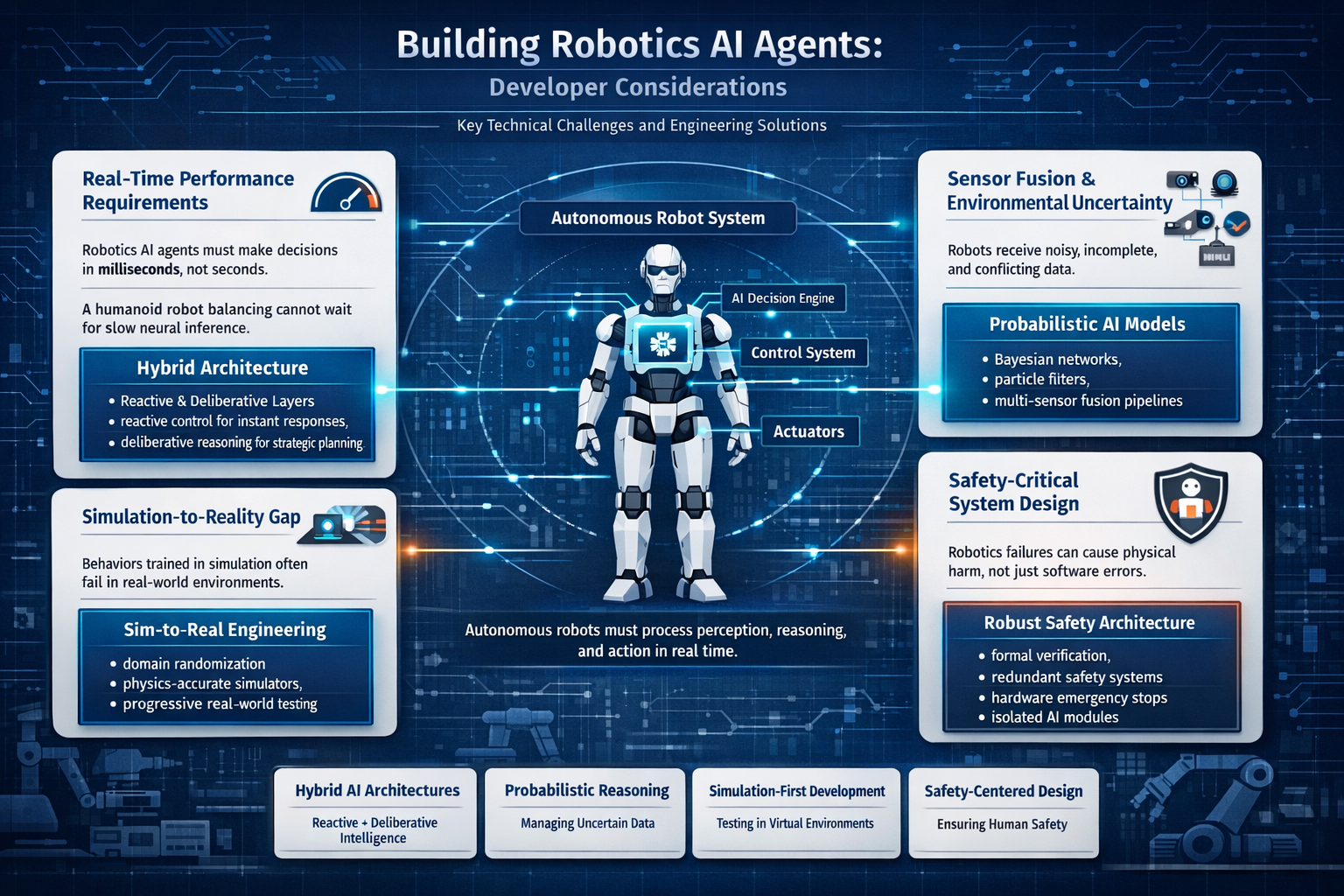
Key Technical Challenges
- Real-Time Performance Requirements
Unlike software agents that can afford processing delays, robotics AI agents must make decisions in milliseconds. A humanoid robot maintaining balance can’t wait seconds for a neural network to process sensor data.
Solution: Hybrid architectures that use fast reactive behaviours for time-critical tasks while running complex reasoning in parallel for strategic decisions.
- Sensor Fusion and Uncertainty
Robots operate with imperfect information. Cameras struggle in poor lighting, LiDAR fails on reflective surfaces, and GPS is unreliable indoors. Intelligent agents must fuse multiple sensor modalities and reason under uncertainty.
Solution: Probabilistic reasoning frameworks like Bayesian networks and particle filters that maintain multiple hypotheses about the world state.
- Sim-to-Real Transfer
Training robots in simulation is fast and safe, but behaviours learned in perfect virtual environments often fail in messy reality and the “reality gap.”
Solution: Domain randomization, physics-accurate simulators, and progressive real-world fine-tuning. The “simulate-then-procure” approach is becoming standard practice in 2026.
- Safety and Reliability
Unlike software bugs that cause crashes, robotics failures can cause physical harm. Intelligent agents must guarantee safe operation even when AI components behave unexpectedly.
Solution: Formal verification of critical behaviours, redundant safety systems, and architectures that separate safety-critical reactive layers from experimental learning layers.
Frameworks and Tools
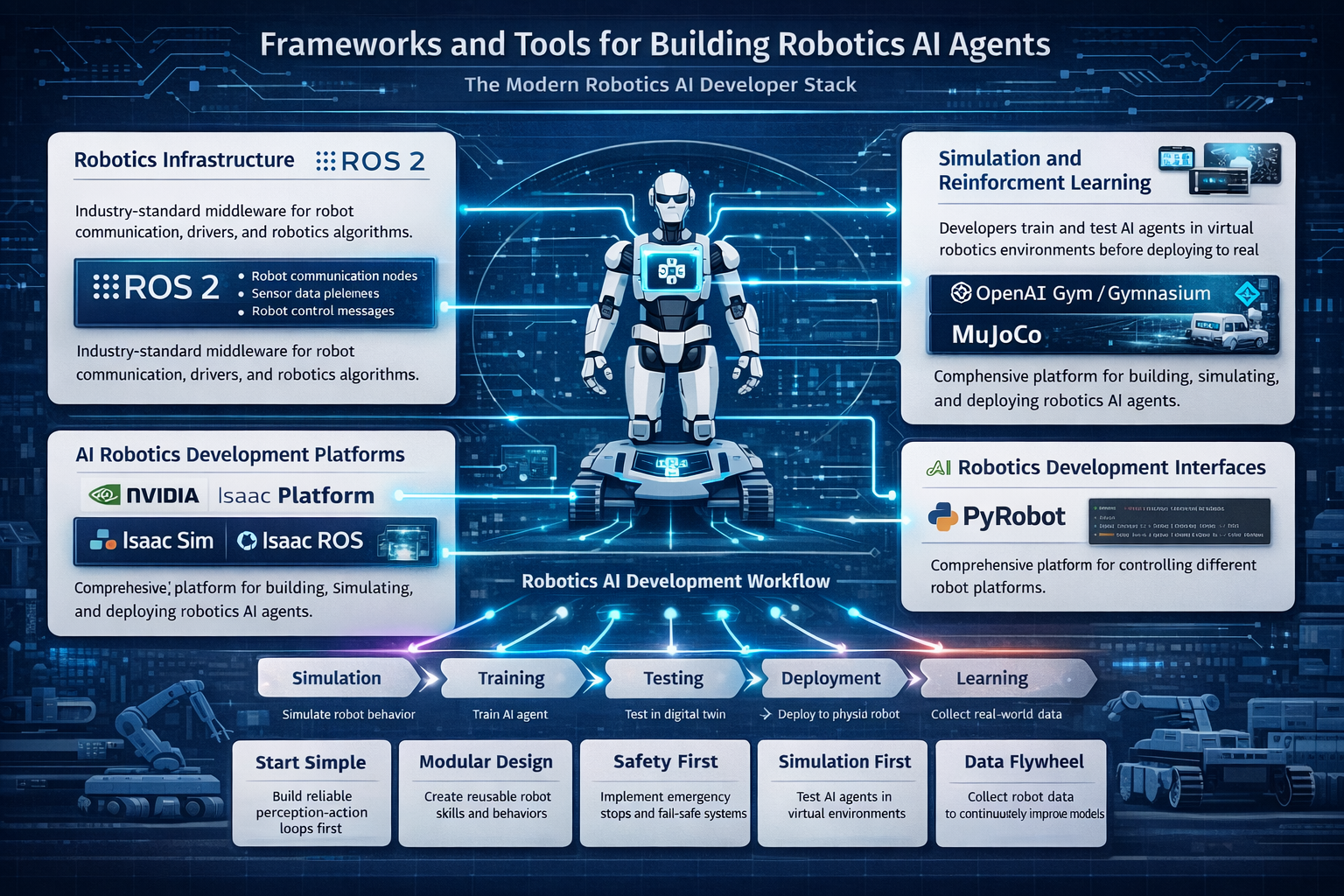
Modern developers have access to powerful agentic AI frameworks specifically designed for robotics:
ROS 2 (Robot Operating System)
The industry-standard middleware for robotics, providing communication infrastructure, sensor drivers, and algorithm libraries. Essential for any serious robotics development.
Qualcomm Dragonwing™ IQ10 Series
Announced at CES 2026, this next-generation robotics processor provides hardware acceleration for Vision-Language Models (VLMs) and Vision-Language-Action (VLA) architectures, enabling advanced reasoning in humanoid robots and industrial AMRs.
Comprehensive toolkit for developing, simulating, and deploying robotics AI agents. Includes Isaac Sim for photorealistic simulation, Isaac ROS for accelerated perception, and Isaac Cortex for behavior orchestration.
Python library providing a unified interface for controlling different robot platforms, making it easier to develop portable agent code.
Standard frameworks for developing and comparing reinforcement learning agents, with robotics-specific environments.
Physics engine optimized for robotics simulation, enabling accurate modelling of contact dynamics, friction, and actuator behaviour.
Implementation Best Practices
Start Simple, Scale Gradually
Begin with basic perception-action loops before adding complex reasoning. A robot that reliably executes simple behaviours is more valuable than one that occasionally performs complex tasks.
Embrace Modularity
Design agents as collections of reusable skills and behaviours. This enables rapid prototyping, easier debugging, and transfer learning across robot platforms.
Prioritize Safety
Implement multiple layers of safety: hardware e-stops, software watchdogs, behaviour bounds, and human oversight. Safety isn’t optional in physical systems.
Leverage Simulation
Develop and test in simulation first. Use tools like digital twins to validate behaviour before deploying to expensive hardware.
Collect and Learn from Data
Implement data collection pipelines from day one. The most successful robotics companies build “AI data flywheels” that continuously improve agent performance.
The Future of Intelligent Agents in Robotics
As we progress through 2026, several trends are shaping the future of robotics AI agents:
Humanoid Robots Enter Production
Companies like Figure, Boston Dynamics (Atlas), and Tesla (Optimus) are moving humanoid robots from research labs to real-world deployments. These general-purpose platforms can navigate human environments, use human tools, and learn new tasks through demonstration and representing the ultimate expression of intelligent agent principles.
Agentic AI Ecosystems
Rather than isolated robots, we’re seeing agentic ecosystemswhere multiple specialized agents collaborate. A factory might coordinate hundreds of agents and some controlling robots, others managing logistics, quality control, or predictive maintenance and all working toward shared objectives.
Foundation Models for Robotics
Large language models and vision-language models are being adapted for robotics, enabling robots to understand natural language instructions, reason about physical tasks, and transfer knowledge across different robot platforms. This represents a convergence of modern AI agent systems with physical embodiment.
Edge AI and Distributed Intelligence
Advanced processors like Qualcomm’s Dragonwing series enable sophisticated AI reasoning directly on robots, reducing latency and enabling operation without constant cloud connectivity and critical for industrial reliability.
Digital Twins and Virtual Commissioning
Before deploying physical robots, companies now create complete digital replicas of their facilities, testing and optimizing agent behaviours in simulation. This “simulate-then-procure” approach dramatically reduces deployment risk and accelerates ROI.
Conclusion
Intelligent agents in robotics represent the convergence of AI and physical systems, bringing autonomous decision-making, adaptive learning, and goal-directed behaviour to machines that interact with the real world. From manufacturing floors to hospital corridors, from warehouses to construction sites, robotics AI agents are transforming how work gets done.
The architecture of these systems and layered control, perception-action loops, and hybrid deliberative-reactive designs and enables robots to balance reactive speed with strategic intelligence. Modern frameworks and processors make developing these agents more accessible than ever, while the economic case for adoption grows stronger each year.
For developers, the opportunity is immense. Whether you’re building industrial automation systems, service robots, or autonomous vehicles, understanding how to design, implement, and deploy intelligent agents is becoming an essential skill. The robots of 2026 aren’t just automated machines and they’re intelligent partners capable of learning, adapting, and collaborating with humans in ways previously confined to science fiction.
As you continue exploring the world of intelligent agents, consider how these principles apply across domains. The same agent architectures powering robots also explore autonomous agent systems in software , and understanding the fundamental differences between AI and intelligent agents will help you choose the right approach for your specific challenges.
The future of robotics is intelligent, adaptive, and autonomous and it’s being built by developers who understand how to create agents that truly think, learn, and act in the physical world.
Ready to build your own robotics AI agent? Check out our practical implementation guide practical implementation guideand explore the top frameworks top frameworksto get started today.
What robotics applications are you most excited about? Share your thoughts in the comments below!

Hi, I’m Pragya.
I write about AI tools, digital trends, and emerging technologies in a way that’s simple, practical, and easy to apply. I enjoy exploring new AI platforms, testing their features, and breaking them down into clear guides that actually help people use them confidently.
My focus is not just on writing content, but on creating value. I believe powerful technology should feel accessible, not overwhelming. That’s why I aim to turn complex tools into actionable insights for creators, marketers, and growing online businesses.
I’m constantly learning, researching, and staying updated with the fast-moving AI space so readers always get relevant and useful information.