


The First Order Reliability Method (FORM) is one of the most useful tools engineers use to estimate the probability of failure when things like load, strength, soil properties, or dimensions are uncertain. Instead of pretending the real world behaves like a perfect spreadsheet, FORM accepts uncertainty and turns it into a measurable safety value.
- What Is the First Order Reliability Method?
- Why the First Order Reliability Method Matters
- First Order Reliability Method Formula
- How the First Order Reliability Method Works Step by Step
- 1) Define the random variables
- 2) Define the limit state function
- 3) Convert variables into standard normal space
- 4) Find the Most Probable Point (MPP)
- 5) Linearize the limit state function
- 6) Calculate the reliability index
- 7) Compute the probability of failure
- First Order Reliability Method Example
- Given
- Step 1: Mean of the limit state function
- Step 2: Standard deviation of the limit state function
- Step 3: Reliability index
- Step 4: Probability of failure
- Final Answer
- First Order Reliability Method in Structural Engineering
- First Order Reliability Method in Geotechnical Engineering
- Hasofer-Lind Reliability Index in FORM
- Rackwitz-Fiessler Algorithm in First Order Reliability Method
- First Order Reliability Method vs Monte Carlo Simulation
- First Order Reliability Method vs SORM
- Advantages of the First Order Reliability Method
- Limitations of the First Order Reliability Method
- FAQs About the First Order Reliability Method
- What is the first order reliability method?
- What is the formula for the first order reliability method?
- What is the reliability index in FORM?
- Where is FORM used?
- What is the difference between FORM and SORM?
- Final Thoughts on the First Order Reliability Method
The first order reliability method is widely used in structural engineering, geotechnical engineering, risk analysis, and reliability-based design because it offers a fast and practical way to evaluate safety. Rather than relying only on a factor of safety, FORM calculates a reliability index (β) and converts it into a probability of failure (Pf).
If you are searching for first order reliability method formula, first order reliability method example, FORM in structural engineering, or FORM vs SORM, this guide explains everything in a simple and clear way.
What Is the First Order Reliability Method?

The First Order Reliability Method (FORM) is a probabilistic method used to estimate the chance that a structure, component, or system will fail when input values are uncertain.
In engineering, uncertainty may come from:
- Material strength variation
- Dead and live load changes
- Wind and earthquake effects
- Soil parameter variation
- Construction tolerances
- Measurement errors
- Model uncertainty
FORM treats these as random variables instead of fixed numbers.
At the center of FORM is the limit state function:
g = R – S
Where:
- R = resistance or strength
- S = load or stress effect
- g > 0 means safe
- g = 0 means limit state
- g < 0 means failure
This simple equation is the foundation of the first order reliability method.
Why the First Order Reliability Method Matters
Traditional design often uses a factor of safety, which is useful but does not tell you the actual chance of failure.
FORM answers a better question:
How likely is the system to fail when uncertainty is included?
That makes FORM much more informative than basic deterministic design.
Why engineers prefer FORM
- Faster than Monte Carlo simulation
- Gives a direct reliability index β
- Supports risk-based design
- Useful for rare failure probabilities
- Practical for design optimization
- Widely used in engineering research and safety codes
First Order Reliability Method Formula
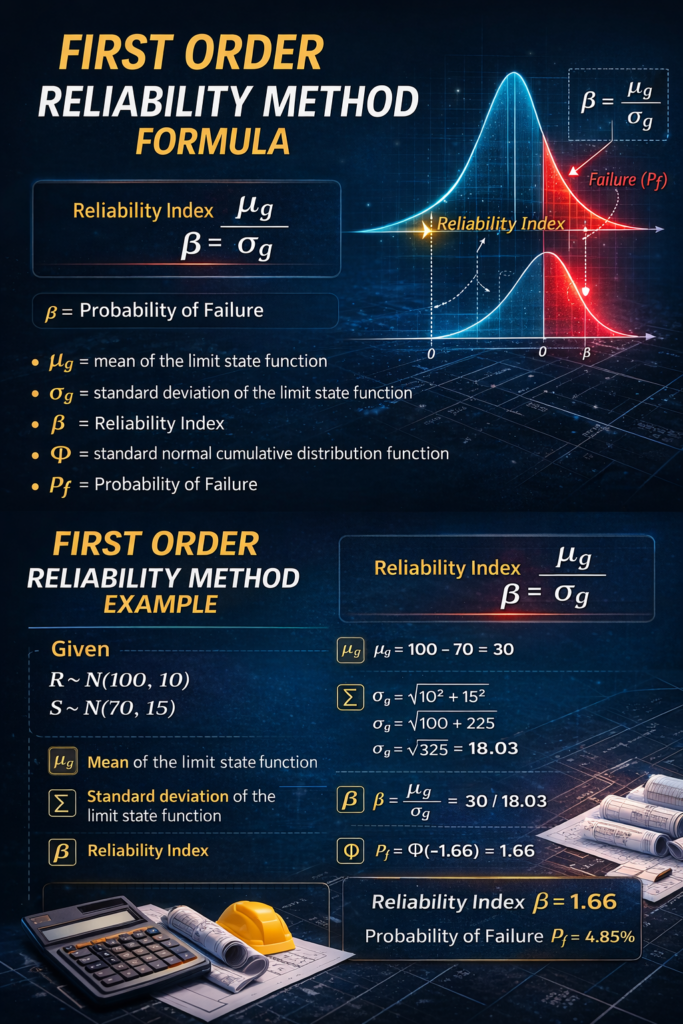
For simple linear problems with normally distributed variables, FORM uses a direct formula.
Reliability index formula
β = μg / σg
Where:
- μg = mean of the limit state function
- σg = standard deviation of the limit state function
Probability of failure formula
Pf = Φ(-β)
Where:
- Φ = standard normal cumulative distribution function
- Pf = probability of failure
These are the most commonly used first order reliability method formulas.
How the First Order Reliability Method Works Step by Step
The first order reliability method follows a structured process.
1) Define the random variables
Example:
R ~ N(μR, σR)
S ~ N(μS, σS)
These represent uncertain resistance and load.
2) Define the limit state function
A common limit state equation is:
g = R – S
If resistance is greater than load, the design is safe.
3) Convert variables into standard normal space
Each variable is transformed using:
Ui = (Xi – μi) / σi
This creates U-space, where:
- Mean = 0
- Standard deviation = 1
4) Find the Most Probable Point (MPP)
The Most Probable Point (MPP), also called the design point, is the point on the failure surface closest to the origin in standard normal space.
This is the most likely combination of variables that causes failure.
5) Linearize the limit state function
FORM uses a first-order linear approximation at the design point.
That is why it is called the First Order Reliability Method.
6) Calculate the reliability index
The reliability index is the distance from the origin to the design point:
β = √(u1² + u2² + … + un²)
A higher β means the system is safer.
7) Compute the probability of failure
Pf = Φ(-β)
As β increases, Pf decreases.
First Order Reliability Method Example
A solved example makes FORM much easier to understand.
Given
R ~ N(100, 10)
S ~ N(70, 15)
Limit state:
g = R – S
Step 1: Mean of the limit state function
μg = 100 – 70 = 30
Step 2: Standard deviation of the limit state function
σg = √(10² + 15²)
σg = √(100 + 225)
σg = √325 = 18.03
Step 3: Reliability index
β = 30 / 18.03 = 1.66
Step 4: Probability of failure
Pf = Φ(-1.66) ≈ 0.0485
Final Answer
- Reliability index (β) = 1.66
- Probability of failure (Pf) = 4.85%
This is a classic FORM solved example and is excellent for snippet optimization.
First Order Reliability Method in Structural Engineering
The first order reliability method in structural engineering is widely used to assess uncertainty in real structures.
Common applications
- Beam bending reliability
- Shear capacity checks
- Column buckling
- Bridge girder reliability
- Reinforced concrete design
- Steel member limit states
- Wind and seismic reliability
- Fatigue analysis
For example, a beam may have uncertain:
- Yield strength
- Live load
- Section dimensions
- Fabrication tolerance
FORM helps convert these uncertainties into a measurable failure probability.
First Order Reliability Method in Geotechnical Engineering
The first order reliability method in geotechnical engineering is especially useful because soil properties vary significantly from one location to another.
Common geotechnical applications
- Slope stability reliability
- Shallow foundation bearing capacity
- Pile capacity analysis
- Retaining wall stability
- Embankment safety
- Settlement risk
- Seepage reliability
Typical random variables
- Cohesion (c)
- Friction angle (φ)
- Unit weight (γ)
- Water table level
- Surcharge load
Because soil is naturally variable, FORM often gives a more realistic picture than a simple factor of safety.
Hasofer-Lind Reliability Index in FORM
The Hasofer-Lind method is one of the most important formulations of FORM.
It defines the reliability index β as:
- The shortest distance from the origin
- To the failure surface
- In standard normal space
This gives FORM a clear geometric meaning and makes the method mathematically consistent, even if the same limit state equation is written in a different form.
In simple words: the math should not change just because someone rewrites the equation in a fancier way.
Rackwitz-Fiessler Algorithm in First Order Reliability Method
In real engineering problems, variables are not always normally distributed.
They may follow:
- Lognormal distribution
- Weibull distribution
- Gumbel distribution
- Gamma distribution
- Beta distribution
The Rackwitz-Fiessler algorithm extends FORM by converting non-normal variables into equivalent normal variables during the iteration process.
This makes FORM more practical for real-world engineering analysis.
First Order Reliability Method vs Monte Carlo Simulation
Many engineers compare FORM vs Monte Carlo simulation.
First Order Reliability Method (FORM)
Advantages:
- Fast
- Efficient
- Good for low failure probabilities
- Useful in optimization
Limitations:
- Uses linear approximation
- Less accurate for highly nonlinear limit states
- May miss multiple failure regions
Monte Carlo Simulation
Advantages:
- Handles strong nonlinearity
- Very accurate with enough samples
- Easy to understand conceptually
Limitations:
- Computationally expensive
- Slow for rare events
- Requires many simulations
If you need speed and practical engineering decisions, FORM often wins.
First Order Reliability Method vs SORM
The Second Order Reliability Method (SORM) improves FORM by using a curved second-order approximation of the failure surface.
FORM
- First-order linear approximation
- Faster
- Easier to implement
- Good for mildly nonlinear problems
SORM
- Second-order approximation
- Better for curved failure surfaces
- More accurate in complex cases
- Requires more computational effort
For many engineering applications, FORM is still the preferred first choice.
Advantages of the First Order Reliability Method
The first order reliability method remains popular because it balances speed and insight.
Key advantages
- Faster than simulation-heavy methods
- Provides direct reliability index β
- Works well for design studies
- Useful for code calibration
- Good for sensitivity analysis
- Practical for reliability-based optimization
Limitations of the First Order Reliability Method
No method is perfect, and FORM has limits.
Key limitations
- Accuracy drops for strongly nonlinear limit states
- Sensitive to input distribution assumptions
- Can struggle with multiple design points
- Requires iterative algorithms in nonlinear cases
- May misestimate probability in complex systems
A strong technical article should always mention these clearly.
FAQs About the First Order Reliability Method
What is the first order reliability method?
The First Order Reliability Method (FORM) is a probabilistic analysis method used to estimate failure probability by linearizing the limit state function at the most probable point of failure in standard normal space.
What is the formula for the first order reliability method?
For simple linear normal cases, the main formulas are:
β = μg / σg
Pf = Φ(-β)
What is the reliability index in FORM?
The reliability index (β) is the shortest distance from the origin to the failure surface in standard normal space.
Where is FORM used?
FORM is used in:
- Structural engineering
- Geotechnical engineering
- Bridge design
- Foundation analysis
- Aerospace reliability
- Offshore structures
- Risk-based engineering
What is the difference between FORM and SORM?
FORM uses a linear approximation, while SORM uses a curved second-order approximation. FORM is faster, while SORM is usually more accurate for highly nonlinear limit state functions.
Final Thoughts on the First Order Reliability Method
The First Order Reliability Method (FORM) is one of the most practical tools in modern engineering for estimating the probability of failure under uncertainty. It gives engineers a smarter way to evaluate safety than a simple factor of safety because it directly measures risk using the reliability index (β).
Whether you are working in structural engineering, geotechnical engineering, bridge analysis, or reliability-based design optimization, FORM is a proven and efficient method that deserves a place in your toolkit.
If you want a method that is fast, respected, and useful in real-world design, the first order reliability method is an excellent choice.

Sandeep Kumar is the Founder & CEO of Aitude, a leading AI tools, research, and tutorial platform dedicated to empowering learners, researchers, and innovators. Under his leadership, Aitude has become a go-to resource for those seeking the latest in artificial intelligence, machine learning, computer vision, and development strategies.