
The AI Readiness Myth
- What Legacy Systems Cannot Support
- 1. Monolithic Architecture Constraints
- 2. Tightly Coupled Data Layers
- 3. Batch Processing Limitations
- 4. Inflexible Integration Patterns
- 5. Security Models Built for Static Environments
- The Data Problem Beneath AI
- Infrastructure Economics and AI Workloads
- Governance and Observability as AI Foundations
- The Modernization Imperative
- Structural Evolution Determines Competitive Capacity
Artificial intelligence is often presented as an inevitable evolution. Organizations adopt new models, invest in data science teams, and deploy pilot programs with the expectation that measurable transformation will follow. Yet many initiatives stall long before value materializes.
Gartner reports more than half of AI projects fail to progress beyond the pilot stage. The common assumption is that models are immature, data scientists are insufficient, or expectations were unrealistic.
In practice, the limitation is rarely algorithmic.
It is architectural.
AI systems do not operate in isolation. They depend on infrastructure capable of sustaining continuous data flow, elastic computation, governance enforcement, and real time responsiveness. When these foundational elements are absent, models become experimental artifacts rather than operational assets.
Organizations frequently mistake experimentation capacity for readiness. A proof of concept may function in a sandbox but scaling that solution across enterprise systems exposes structural constraints embedded years earlier.
AI readiness is not determined by model sophistication. It is determined by infrastructure maturity.
What Legacy Systems Cannot Support
Legacy systems were built for predictability, not adaptability. They were designed in environments where batch processing, monolithic applications, and tightly coupled architectures were sufficient for operational stability.
AI workloads require a fundamentally different foundation.
1. Monolithic Architecture Constraints
Monolithic systems centralize logic and tightly bind services. Changes to one component often require system wide testing and deployment. This slows iteration cycles and prevents independent scaling of compute intensive functions such as model inference.
AI driven features demand modularity. Without decoupling, performance optimization becomes complex and fragile.
2. Tightly Coupled Data Layers
In many enterprises, applications maintain isolated databases with limited interoperability. Integrations are achieved through custom scripts or periodic synchronization jobs.
AI systems depend on unified, continuously updated data streams. Fragmented data layers introduce latency and inconsistency that degrade model accuracy and reliability.
3. Batch Processing Limitations
Traditional systems often rely on scheduled batch updates. Data is collected, processed, and synchronized at fixed intervals.
AI systems operate most effectively when fed real time inputs. Predictive recommendations, fraud detection, dynamic pricing, and operational optimization all require continuous streams rather than periodic refresh cycles.
4. Inflexible Integration Patterns
Legacy integration methods frequently rely on point-to-point connectors. As the number of systems grows, complexity multiplies. Each new integration increases maintenance overhead and fragility.
Modern AI ecosystems rely on standardized interfaces and service abstraction layers. Without these, experimentation becomes costly and expansion becomes risky.
5. Security Models Built for Static Environments
Older systems were architected for perimeter based security. Data exchange across distributed environments was limited.
AI adoption increases the need for secure data mobility across services, environments, and partners. Governance models must support distributed trust and policy enforcement rather than static boundaries.
IDC research indicates that organizations with higher digital maturity consistently outperform peers in operational agility and cost efficiency. McKinsey similarly links modernization maturity with faster innovation cycles and improved analytics adoption.
AI readiness is therefore inseparable from architectural readiness.
The Data Problem Beneath AI
Infrastructure limitations are often most visible in data management practices.
Harvard Business Review has emphasized that fragmented data remains one of the primary barriers to advanced analytics implementation. In many enterprises, valuable information exists across disconnected systems, each governed independently.
AI systems require:
- Consistent and validated data pipelines
- Scalable storage architectures
- Observability across distributed services
- Embedded governance at ingestion and transformation layers
Legacy environments frequently lack centralized oversight of data quality and lineage. Data transformations are applied in isolated silos, and documentation is inconsistent. When models are trained on such data, outputs inherit the limitations of their inputs.
Cloud migration does not automatically resolve this challenge. Moving legacy databases into hosted environments without redesign preserves fragmentation.
AI magnifies structural weaknesses in data management. It exposes inconsistency, duplication, and latency. Without consolidation and architectural abstraction, intelligence systems cannot produce reliable outcomes at scale.
Infrastructure Economics and AI Workloads
Beyond technical limitations, infrastructure constraints also affect financial sustainability.
Flexera reports that a substantial share of cloud expenditure is wasted due to unused or poorly optimized resources. Many enterprises migrate legacy systems into cloud environments without revisiting architectural design principles.
As a result, systems behave as they did on premises, only at greater operational cost.
AI workloads intensify this inefficiency. Model training requires scalable compute clusters. Real time inference demands distributed processing. Storage needs increase as data volumes expand.
When legacy architecture is merely replicated rather than restructured, operational costs escalate disproportionately to business value.
Economic inefficiency becomes a structural inhibitor of AI adoption.
Cloud adoption alone is not modernization. Architectural realignment determines whether investment translates into scalable capability.
Governance and Observability as AI Foundations
AI systems introduce new governance requirements.
Decision logic embedded in models must be transparent, traceable, and auditable. Data lineage must be documented. Performance drift must be monitored continuously.
Legacy environments often lack integrated observability frameworks. Logging is fragmented. Monitoring tools are disconnected. Compliance policies are enforced manually.
Operationalizing AI without embedded governance introduces risk. Enterprises face regulatory scrutiny, reputational exposure, and ethical accountability concerns.
Modern infrastructure supports automated observability across services, standardized monitoring protocols, and centralized policy enforcement. Without this foundation, AI remains experimental rather than enterprise ready.
Governance maturity is therefore not an afterthought. It is a prerequisite for sustainable AI integration.
The Modernization Imperative
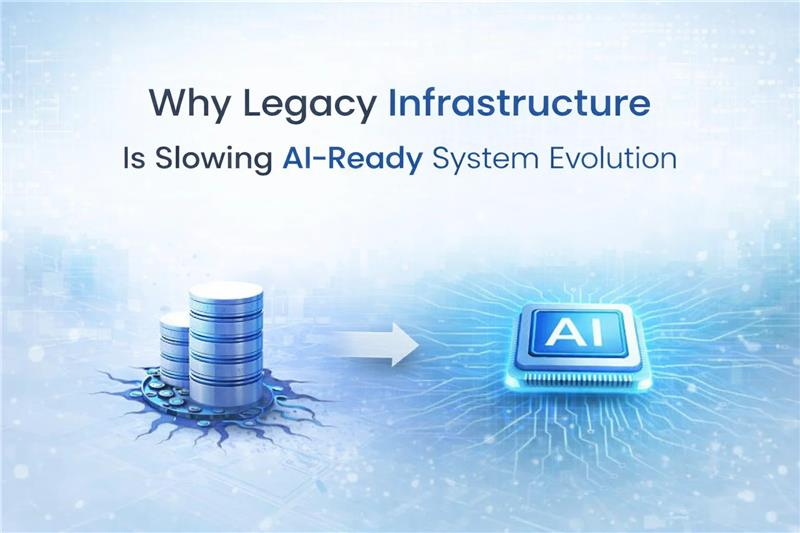
AI readiness is ultimately an infrastructure question.
Sustainable evolution requires phased architectural restructuring rather than superficial upgrades.
Transformation typically involves:
- Decoupling tightly bound services to enable modular scaling
- Introducing API abstraction layers for consistent interoperability
- Consolidating data pipelines to enforce integrity and governance
- Building elasticity into compute layers for workload variability
- Embedding observability mechanisms across system boundaries
Organizations that prioritize modernizing core enterprise systems for long term scalability are significantly more likely to transition AI initiatives from pilot programs to operational deployment.
Modernization does not imply indiscriminate replacement. It requires disciplined evaluation of core constraints and systematic redesign of foundational layers.
Legacy platforms evolved under different assumptions about data velocity, integration patterns, and compute demand. AI introduces new requirements that cannot be satisfied by incremental patches.
Architectural restructuring aligns foundational systems with future technological demands rather than forcing emerging capabilities into outdated environments.
Structural Evolution Determines Competitive Capacity
Artificial intelligence amplifies existing structural realities.
In environments where modularity, governance, and elasticity are embedded, AI accelerates innovation. New features are deployed rapidly. Insights are operationalized consistently. Economic scaling becomes predictable.
In environments constrained by tightly coupled architecture and fragmented data, AI initiatives remain isolated experiments. Performance bottlenecks persist. Governance risks increase. Costs escalate without proportional returns.
The distinction between AI leaders and AI laggards is not defined solely by investment in models. It is defined by infrastructure readiness.
Organizations that evolve their systems create optionality. They position themselves to integrate emerging technologies without repeated structural overhaul.
Those that defer modernization encounter recurring ceilings. Each new innovation exposes unresolved architectural constraints.
AI is not merely a software upgrade. It is an amplifier of architectural maturity.
Enterprises that recognize this reality treat modernization as a strategic foundation rather than a reactive adjustment.
The future of AI adoption will be determined not by who experiments first, but by who prepares infrastructure to sustain intelligent systems at scale.

Sandeep Kumar is the Founder & CEO of Aitude, a leading AI tools, research, and tutorial platform dedicated to empowering learners, researchers, and innovators. Under his leadership, Aitude has become a go-to resource for those seeking the latest in artificial intelligence, machine learning, computer vision, and development strategies.