
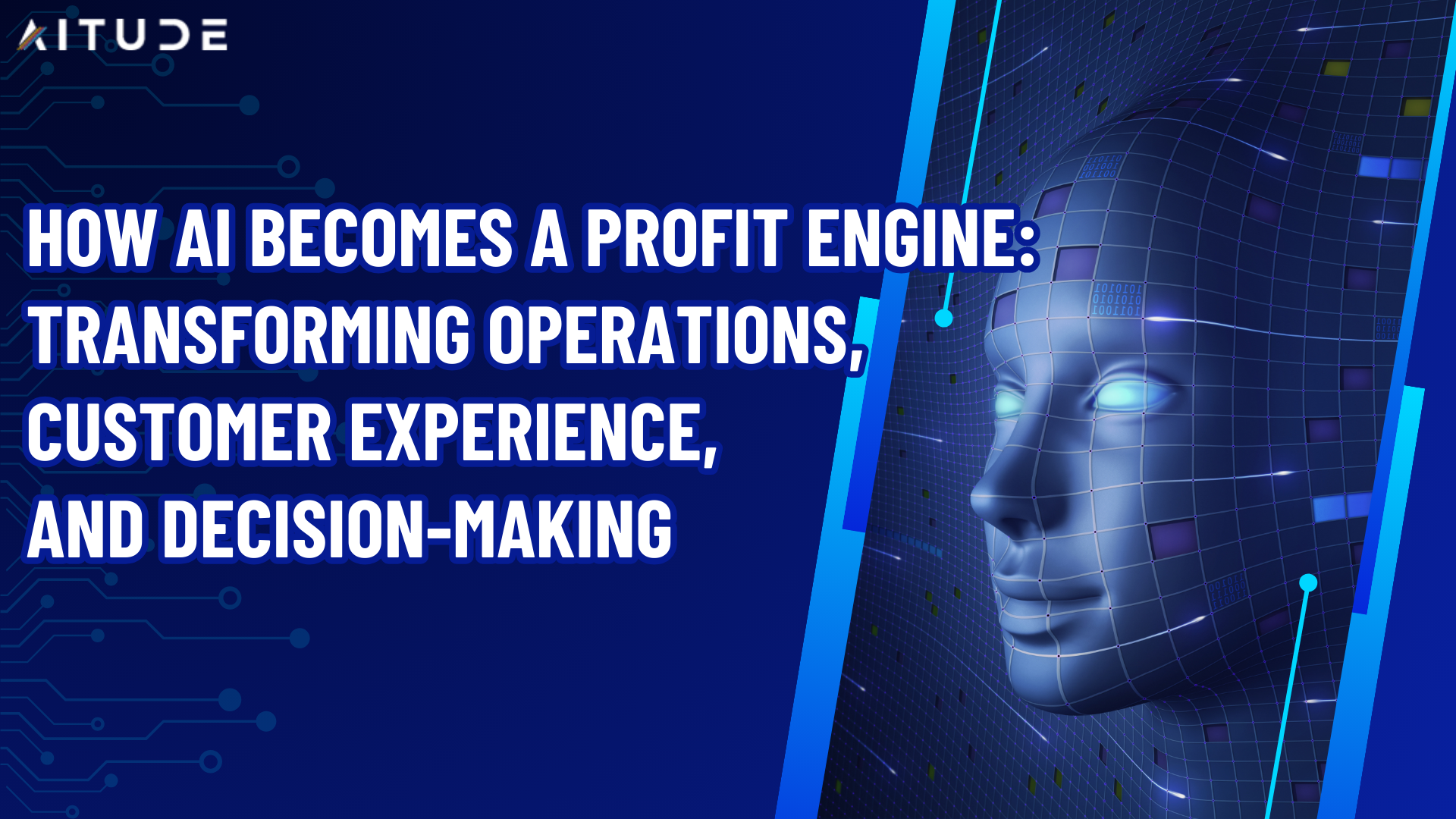
AI has moved far beyond the realm of automation experiments and novelty features—it now shapes the financial destiny of entire industries. Any enterprise partnering with an AI development company quickly sees that AI is no longer a support tool but a mechanism for generating measurable profit. Companies that adopt AI strategically outperform competitors on speed, accuracy, and innovation. The future belongs to firms that treat AI as an economic engine, not an IT project.
- AI as a Driver of Operational Efficiency and Cost Reduction
- Enhancing Workforce Productivity Through Intelligent Tools
- Intelligent Customer Support Through Chatbots and AI Agents
- AI as a Catalyst for Innovation and New Business Models
- Building a Sustainable AI Profit Strategy in the Enterprise
AI as a Driver of Operational Efficiency and Cost Reduction
AI becomes profitable the moment it begins removing friction, waste, and inefficiency across the enterprise.
Automating Repetitive Workflows Across Departments
Organizations waste millions each year on manual, repetitive work that AI can eliminate instantly. Partnering with an AI agents development company helps enterprises deploy intelligent agents that process documents, route requests, and manage approvals without human supervision. These agents work 24/7, scale without additional cost, and adapt to changing workflows in real time. Employees can finally redirect their energy toward strategic tasks instead of operational noise. The result is a leaner, faster, and more profitable business engine.
Optimizing Resource Allocation and Reducing Waste
AI identifies inefficiencies that humans overlook due to complexity or volume. By analyzing patterns across operations, it reallocates resources where they produce the highest return. This reduces unnecessary spending, improves utilization, and stabilizes workloads. AI-driven optimization prevents overstocking, understaffing, and wasteful processes. Profit emerges naturally when operations stop leaking value.
Predictive Maintenance for Lower Downtime Costs
Unplanned downtime is one of the most expensive operational failures for enterprises. AI models can predict equipment failures before they occur, preventing costly disruptions. Maintenance teams transition from reactive to proactive workflows, saving both time and money. Equipment life cycles extend due to early intervention. Performance becomes predictable instead of chaotic.
Enhancing Workforce Productivity Through Intelligent Tools
AI enhances human output by automating low-value tasks and augmenting complex decision-making. Employees gain access to instant insights, personalized recommendations, and digital assistance. This shortens task cycles, reduces errors, and improves job satisfaction. When teams become more productive, companies generate more value without increasing headcount. Workforce efficiency directly transforms into revenue acceleration.
AI’s Impact on Customer Experience and Revenue Growth
AI elevates customer interactions from static and generic to dynamic and deeply personalized.
Hyper-Personalization Across Digital Touchpoints
AI analyzes user behavior in real time, enabling personalized experiences at every interaction. Customers receive content, offers, and recommendations that match their immediate needs. This increases engagement and reduces friction across digital channels. Personalization drives conversion rates dramatically higher. Businesses differentiate through relevance, not volume.
AI-Powered Recommendation Engines and Upsell Strategies
Recommendation systems boost sales by anticipating what customers want before they ask for it. AI uncovers hidden buying patterns and generates intelligent upsell and cross-sell opportunities. Customers experience smoother journeys, while companies benefit from larger transactions. Over time, revenue per user steadily climbs. AI turns browsing into purchasing.
Intelligent Customer Support Through Chatbots and AI Agents
Modern AI agents handle routine support interactions instantly and accurately. They resolve common issues, guide users through processes, and escalate complex matters with full context. This reduces support costs and improves customer satisfaction. AI-powered support scales infinitely without queue times. Brand loyalty strengthens when customers feel heard without delay.
Real-Time Behavioral Insights for Better Engagement
AI continuously monitors user behavior to detect interest shifts, frustration signals, and intent indicators. Teams adjust messaging, product placement, or service offerings in real time. This keeps customers engaged and prevents drop-offs. Businesses gain agility in responding to changing needs. Engagement becomes a measurable and controllable growth lever.
AI-Enhanced Decision-Making for Executives and Teams
When decisions rely on predictive intelligence rather than intuition, profit becomes predictable.
Turning Raw Data Into Actionable Business Intelligence
AI processes vast data streams to deliver clear, actionable insights. Executives gain visibility into patterns that would otherwise remain hidden. Complex decisions become faster and more precise. Teams rely on evidence instead of assumptions. Business intelligence becomes a core driver of competitive strategy.
Predictive Analytics for Demand, Risk, and Market Trends
AI forecasts future outcomes using historical and real-time data. Companies anticipate customer demand, supply-chain risks, and market fluctuations with impressive accuracy. This reduces uncertainty and strengthens strategic planning. Budgets become more accurate and agile. Stability emerges from predictability.
Scenario Simulation and Forecasting for Strategic Planning
AI models simulate the impact of different decisions across operations, finance, and customer behavior. Leaders experiment with strategies before committing resources. This avoids costly mistakes and uncovers hidden opportunities. Decision-making becomes safer, faster, and more informed. The organization moves with confidence instead of hesitation.
Reducing Human Bias and Improving Decision Accuracy
AI minimizes subjective judgment by basing decisions on data, not personal perception. This reduces costly miscalculations caused by cognitive bias. Hiring, pricing, operations, and forecasting benefit from greater accuracy. Fairness and consistency improve across the organization. Data-driven decisions outperform instinct every time.
AI as a Catalyst for Innovation and New Business Models
AI enables enterprises not only to improve existing operations but to reinvent entire value propositions.
Unlocking New Digital Products and Services
AI enables services that didn’t exist before—smart assistants, adaptive apps, predictive platforms. Businesses can enter new markets or create entirely new revenue streams. Product development accelerates due to generative and analytical capabilities. Innovation cycles shrink dramatically. The company evolves from stable to trailblazing.
Enabling Autonomous Workflows and AI Agents
Autonomous AI agents take ownership of end-to-end processes—from reporting to scheduling to quality control. This reduces human oversight and increases operational reliability. Workflows become self-optimizing without constant intervention. The enterprise gains an autonomous layer that operates continuously. Productivity spikes without additional labor costs.
Creating Scalable Ecosystems Through AI APIs and Integrations
AI capabilities expand exponentially when exposed through APIs. Companies build ecosystems of AI-driven services that integrate across tools, partners, and platforms. This increases flexibility and strengthens digital infrastructure. Innovation becomes modular and rapid. A connected ecosystem drives exponential growth.
Accelerating R&D Through Generative and Analytical AI
AI speeds up research cycles by analyzing large datasets and generating new designs or concepts. This reduces time-to-market for new products. Teams experiment more aggressively with less risk. R&D transforms from slow iteration to rapid discovery. Breakthroughs occur more frequently.
Building a Sustainable AI Profit Strategy in the Enterprise
AI delivers long-term value only when it becomes embedded in strategy, not added as a feature.
Choosing High-ROI Use Cases for AI Adoption
Identifying the right AI use cases requires evaluating cost savings, scalability, and revenue potential. Businesses should start with tasks that create immediate impact. Quick wins build momentum and stakeholder confidence. Strategic alignment ensures the greatest financial return. AI investment becomes a predictable value generator.
Integrating AI into Existing Technology Infrastructure
AI should plug into existing systems without causing disruption. Seamless integration ensures smooth workflows and consistent data flow. This reduces implementation risk and accelerates adoption. Infrastructure becomes future-ready with minimal upheaval. AI extends capability instead of replacing stability.
Establishing Governance, Compliance, and Responsible AI
Governance frameworks ensure ethical, secure, and compliant AI operations. Enterprises must define policies for data usage, transparency, and model monitoring. This protects against legal and reputational risks. Responsible AI enhances trust internally and externally. Governance becomes the backbone of sustainable innovation.
Measuring Impact with AI-Specific KPIs and Financial Metrics
AI performance should tie directly to revenue, cost savings, and operational gains. KPIs such as automation ratio, prediction accuracy, and customer engagement quantify success. Financial metrics track ROI and long-term value creation. Transparency helps optimize investments. AI becomes an accountable business asset.

Sandeep Kumar is the Founder & CEO of Aitude, a leading AI tools, research, and tutorial platform dedicated to empowering learners, researchers, and innovators. Under his leadership, Aitude has become a go-to resource for those seeking the latest in artificial intelligence, machine learning, computer vision, and development strategies.